Key takeaways
- Peec.ai is the most established of the four, with solid monitoring across ChatGPT, Perplexity, and Gemini, but it stops at tracking -- no content generation or gap analysis
- Xfunnel leans into GEO workflows for marketing teams, making it more action-oriented than pure monitoring tools
- Airefs focuses on brand visibility tracking across AI search engines with a clean, accessible interface
- None of the four platforms match the full action loop (find gaps → generate content → track results) that more complete platforms offer
- If budget is the constraint, these tools are worth evaluating -- but know what you're giving up
The AI visibility tool market has exploded. There are now well over 40 platforms claiming to help you show up in ChatGPT, Perplexity, Google AI Overviews, and the rest. Most of them do roughly the same thing: run your brand name through a set of prompts, count how often you appear, and hand you a dashboard.
The interesting question isn't "which tool tracks the most?" It's "which tool actually helps you do something about what you find?" That's where these four platforms -- Peec.ai, Xfunnel, Radarkit, and Airefs -- start to diverge.
Let's go through each one honestly.
Peec.ai
Peec AI is probably the best-known of the four. It launched early in the GEO monitoring wave and has built a real user base among marketing teams who want to understand their brand's presence across AI engines.

The platform uses UI scraping to simulate real user interactions -- meaning it actually opens ChatGPT or Perplexity and runs your prompts the way a human would, rather than hitting an API directly. That matters because API responses and real UI responses can differ, especially for models with browsing or retrieval features.
What it covers:
- ChatGPT, Perplexity, and Gemini (core coverage)
- Citation tracking and share-of-voice metrics
- Competitor benchmarking
- Prompt-level visibility data
Where it falls short: Peec.ai is a monitoring tool. It tells you where you stand, but it doesn't tell you what content to create, doesn't generate anything for you, and doesn't show you which specific gaps your competitors are exploiting. The Discovered Labs review puts it plainly: "Peec AI stops at diagnosis."
Pricing starts around €89/month for the Starter plan with a 7-day trial. That's a reasonable entry point, though some competing tools offer broader engine coverage at lower price points (Promptmonitor, for instance, reportedly covers 8+ engines at $29/month, though with fewer analytical features).
If you want a clean monitoring dashboard and don't need to act on the data within the same platform, Peec.ai is a solid choice. If you want to close the loop from "I'm invisible" to "here's the content that will fix it," you'll need to look elsewhere.
Xfunnel
Xfunnel positions itself as a GEO platform for marketing teams, not just a tracker. That framing is meaningful -- it suggests the product is built around workflows, not just reports.
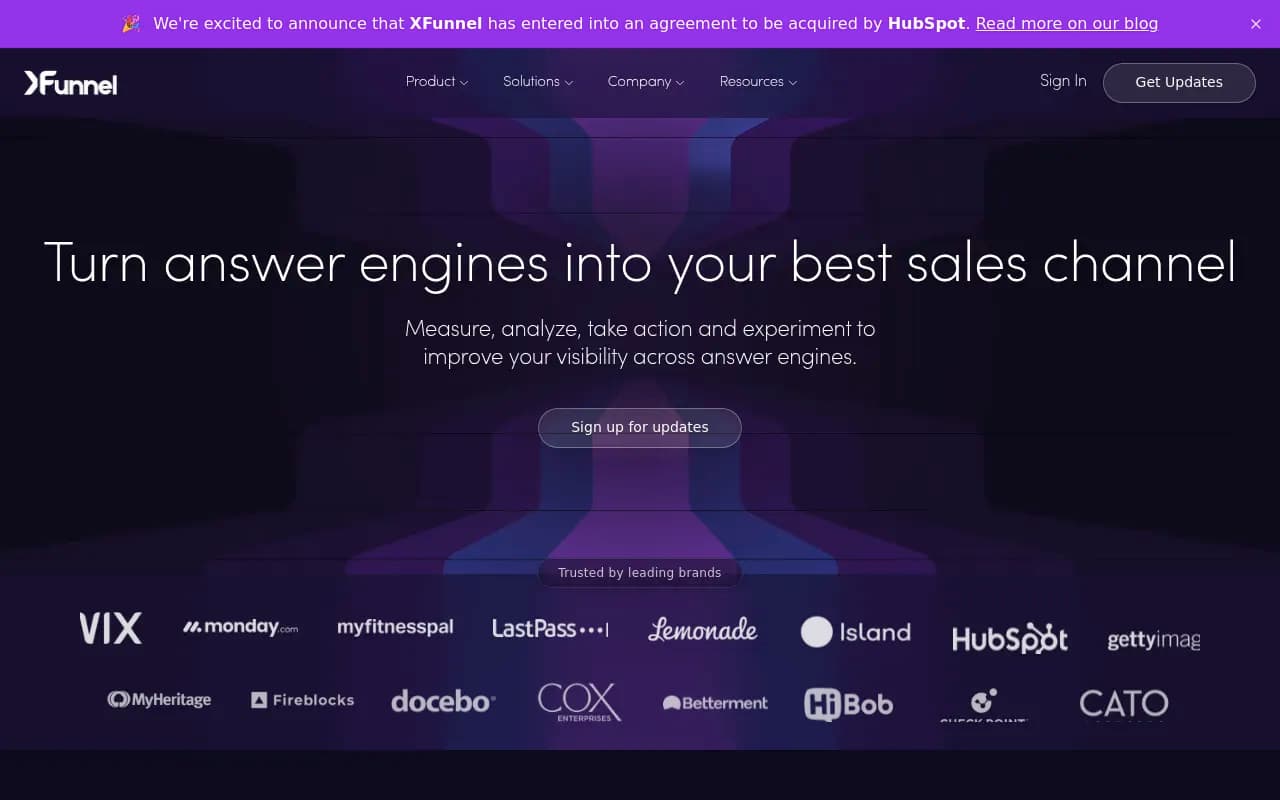
The platform is designed to help teams understand how their content performs in generative search and take steps to improve it. It's more workflow-oriented than Peec.ai, which makes it appealing if you have a content team that needs to act on visibility data rather than just observe it.
What it covers:
- AI search visibility monitoring
- GEO-focused content workflows
- Competitor analysis
- Marketing team collaboration features
Where it falls short: Xfunnel is a newer entrant and the feature set, while promising, isn't as deep as more established platforms. The prompt intelligence layer -- things like volume estimates, difficulty scores, and query fan-outs -- isn't as developed. And like most tools in this tier, it lacks AI crawler log monitoring, which means you can't see how often AI bots are actually crawling your pages or what errors they're hitting.
For a marketing team that wants to move beyond pure monitoring and start connecting visibility data to content decisions, Xfunnel is worth a look. It's more action-oriented than Peec.ai, even if it doesn't yet match the depth of enterprise platforms.
Radarkit
Radarkit (sometimes called Radarkit AI) has been getting attention in the Peec.ai alternatives conversation. A LinkedIn roundup by Sanjay Singh called it "the first place I'd look" when evaluating Peec.ai alternatives, citing its realistic UI-level tracking approach.
The platform focuses on monitoring brand visibility across AI engines with an emphasis on accuracy -- using real UI interactions rather than API calls, similar to Peec.ai's approach.
What it covers:
- Multi-engine AI visibility monitoring
- UI-level scraping for realistic results
- Brand and competitor tracking
- Citation and source analysis
Where it falls short: Radarkit is primarily a monitoring tool. It's good at telling you what's happening but doesn't have built-in content generation or gap analysis to help you fix it. It also has less of a track record than Peec.ai, so there's more uncertainty around data reliability and product roadmap.
That said, if accurate, realistic monitoring is your primary need and you have a separate content workflow, Radarkit is a credible option.
Airefs
Airefs (getairefs.com) is a brand visibility tracker built specifically for AI search. It's clean, accessible, and focused on helping teams understand how they appear across AI engines like ChatGPT, Gemini, and Perplexity.
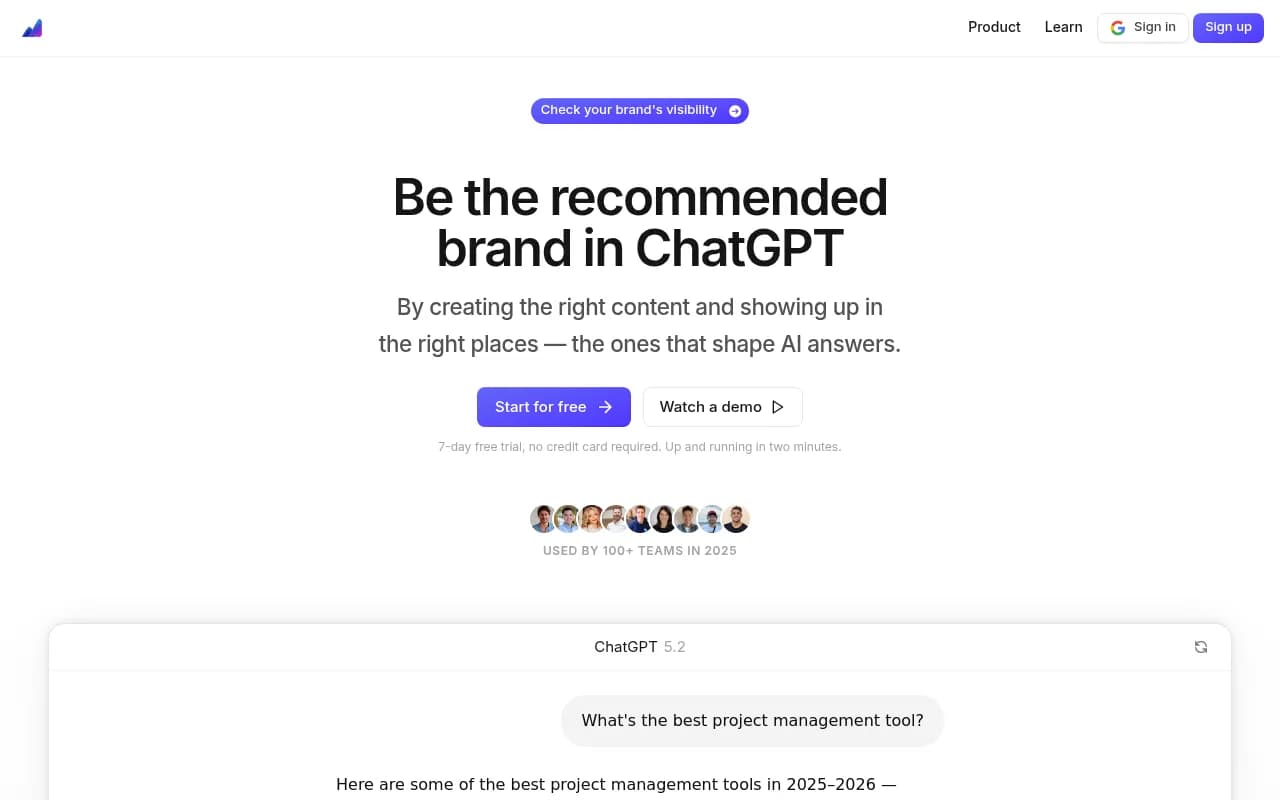
The name is a nod to the traditional SEO world (Ahrefs being the dominant player there), and the positioning suggests it wants to be the go-to AI search tracking tool for teams already familiar with traditional SEO metrics.
What it covers:
- Brand visibility tracking across AI search engines
- Citation monitoring
- Competitor comparison
- Clean, accessible reporting interface
Where it falls short: Airefs is monitoring-focused. Like Peec.ai and Radarkit, it shows you the data but doesn't help you act on it. There's no content generation, no answer gap analysis, and no crawler log monitoring. It's also worth noting that the name similarity to Ahrefs (the SEO giant) can cause confusion -- these are entirely separate products.
For teams that want a straightforward, well-designed monitoring tool without a steep learning curve, Airefs is worth evaluating.
Head-to-head comparison
| Feature | Peec.ai | Xfunnel | Radarkit | Airefs |
|---|---|---|---|---|
| AI engine coverage | ChatGPT, Perplexity, Gemini | Multiple (varies) | Multiple | ChatGPT, Gemini, Perplexity |
| UI-level scraping | Yes | Partial | Yes | Unknown |
| Citation tracking | Yes | Yes | Yes | Yes |
| Competitor benchmarking | Yes | Yes | Yes | Yes |
| Content gap analysis | No | Partial | No | No |
| Built-in content generation | No | No | No | No |
| AI crawler logs | No | No | No | No |
| Reddit/YouTube tracking | No | No | No | No |
| Prompt volume/difficulty | No | No | No | No |
| Starting price | ~€89/mo | Varies | Varies | Varies |
| Best for | Monitoring-focused teams | GEO workflow teams | Accurate monitoring | Simple, clean tracking |
The real gap: monitoring vs. optimization
Here's the honest assessment of all four tools: they're monitoring platforms. They answer the question "are we visible in AI search?" reasonably well. What they don't answer is "what do we do about it?"
That distinction matters more than it might seem. Knowing you're invisible in Perplexity for a high-value prompt is only useful if you can figure out what content to create, create it, and then track whether it worked. None of these four platforms close that loop.
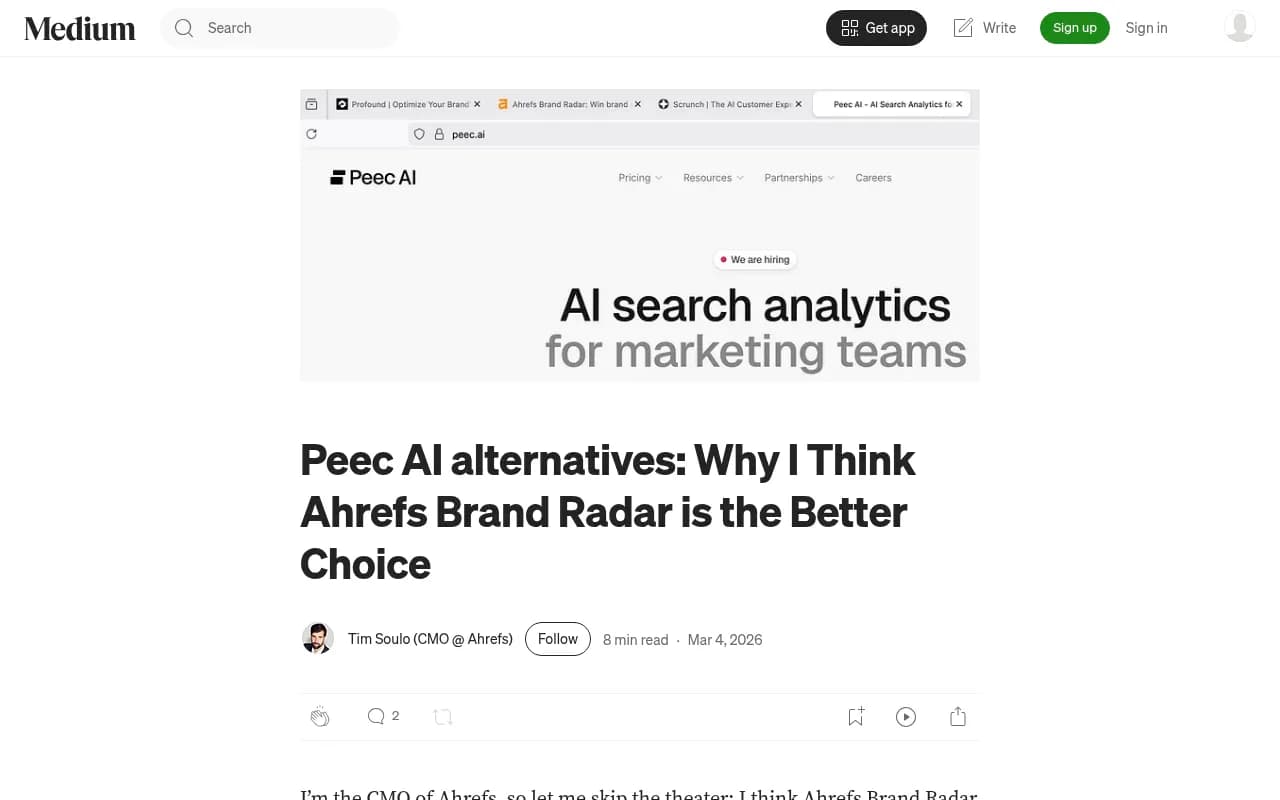
This is the core critique that Tim Soulo (CMO at Ahrefs) made in his Medium piece on Peec.ai alternatives -- most GEO tools are dashboards that show you data but leave you stuck. His argument was that Ahrefs Brand Radar integrates better with existing SEO workflows, which is a fair point for teams already deep in the Ahrefs ecosystem.
But the broader point stands regardless of which tool you prefer: if your goal is to actually improve your AI search visibility, monitoring alone isn't enough.
When these tools make sense
These four platforms are worth considering if:
- You're in an early evaluation phase and want to understand your current AI visibility before investing in a more complete solution
- Your team has strong content capabilities and just needs data to direct them
- Budget is genuinely constrained and you can't justify a more comprehensive platform
- You want a lightweight tool to complement a broader SEO stack
They're probably not the right fit if:
- You need to understand which specific prompts competitors are winning that you're not
- You want to generate content directly informed by citation data and prompt volumes
- You need to see how AI crawlers are interacting with your site
- You're managing multiple brands or client accounts at scale
What a more complete platform looks like
For teams that want to go beyond monitoring, Promptwatch is worth understanding as a reference point. It's built around what it calls an action loop: find the gaps (answer gap analysis showing which prompts competitors rank for that you don't), generate content (an AI writing agent grounded in citation data), and track results (page-level visibility tracking with traffic attribution).

The difference isn't just feature count -- it's the underlying philosophy. Monitoring tools assume you'll take the data somewhere else and figure out what to do with it. An optimization platform assumes you want to close the loop in one place.
That said, Promptwatch starts at $99/month for the Essential plan, which is meaningfully more than some of the budget options above. Whether that premium is worth it depends entirely on how much your team's time costs and how seriously you're treating AI search as a channel.
Other tools worth considering in this space:
Otterly.AI

Profound


Bottom line
If you're choosing between Peec.ai, Xfunnel, Radarkit, and Airefs specifically:
- Peec.ai is the safest bet in this group -- most established, solid UI-level tracking, transparent pricing, and a real user base
- Xfunnel is the most action-oriented of the four, worth trying if you want GEO workflows rather than just a dashboard
- Radarkit is a credible monitoring alternative with accurate UI-level data, though less proven than Peec.ai
- Airefs is the simplest and most accessible -- good for teams that want clean reporting without complexity
None of them will tell you what content to write or help you write it. If that matters to you, factor it into your decision before committing to any of them.