Key takeaways
- Promptwatch is the more complete platform -- it tracks visibility, identifies content gaps, and generates content to close them. Radarkit AI is a capable tracker with some optimization features, but the action loop isn't as developed.
- Radarkit AI is slightly cheaper to start ($79/mo vs $99/mo), which matters if budget is tight and you just need basic monitoring.
- Promptwatch monitors 10+ AI models including Claude, DeepSeek, Grok, and Mistral. Radarkit covers 6 models -- a meaningful gap if your audience uses a wider range of AI tools.
- Promptwatch's AI crawler logs are a genuine differentiator: you can see exactly which pages ChatGPT or Perplexity crawled, when, and whether they led to citations. Radarkit doesn't appear to offer this.
- Both tools target agencies, but Promptwatch's depth of data (traffic attribution, Reddit/YouTube tracking, ChatGPT Shopping) gives agency teams more to report on per client.
- If you only need to monitor brand mentions across a handful of AI models and produce clean client reports, Radarkit is a reasonable, lower-cost option. If you want to actually move the needle on AI visibility, Promptwatch is the stronger choice.
Overview
Promptwatch

Promptwatch is a Dutch-built AI Search Visibility and GEO platform used by 1,780+ brands and agencies -- including Duolingo, Yelp, Typeform, Shutterstock, and Bitvavo. It tracks how brands appear in AI-generated answers across ChatGPT, Claude, Gemini, Perplexity, Grok, DeepSeek, Mistral, Copilot, Meta AI, and Google AI Overviews. The core idea is an action loop: find the prompts where competitors are visible but you're not, generate content to fill those gaps, then track whether AI models start citing your new pages.
Rated 4.7/5 on G2, it's one of the more mature platforms in the space, with data from 4.5+ billion citations and prompts processed. It's not just a dashboard -- it has Content Agents that write articles and briefs grounded in real prompt and citation data.
Radarkit AI
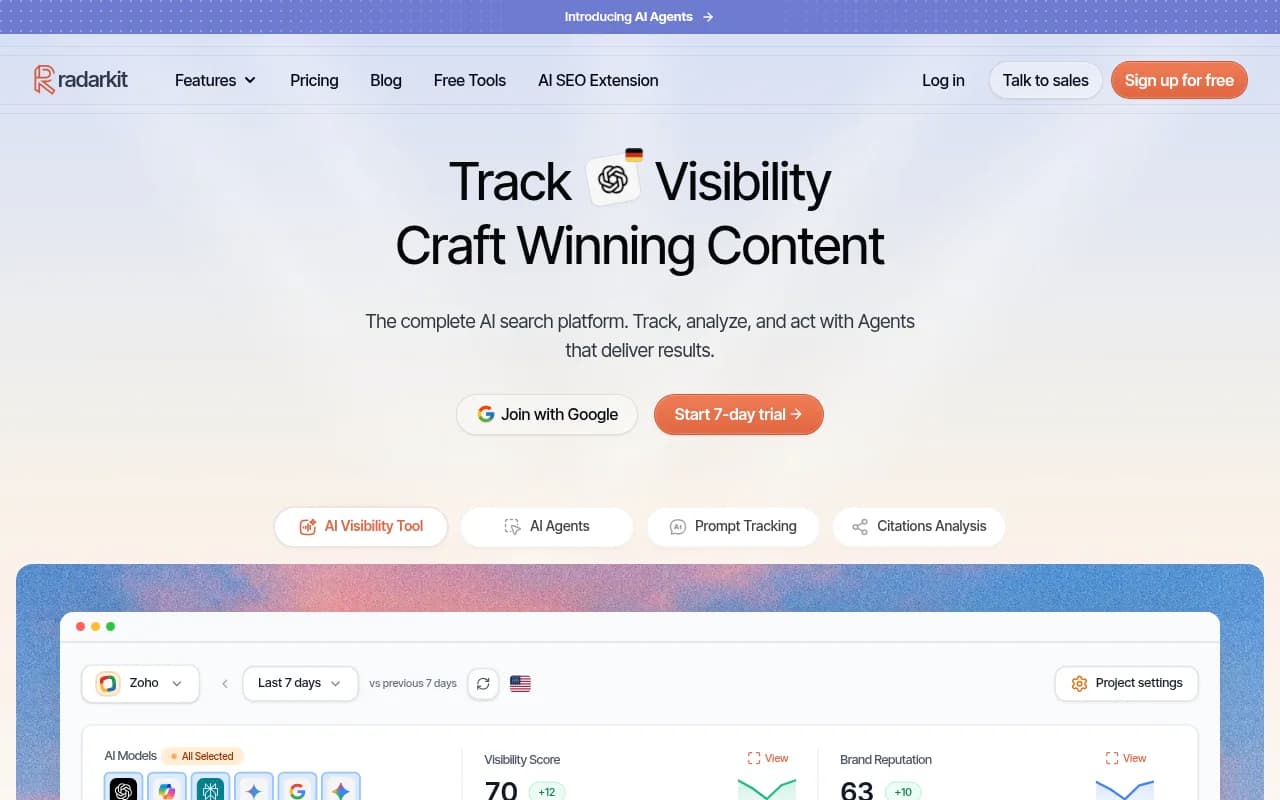
Radarkit AI is a newer entrant positioning itself as "the complete AI search platform" for tracking, analyzing, and acting on AI search visibility. It covers ChatGPT, Copilot, Perplexity, Gemini, Google AI Mode, and Google AI Overviews. The interface shows visibility scores, brand reputation scores, average position rankings, and sentiment breakdowns -- a clean, agency-friendly dashboard.
Radarkit also advertises content optimization ("Craft Winning Content") alongside its tracking features, and it's built with multi-client workflows in mind. The $79/mo starting price makes it accessible, and a 7-day trial lets you test before committing.
Side-by-side comparison
| Feature | Promptwatch | Radarkit AI |
|---|---|---|
| Starting price | $99/mo (Essential) | $79/mo (Popular) |
| Free tier | Free trial, 50 prompts | 7-day trial |
| AI models covered | 10+ (ChatGPT, Claude, Gemini, Perplexity, Grok, DeepSeek, Mistral, Copilot, Meta AI, Google AIO) | 6 (ChatGPT, Copilot, Perplexity, Gemini, Google AI Mode, Google AI Overviews) |
| Prompt tracking | Yes, with volume & difficulty scores | Yes |
| Competitor analysis | Yes, heatmaps + share of voice | Yes, average position ranking |
| Content generation | Yes -- full Content Agents (articles, listicles, briefs) | Content optimization features (advisory) |
| AI crawler logs | Yes -- real-time, page-level | Not confirmed |
| Traffic attribution | Yes -- connects AI visibility to revenue | Not confirmed |
| Reddit & YouTube tracking | Yes | Not confirmed |
| ChatGPT Shopping tracking | Yes | Not confirmed |
| Sentiment analysis | Yes | Yes |
| Multi-language/region | Yes | Yes (US confirmed) |
| Agency features | Dedicated agency tier, custom pricing | Built-in multi-client reporting |
| API / integrations | API, Looker Studio, GSC, Cloudflare, Vercel | Not publicly confirmed |
| G2 rating | 4.7/5 | Not listed |
| Customer count | 1,780+ brands & agencies | Not disclosed |
Head-to-head feature deep-dive
Prompt tracking and AI model coverage
Promptwatch tracks prompts across 10+ AI models, including some that most competitors skip entirely: Grok, DeepSeek, Mistral, and Meta AI. That matters more than it sounds. If your audience is tech-savvy or international, they're not all using ChatGPT. Missing Grok or DeepSeek means you're flying blind on a real slice of your visibility.
Radarkit covers the six most common models -- ChatGPT, Copilot, Perplexity, Gemini, Google AI Mode, and Google AI Overviews. For most brands, that's probably enough. But "probably enough" is a gamble when the AI search landscape is shifting this fast.
Both tools let you define custom prompts and track how your brand appears in responses. Promptwatch adds volume estimates and difficulty scores per prompt, which helps you prioritize. Radarkit shows average position rankings across models, which is a clean way to visualize competitive standing.
Verdict: Promptwatch wins on breadth. Radarkit's coverage is solid for mainstream use cases.
Content generation and gap analysis
This is where the gap between the two platforms is most obvious.
Promptwatch's Content Agents generate full articles, listicles, comparison pages, and content briefs -- not generic SEO filler, but content built around specific prompts where competitors are visible and you're not. The briefs include brand instructions, competitor analysis, citation data, and even screenshots. You can upload your own knowledge-base files. The output is designed to be cited by AI models, not just ranked in Google.
Radarkit advertises "Craft Winning Content" on its homepage, but the feature appears to be more advisory -- guidance on what to create rather than an agent that creates it for you. That's still useful, but it's a different category of capability.
If your goal is to actually close visibility gaps rather than just identify them, Promptwatch's content generation is a meaningful advantage.
Verdict: Promptwatch is clearly ahead here. Radarkit's content features are useful but lighter.
Crawler logs and traffic attribution
Promptwatch's AI Crawler Logs are one of its most distinctive features. You can see in real time when ChatGPT, Perplexity, or Claude crawls your pages -- which URLs they hit, what errors they encounter, how often they return, and when a crawled page moves to an actual citation. This is the kind of data that tells you whether your content is being discovered at all, not just whether it's being cited.
Traffic attribution goes further: Promptwatch connects AI visibility to actual website traffic and revenue, so you can show stakeholders a direct line from "we published this article" to "we got these visitors and conversions."
Radarkit doesn't appear to offer crawler logs or traffic attribution based on available information. It tracks visibility and position, but the connection between AI appearances and business outcomes isn't something the platform currently surfaces.
Verdict: Promptwatch wins decisively. Crawler logs and traffic attribution are features most competitors don't have at all.
Competitor analysis
Both tools let you track competitors alongside your own brand. Promptwatch shows competitor heatmaps -- a visual breakdown of who's winning for each prompt across each AI model. You can see exactly where a competitor is outperforming you and why (based on which pages they're getting cited for).
Radarkit shows average position rankings with competitor domains listed, which is clean and easy to read. The dashboard demo shows Zoho ranked #1 with Salesforce, HubSpot, Asana, and Monday.com below it -- a clear, scannable view.
Promptwatch's Answer Gap Analysis goes deeper: it identifies specific prompts where competitors appear but you don't, then surfaces the content gaps causing that. Radarkit's competitor view is more of a scoreboard.
Verdict: Promptwatch's gap analysis is more actionable. Radarkit's position ranking is easier to read at a glance.
Sentiment analysis and brand reputation
Radarkit has a notable feature here: a Brand Reputation score alongside the Visibility Score. The sentiment breakdown shows positive, mixed, and negative mentions, plus specific sentiment insights ("budget-conscious teams", "known for affordability"). That's genuinely useful for brand monitoring beyond just "are we mentioned."
Promptwatch also tracks sentiment, but Radarkit's reputation scoring feels more prominent and polished in the interface. If brand health monitoring is a primary use case -- not just visibility -- Radarkit's framing might resonate more.
Verdict: Radarkit's reputation scoring is a nice touch. Roughly even on sentiment, with Radarkit having a slight edge in presentation.
Agency and multi-client features
Radarkit is explicitly built with agencies in mind. Multi-client reporting, clean dashboards, and a pricing structure that scales by project make it easy to manage multiple clients without the workflow getting messy.
Promptwatch has a dedicated agency tier with custom pricing, and its depth of data gives agencies more to work with per client: crawler logs, traffic attribution, content agents, Reddit/YouTube insights, and ChatGPT Shopping tracking all translate into richer deliverables. The Looker Studio integration and API make it easier to build custom reports.
The tradeoff is complexity. Radarkit is simpler to set up and present. Promptwatch has more data but requires more setup to use well.
Verdict: Radarkit is easier for agencies to get started with. Promptwatch gives agencies more to offer clients once they're set up.
Pricing comparison
| Plan | Promptwatch | Radarkit AI |
|---|---|---|
| Entry / Popular | $99/mo (Essential: 1 site, 50 prompts, 5 articles) | $79/mo (Popular) |
| Mid-tier | $249/mo (Professional: 2 sites, 150 prompts, 15 articles, crawler logs) | $139/mo (Pro) |
| Business | $579/mo (Business: 5 sites, 350 prompts, 30 articles) | Not publicly listed |
| Enterprise | Custom | Custom |
| Free access | Free trial with 50 prompts | 7-day trial |
| Annual discount | Yes | Not confirmed |
Radarkit is cheaper at every comparable tier. The $79 vs $99 gap at entry level isn't huge, but the $139 vs $249 gap at mid-tier is more significant. Whether that difference is worth it depends on whether you need Promptwatch's deeper features -- crawler logs, content agents, traffic attribution -- which only kick in at the Professional tier.
For pure monitoring on a budget, Radarkit is the better value. For teams that want to act on the data, Promptwatch's higher price buys meaningfully more capability.
Pros and cons
Promptwatch
Pros:
- Covers 10+ AI models, including Grok, DeepSeek, Mistral, and Meta AI
- Content Agents generate full articles and briefs grounded in real prompt data
- AI Crawler Logs show exactly which pages AI models are crawling and when
- Traffic attribution connects AI visibility to actual revenue
- Reddit and YouTube tracking surfaces external citation sources
- ChatGPT Shopping and entity tracking
- Strong customer base (1,780+ brands) with recognizable names
- 4.7/5 on G2
Cons:
- More expensive at every tier
- More complex to set up and use well
- Content Agents require time to configure properly
- Overkill if you just need basic monitoring
Radarkit AI
Pros:
- Lower starting price ($79/mo)
- Clean, easy-to-read dashboard
- Brand Reputation score is a useful addition to visibility tracking
- Average position ranking gives a clear competitive view
- Built with agency multi-client workflows in mind
- 7-day trial to test before committing
Cons:
- Fewer AI models covered (6 vs 10+)
- No confirmed crawler logs or traffic attribution
- Content features appear advisory rather than generative
- Smaller customer base and less established track record
- No Reddit/YouTube tracking or ChatGPT Shopping monitoring
Who should pick which tool
Pick Promptwatch if:
- You want to do more than monitor -- you want to actually improve your AI visibility
- You need coverage across a wide range of AI models, including Grok, DeepSeek, or Mistral
- Traffic attribution matters to you (connecting AI mentions to revenue)
- You want AI-generated content briefs and articles built around real prompt gaps
- You're an agency that wants to offer clients a full optimization service, not just a report
- You need crawler logs to diagnose why AI models aren't citing your content
Pick Radarkit AI if:
- Budget is the primary constraint and you need basic monitoring at a lower price
- You mainly care about ChatGPT, Perplexity, Gemini, and Google AI Overviews
- You want a clean, simple dashboard that's easy to present to clients
- Brand reputation scoring and sentiment analysis are high priorities
- You're an agency that needs quick multi-client setup without a steep learning curve
Final verdict
Radarkit AI is a capable monitoring tool with a clean interface and a price point that makes it accessible. For teams that just need to track brand mentions across the main AI models and produce tidy reports, it does the job.
But Promptwatch is a different category of product. The crawler logs, traffic attribution, Content Agents, and Reddit/YouTube tracking aren't just extra features -- they're what separates a monitoring dashboard from a platform that actually helps you rank in AI search. If you're serious about GEO and want to close the gap between where you are and where your competitors are showing up, Promptwatch is the more complete tool.
The price difference is real, but so is the capability gap. For most marketing and SEO teams with AI visibility as a genuine priority, Promptwatch is worth the extra spend.