Rivalsee Review 2026
Affordable platform for tracking brand visibility in AI-generated answers with competitive pricing and essential GEO monitoring features.
Key Takeaways:
• Persona-driven approach: Unlike keyword-based tools, RivalSee uses dynamic customer personas that ask questions like real users, providing more realistic visibility scores across ChatGPT, Claude, Perplexity, Google AI, and Gemini • Affordable entry point: Starting at $69.99/month (additional sites $59.99), significantly cheaper than enterprise GEO platforms while covering essential monitoring and optimization features • Agency-friendly: Built-in Agency Mode with co-branded reports, multi-client management, and volume discounts makes it practical for consultants and digital agencies • Actionable insights: Goes beyond monitoring to show content gaps, winning sources, and specific optimization recommendations based on what AI models actually cite • Best for: Small businesses, SaaS companies, and agencies looking for cost-effective AI visibility tracking without enterprise-level complexity or pricing
RivalSee is an AI search visibility platform that helps businesses and agencies track how often ChatGPT, Claude, Perplexity, Google AI, and Gemini recommend their brand versus competitors. Founded as an affordable alternative to enterprise GEO (Generative Engine Optimization) tools, RivalSee focuses on persona-driven monitoring rather than static keyword tracking. The platform is designed for small businesses, SaaS companies, digital agencies, and consultants who want to understand and improve their presence in AI-generated answers without paying thousands per month.
The core insight behind RivalSee is that AI search doesn't work like traditional SEO. Large language models don't just match keywords -- they have conversations, remember context, and tailor responses based on user personas. RivalSee mirrors this behavior by creating dynamic customer personas that ask questions the way real users would, then tracks which brands get cited in the responses. This approach provides more realistic visibility data than tools that simply scrape generic FAQs or run fixed prompt lists.
Persona-Driven Monitoring (Not Just Keywords)
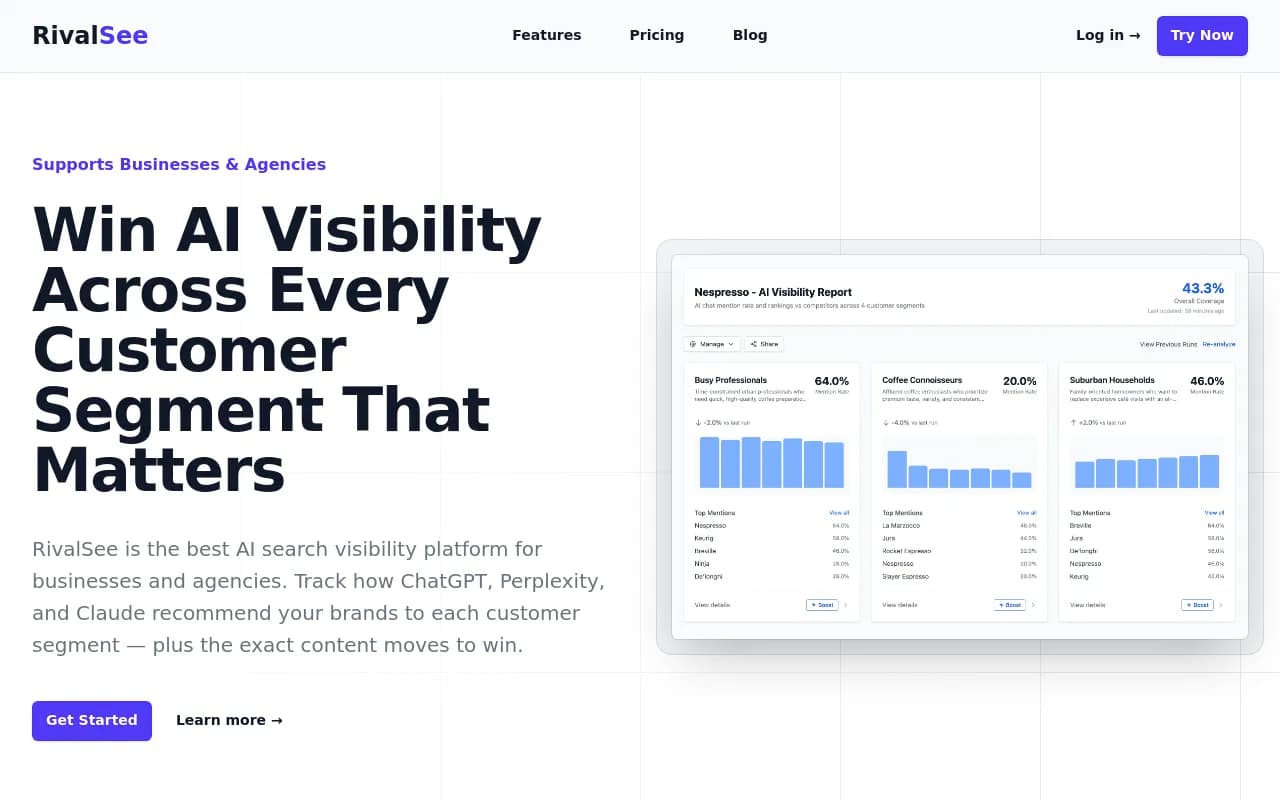
RivalSee's standout feature is its persona system. Instead of feeding the platform a list of keywords, you define customer segments (enterprise buyers, individual users, specific industries, demographics, psychographics). The platform then automatically generates personas representing those segments and creates context-aware questions based on their needs. For example, an enterprise buyer persona might ask about integration capabilities and compliance, while an individual user persona focuses on ease of use and pricing. Each persona builds on previous questions, mimicking how AI chatbots use conversation history to personalize responses. This results in 150+ queries per analysis on the Startup plan and 250+ on Pro, covering different customer journeys and search patterns. The system auto-regenerates questions and personas over time to keep testing fresh and aligned with evolving customer behavior.
Multi-LLM Tracking and Trend Analysis
RivalSee monitors five major AI platforms: ChatGPT (including Search mode), Google AI Overviews, Claude, Perplexity, and Gemini. Support for additional engines like Grok is on the roadmap. The dashboard shows your brand's mention rate (share of voice) across these platforms, broken down by persona and query type. You can see which AI models favor your brand, which ones ignore you, and how your visibility changes over time. Tracking frequency depends on your plan: Startup runs weekly, Pro runs twice per week, and Enterprise customers can request custom cadences. Historical trend charts let you correlate visibility spikes with content updates, PR campaigns, or competitor moves. The platform also tracks your top competitors automatically, showing when they gain ground and which sources AI models cite when recommending them.
Content Gap Analysis and Optimization Recommendations
RivalSee doesn't just report numbers -- it tells you what to fix. The Boost feature identifies prompts where you're missing, shows which pages and sources AI models prefer, and highlights structural patterns those winning sources share (schema markup, backlink profiles, narrative style, content depth). You get specific, actionable recommendations: "Add a comparison table to your pricing page," "Create a case study targeting enterprise buyers," "Optimize your about page with team credentials." The platform also surfaces the exact keywords and phrases AI models use when searching the web for answers, helping you align your content with how LLMs actually retrieve information. This is particularly useful for filling content gaps -- if competitors are winning on "best [category] for [use case]" prompts, RivalSee shows you what content you need to create to compete.
Competitor Benchmarking and Source Tracking
The competitor analysis dashboard shows win/loss patterns: when do you get recommended over rivals, and when do you lose? RivalSee tracks the exact pages, blog posts, Reddit threads, and third-party reviews that AI platforms cite when recommending competitors. This source tracking reveals which content types and distribution channels matter most for AI visibility. For example, you might discover that Perplexity heavily cites Reddit discussions while ChatGPT prefers authoritative blog posts with strong backlinks. You can then prioritize creating similar content or building presence on those channels. The platform also flags sudden competitor gains, letting you reverse-engineer the PR hits, product launches, or content updates behind those spikes.
Agency Mode and Multi-Client Management
RivalSee is explicitly built for agencies and consultants who want to offer AI visibility as a service. Agency Mode lets you manage unlimited client sites under one dashboard, with automatic volume discounts as you scale. Each client gets a co-branded report featuring both your agency logo and RivalSee branding, which you can share via public URL or keep private. Clients can receive view-only access to their reports while you retain full control over analysis runs and optimization strategies. This makes it easy to pitch AI visibility services, demonstrate value with branded reports, and retain accounts by showing ongoing progress. Additional sites cost $59.99/month on Startup and $109.99/month on Pro, making it feasible to add multiple clients without breaking the bank.
Who Is RivalSee For?
RivalSee targets three main audiences. First, small businesses and local companies (pest control, law firms, home services) that want to show up when potential customers ask AI chatbots for recommendations. These businesses typically can't afford $500+/month enterprise tools but need basic visibility tracking and optimization guidance. Second, SaaS companies and startups that want to track how AI positions their product versus alternatives. When someone asks ChatGPT "best project management tool for remote teams," does your brand get mentioned? RivalSee shows you where you stand and what content to create to improve. Third, digital agencies, consultants, and freelancers who want to add AI visibility to their service offerings. Agency Mode makes it practical to manage multiple clients, and the affordable per-site pricing means you can profitably resell the service.
RivalSee is NOT ideal for enterprise brands managing hundreds of sites, companies that need real-time crawler log analysis, or teams that want built-in content generation tools. It's a monitoring and optimization platform, not an end-to-end GEO suite. If you need features like AI traffic attribution, Reddit/YouTube deep dives, or prompt volume estimates, you'll want a more comprehensive platform like Promptwatch.
Integrations and Ecosystem
RivalSee is a standalone web app with no native integrations. There's no API, no Zapier connection, no Google Search Console sync. You manually input your site URL and competitors, define personas, and let the platform handle the rest. Reports are shareable via public URLs (which you can flip to private on paid plans), but there's no export to CSV, Looker Studio, or other analytics tools. This simplicity keeps the product focused and affordable, but it also means RivalSee won't fit into complex marketing stacks or automated reporting workflows. The platform is entirely browser-based -- no mobile app, no browser extension, no desktop client.
Pricing and Value
RivalSee offers four tiers. The Free plan is a one-time baseline scan with 1 persona, ChatGPT + Gemini only -- enough to see where you stand but not for ongoing tracking. Startup ($69.99/month, additional sites $59.99) includes weekly tracking, 3 customer segments, 6 personas, 150+ queries, multi-LLM support, and actionable recommendations. Pro ($129.99/month, additional sites $109.99) doubles the tracking frequency (2x per week), expands to 5 customer segments and 10 personas with 250+ queries, adds priority support, and includes personalized improvement recommendations. Enterprise/Agency is custom pricing with dedicated support, higher cadences, and advanced features tailored to organizational needs. All paid plans come with a 7-day money-back guarantee.
Compared to competitors, RivalSee is aggressively affordable. Enterprise GEO platforms like Profound, Otterly.AI, and AthenaHQ start at $300-500/month. Semrush and Ahrefs don't offer dedicated AI visibility tracking at this depth. RivalSee positions itself as the budget-friendly option for businesses that need core monitoring and optimization features without enterprise complexity. The trade-off: you don't get crawler logs, traffic attribution, Reddit/YouTube insights, or built-in content generation. But if your primary goal is "track how often ChatGPT recommends me vs competitors and get tips to improve," RivalSee delivers at a fraction of the cost.
Strengths
Persona-driven approach is genuinely differentiated: Most GEO tools use static keyword lists or generic prompts. RivalSee's dynamic personas that build on conversation history mirror how AI actually works, providing more realistic visibility scores.
Affordable entry point: At $69.99/month, it's accessible to small businesses and agencies that can't justify $500+/month enterprise tools. The per-site pricing for additional clients is also reasonable.
Agency Mode is well-executed: Co-branded reports, multi-client management, and volume discounts make it practical for consultants and agencies to resell AI visibility services.
Actionable recommendations: The platform doesn't just show you numbers -- it tells you which content to create, which pages to optimize, and which sources to emulate.
Limitations
No integrations or API: RivalSee is a standalone tool with no way to connect to Google Search Console, export data to Looker Studio, or automate workflows via API. This limits its usefulness for teams with complex reporting needs.
Limited LLM coverage: Five AI platforms is solid, but competitors like Promptwatch track 10+ models including DeepSeek, Mistral, and Copilot. If you need comprehensive coverage, RivalSee falls short.
No traffic attribution or crawler logs: RivalSee can't tell you if AI visibility improvements actually drive traffic or revenue. It also doesn't show you which AI crawlers are hitting your site or how they're indexing your content. Tools like Promptwatch and Profound offer these features.
No content generation: Unlike platforms with built-in AI writing agents, RivalSee only tells you what to create -- you have to write it yourself or use a separate tool.
Bottom Line
RivalSee is the best choice for small businesses, SaaS companies, and agencies that want affordable AI visibility tracking without enterprise-level complexity. The persona-driven approach is smarter than keyword-based monitoring, and the actionable recommendations help you actually improve your presence in AI search results. Agency Mode makes it practical to manage multiple clients and resell the service profitably. However, if you need advanced features like traffic attribution, crawler logs, or built-in content generation, you'll outgrow RivalSee quickly. Best use case: You're a digital agency managing 5-10 clients who want to know "how often does ChatGPT recommend us vs competitors?" and you need an affordable, easy-to-explain tool to deliver that insight.
Tags:
Similar and alternative tools to Rivalsee