Segment Review 2026
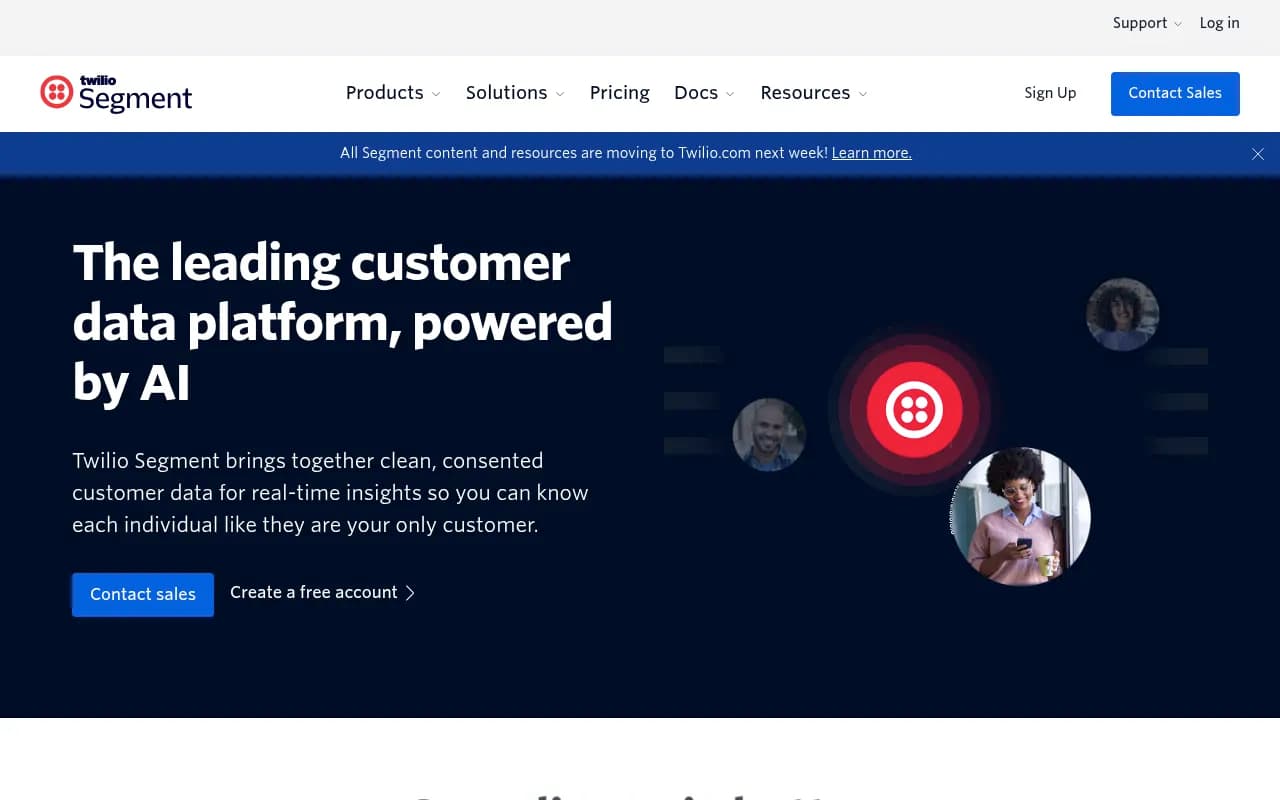
Twilio Segment is an enterprise customer data platform (CDP) that collects, cleans, and activates customer data from 700+ sources. Used by 25,000+ companies including IBM, Domino's, and MongoDB, it builds unified customer profiles with AI-powered predictions, reverse ETL for warehouse activation, an
Summary
- Best for: Mid-market to enterprise companies (50+ employees) with complex data stacks who need to unify customer data across marketing, product, and engineering teams -- especially B2C brands, SaaS companies, and digital-first businesses managing millions of customer interactions
- Core strength: Industry-leading data infrastructure that processes 12+ trillion API calls annually with 700+ pre-built integrations, making it the most battle-tested CDP for high-volume, real-time data activation
- Key limitation: Pricing scales quickly with monthly tracked users (MTUs) -- companies with large user bases can face $50K+ annual costs, making it expensive compared to newer CDPs like RudderStack or Hightouch for smaller teams
- Standout capability: Zero-copy architecture with reverse ETL treats your data warehouse as the source of truth, letting you activate warehouse data without moving it -- a major advantage over traditional CDPs that force you to duplicate data
- Watch out for: Implementation complexity -- while Segment is powerful, getting full value requires engineering resources to instrument tracking correctly and maintain data quality across sources
Twilio Segment has been the dominant player in the customer data platform space since its 2011 founding (acquired by Twilio in 2020 for $3.2 billion). It's the infrastructure layer that sits between your data sources (websites, mobile apps, servers, warehouses) and your destinations (marketing tools, analytics platforms, data warehouses). The core promise: collect customer data once, send it everywhere, and build unified profiles that every team can use.
The platform serves three primary audiences. Data engineers use it as a data pipeline to collect events from hundreds of thousands of sources per second and route them to downstream tools without writing custom integrations. Marketers use it to build audiences, run predictive models, and activate personalized campaigns across channels. Product managers use it to understand user behavior, optimize conversion funnels, and power in-app personalization.
Segment's customer base skews toward mid-market and enterprise -- companies like IBM, Domino's Pizza, Sanofi, MongoDB, and Allergan. These are organizations with complex tech stacks, multiple customer touchpoints, and teams that need shared access to clean customer data. The platform processes over 12 trillion API calls annually and tracks 12,696 unique events across its customer base, giving you a sense of the scale it operates at.
Data Collection & Infrastructure
Segment's data collection layer is where it built its reputation. The platform provides client-side libraries (JavaScript, iOS, Android), server-side SDKs (Node.js, Python, Ruby, Go, Java, PHP, .NET), and cloud sources (Stripe, Salesforce, Zendesk, etc.) that automatically collect and standardize customer data. You instrument tracking once using Segment's API, and the data flows to every connected destination.
The tracking spec is event-based: identify calls for user traits, track calls for actions, page/screen calls for pageviews, and group calls for account-level data. This creates a consistent data model across sources, which is critical when you're trying to unify data from web, mobile, server, and third-party tools. Segment handles schema validation, data transformation, and delivery retries automatically.
What separates Segment from newer competitors is reliability at scale. The platform is built on AWS infrastructure with 99.9% uptime SLA, automatic failover, and real-time monitoring. When you're processing millions of events per day, this infrastructure matters -- dropped events or delayed delivery can break attribution models and personalization engines.
The platform also includes Functions, a serverless compute layer that lets you transform data in-flight using JavaScript. You can enrich events, filter out PII, route data conditionally, or call external APIs before data reaches destinations. This is more flexible than the rigid transformation rules in older CDPs.
Unified Customer Profiles (Unify)
Segment Unify is the identity resolution engine that stitches together anonymous and known user data into unified profiles. It uses deterministic matching (email, user ID) and probabilistic matching (device fingerprinting, behavioral signals) to connect cross-device activity and build a single customer view.
The profile merging happens in real-time as new events arrive. When an anonymous visitor signs up or logs in, Segment retroactively merges their pre-login activity into their known profile. This is essential for attribution -- you need to know that the person who clicked your ad, browsed three product pages, and then signed up is the same individual.
Each unified profile includes identity traits (email, name, company), computed traits (total purchases, last seen date, engagement score), and event history. You can query profiles via API or export them to warehouses and downstream tools. The profile data is also available in Segment's Audiences product for building segments.
One limitation: Segment's identity graph is siloed within Segment. If you're using multiple CDPs or identity solutions, you can't easily merge Segment's graph with external identity data. Competitors like Hightouch and Census let you build identity graphs directly in your warehouse, giving you more control.
Audiences & Predictive AI
Segment Audiences is where marketers build segments and activate them across channels. You can create audiences using point-and-click filters (users who purchased in the last 30 days, visited pricing page but didn't convert, etc.) or write SQL queries for complex logic. Audiences sync to destinations like Facebook Ads, Google Ads, Braze, Iterable, and 700+ other tools.
The platform includes Predictive Audiences powered by AI models trained on Segment's cross-customer data. These predict behaviors like likelihood to purchase, churn risk, or product affinity. You can use predictions to build high-intent audiences (e.g. users with 70%+ purchase probability) and target them with personalized campaigns. According to Segment's case studies, Domino's decreased cost per acquisition by 65% using predictive targeting.
Segment also added generative AI features in 2024. You can now create audiences using natural language prompts ("show me users who viewed product pages but didn't add to cart in the last week") instead of manually building filters. The AI translates your prompt into audience logic and suggests refinements. This makes audience building accessible to non-technical marketers.
One gap: Segment's predictive models are black boxes. You can't see feature importance, adjust model parameters, or bring your own models. If you want full control over ML, you're better off building models in your warehouse and using Segment to activate the predictions.
Reverse ETL & Warehouse Integration
Segment's reverse ETL product (launched 2021) is a major differentiator. It treats your data warehouse (Snowflake, BigQuery, Redshift, Databricks) as a source, letting you sync warehouse data back to business tools without moving it. This is critical for companies that have invested in building their data warehouse as the source of truth.
The workflow: you write SQL queries in your warehouse to define audiences or entity data (accounts, products, etc.), then Segment syncs the results to destinations on a schedule. For example, you could sync a "high-value accounts" list from your warehouse to Salesforce, or sync product recommendations from your ML models to your email tool.
This zero-copy architecture means you're not duplicating data into Segment's infrastructure. Your warehouse remains the source of truth, and Segment acts as the activation layer. This is cleaner than traditional CDPs that force you to replicate data into their systems.
The reverse ETL product competes directly with standalone tools like Hightouch, Census, and Polytomic. Segment's advantage is the unified platform -- you can use the same interface for event streaming, identity resolution, and warehouse activation. The disadvantage is less flexibility -- Hightouch and Census offer more advanced features like bi-directional syncs, change data capture, and warehouse-native transformations.
Integrations & Destinations
Segment's 700+ pre-built integrations are its moat. Every major marketing, analytics, and data tool has a Segment integration, and enabling a new destination is literally flipping a switch in the UI. This is the core value prop: instrument tracking once, send data everywhere.
Integrations are categorized as cloud-mode (data routes through Segment's servers) or device-mode (Segment loads the destination's SDK directly on your site/app). Cloud-mode is more reliable and privacy-friendly, but device-mode is required for tools that need direct access to the client (e.g. session replay tools, some ad pixels).
Segment also supports custom destinations via webhooks or the Destination Functions API. You can write JavaScript to transform data and send it to internal APIs or niche tools that don't have official integrations.
One frustration: some integrations are maintained by Segment, others by the destination vendor. Quality varies, and debugging integration issues can be painful when you're not sure whether the problem is on Segment's side or the destination's side. The documentation is generally strong, but you'll occasionally hit edge cases that require support tickets.
Privacy & Governance
Segment's Privacy Portal is a centralized dashboard for managing data privacy and consent. You can configure consent management (GDPR, CCPA), set up data deletion workflows, and control which destinations receive PII. The platform integrates with consent management platforms like OneTrust and Osano.
The governance features include schema validation (enforce required properties on events), data quality monitoring (alert when event volume drops or schemas change), and audit logs (track who made changes to tracking plans or destinations). These are essential for regulated industries like healthcare and finance.
Segment is SOC 2 Type II certified, HIPAA compliant, and GDPR compliant. Data is encrypted in transit and at rest. The platform also supports data residency options (EU, US) for companies with regional data requirements.
One limitation: Segment's privacy controls are destination-level, not user-level. You can block PII from going to specific tools, but you can't easily implement per-user consent preferences (e.g. user A opted out of marketing but not analytics). For granular consent management, you'll need to build custom logic using Functions or integrate a dedicated consent platform.
Protocols & Data Quality
Segment Protocols is a data governance layer that enforces tracking standards. You define a tracking plan (which events and properties are allowed), and Protocols validates incoming data against the plan. Invalid events are flagged or blocked, preventing bad data from polluting downstream tools.
This is critical for large organizations where multiple teams are instrumenting tracking. Without enforcement, you end up with inconsistent naming ("Product Viewed" vs "product_viewed" vs "ProductView"), missing properties, and data quality issues that break reports and models.
Protocols also includes schema suggestions powered by AI. It analyzes your existing events and recommends standardized naming conventions based on Segment's best practices. This helps teams adopt consistent tracking without starting from scratch.
The downside: Protocols is a paid add-on, not included in base plans. For smaller companies, the cost may not be justified until you have multiple teams instrumenting tracking.
AI Features
Segment's AI capabilities span three areas: generative AI for audience creation (natural language prompts), predictive AI for behavior forecasting (churn, purchase likelihood), and AI-ready data (clean, consented data for training models).
The generative AI features are useful for non-technical marketers but limited compared to dedicated AI tools. You can create audiences with prompts, but you can't generate full customer journeys, content recommendations, or complex workflows. It's a convenience feature, not a core differentiator.
The predictive AI models are more impactful. Segment trains models on aggregated data across its customer base, giving you predictions without needing your own data science team. The models improve over time as Segment collects more training data. However, you're locked into Segment's models -- you can't bring your own or customize the algorithms.
The "AI-ready data" positioning is marketing speak for Segment's core value prop: clean, unified customer data. If you're building AI models (recommendation engines, LLMs, etc.), having clean training data matters. Segment ensures data quality through schema validation, identity resolution, and consent management. But this isn't a unique AI feature -- it's just good data infrastructure.
Who Should Use Segment
Segment is best for mid-market to enterprise companies (50+ employees, $5M+ revenue) with complex data needs. Ideal customers:
- B2C brands with high transaction volume: E-commerce, travel, food delivery, fintech -- companies that need to track millions of customer interactions and activate data in real-time for personalization and ad targeting
- SaaS companies with product-led growth: Companies that need to track in-app behavior, build activation funnels, and sync product usage data to marketing and sales tools
- Multi-channel businesses: Brands with web, mobile, retail, and call center touchpoints that need unified customer profiles across channels
- Data-mature organizations: Companies with data warehouses, engineering teams, and a commitment to treating data as a strategic asset
Segment is overkill for early-stage startups (pre-product-market fit), small businesses with simple analytics needs, or companies that only need basic event tracking. If you're just sending data to Google Analytics and one email tool, use a simpler solution like Mixpanel or Amplitude's free tier.
Segment is also not ideal for companies that want full control over their data infrastructure. The platform is opinionated about data models, and customization requires workarounds. If you want to build everything in your warehouse, consider warehouse-native tools like Hightouch or Census instead.
Pricing
Segment pricing is based on monthly tracked users (MTUs) -- unique users who trigger at least one event in a month. The free tier includes 1,000 MTUs and two sources. Paid plans start at $120/month for 10,000 MTUs (Team plan), with Business and Enterprise tiers for higher volumes.
Pricing scales non-linearly. According to Vendr's negotiation data, companies with 50,000 MTUs pay $983-$1,820/month (negotiated rates), while companies with millions of MTUs can pay $50K-$200K+ annually. Add-ons like Unify (identity resolution), Protocols (data governance), and Engage (advanced audiences) increase costs further.
The MTU pricing model penalizes high-traffic consumer apps. If you have 10 million monthly active users, Segment becomes prohibitively expensive. Competitors like RudderStack offer event-based pricing that's cheaper for high-volume use cases.
Segment also charges for some destinations. Cloud-mode destinations are free, but device-mode destinations and warehouse destinations may incur additional fees. Read the pricing page carefully before committing.
Strengths
- Proven infrastructure: 12+ trillion API calls processed annually, 99.9% uptime, and a decade of operational experience make Segment the most reliable CDP for mission-critical data pipelines
- Integration breadth: 700+ pre-built integrations cover every major tool in the marketing, analytics, and data stack -- no other CDP comes close
- Reverse ETL: Zero-copy architecture lets you activate warehouse data without duplicating it, giving you flexibility to build your data stack however you want
- Identity resolution: Unify's real-time profile merging and cross-device tracking are best-in-class for building unified customer views
- Enterprise-grade governance: Privacy Portal, Protocols, and audit logs provide the compliance and data quality controls that large organizations require
Limitations
- Pricing scales aggressively: MTU-based pricing becomes expensive fast for high-traffic apps -- companies with millions of users often hit budget constraints and migrate to cheaper alternatives like RudderStack or Snowplow
- Implementation complexity: Getting full value requires engineering resources to instrument tracking correctly, maintain data quality, and troubleshoot integration issues -- not a plug-and-play solution
- Limited warehouse-native features: While reverse ETL is solid, Segment lacks advanced warehouse capabilities like bi-directional syncs, change data capture, and warehouse-native transformations that competitors like Hightouch and Census offer
- Black-box AI models: Predictive audiences are useful but opaque -- you can't see how models work, adjust parameters, or bring your own models, limiting flexibility for data science teams
- Destination maintenance burden: Some integrations are maintained by third-party vendors, leading to inconsistent quality and debugging headaches when things break
Bottom Line
Segment is the industry-standard CDP for companies that need enterprise-grade data infrastructure, 700+ integrations, and real-time customer profiles at scale. It's the right choice if you're a mid-market or enterprise company with complex data needs, multiple customer touchpoints, and teams that need shared access to unified customer data. The platform's reliability, integration breadth, and reverse ETL capabilities justify the premium pricing for organizations where customer data is a strategic asset.
However, Segment's MTU-based pricing and implementation complexity make it a poor fit for early-stage startups, high-traffic consumer apps on tight budgets, or companies that want full control over their data infrastructure. If you're just getting started with customer data, consider simpler alternatives like Mixpanel or Amplitude. If you're building a warehouse-first data stack, evaluate warehouse-native tools like Hightouch or Census. And if you need a more affordable CDP for high-volume use cases, look at open-source options like RudderStack.
Best use case in one sentence: Mid-market to enterprise B2C brands and SaaS companies that need to unify customer data across marketing, product, and engineering teams with enterprise-grade reliability and 700+ integrations.
Tags:
Frequently asked questions
What is Segment and what does it do?
How much does Segment cost?
Who is Segment best for?
Does Segment have a free plan?
What are Segment's key features?
How does Segment compare to RudderStack and Hightouch?
What is reverse ETL in Segment?
What are the limitations of using Segment?
Similar and alternative tools to Segment