Skale Review 2026
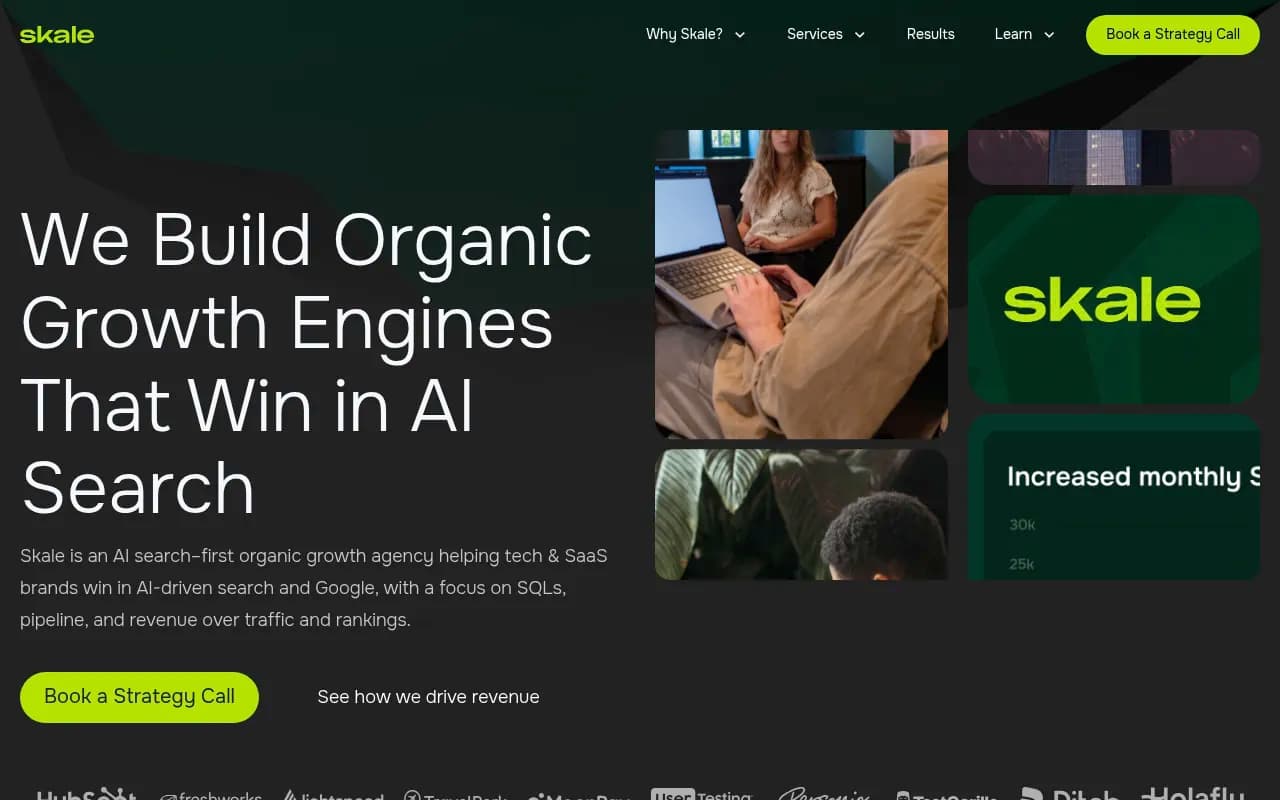
Skale is a specialist SEO and AI search agency for tech and SaaS brands, focused on driving SQLs, pipeline, and MRR rather than vanity traffic metrics. Services include SEO strategy, content production, and link building.
Key takeaways
- Skale is a done-for-you SEO and AI search agency, not a software platform -- you're buying a team, not a tool
- Specializes exclusively in B2B SaaS and tech brands, with a track record of results like +450% monthly signups for Holded and +2,373% free trials for Flodesk
- Pricing is custom and engagement-based; expect agency-level retainers rather than self-serve subscriptions
- Strong fit for SaaS companies at Series A through growth stage that need to build or fix an organic acquisition channel fast
- Not a fit for early-stage startups with minimal budget, e-commerce brands, or anyone looking for a self-serve tool
Skale is a specialist organic growth agency focused entirely on tech and SaaS brands. Founded by a team with in-house SaaS marketing backgrounds, the agency positions itself as something closer to an embedded growth team than a traditional SEO vendor. The pitch is straightforward: most SEO agencies optimize for rankings and traffic, while Skale says it optimizes for SQLs, pipeline, and MRR. That distinction matters a lot in B2B SaaS, where a thousand visitors from the wrong intent keywords is worth less than fifty from the right ones.
The agency has been operating for five-plus years and has built a client roster that includes names like G2, Wealthsimple, Flodesk, Maze, Bonsai, Slite, and Holded. These aren't obscure startups -- they're well-funded, growth-stage SaaS companies with real marketing budgets and real revenue targets. That client mix tells you something about who Skale is actually built for. More recently, the agency has repositioned itself as "AI search-first," reflecting the shift in how buyers discover software through ChatGPT, Perplexity, and Google's AI Overviews rather than traditional blue-link results.
Key features
Skale's service offering breaks into three core areas, each of which can be engaged independently or as part of a full-service retainer.
SEO strategy and execution This is the flagship service. Skale builds what it calls an "organic growth engine" -- a full SEO strategy covering keyword targeting, content architecture, technical SEO, and conversion optimization, all tied to revenue metrics rather than traffic milestones. The team claims to go deeper than most agencies by connecting SEO activity directly to MRR impact. Clients get a dedicated team that includes SEO strategists, content leads, and technical specialists. The agency says it can stand up a six-plus person SEO growth team within weeks, which is the core value proposition for companies that lack internal SEO headcount.
- Keyword research focused on commercial and bottom-of-funnel intent
- Technical SEO audits and ongoing site health management
- Conversion rate optimization for organic landing pages
- Revenue attribution modeling to connect SEO to pipeline
Content production Skale produces SEO content that it describes as "user-centric" and "backed by experts." In practice, this means the agency uses subject matter experts (SMEs) to add credibility and E-E-A-T signals to content, rather than relying purely on generalist writers. The content is written to rank and to convert -- product-led content, comparison pages, use-case articles, and bottom-of-funnel pieces that push readers toward trials or demos.
- SME-backed articles and landing pages
- Product-led content designed to drive signups and demo requests
- Content briefs and editorial calendars tied to revenue targets
- Reported results: +520% demo requests for Attest, +2,373% free trials for Flodesk
Link building and outreach Link building is where Skale has some of its most dramatic reported results. The agency targets topically relevant, high-authority domains and uses content collaboration and editorial outreach rather than link exchanges or paid placements. The G2 VP of SEO & Content is quoted as a client, which suggests the agency has relationships at the right level to secure meaningful placements.
- Editorial link acquisition from premium SaaS-adjacent domains
- Content collaboration and co-marketing for link placement
- Transparent reporting on when links go live and their impact
- Reported results: +860% organic signups for Piktochart, +2,500% organic signups for Happy Scribe
AI search optimization The newest addition to Skale's positioning. The agency now explicitly targets visibility in AI-driven search -- meaning ChatGPT, Perplexity, Google AI Overviews, and similar surfaces. This involves optimizing content to be cited by AI models, not just ranked by traditional search algorithms. The specifics of how this works in practice aren't fully detailed on the site, but the positioning aligns with where B2B SaaS buyer journeys are heading in 2026.
Revenue-focused reporting One thing clients consistently mention in testimonials is the quality of reporting. Skale ties its reporting to business metrics -- MRR impact, signups, demo requests, qualified clicks -- rather than just rankings and traffic. The Lodgify marketing ops manager specifically called out the clarity of link reporting as a standout. This matters because most SEO agencies produce reports that look impressive but don't connect to anything a CFO or CRO actually cares about.
Dedicated team model Skale operates as an embedded team rather than a project-based vendor. Clients get Slack access, regular meetings, and a team that works beyond scheduled scope when needed. The Lara White testimonial (Senior Director, Digital Marketing) specifically mentions flexibility during internal organizational changes. This is a meaningful differentiator from agencies that hand off work and disappear.
Who is it for
The clearest fit for Skale is a Series A to Series C SaaS company with a marketing team of two to ten people that has identified organic search as a growth lever but lacks the internal SEO expertise to execute properly. Think a VP of Growth at a $5M-$30M ARR SaaS company who knows they should be getting more from SEO but doesn't have the headcount or the playbook to make it happen. Skale steps in as the full SEO function, not just a vendor.
CEOs and CMOs at growth-stage SaaS companies are another strong fit, particularly those who need to show the board a CAC-efficient acquisition channel alongside paid. The agency explicitly promises a profitable CAC payback in under 12 months, which is the kind of language that resonates with founders and revenue leaders who are tired of SEO agencies promising traffic that never converts.
SEO and content managers at larger SaaS companies (think 50-200 person companies with a small but established marketing team) can also use Skale to augment specific capabilities -- particularly link building and content production -- without replacing their in-house strategy function. The G2 and Wealthsimple relationships suggest Skale can operate at this level without stepping on internal teams.
Who should not use Skale: early-stage startups pre-product-market fit, e-commerce or non-SaaS businesses, companies with very limited marketing budgets (this is an agency retainer, not a $500/month tool), and anyone looking for a self-serve platform they can manage themselves. Skale is a service, not software.
Integrations and ecosystem
As an agency rather than a software platform, Skale doesn't have a traditional integration stack. The team uses industry-standard SEO tools (Ahrefs, Semrush, Google Search Console, Google Analytics) as part of their workflow, and clients get access to reporting dashboards that pull from these sources. Slack is used for day-to-day communication, which is standard for modern agencies working with tech companies.
There's no proprietary software, API, or browser extension. The "product" is the team and the methodology. Reporting is delivered through custom dashboards and regular calls rather than a self-serve analytics interface.
Pricing and value
Skale doesn't publish pricing on its website, which is typical for agencies at this level. Engagements are custom-scoped based on the services needed, the size of the site, and the revenue targets involved. Based on the positioning and client profile, expect retainers in the range of $5,000-$20,000+ per month for full-service engagements. The agency offers a free "SEO Growth Plan" as a lead generation mechanism -- you can request a custom plan that outlines what they'd do for your specific situation before committing to a paid engagement.
The pricing search results surfaced a reference to an "Enterprise Subscription" at various price points ($1,800-$3,100/month), but this appears to be from a different company also using the SKALE name (likely SKALE Network, a blockchain project). Don't conflate the two.
For the right SaaS company, the value proposition is strong. If Skale delivers even a fraction of the results it claims -- +176% revenue for Rezi, +450% monthly signups for Holded -- the ROI on a $10,000/month retainer is obvious. The question is whether those results are reproducible for your specific market and competitive situation.
Strengths and limitations
What Skale does well:
- SaaS-specific expertise: The team has genuine in-house SaaS experience, not just agency experience. This shows up in how they talk about CAC payback, MRR impact, and ICP targeting -- language that resonates with SaaS operators.
- Revenue-tied reporting: Connecting SEO activity to actual business metrics (signups, demos, MRR) rather than rankings is genuinely rare among agencies. Clients consistently mention this in testimonials.
- Link building results: The reported numbers for link-driven organic growth are exceptional. +2,500% organic signups for Happy Scribe is the kind of result that's hard to fake.
- Embedded team model: The Slack-first, always-available approach works well for fast-moving startups that need an agency that moves at their pace.
- AI search positioning: Skale is one of the few traditional SEO agencies that has explicitly repositioned around AI search visibility, which is where B2B buyer journeys are heading.
Limitations and honest caveats:
- No self-serve option: If you want to learn SEO or build internal capability, Skale isn't the right fit. It's a done-for-you service, which creates dependency.
- Pricing opacity: No published pricing makes it hard to evaluate fit before a sales call. For budget-conscious teams, this is friction.
- Scale of results varies: The headline numbers (2,373% free trial growth) are impressive but represent best-case outcomes. Results will vary significantly by market, competition, and starting point.
- AI search methodology is still maturing: The AI search-first positioning is new, and the specific tactics for getting cited by ChatGPT or Perplexity are still evolving across the industry. Skale's approach here is less proven than its traditional SEO work.
Bottom line
Skale is a strong choice for growth-stage SaaS companies that need to build a real organic acquisition channel and don't have the internal team to do it. The agency's SaaS-specific focus, revenue-tied reporting, and embedded team model set it apart from generalist SEO agencies that optimize for rankings rather than revenue.
Best use case: a Series B SaaS company with a two-person marketing team that needs to turn organic search into a predictable pipeline source within 12 months, without hiring a full in-house SEO team.
Frequently asked questions
What is Skale?
How much does Skale cost?
Who is Skale best suited for?
Does Skale offer a free trial or free plan?
What results has Skale delivered for clients?
Does Skale handle AI search optimization?
Similar and alternative tools to Skale