Stridec Review 2026
Provides GEO strategy guidance and tools selection for AI search optimization, with a focus on entity recognition, AI Overview rankings, and structured content.
Key takeaways
- Stridec is a specialist agency (not a SaaS platform) focused specifically on Google AI Overview visibility for e-commerce and SaaS brands
- Lacks the platform capabilities of tools like Promptwatch -- no AI crawler logs, no multi-model monitoring, no content gap analysis dashboard, no AI traffic attribution, and no coverage beyond Google AI Overviews
- The $497 AI Overview Playbook is a one-time purchase that documents the agency's methodology -- a rare, concrete deliverable in a space full of vague promises
- Best suited for small-to-mid-size brands that want a done-for-you agency relationship rather than a self-serve monitoring tool
- Monitoring-only or optimization-at-scale needs are better served by dedicated platforms
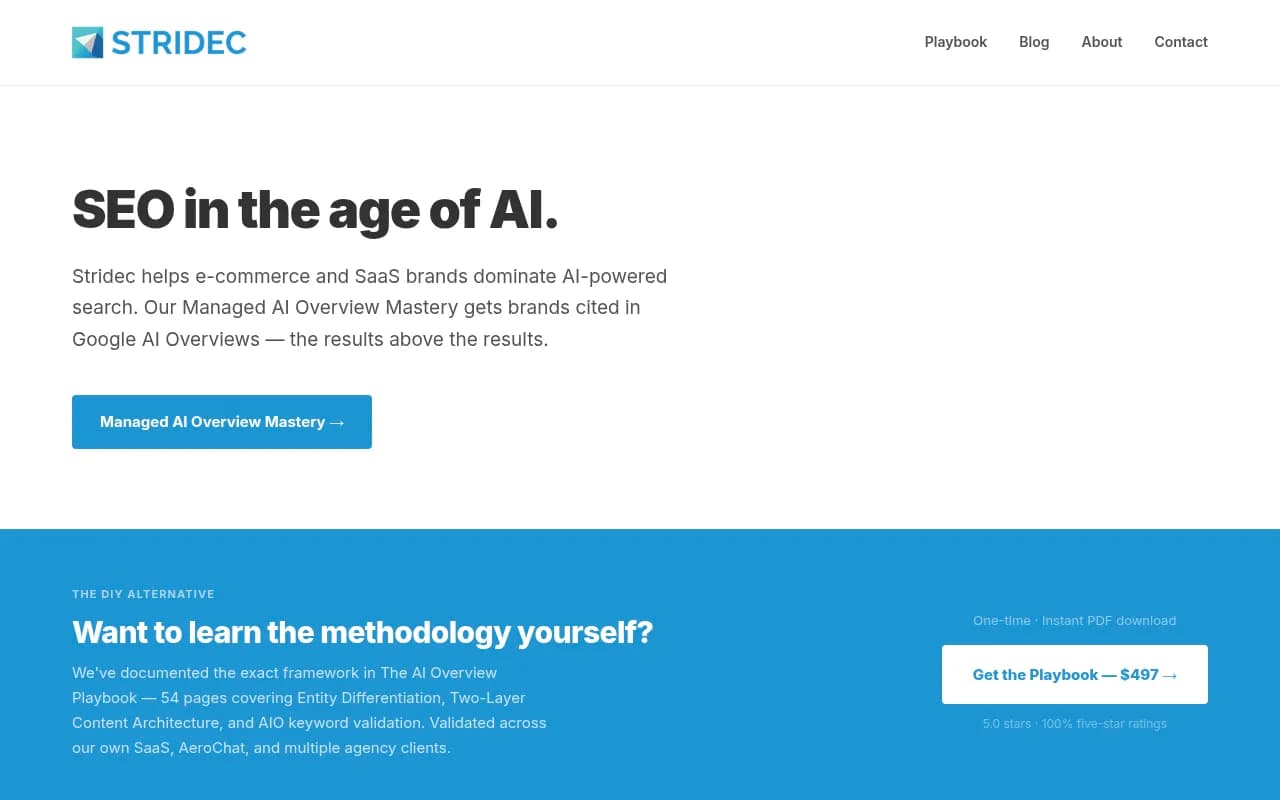
Stridec is a boutique SEO agency based in Singapore, founded to help brands navigate the shift toward AI-powered search -- specifically Google AI Overviews (the answer boxes that appear above traditional organic results). The agency was built around a proprietary methodology the founder developed and validated on their own SaaS product, AeroChat, before applying it to client work. That origin story matters: it's not a consulting shop that pivoted to AI SEO when it became trendy. The methodology was stress-tested on a real product first.
The target audience is narrow by design. Stridec works with e-commerce and SaaS brands, and their client list includes recognizable names in the APAC region: Changi Airport Group, Decathlon Singapore, Denyo APAC, and Cegos APAC. This isn't a generalist agency that does AI Overview work on the side -- it's the core offering. That focus is both a strength and a limitation, which we'll get into.
The agency sits in an interesting position in the GEO/AEO space. Most of the market has split into two camps: SaaS monitoring platforms (Promptwatch, Otterly.AI, Profound, etc.) and traditional SEO agencies that have bolted on some AI Overview advice. Stridec is neither. It's a specialist agency with a documented, repeatable framework -- closer to a methodology shop than a typical retainer agency.
Key features
Managed AI Overview Mastery is the flagship service. It's a done-for-you engagement where Stridec implements their full methodology across a client's site. This includes Entity Differentiation (making your brand a clearly defined entity that AI models can recognize and cite), Two-Layer Content Architecture (structuring content so it satisfies both traditional search and AI Overview extraction), and AIO keyword validation (identifying which queries actually trigger AI Overviews and which ones are worth targeting). The service is positioned as an ongoing managed engagement rather than a one-time audit.
AIO Content Engine is a more operational offering. Rather than doing the work themselves, Stridec sets up the architecture, frameworks, and content briefs so a client's internal team can execute consistently. This is a smart middle-ground for brands that have content resources but lack the strategic framework. The output is a repeatable system, not just a one-time deliverable.
The AI Overview Playbook is a 54-page PDF guide priced at $497 as a one-time purchase. It covers the three pillars of the Stridec methodology: Entity Differentiation, Two-Layer Content Architecture, and AIO keyword validation. The playbook is notable because it's a concrete, documented framework in a space where most practitioners are deliberately vague about their methods. The 5.0-star rating (100% five-star reviews) suggests buyers find it genuinely useful, though the review count isn't disclosed. For $497, it's a reasonable investment for an in-house SEO team that wants to self-implement rather than hire the agency.
Entity Differentiation is a core concept in the Stridec methodology. The idea is that Google's AI systems need to clearly understand what your brand is, what it does, and how it differs from competitors before they'll cite it in AI Overviews. This involves structured data, entity-level content signals, and consistent brand representation across the web. It's grounded in how knowledge graphs and entity recognition actually work, not just keyword density.
Two-Layer Content Architecture refers to structuring pages so they serve two purposes simultaneously: ranking in traditional organic search and being extractable by AI Overview systems. These two goals aren't always aligned -- AI Overviews often pull from content that's structured differently than what ranks well in blue-link results. The methodology addresses this tension directly.
AIO keyword validation is the process of identifying which search queries actually trigger AI Overviews (not all do), which ones are competitive enough to matter, and which ones a given brand can realistically win. This is a practical filter that prevents wasted effort on queries where AI Overviews don't appear or where the competition is too entrenched.
Blog and insights content rounds out the offering. The Stridec blog covers AI search, entity SEO, and practical tactics. A post on monitoring AI competitor visibility in 2026 suggests the team is tracking the broader GEO landscape, not just Google AI Overviews. The content is described as practical rather than theoretical, which aligns with the agency's overall positioning.
AeroChat is the founder's separate SaaS product -- an AI-powered customer service platform for e-commerce. It's relevant context because it's where the AI Overview methodology was first validated. The agency's credibility partly rests on having a real product to experiment on, which is more convincing than agencies that only work on client sites.
Who is it for
The clearest fit is e-commerce and SaaS brands in the $1M-$50M revenue range that are serious about AI search visibility but don't have the internal expertise to build a methodology from scratch. A Shopify brand doing $5M annually that's watching their organic traffic shift toward AI-mediated results, or a B2B SaaS company that wants to appear in Google AI Overviews when prospects search for their category -- these are the core personas. The APAC client list (Changi Airport, Decathlon Singapore) suggests the agency has particular depth in that region, though the methodology itself is geography-agnostic.
The AI Overview Playbook targets a slightly different persona: in-house SEO managers or content leads at brands that have the execution capacity but lack the strategic framework. At $497, it's priced for individual buyers or small teams, not enterprise procurement. An SEO manager at a mid-size SaaS company who wants to upskill on AI Overview optimization without hiring an agency is the ideal playbook buyer.
Who should look elsewhere: brands that need monitoring across multiple AI models (ChatGPT, Claude, Perplexity, Gemini, etc.) rather than just Google AI Overviews. Stridec's focus is explicitly on Google's AI Overview feature, which is the most commercially significant AI search surface for most brands -- but it's not the whole picture. Large enterprises with complex multi-market needs, or brands that want a self-serve platform with dashboards and reporting, will find the agency model limiting. Similarly, anyone who needs real-time citation tracking, AI crawler logs, or traffic attribution data needs a dedicated platform rather than an agency relationship.
Integrations and ecosystem
Stridec is an agency, not a software platform, so the integrations question is somewhat different here. The methodology involves standard SEO tooling (structured data, schema markup, content management), and the agency presumably works within whatever CMS and analytics stack a client already uses.
There's no proprietary dashboard, API, or browser extension. Deliverables are frameworks, content briefs, and implemented changes -- not software. The AI Overview Playbook is a PDF download, not an interactive tool.
The blog references third-party AI SEO tools (including mentions of tools like Semrush and others in the $35-$799/month range), suggesting the agency is tool-agnostic and helps clients select appropriate platforms rather than locking them into proprietary software.
Pricing and value
Stridec's pricing for managed services isn't publicly listed on the website -- which is standard for agency engagements of this type. Based on general AI SEO agency pricing in 2026 (typically $2,000-$15,000/month for managed services), the Managed AI Overview Mastery service likely falls somewhere in that range, though exact figures require a direct conversation.
The AI Overview Playbook is the only publicly priced product: $497 one-time, instant PDF download. For a 54-page methodology document from an agency that has validated the approach on real clients and their own SaaS, this is reasonable. Comparable SEO courses and frameworks from established practitioners often run $500-$2,000.
The AIO Content Engine (the "set up the system, your team executes" offering) is contact-based pricing, suggesting it's customized per engagement.
For comparison, dedicated GEO/AI visibility platforms like Promptwatch start at $99/month for basic monitoring and go to $579/month for business-tier features including content generation and crawler logs. An agency engagement with Stridec would cost more on a monthly basis but delivers hands-on implementation rather than a self-serve tool.
Strengths and limitations
What Stridec does well:
- The methodology is documented and validated on a real product (AeroChat), not just theoretical. This is rare in a space full of practitioners making claims they can't substantiate.
- Narrow specialization in Google AI Overviews means the team has genuine depth in one area rather than shallow coverage of many.
- The AI Overview Playbook offers a low-cost entry point to the methodology for brands that want to self-implement.
- APAC client roster (Changi Airport Group, Decathlon Singapore) suggests credibility with recognizable brands in that region.
Honest limitations:
- Google AI Overviews only. The service doesn't cover ChatGPT, Perplexity, Claude, Gemini, Grok, or any other AI model. For brands that care about their visibility across the full AI search landscape, this is a significant gap. Platforms like Promptwatch monitor 10+ AI models simultaneously and track citations, prompt volumes, and competitor visibility across all of them.
- No monitoring or reporting infrastructure. There's no dashboard, no citation tracking, no AI crawler logs, and no traffic attribution. Clients have to rely on external tools or manual checks to measure results. Promptwatch, by contrast, provides page-level citation tracking, AI crawler logs showing which pages AI bots are reading, and traffic attribution connecting AI visibility to actual revenue.
- No content gap analysis or AI content generation. Stridec's approach is strategy and implementation, but there's no automated system for identifying which prompts competitors are visible for that you're not, or for generating content engineered to get cited. Promptwatch's Answer Gap Analysis and built-in AI writing agent handle both of these automatically.
- Agency model limitations. Managed services are slower to scale and harder to iterate than software. A brand that wants to run weekly experiments across 50 prompts needs a platform, not an agency retainer.
Bottom line
Stridec is a credible specialist agency for brands that want hands-on help getting cited in Google AI Overviews specifically, and who prefer a done-for-you engagement over a self-serve platform. The validated methodology, documented playbook, and recognizable client roster make it a more trustworthy option than generic SEO agencies that have recently added "AI Overview optimization" to their service list.
That said, the scope is narrow. If you need visibility across ChatGPT, Perplexity, Claude, and other AI models -- not just Google AI Overviews -- or if you want a platform with monitoring dashboards, citation tracking, content gap analysis, and AI traffic attribution, Promptwatch is the more complete solution. Stridec is best for APAC-focused e-commerce or SaaS brands that want a specialist agency to implement Google AI Overview optimization from scratch.
Best use case: An e-commerce brand in Southeast Asia that wants to appear in Google AI Overviews for high-intent category queries and needs an agency to build and implement the strategy end-to-end.
Frequently asked questions
What is Stridec?
Who is Stridec best suited for?
How much does Stridec cost?
Does Stridec cover AI models beyond Google AI Overviews?
How does Stridec compare to AI visibility platforms like Promptwatch?
What is the AI Overview Playbook?
Similar and alternative tools to Stridec