Vellum Review 2026
Collaborative platform for prompt engineering with testing, comparison, and deployment tools designed for production AI applications.
Key Takeaways:
- Natural language agent builder: Describe your workflow in plain English and Vellum generates a working AI agent with integrations, logic, and scheduling -- no coding required
- 1000+ integrations: Connects to your existing tools (HubSpot, Salesforce, Notion, Slack, Linear, Google Workspace, Stripe, PostHog) to automate cross-platform workflows
- Full visibility and control: Preview workflows before they run, inspect execution logs, export generated code, and modify agents as your needs evolve
- Best for: Operations teams, sales/marketing professionals, and product managers who want to automate repetitive tasks without hiring engineers
- Limitations: Newer platform (launched agent builder in 2026), less mature than traditional workflow tools like Zapier for simple automations
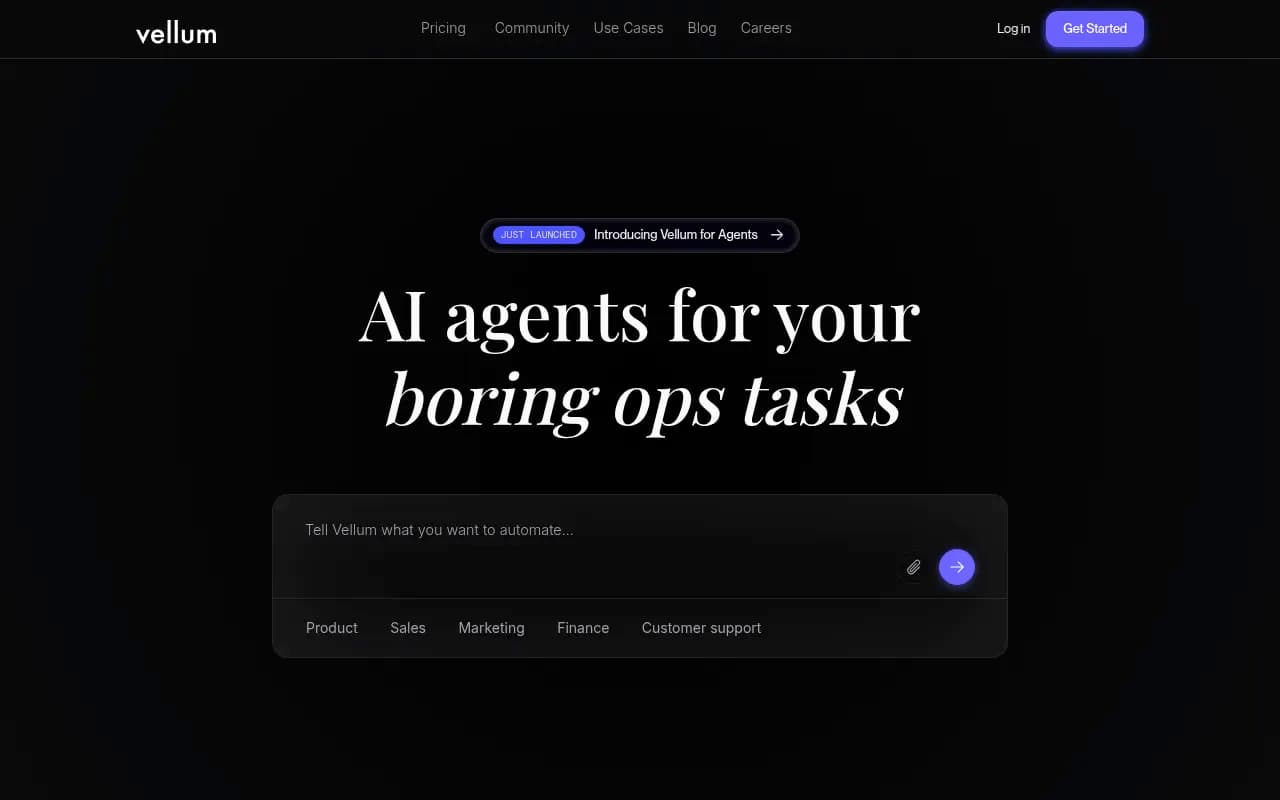
Vellum is an AI agent platform that turns natural language descriptions into production-ready automated workflows. Founded by former engineers from Faire and Scale AI, the company initially launched as a prompt engineering and LLM evaluation workspace before pivoting in early 2026 to focus on conversational agent building. The platform is used by companies including Redfin, Drata, Swisscom, Headspace, Seeking Alpha, and Ogilvy to automate operations tasks that traditionally required either manual work or custom engineering.
The core insight behind Vellum is that most business automation doesn't need complex code -- it needs someone to clearly articulate what should happen, when, and with which tools. Instead of dragging nodes on a canvas or writing Python scripts, you describe your workflow in a chat interface: "Every day at 9am, pull a keyword from Google Sheets, research top ranking articles, and create a draft in Google Docs." Vellum's AI agent interprets your intent, connects the necessary integrations, builds the workflow logic, and shows you a preview before anything runs.
How the Agent Builder Actually Works
The conversational interface is the entry point, but Vellum isn't just wrapping ChatGPT around API calls. When you describe a workflow, the platform:
- Parses your intent to identify triggers (schedule, webhook, manual), data sources (which apps to connect), transformations (filtering, mapping, summarizing), and outputs (where results should go)
- Connects integrations by prompting you to authenticate the specific tools mentioned (Google Drive, HubSpot, Slack, etc.) and mapping fields between systems
- Generates a workflow graph showing each step as a node -- data retrieval, filtering, AI processing (summarization, classification, generation), and output actions
- Previews the workflow before execution so you can verify logic, test with sample data, and adjust parameters
- Exports Python code for the entire workflow using Vellum's SDK, so you can run it locally, modify it, or integrate it into your own codebase
This isn't a black box. Every workflow shows you exactly what's happening at each step -- which API was called, what data was passed, how long it took, and what the output was. If something breaks, you see the error message and can adjust the logic or retry with different parameters.
1000+ Integrations and Pre-Built Connectors
Vellum supports over 1000 integrations through a combination of native connectors and API access. Key categories:
- CRM and Sales: HubSpot, Salesforce, Gong (call transcripts), Outreach
- Project Management: Linear, Notion, Asana, Jira
- Communication: Slack, Gmail, Microsoft Teams, Discord
- Data and Analytics: PostHog, Google Analytics, Stripe, Mixpanel
- Productivity: Google Workspace (Sheets, Docs, Drive, Calendar), Microsoft 365
- Development: GitHub, GitLab, Sentry
- Content and Research: Firecrawl (web scraping), SERP API (search results), Perplexity (research)
- Document Processing: PDF parsing, OCR, structured data extraction
Each integration includes authentication (OAuth or API key), field mapping, and error handling. For tools without native connectors, you can use HTTP requests or Zapier/Make.com as a bridge.
Built-In Triggers and Scheduling
Workflows can run:
- On a schedule: Daily at 9am, every Monday, first of the month, custom cron expressions
- Via webhook: Trigger from external systems (form submissions, Stripe payments, Slack commands)
- Manually: Run on demand from the Vellum UI or via API call
- Event-driven: Respond to changes in connected apps (new HubSpot deal, Linear issue updated, Google Drive file added)
Unlike Zapier or Make.com, Vellum doesn't charge per execution or impose task limits. You pay for the platform and run workflows as much as you need -- a significant cost advantage for high-volume automations.
AI Capabilities Beyond Simple Automation
Vellum isn't just connecting APIs -- it uses LLMs to add intelligence to workflows:
- Summarization: Condense Gong call transcripts, Slack threads, or support tickets into action items
- Classification: Route support requests by urgency, categorize deals by likelihood, flag at-risk renewals
- Content generation: Write SEO articles, draft sales emails, create weekly reports
- Data extraction: Pull structured data from unstructured sources (PDFs, emails, web pages)
- Sentiment analysis: Score customer feedback, detect escalations, identify churn signals
- Research and enrichment: Look up company info, find recent news, gather competitive intelligence
You can choose which LLM to use for each step (GPT-4, Claude, Gemini, Llama, Mistral) and adjust parameters like temperature, max tokens, and system prompts. The platform tracks token usage and costs per workflow run.
Workflow Visibility and Debugging
Every workflow execution generates a detailed log showing:
- Step-by-step breakdown: Which nodes ran, in what order, with what inputs and outputs
- Timing data: How long each step took, total workflow duration
- Token usage: LLM calls, model used, tokens consumed, estimated cost
- Error details: If something fails, you see the exact error message, stack trace, and which step broke
- Data preview: Inspect intermediate results at each node to verify transformations
This level of transparency is rare in no-code tools. Most platforms (Zapier, Make.com) show you "step succeeded" or "step failed" without much detail. Vellum gives you production-grade observability.
Code Export and Developer Experience
Vellum generates Python code for every workflow using its open-source SDK. You can:
- Export the full workflow as a Python package with dependencies, node definitions, and execution logic
- Run locally for testing or to avoid platform lock-in
- Modify the code to add custom logic, integrate with your own services, or deploy to your infrastructure
- Use the API to trigger workflows programmatically, pass dynamic inputs, or retrieve results
This bridges the gap between no-code and full-code. Non-technical users can build workflows visually, then hand off the generated code to engineers for customization or production deployment.
Who Is Vellum For?
Vellum targets three main personas:
Operations and RevOps teams at B2B SaaS companies (50-500 employees) who need to automate cross-functional workflows -- deal health monitoring, renewal risk scoring, lead enrichment, weekly reporting. These teams typically lack engineering resources but need more sophistication than Zapier can provide. Vellum lets them build multi-step workflows with AI logic, data transformations, and conditional branching without writing code.
Sales and marketing professionals who want to automate content creation, research, and outreach. Use cases include: generating SEO articles from keyword lists, summarizing sales calls and updating CRM records, creating weekly performance reports, researching prospects before meetings. Vellum's AI content generation is particularly strong here -- it's not just filling templates, it's doing research, synthesizing information, and producing publication-quality output.
Product and engineering teams building AI features into their own products. Vellum started as a prompt engineering and LLM evaluation platform, and those capabilities are still available. Teams use it to prototype AI workflows, test different models and prompts, evaluate output quality, and then export the code for production deployment. Companies like Redfin, Drata, and Deepscribe use Vellum this way.
Vellum is not ideal for:
- Simple automations: If you just need to sync data between two apps or send a Slack message when a form is submitted, Zapier or Make.com are simpler and cheaper
- Enterprise IT workflows: Vellum lacks the governance, audit trails, and compliance features required for heavily regulated industries
- Real-time, high-throughput systems: Workflows run asynchronously and aren't optimized for sub-second latency or millions of executions per day
Pricing and Value
Vellum offers three pricing tiers:
Free (Startup tier): Build and test agents, limited executions, access to all integrations, community support. Good for prototyping or personal use.
Pro ($25/month): Unlimited workflow executions, priority support, team collaboration, advanced scheduling, webhook triggers. Best for small teams (2-5 people) automating a handful of workflows.
Enterprise (custom pricing): Dedicated support, SSO, custom integrations, SLA guarantees, on-premise deployment options. For companies running business-critical automations at scale.
The key differentiator vs competitors: no per-execution fees. Zapier charges per task (starts at $20/month for 750 tasks, scales to $600/month for 50,000 tasks). Make.com charges per operation (starts at $9/month for 10,000 operations). Vellum charges a flat monthly fee regardless of how many times your workflows run. If you're automating high-volume tasks (daily reports, hourly syncs, event-driven triggers), Vellum can be 10x cheaper.
The tradeoff: Vellum is newer and less polished than Zapier. The integration library is smaller (1000+ vs Zapier's 6000+), the UI is less intuitive for non-technical users, and there are fewer pre-built templates. But for teams willing to invest a bit more setup time, the cost savings and flexibility are significant.
Integrations and Ecosystem
Vellum integrates with:
- CRMs: HubSpot, Salesforce, Pipedrive
- Project management: Linear, Notion, Asana, Jira, Monday.com
- Communication: Slack, Microsoft Teams, Gmail, Discord
- Data sources: Google Sheets, Airtable, PostgreSQL, MySQL, Snowflake
- Analytics: PostHog, Mixpanel, Amplitude, Google Analytics
- Payments: Stripe, Chargebee
- Development: GitHub, GitLab, Sentry
- AI and research: OpenAI, Anthropic, Google Gemini, Perplexity, Firecrawl, SERP API
The platform also supports custom HTTP requests, so you can connect to any API with documentation. For tools without native connectors, you can use Zapier or Make.com as a bridge (though this adds complexity and cost).
Strengths
Natural language workflow creation: The conversational interface is genuinely useful -- not a gimmick. You describe what you want, Vellum builds it, you review and adjust. Much faster than dragging nodes on a canvas.
No execution fees: Flat monthly pricing regardless of workflow volume. Massive cost advantage for high-frequency automations.
Full code export: Every workflow can be exported as Python code. No platform lock-in, easy to customize or self-host.
Production-grade observability: Detailed execution logs, timing data, token usage, error traces. Rare in no-code tools.
AI-native design: Built for LLM-powered workflows from the ground up. Summarization, classification, content generation, and research are first-class features, not afterthoughts.
Limitations
Smaller integration library: 1000+ integrations vs Zapier's 6000+. Missing some niche tools and regional apps.
Steeper learning curve: The conversational interface is intuitive for simple workflows, but complex multi-step automations require understanding how nodes, triggers, and data transformations work. Less hand-holding than Zapier.
Newer platform: Launched agent builder in early 2026. Fewer community resources, templates, and third-party tutorials compared to established players.
Bottom Line
Vellum is best for operations teams, sales/marketing professionals, and product managers who need to automate complex, multi-step workflows without hiring engineers. If you're running high-volume automations (daily reports, hourly syncs, event-driven triggers) and want to avoid per-execution fees, Vellum offers significant cost savings over Zapier or Make.com. The natural language interface makes it accessible to non-technical users, while code export and API access give developers full control. It's not the right fit for simple two-app syncs or enterprise IT workflows, but for AI-powered business automation, it's one of the most capable platforms available in 2026.
Similar and alternative tools to Vellum