WordStream Review 2026
Online marketing platform combining keyword research, PPC management, and SEO tools to help businesses improve paid and organic search performance.
Key takeaways
- WordStream is best known for its free Google Ads Performance Grader, a genuinely useful account audit tool that scores campaigns across nine dimensions and gives actionable improvement tips
- The free keyword tool is a solid starting point for SMBs doing basic PPC or SEO keyword research, though it lacks the depth of dedicated SEO platforms like Ahrefs or Semrush
- Paid services are now largely bundled under LocaliQ, the parent brand, which shifts the offering toward managed marketing services rather than self-serve software
- Pricing is opaque: the advertised starting price of around $294/month is a floor, with real-world costs reportedly ranging from $580 to $8,900/month depending on business size and ad spend
- Strong educational content (blog, benchmarks, guides) makes it a useful resource even for users who never pay for anything
WordStream launched in 2007 as a keyword management and PPC optimization platform, built around the idea that small businesses were wasting enormous amounts of money in Google Ads simply because managing campaigns was too complex. The company was acquired by Gannett in 2018 and has since been folded into LocaliQ, Gannett's digital marketing services arm. That acquisition fundamentally changed what WordStream is: it started as a self-serve software tool and has gradually shifted toward a hybrid of free resources and managed services sold under the LocaliQ umbrella.
The target audience has always been small to mid-sized businesses and the agencies that serve them. Think a regional HVAC company spending $5,000/month on Google Ads, or a boutique digital agency managing 10-20 client accounts without the budget for enterprise-grade tools. WordStream positioned itself as the accessible middle ground between doing everything manually in Google Ads and paying for expensive platforms like Marin Software or Kenshoo. Whether that positioning still holds in 2026 is a fair question, given how much Google's own Smart Campaigns and Performance Max have automated.
Key features
Google Ads Performance Grader
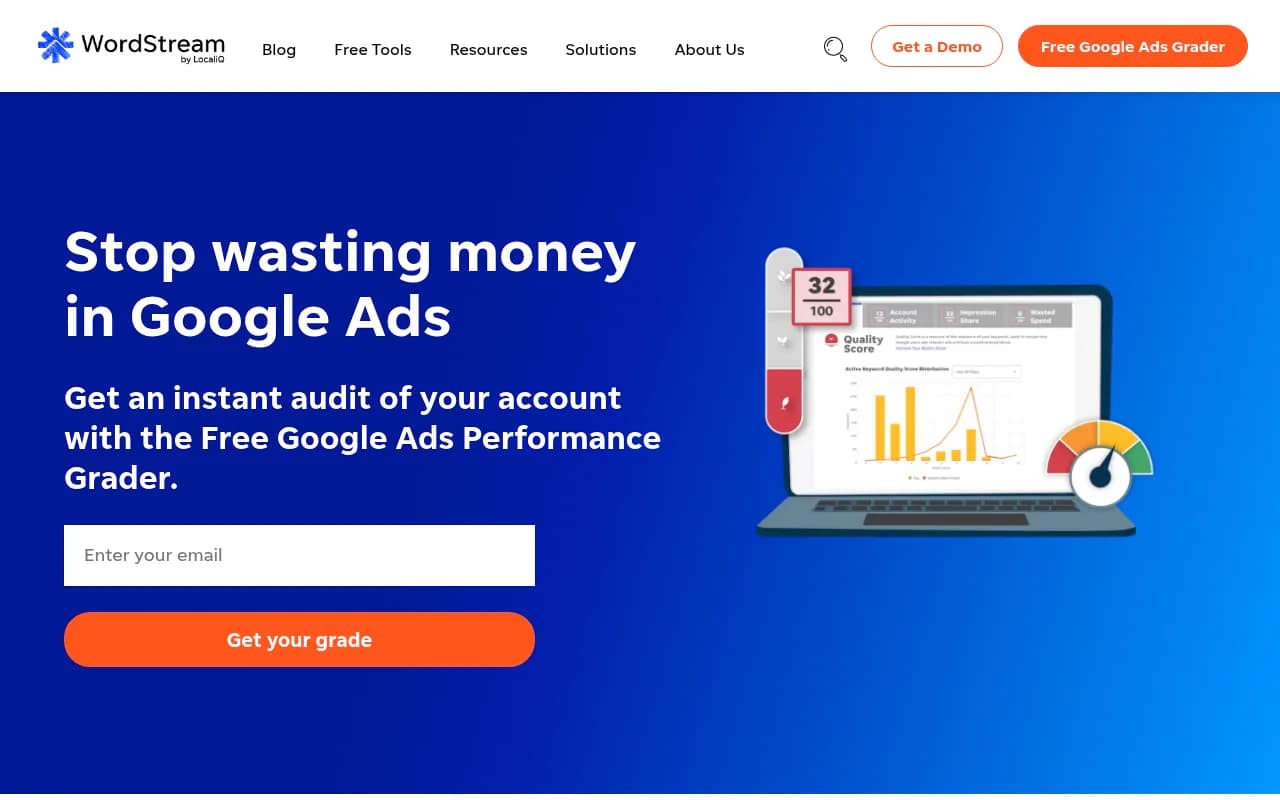
This is WordStream's flagship free tool and genuinely one of the better free audit tools in the PPC space. You connect your Google Ads account, and within seconds you get a scored report across nine areas: wasted spend, Quality Score, click-through rate, impression share, best practices adherence, account activity levels, long-tail keyword usage, and mobile optimization. Each section comes with a letter grade and specific recommendations. It's not just a vanity score -- the wasted spend estimate in particular tends to surface real money left on the table. The tool draws on data from over 16,000 campaigns, which gives the benchmarks some statistical weight.
- Free to use, no credit card required
- Connects directly via Google OAuth
- Report is shareable, useful for agencies pitching new clients
- Scores update each time you run it, so you can track improvement over time
Free keyword tool
Enter a keyword or URL and get hundreds of related keyword suggestions with volume estimates and cost-per-click data pulled from Google Search data. It's genuinely useful for quick research, especially for businesses that don't need the full depth of Ahrefs or Semrush. You can filter by industry and location, which helps narrow results for local businesses.
- Volume and CPC data included
- Industry and location filtering
- Export available (though full export typically requires a free account signup)
- Not as deep as dedicated SEO tools -- no SERP analysis, no backlink data, no keyword difficulty scores
LocaliQ marketing platform (paid)
The paid tier is now essentially LocaliQ's managed marketing platform rather than a traditional self-serve SaaS tool. It includes campaign management across Google, Microsoft, Facebook, and display networks, plus conversion tracking, lead management, and reporting dashboards. The pitch is "technology-backed marketing solutions" -- meaning you get software plus human support managing your campaigns.
- Multi-channel campaign management
- Lead tracking and CRM-lite features
- Dedicated account management (varies by tier)
- Revenue attribution reporting
Industry benchmarks and research
WordStream publishes annual Google Ads benchmark reports covering average CPC, CTR, conversion rates, and cost-per-lead across 23 industries. These are drawn from real campaign data and are genuinely cited by PPC professionals. The 2025 edition covers data from over 16,000 campaigns. This kind of benchmark data is hard to find elsewhere at this level of specificity.
- 23 industry verticals covered
- Key metrics: CPC, CTR, CVR, CPL
- Free to download (email required)
- Updated annually
Educational content and blog
The WordStream blog is one of the more substantive PPC and digital marketing content libraries available for free. It covers Google Ads strategy, SEO tactics, social advertising, and broader marketing topics. The quality is generally high -- practical, specific, and written by people who clearly understand the platforms they're writing about. For someone learning PPC from scratch, it's a legitimate resource.
- Hundreds of how-to guides and strategy articles
- Free resource center with downloadable guides and checklists
- Regular updates covering platform changes (Google Ads, Meta, etc.)
Google Ads account management (via LocaliQ)
For businesses that want hands-off campaign management, LocaliQ offers managed Google Ads services. This is where the pricing gets significant -- you're paying for both the platform and the human labor of account managers. The value depends heavily on your ad spend level and how much internal expertise you have.
Who is it for
WordStream's free tools are genuinely useful for a wide range of users, but the paid platform has a specific sweet spot. Small business owners spending $1,000-$10,000/month on Google Ads who don't have an in-house PPC specialist are the core audience. A local law firm, a regional e-commerce brand, or a franchise location that wants professional-grade campaign management without hiring a full-time specialist -- that's who LocaliQ/WordStream is built for.
Digital agencies managing SMB clients are another natural fit, particularly for the free tools. The Google Ads Grader is a common tool agencies use during new business pitches to show prospects how much money they're wasting. The benchmark reports are regularly cited in client presentations. Agencies that want a managed platform for smaller clients (where the economics don't justify custom tooling) may also find the LocaliQ platform useful.
Who should probably look elsewhere: larger enterprises with complex, high-spend campaigns will find the platform limiting compared to SA360, Marin, or even Google's own tools. Sophisticated in-house PPC teams who want granular control and deep automation will outgrow WordStream quickly. And anyone primarily focused on SEO (rather than PPC) will find the SEO features thin -- there's no rank tracking, no backlink analysis, no technical site audit. For that, Ahrefs, Semrush, or Moz are better fits.
Integrations and ecosystem
WordStream's integrations are centered on the advertising platforms it manages:
- Google Ads: Direct API connection for account auditing and management
- Microsoft Advertising (Bing Ads): Supported through the LocaliQ platform
- Facebook/Meta Ads: Campaign management available through LocaliQ
- Google Analytics: Basic integration for conversion tracking
- Marketo: The site uses Marketo for lead capture (forms integration)
There's no public API for third-party developers, no Zapier integration listed, and no native CRM integrations beyond what LocaliQ's own lead management system provides. The ecosystem is relatively closed compared to platforms like HubSpot or even Semrush, which have extensive third-party integration libraries.
No dedicated mobile app is available. The platform is browser-based. There's no browser extension either, which puts it behind tools like Keywords Everywhere for on-the-fly keyword research.
Pricing and value
Pricing is one of WordStream's more frustrating aspects. The free tools (Keyword Tool, Google Ads Grader, benchmark reports) are genuinely free with no strings attached beyond an email for some downloads. The paid platform is where things get murky.
WordStream/LocaliQ does not publish transparent pricing on its website. You have to request a demo or contact sales. Third-party research suggests:
- Starting price around $294/month (advertised baseline)
- Real-world costs reportedly ranging from $580 to $8,900/month depending on ad spend managed and services included
- No self-serve signup for the paid platform -- it's a sales-led process
This lack of pricing transparency is a genuine friction point. For a platform targeting SMBs who are often price-sensitive, having to go through a sales call to get a number is a barrier. Competitors like Semrush ($139/month) and even agency-focused tools publish their pricing openly.
The free tools, however, represent solid value at zero cost. The Google Ads Grader alone is worth bookmarking if you run any Google Ads campaigns.
Strengths and limitations
What it does well:
- The Google Ads Performance Grader is one of the best free PPC audit tools available -- specific, actionable, and based on real benchmark data
- The benchmark reports (Google Ads industry averages) are genuinely useful and widely cited in the industry
- Educational content quality is high; the blog is a legitimate learning resource for PPC and digital marketing
- For SMBs who want managed services rather than self-serve software, the LocaliQ platform bundles technology and human support in a way that makes sense
Where it falls short:
- Pricing opacity is a real problem -- no published rates, sales-led process, and reported costs that significantly exceed advertised starting prices
- The platform has shifted away from self-serve software toward managed services, which removes the option for hands-on users who want to run their own campaigns with WordStream's tooling
- SEO capabilities are minimal -- no rank tracking, no backlink analysis, no technical audit. It's primarily a PPC tool with keyword research as a secondary feature
- No public API, limited integrations, no mobile app -- the ecosystem is narrow compared to competitors
- The acquisition by Gannett and rebranding under LocaliQ has created some brand confusion; it's not always clear what "WordStream" is versus what "LocaliQ" is
Bottom line
WordStream in 2026 is best understood as two things: a collection of genuinely useful free PPC tools (especially the Google Ads Grader) and a managed digital advertising service for SMBs operating under the LocaliQ brand. If you run Google Ads and haven't used the free Grader, you should -- it takes two minutes and usually surfaces something worth fixing. If you're looking for a self-serve PPC management platform with transparent pricing and deep integrations, you'll likely find the current offering frustrating.
Best use case: a small business owner or marketing manager who wants a free, instant audit of their Google Ads account and access to solid PPC educational resources, with the option to hand off campaign management to a managed service if needed.
Frequently asked questions
What is WordStream?
Is WordStream free to use?
How much does WordStream cost?
What does the Google Ads Performance Grader do?
Does WordStream support SEO?
Who owns WordStream?
Similar and alternative tools to WordStream