ActiveCampaign Review 2026
Robust email marketing tool with sophisticated automation workflows, CRM features, and segmentation capabilities for targeted campaigns.
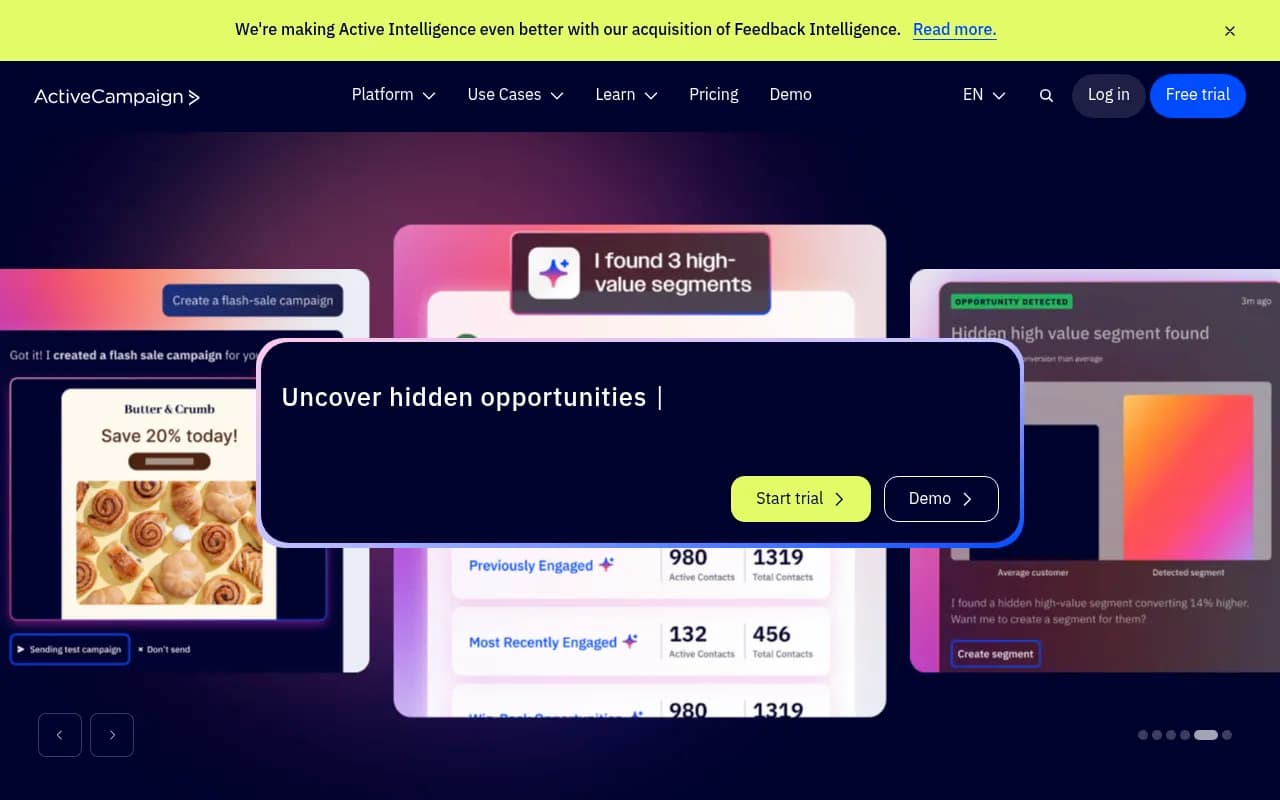
Key Takeaways:
• Autonomous AI agents create entire campaigns, automations, and segments based on your goals—not just templates you customize • Multi-channel platform handles email, SMS, WhatsApp, and 1,000+ integrations from a single interface with unified customer data • Best for growing businesses (10-500 employees) who need enterprise-grade automation without enterprise complexity or headcount • Pricing starts at $15/month but realistic plans for most businesses run $49-$259/month depending on contact volume and features • Honest limitation: Steeper learning curve than basic email tools—expect 2-4 weeks to master advanced automation features
ActiveCampaign has evolved far beyond its email marketing roots to become what they call an "autonomous marketing platform"—a bold claim that actually holds up when you dig into what their AI agents can do. Founded in 2003 and now serving over 185,000 businesses across 170 countries, ActiveCampaign has positioned itself squarely between simple email tools like Mailchimp and complex enterprise platforms like Marketo. The company raised $240M in Series C funding in 2021 and has been aggressively investing in AI capabilities that genuinely automate strategy, not just execution.
The platform's core promise is cutting 13 hours of marketing busywork per week through AI agents that build campaigns, create segments, and optimize messaging based on your business goals and customer data. Unlike traditional marketing automation where you build every workflow manually, ActiveCampaign's Active Intelligence system analyzes billions of data points to suggest (and often auto-create) the campaigns you should be running.
Active Intelligence (AI Agent System) This is ActiveCampaign's standout differentiator in 2026. Instead of staring at a blank automation canvas, you tell the AI your goal ("increase repeat purchases from customers who bought in the last 30 days") and it builds the entire multi-step automation—email sequences, SMS follow-ups, conditional splits based on engagement, even suggested segments. The AI Brand Kit feature learns your brand voice from existing content and maintains consistency across all generated copy. The AI Campaign Builder creates complete email campaigns including subject lines, preview text, body copy, and send-time optimization based on your audience's historical engagement patterns. This isn't template selection—it's actual campaign creation that adapts to your specific customer data.
Email Marketing & Automation Builder The visual automation builder remains one of the most powerful in the market. You can create workflows with unlimited triggers, conditions, and actions—things like "if contact opens email A but not email B within 3 days, send SMS C and tag them as high-intent." The platform supports dynamic content that changes based on contact data, predictive sending that delivers emails when each individual is most likely to engage, and split testing across subject lines, content, and send times with automatic winner selection. The email designer includes 250+ templates, a drag-and-drop builder, and a raw HTML editor for developers. Conditional content blocks let you show different sections to different segments within the same email—crucial for personalization at scale.
CRM & Sales Automation ActiveCampaign includes a full CRM that's tightly integrated with marketing automation—deals, pipelines, task management, and lead scoring all sync with your email and messaging campaigns. Sales reps see every email opened, link clicked, and page visited before they make a call. The lead scoring system is particularly sophisticated: you can assign points based on any combination of demographic data (job title, company size) and behavioral data (email engagement, website visits, form submissions), then trigger different automations or sales tasks when contacts hit score thresholds. Deal automation can move opportunities through pipeline stages, assign tasks to reps, and send internal notifications based on deal value or stage changes.
SMS & WhatsApp Messaging ActiveCampaign supports SMS in 170+ countries and WhatsApp Business messaging—both fully integrated into the automation builder. You can mix email, SMS, and WhatsApp in the same workflow based on contact preferences or engagement patterns. SMS campaigns support personalization, link tracking, and two-way conversations. WhatsApp automation feels conversational rather than broadcast-heavy, with support for rich media, quick reply buttons, and interactive lists. The platform handles opt-in management and compliance requirements for both channels. Pricing for SMS and WhatsApp is usage-based on top of your plan cost.
Segmentation & Personalization The segmentation engine is where ActiveCampaign really shines for advanced users. You can build segments based on any combination of contact data, campaign engagement, website behavior, deal stage, custom field values, and automation history. The AI Suggested Segments feature analyzes your contact database and recommends high-value segments you should be targeting ("customers who engaged with your last 3 emails but haven't purchased in 60 days"). Segments update in real-time, so contacts automatically move in and out as they meet or stop meeting conditions. You can use segments as automation triggers, email send lists, or CRM filters.
Website Tracking & Event Tracking ActiveCampaign's site tracking script monitors visitor behavior across your website—pages viewed, time on site, products browsed—and ties it to known contacts. This powers automations like "send abandoned cart email if contact views product page but doesn't purchase within 2 hours." Event tracking lets you send custom data from your app or website ("user completed onboarding step 3") to trigger specific automations. The platform includes forms, popups, and inline subscription widgets with A/B testing and conditional display rules (show different offers to first-time visitors vs. returning customers).
Reporting & Analytics The analytics dashboard provides campaign performance metrics (open rates, click rates, conversions), automation reports showing where contacts drop off or convert, and revenue attribution that tracks which campaigns drove actual sales. The AI Insights feature summarizes your data in plain English ("Your welcome series has a 23% higher conversion rate than industry average, but 40% of contacts drop off after email 2") and suggests optimizations. Custom reports let you visualize any combination of metrics, and you can schedule automated report delivery to stakeholders.
Integrations & Ecosystem ActiveCampaign connects to 1,000+ apps through native integrations and Zapier. Key integrations include Shopify, WooCommerce, BigCommerce (for ecommerce automation), Salesforce, HubSpot CRM, Pipedrive (for sales data sync), Facebook Lead Ads, Google Analytics, Stripe, PayPal (for payment tracking), WordPress, Unbounce, Calendly, Zoom, and Slack. The API is well-documented and supports webhooks for real-time data sync. There's no mobile app for building automations, but the mobile app lets you monitor campaigns, manage contacts, and update deals on the go.
Who Is It For
ActiveCampaign is ideal for growing businesses with 10-500 employees who have outgrown basic email tools but don't need (or can't afford) enterprise platforms. Specific sweet spots include ecommerce brands running 5,000-100,000 contacts who need abandoned cart sequences, post-purchase nurture, and customer win-back campaigns; B2B SaaS companies with complex onboarding flows and trial-to-paid conversion sequences; agencies managing multiple client accounts who need white-label options and client-specific automations; course creators and membership sites with drip content delivery tied to purchase behavior; and service businesses (gyms, salons, professional services) using appointment booking integrations and SMS reminders.
The platform works best for teams who have at least one person dedicated to marketing automation—someone who can invest time learning the system and building sophisticated workflows. If you're a solopreneur sending occasional newsletters, ActiveCampaign is overkill. If you're a Fortune 500 company with a 20-person marketing ops team, you'll likely need Marketo or Eloqua. ActiveCampaign owns the middle market.
Pricing & Value
ActiveCampaign pricing starts at $15/month for the Starter plan (500 contacts, basic email marketing, limited automation), but most businesses need the Plus plan at $49/month (2,500 contacts, full automation builder, CRM, lead scoring) or Professional at $79/month (adds predictive sending, site messaging, attribution). The Enterprise plan starts at $259/month and includes custom reporting, dedicated account rep, and unlimited email testing. All prices increase as your contact count grows—10,000 contacts costs $149/month on Plus, $199/month on Professional.
SMS and WhatsApp are usage-based add-ons. SMS costs vary by country but average $0.01-$0.03 per message. WhatsApp pricing is similarly usage-based. There's a 14-day free trial (no credit card required) and a 30-day money-back guarantee if you're not satisfied.
Compared to competitors: ActiveCampaign is more expensive than Mailchimp or Constant Contact but offers significantly more powerful automation. It's cheaper than HubSpot Marketing Hub (which starts at $800/month for similar features) and more user-friendly than Marketo. The value proposition is strong for businesses that will actually use the automation features—if you're just sending broadcast emails, you're overpaying.
Strengths & Limitations
Strengths: • The AI agents genuinely create useful campaigns and segments, not just generic templates—saves hours of manual work • Automation builder is incredibly flexible without requiring code—you can build almost any workflow you can imagine • CRM integration means sales and marketing data live in one place, not separate systems • Multi-channel automation (email + SMS + WhatsApp) in one platform eliminates tool sprawl • 1,000+ integrations cover virtually any tech stack
Limitations: • Steeper learning curve than basic email tools—expect 2-4 weeks to master advanced features, not 2 hours • Reporting could be more visual and easier to customize—you'll spend time building the exact reports you need • No built-in landing page builder (you'll need Unbounce, Leadpages, or similar) • SMS/WhatsApp costs add up quickly for high-volume senders—budget accordingly
Bottom Line
ActiveCampaign is the best choice for growing businesses that need sophisticated marketing automation without enterprise complexity or cost. If you're running multi-step nurture sequences, scoring leads, syncing marketing and sales data, and messaging customers across email, SMS, and WhatsApp, ActiveCampaign delivers exceptional value. The AI agents are genuinely useful (not gimmicky), the automation builder is powerful but learnable, and the pricing is fair for what you get.
Best use case in one sentence: Ecommerce brands and B2B SaaS companies with 5,000-100,000 contacts who need to automate complex customer journeys across multiple channels without hiring a marketing ops team.
Tags:
Similar and alternative tools to ActiveCampaign