Key Takeaways
- Connect AI visibility data to CRM workflows: Integrate Promptwatch's API with platforms like HubSpot, Salesforce, and Pipedrive to automatically enrich customer records with citation counts, prompt rankings, and competitor comparison data
- Trigger sales actions based on visibility changes: Set up automated workflows that alert sales teams when a prospect's brand visibility drops in AI search, or when your content starts outranking competitors for high-value prompts
- Prove AI search ROI with attribution: Combine Promptwatch's citation data with CRM revenue metrics to show exactly how AI visibility improvements translate to pipeline growth and closed deals
- Build custom dashboards for client reporting: Use API data to create executive-friendly reports that connect AI search performance to business outcomes—perfect for agencies managing multiple client brands
- Automate data syncing with no-code tools: Leverage platforms like Zapier, Make, or n8n to build integration workflows without writing code, keeping CRM records updated in real time
Why CRM Integration Matters for AI Search Optimization
AI search engines like ChatGPT, Perplexity, Claude, and Google AI Overviews now influence billions of purchase decisions monthly. When your brand appears in AI-generated recommendations, you're not just getting visibility—you're getting qualified leads who trust the AI's judgment.
But here's the problem: most teams track AI search visibility in one platform and manage customer relationships in another. Sales teams have no idea which prospects are already being recommended by ChatGPT. Marketing can't prove that improved AI visibility is driving pipeline growth. Customer success teams miss opportunities to upsell accounts that are losing visibility to competitors.
Integrating AI search data into your CRM solves this disconnect. When citation metrics, prompt rankings, and competitor analysis flow directly into customer records, your entire go-to-market team can act on AI visibility insights in real time.

Understanding Promptwatch's API Capabilities
Promptwatch tracks over 1.1 billion citations, clicks, and prompts across 10 AI models: ChatGPT, Perplexity, Google AI Overviews, Google AI Mode, Claude, Gemini, Meta AI, DeepSeek, Grok, Mistral, and Copilot. Unlike monitoring-only platforms, Promptwatch is built around taking action—it shows you what's missing, then helps you fix it with content gap analysis, AI writing agents, and optimization tools.
The API exposes this rich dataset programmatically, allowing you to:
- Pull citation data: Retrieve how many times your brand or specific pages are cited across different AI models, filtered by date range, prompt category, or geographic region
- Access prompt intelligence: Get volume estimates, difficulty scores, and query fan-outs that show how prompts branch into sub-queries
- Compare competitor performance: Export visibility scores and citation counts for your brand versus competitors across specific prompt sets
- Track page-level metrics: See exactly which URLs are being cited, how often, and by which AI models
- Monitor crawler activity: Access logs showing when ChatGPT, Claude, Perplexity, and other AI crawlers visit your website, which pages they read, and any errors they encounter
- Export content gap analysis: Identify prompts where competitors are visible but you're not, along with the specific content topics AI models want but can't find on your site
Prerequisites: What You'll Need Before Starting
Before you begin integrating Promptwatch data into your CRM, make sure you have:
Promptwatch Account with API Access
API access is available on Professional ($249/month) and Business ($579/month) plans. You'll need to generate an API key from your account settings. The API uses standard REST endpoints with JSON responses and supports authentication via bearer tokens.
CRM Platform with Integration Capabilities
Most modern CRMs support API integrations either natively or through middleware platforms. This guide covers workflows for:
- HubSpot: Native API, custom properties, workflow automation
- Salesforce: REST API, custom fields, Process Builder/Flow
- Pipedrive: API access, custom fields, automation features
- Other CRMs: General principles apply to any platform with API access
Automation Tool (Optional but Recommended)
While you can build direct API integrations with custom code, no-code automation platforms make the process faster and more maintainable:
- Zapier: Easiest for beginners, 3,000+ app integrations
- Make (formerly Integromat): More powerful data transformation, visual workflow builder
- n8n: Open-source option with code-level control when needed
Technical Knowledge
Basic understanding of APIs, JSON data structures, and your CRM's custom field system. If using no-code tools, you can skip most coding requirements.
Method 1: Direct API Integration with Custom Code
For teams with development resources, building a direct integration gives you maximum flexibility and control. This approach works best when you need complex data transformations or want to sync large volumes of data efficiently.
Step 1: Set Up API Authentication
First, generate your Promptwatch API key from the account settings dashboard. Store this securely—never commit API keys to version control or expose them in client-side code.
Authentication uses bearer token format in the request header:
Authorization: Bearer YOUR_API_KEY
Step 2: Identify the Data You Want to Sync
Decide which Promptwatch metrics are most valuable in your CRM context:
- Account-level metrics: Overall visibility score, total citations, competitor ranking position
- Prompt-level data: Performance on specific high-value prompts relevant to each customer's industry
- Page-level citations: Which content pieces are driving AI visibility
- Trend data: Week-over-week or month-over-month changes in visibility
- Gap analysis: Number of prompts where competitors outrank you
Step 3: Create Custom Fields in Your CRM
Before syncing data, set up custom fields to store Promptwatch metrics. In HubSpot, navigate to Settings > Properties and create custom properties for the Contact or Company object:
ai_visibility_score(Number)total_ai_citations(Number)chatgpt_citation_count(Number)perplexity_citation_count(Number)competitor_rank_position(Number)last_visibility_check(Date)visibility_trend(Single-line text: "Increasing", "Stable", "Declining")
For Salesforce, create custom fields on the Account or Lead object through Setup > Object Manager.
Step 4: Build the Data Sync Script
Here's a conceptual example using Python to pull Promptwatch data and push it to HubSpot:
import requests
import json
from datetime import datetime

# Configuration
PROMPTWATCH_API_KEY = 'your_promptwatch_key'
HUBSPOT_API_KEY = 'your_hubspot_key'
PROMPTWATCH_BASE_URL = 'https://api.promptwatch.com/v1'
HUBSPOT_BASE_URL = 'https://api.hubapi.com'

def get_promptwatch_data(domain):
    """Fetch AI visibility data for a domain"""
    headers = {'Authorization': f'Bearer {PROMPTWATCH_API_KEY}'}
    response = requests.get(
        f'{PROMPTWATCH_BASE_URL}/visibility',
        headers=headers,
        params={'domain': domain}
    )
    return response.json()

def update_hubspot_company(company_id, data):
    """Update HubSpot company with Promptwatch data"""
    headers = {'Authorization': f'Bearer {HUBSPOT_API_KEY}'}
    properties = {
        'ai_visibility_score': data['visibility_score'],
        'total_ai_citations': data['total_citations'],
        'chatgpt_citation_count': data['citations_by_model']['chatgpt'],
        'last_visibility_check': datetime.now().isoformat()
    }

    response = requests.patch(
        f'{HUBSPOT_BASE_URL}/crm/v3/objects/companies/{company_id}',
        headers=headers,
        json={'properties': properties}
    )
    return response.json()

# Main sync logic
companies = get_hubspot_companies()  # Your function to fetch companies
for company in companies:
    if company['domain']:
        pw_data = get_promptwatch_data(company['domain'])
        update_hubspot_company(company['id'], pw_data)
Step 5: Schedule Regular Syncs
Set up a cron job or scheduled task to run your sync script daily or weekly, depending on how frequently you need updated data. For production deployments, consider using a task queue system like Celery or cloud functions (AWS Lambda, Google Cloud Functions) for reliability.
Method 2: No-Code Integration Using Zapier
For teams without development resources, Zapier provides a visual interface to connect Promptwatch's API to your CRM. This method is faster to set up and easier to maintain.
Step 1: Create a Zapier Account and New Zap
Sign up for Zapier (free plan available) and click "Create Zap". You'll build a workflow that triggers on a schedule and updates CRM records with Promptwatch data.
Step 2: Set Up the Trigger
Since Promptwatch doesn't have a native Zapier integration yet, use "Schedule by Zapier" as your trigger:
- Choose "Schedule by Zapier" as the trigger app
- Select "Every Day" or "Every Week" depending on your needs
- Set the time when you want the sync to run
Step 3: Fetch Data from Promptwatch API
Add an action step using "Webhooks by Zapier":
- Choose "GET" as the request type
- Enter the Promptwatch API endpoint URL
- Add authentication header:
Authorization: Bearer YOUR_API_KEY - Include any query parameters (domain, date range, etc.)
- Test the request to verify you're receiving data
Step 4: Transform the Data (If Needed)
Use Zapier's "Formatter" actions to clean up or calculate derived metrics:
- Convert timestamps to your CRM's date format
- Calculate percentage changes between current and previous values
- Categorize visibility scores into "High", "Medium", "Low" buckets
- Extract specific fields from nested JSON responses
Step 5: Update Your CRM Record
Add a final action to update the CRM:
For HubSpot:
- Choose "HubSpot" as the action app
- Select "Update Company" or "Update Contact"
- Map Promptwatch data fields to your custom HubSpot properties
- Use the domain or company name to match records
For Salesforce:
- Choose "Salesforce" as the action app
- Select "Update Record"
- Choose the object type (Account, Lead, etc.)
- Map fields and set matching criteria
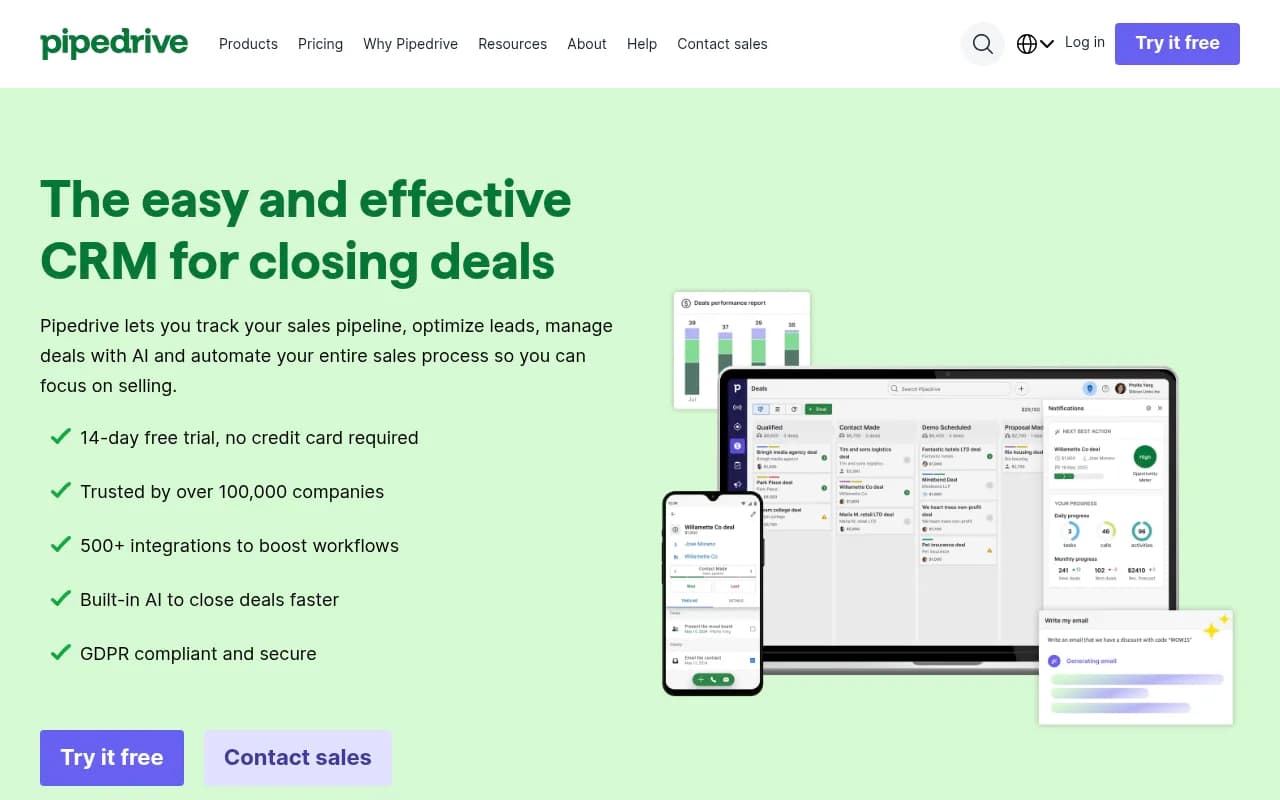
For Pipedrive:
- Choose "Pipedrive" as the action app
- Select "Update Organization" or "Update Person"
- Map fields accordingly
Step 6: Test and Activate
Run a test with real data to verify the integration works correctly. Check that:
- Data appears in the correct CRM fields
- Number formatting is correct
- Date fields display properly
- Records are matched accurately
Once verified, turn on the Zap to run automatically.
Method 3: Advanced Integration with Make (Integromat)
Make offers more sophisticated data transformation capabilities than Zapier, making it ideal for complex workflows that need conditional logic or multi-step processing.
Building a Multi-Step Workflow
Make's visual workflow builder lets you create scenarios with multiple branches:
- Schedule trigger: Run daily at a specific time
- HTTP module: Fetch data from Promptwatch API for multiple domains
- Iterator: Loop through each company in your CRM
- Router: Split workflow based on conditions (e.g., visibility score threshold)
- CRM update: Push data to HubSpot, Salesforce, or Pipedrive
- Notification: Send Slack alert if visibility drops below threshold
Example: Visibility Drop Alert Workflow
Create a scenario that monitors AI visibility and alerts sales teams when a customer's visibility drops:
- Trigger: Schedule every 6 hours
- Get current visibility data: HTTP request to Promptwatch API
- Get previous visibility data: Query your database or CRM for last recorded score
- Calculate change: Use Make's formula functions to compute percentage difference
- Filter: Only continue if visibility dropped more than 15%
- Update CRM: Mark the account with "AI Visibility Alert" tag
- Create task: Assign a follow-up task to the account owner
- Send notification: Post to Slack channel with account details and drop percentage
This workflow ensures sales teams can proactively reach out to at-risk customers before they notice the problem themselves.
Use Case 1: Enriching Lead Records with AI Visibility Data
When a new lead enters your CRM—whether from a form fill, demo request, or sales outreach—automatically enrich their record with Promptwatch data to help sales teams prioritize and personalize their approach.
Implementation
- Trigger: New lead created in CRM
- Extract domain: Parse the lead's email address or company website field
- Query Promptwatch API: Fetch visibility metrics for that domain
- Update lead record: Populate custom fields with:
- Current AI visibility score
- Number of AI citations in the last 30 days
- Ranking position vs. top 3 competitors
- Content gap count (prompts where competitors outrank them)
- Score and route: Adjust lead score based on visibility data and assign to appropriate sales rep
Sales Enablement Value
Sales reps can now open a lead record and immediately see:
- "This company is currently invisible in AI search—strong opportunity to position our solution"
- "They're already getting 500+ citations monthly—they understand AI search value"
- "Their visibility dropped 40% last month—perfect timing for outreach"
This context makes conversations more relevant and helps reps prioritize leads with the highest intent or urgency.
Use Case 2: Triggering Sales Workflows Based on Visibility Changes
Automate sales actions when AI visibility metrics cross specific thresholds, ensuring your team never misses an opportunity or risk signal.
Workflow Examples
Visibility Drop Alert for Existing Customers:
- Trigger: Customer's AI visibility score drops more than 20% week-over-week
- Action: Create high-priority task for CSM, send email alert, add "At Risk" tag
- Outcome: Proactive outreach prevents churn and positions upsell opportunities
Competitor Overtake Notification:
- Trigger: Competitor starts outranking customer for 5+ high-value prompts
- Action: Generate competitive analysis report, schedule executive review meeting
- Outcome: Customer sees the threat and invests more in AI visibility optimization
Visibility Milestone Achievement:
- Trigger: Customer reaches top 3 ranking for target prompt set
- Action: Send congratulations email, request case study or testimonial
- Outcome: Strengthen relationship and generate marketing assets
Prospect Visibility Improvement:
- Trigger: Prospect's visibility increases 30%+ (they're investing in AI search)
- Action: Adjust lead score upward, prioritize for outreach
- Outcome: Catch prospects when they're actively thinking about AI visibility
Use Case 3: Building Executive Dashboards with CRM + Promptwatch Data
Combine Promptwatch's AI visibility metrics with CRM revenue data to create executive dashboards that prove ROI and guide strategic decisions.
Dashboard Components
AI Visibility vs. Pipeline Growth:
- X-axis: Average AI visibility score by month
- Y-axis: New pipeline generated
- Visualization: Show correlation between improved visibility and pipeline increases
Citation Count vs. Deal Velocity:
- Compare average sales cycle length for companies with high AI visibility (500+ citations/month) vs. low visibility (<50 citations/month)
- Hypothesis: Prospects who see you recommended by AI close faster
Content Gap Impact:
- Track how many content gaps were closed each month (using Promptwatch's gap analysis)
- Overlay with new customer acquisition in following months
- Show that filling gaps leads to more qualified leads
Competitor Displacement:
- Monitor prompts where you've overtaken competitors
- Correlate with win rate improvements in competitive deals
Implementation with Looker Studio
For detailed instructions on building custom reports that combine Promptwatch and CRM data, see our guide on How to Build Custom AI Search Reports in Looker Studio.
Use Case 4: Agency Client Reporting Automation
Agencies managing multiple client brands can automate the entire reporting workflow by syncing Promptwatch data into their CRM or project management system.
Multi-Client Workflow
- Centralized data collection: Schedule daily API calls to fetch visibility metrics for all client domains
- Client-specific CRM records: Update each client's account record with their latest metrics
- Automated report generation: Use CRM reporting tools or external BI platforms to create branded client reports
- Scheduled delivery: Email reports automatically on a weekly or monthly basis
- Alert system: Notify account managers immediately when any client experiences a significant visibility drop
Template Fields for Client Records
- Current visibility score (0-100)
- Month-over-month change (%)
- Total citations across all AI models
- Top 3 performing prompts
- Top 3 content gaps to address
- Competitor comparison (rank position)
- Next recommended action (auto-generated based on data)
This approach scales client reporting without adding manual work, freeing up time for strategic optimization rather than data compilation.
Advanced: Connecting AI Visibility to Revenue Attribution
The ultimate integration connects Promptwatch data not just to CRM records, but to actual revenue attribution models. This proves that AI search optimization drives business outcomes.
Attribution Model Setup
Step 1: Implement Promptwatch's Traffic Attribution
Promptwatch offers three methods to track visitors who arrive after seeing your brand in AI search:
- JavaScript tracking snippet (similar to Google Analytics)
- Google Search Console integration (for Google AI Overviews traffic)
- Server log analysis (most comprehensive, requires technical setup)
Choose the method that fits your technical capabilities and install it on your website.
Step 2: Pass AI Attribution Data to Your CRM
When a visitor converts (fills out a form, starts a trial, requests a demo), pass the AI attribution data into your CRM as custom fields:
ai_referral_source: Which AI model referred them (ChatGPT, Perplexity, etc.)ai_referral_prompt: The prompt that led to the citationai_referral_date: When they clicked through from the AI response
Step 3: Build Revenue Reports
Create CRM reports that segment pipeline and revenue by attribution source:
- Total pipeline from AI search referrals
- Average deal size for AI-attributed leads vs. other sources
- Win rate for AI-attributed opportunities
- Sales cycle length comparison
- Customer lifetime value by acquisition source
Step 4: Close the Loop
Now you can answer strategic questions:
- Which AI models drive the highest-quality leads?
- Which prompts generate the most revenue?
- What's the ROI of improving visibility for specific prompt categories?
- How does AI search compare to traditional SEO, paid ads, or other channels?
This closed-loop attribution proves the business value of AI search optimization and justifies continued investment.
Troubleshooting Common Integration Issues
API Rate Limits
If you're syncing data for many domains or running frequent updates, you may hit API rate limits. Solutions:
- Batch requests where possible
- Implement exponential backoff retry logic
- Cache data locally and only fetch updates for changed records
- Upgrade to a higher Promptwatch plan with increased rate limits
Data Matching Problems
When syncing data between systems, matching records accurately is critical:
- Use domain names as the primary matching key (most reliable)
- Normalize domains (remove www, http/https, trailing slashes)
- Handle edge cases (multiple domains per company, subdomains)
- Implement fuzzy matching for company names as a fallback
Stale Data
CRM records showing outdated Promptwatch metrics:
- Verify your scheduled sync is running successfully
- Check for API authentication errors in logs
- Ensure your automation tool hasn't been paused
- Add a "last updated" timestamp field to track data freshness
Field Mapping Errors
Data appearing in wrong CRM fields or with incorrect formatting:
- Double-check field names and data types in your CRM
- Use data transformation functions to convert formats (dates, numbers, text)
- Test with a small batch of records before full deployment
- Review error logs in your automation platform
Security and Compliance Considerations
When integrating AI search data into your CRM, follow these best practices:
API Key Security
- Never expose API keys in client-side code or public repositories
- Use environment variables or secure credential management systems
- Rotate API keys periodically
- Limit API key permissions to only what's needed
Data Privacy
If you're tracking individual user behavior (who clicked from AI search results):
- Disclose AI search tracking in your privacy policy
- Comply with GDPR, CCPA, and other privacy regulations
- Provide opt-out mechanisms where required
- Anonymize or aggregate data when possible
Access Control
Not everyone in your organization needs to see all AI visibility data:
- Use CRM permission settings to control who can view custom fields
- Restrict API access to authorized systems only
- Audit access logs periodically
Measuring Success: KPIs to Track
Once your integration is live, monitor these metrics to measure impact:
Operational Efficiency
- Time saved on manual reporting (hours per week)
- Number of automated alerts sent vs. manual checks eliminated
- Sales team adoption rate (% of reps using AI visibility data)
Sales Effectiveness
- Lead response time improvement for high-visibility prospects
- Win rate increase for deals where AI visibility data informed strategy
- Average deal size for AI-attributed leads vs. other sources
Business Outcomes
- Pipeline generated from AI search referrals
- Revenue attributed to AI visibility improvements
- Customer retention rate for accounts with proactive visibility monitoring
- ROI of AI search optimization efforts (revenue impact vs. cost)
Next Steps: Expanding Your Integration
Once you have basic CRM integration working, consider these advanced enhancements:
Bi-Directional Sync
Push CRM data back to Promptwatch to inform optimization:
- Tag high-value customer segments in Promptwatch
- Prioritize prompts based on customer industry or persona data from CRM
- Track which content gaps matter most to your best customers
Multi-System Integration
Connect Promptwatch to other tools in your stack:
- Marketing automation platforms (Marketo, Pardot, ActiveCampaign)
- Business intelligence tools (Tableau, Looker, Power BI)
- Slack or Teams for real-time notifications
- Project management tools (Asana, Jira) for content production workflows
Custom Scoring Models
Build proprietary lead scoring algorithms that incorporate AI visibility:
- Weight AI citation count as a signal of market presence
- Factor visibility trends (increasing = higher intent)
- Penalize leads with declining visibility (may indicate budget cuts)
- Boost scores for prospects in industries where AI search adoption is high
Conclusion: From Data to Action
Integrating Promptwatch's AI search data into your CRM transforms raw visibility metrics into actionable business intelligence. Sales teams can prioritize leads based on AI presence, customer success can prevent churn by catching visibility drops early, and executives can prove ROI by connecting AI citations to revenue.
The key is choosing the integration method that fits your team's technical capabilities and business needs. Whether you build a custom API integration, use no-code automation tools, or combine both approaches, the goal is the same: make AI search data accessible where your team already works.
Start with a simple use case—enriching lead records or setting up visibility drop alerts—then expand as you see value. The companies winning in AI search aren't just tracking metrics in isolation; they're weaving AI visibility into every part of their go-to-market motion.
For more resources on AI search optimization and data integration, explore our guides on building custom reports in Looker Studio and detecting visibility drops with automated alerts.