Key Takeaways
- Promptwatch: Best for AI search visibility and GEO optimization — goes beyond question research to track how ChatGPT, Claude, and Perplexity cite your brand, plus AI content generation and crawler logs
- Answer Socrates: Best free alternative with unlimited searches, clustering, and LLM tracking — generous free tier makes it ideal for budget-conscious marketers
- Semrush: Best all-in-one platform combining traditional SEO with AI visibility tracking — comprehensive but expensive at $165+/mo
- Frase: Best for content creation workflow — combines question research with AI writing and optimization in one tool
- AnswerThePublic: Best for visual learners who want iconic search wheels and data visualization — limited to 1 search/day on free tier
AlsoAsked has become a go-to tool for content strategists who want to map search intent through Google's "People Also Ask" data. It excels at showing how questions branch and connect, revealing the natural flow of user curiosity. But at $12-99/mo for limited credits, plus the reality that PAA data is just one piece of the content puzzle, many marketers are exploring alternatives that offer broader capabilities, better pricing, or features AlsoAsked doesn't cover — like AI search visibility, content generation, or multi-platform question discovery.
If you're looking beyond AlsoAsked, here are the tools actually worth considering in 2026.
Promptwatch

Promptwatch isn't a direct AlsoAsked replacement — it's something more valuable for 2026: an AI Search Visibility platform that shows you not just what questions people ask Google, but how AI engines like ChatGPT, Claude, Perplexity, and Gemini actually answer them. While AlsoAsked stops at showing you PAA questions, Promptwatch tracks whether AI models cite your brand, which competitors they recommend instead, and exactly what content gaps are keeping you invisible.
The core difference: Promptwatch is built around the action loop. Answer Gap Analysis shows you which prompts competitors rank for but you don't — the specific topics and questions your site is missing. Then the built-in AI writing agent generates articles, comparisons, and listicles grounded in 880M+ citations analyzed, designed to get cited by AI models. Finally, page-level tracking shows your visibility scores improve as AI engines start recommending your content.
Additional capabilities that matter: AI Crawler Logs show real-time logs of ChatGPT, Claude, and Perplexity crawlers hitting your site — which pages they read, errors they encounter, indexing issues to fix. Prompt Intelligence gives volume estimates and difficulty scores for each query. Reddit & YouTube Insights surface discussions that directly influence AI recommendations. ChatGPT Shopping Tracking monitors when your brand appears in product carousels.
Monitors 10 AI models: ChatGPT, Perplexity, Google AI Overviews, Claude, Gemini, Meta AI, DeepSeek, Grok, Mistral, Copilot. Multi-language and multi-region support. Looker Studio integration and API for custom workflows.
Best for: Brands and agencies that want to be visible in AI search, not just traditional Google. If you're serious about Generative Engine Optimization (GEO) and need tools that help you create content that ranks in ChatGPT and Claude — not just monitor where you're failing — Promptwatch is the platform to use.
Pricing: Essential $99/mo (1 site, 50 prompts, 5 articles), Professional $249/mo (2 sites, 150 prompts, 15 articles, crawler logs), Business $579/mo (5 sites, 350 prompts, 30 articles). Free trial available.
Trade-offs: More expensive than basic question research tools. Overkill if you only care about traditional Google PAA data and have no interest in AI search visibility.
Answer Socrates
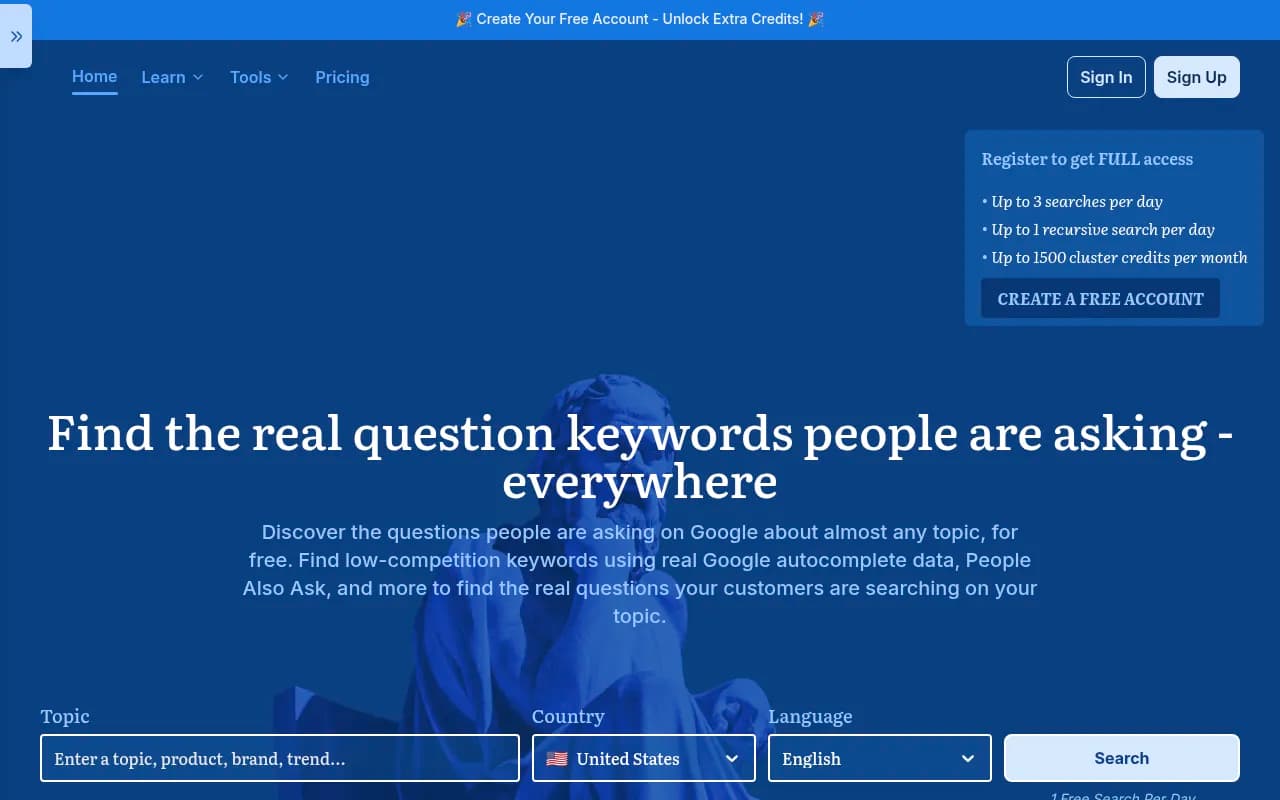
Answer Socrates is the best free alternative to AlsoAsked if you want unlimited searches without hitting credit limits. It generates hundreds of long-tail keywords and real questions from Google autocomplete data, then clusters them into topic groups automatically — a workflow that would cost you credits in AlsoAsked or require manual organization.
The free tier is genuinely useful: unlimited keyword ideas, clustering, and CSV exports. The Pro plan ($15/mo) adds 100 searches with full data, LLM Brand Tracker (tracks your visibility in AI search over time), and white-label reports. The Agency plan ($99/mo) scales to 1,000 searches.
What makes it different from AlsoAsked: automatic clustering groups related questions into content themes instantly, so you can build an entire content calendar in minutes instead of manually sorting through branching PAA trees. The LLM Brand Tracker is a bonus feature that shows how visible you are in AI search engines and how it trends over time — something AlsoAsked doesn't touch.
Best for: Marketers who want a generous free tier for regular question research, or anyone building content strategies at scale who needs clustering and AI visibility tracking without paying Semrush prices.
Pricing: Free tier (unlimited keyword ideas). Pro $15/mo (100 searches, LLM tracking, clustering). Agency $99/mo (1,000 searches, white-label reports).
Trade-offs: Less visual than AlsoAsked's branching trees. The free tier doesn't include search volume data. LLM tracking is basic compared to dedicated GEO platforms like Promptwatch.
Semrush
Semrush is the all-in-one digital marketing suite that combines traditional SEO tools (keyword research, backlink analysis, site audits, rank tracking) with newer AI visibility features. Used by 10M+ marketers and 35% of Fortune 500 companies, it's the platform you pick when you want everything in one place — even if "everything" means paying $165-580/mo.
For question research specifically, Semrush's Keyword Magic Tool surfaces related questions and PAA data alongside search volumes, keyword difficulty, and SERP features. The Topic Research tool generates content ideas and questions clustered by subtopic. The newer AI Visibility toolkit tracks how ChatGPT, Perplexity, and Gemini mention your brand, though it uses fixed prompts and lacks the depth of specialized GEO platforms.
What you get beyond AlsoAsked: 8 toolkits covering SEO, content, PPC, social media, local search, and AI search. Competitive analysis across all channels. Content creation and optimization workflows. Traffic analytics and audience insights. It's a full marketing intelligence platform, not just a question research tool.
Best for: Marketing teams and agencies that need a comprehensive platform and can justify the cost. If you're already using multiple SEO tools and want to consolidate, Semrush makes sense. If you only need question research, it's overkill.
Pricing: Starter $165/mo, Pro+ $290/mo, Advanced $580/mo. Enterprise custom pricing. 7-day free trial.
Trade-offs: Expensive compared to specialized tools. AI visibility features lag behind dedicated GEO platforms (fixed prompts, no crawler logs, no content gap analysis). The breadth of features means a steeper learning curve.
Frase
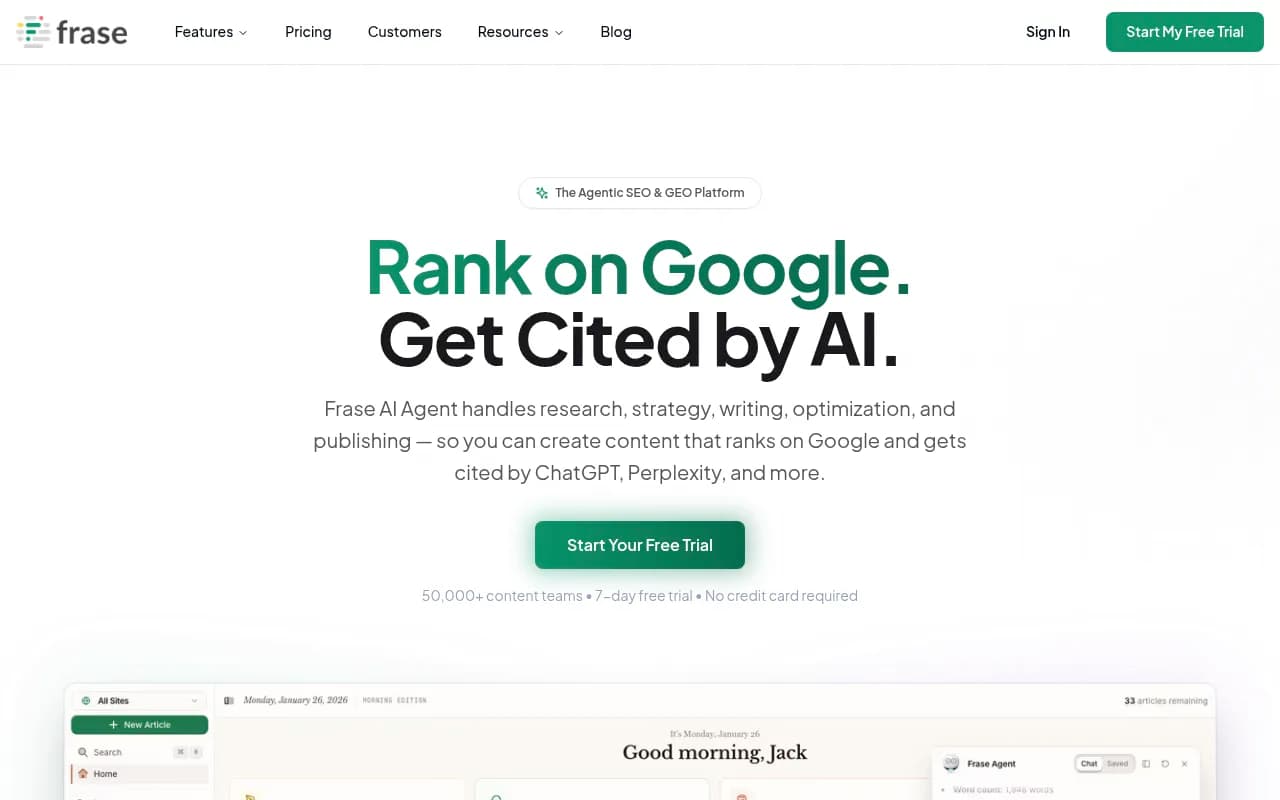
Frase is built around the content creation workflow: research, outline, write, optimize. While AlsoAsked stops at showing you questions, Frase takes you all the way to published content. It analyzes top-ranking pages for your target keyword, extracts the questions they answer, generates an SEO brief with topic targets, then helps you write and optimize the article — all in one tool.
The research module pulls PAA questions, related searches, and competitor content. The outline builder structures your article around the questions and topics that matter. The AI writing assistant generates sections grounded in SERP analysis. The content optimizer scores your draft in real-time and shows what's missing.
What makes it different: Frase is designed for the full content lifecycle, not just research. You research, write, and optimize in the same workspace. The AI writing is trained on actual ranking content, not generic GPT output. The recent addition of GEO optimization helps structure content for AI citation readiness.
Best for: Content teams and agencies that want to move from research to published articles fast. If you're tired of jumping between tools (AlsoAsked for questions, Google Docs for writing, Surfer for optimization), Frase consolidates the workflow.
Pricing: 7-day free trial, then $39/mo (Starter), $103/mo (Professional), $239/mo (Scale). Annual billing available.
Trade-offs: Less visual than AlsoAsked's branching trees. The AI writing is good but not perfect — you'll still need to edit. The GEO features are newer and less mature than dedicated platforms like Promptwatch.
Ahrefs
Ahrefs is the SEO platform built on the web's largest backlink index and keyword database. Used by 44% of Fortune 500 companies, it's known for accurate data and comprehensive competitive analysis. For question research, the Questions report in Keywords Explorer surfaces thousands of question-based keywords with search volumes, difficulty scores, and SERP features.
What you get beyond AlsoAsked: Site Audit finds technical issues. Rank Tracker monitors your positions. Content Explorer finds top-performing content in your niche. Brand Radar tracks mentions of your brand in AI search engines (ChatGPT, Perplexity, Gemini), though it uses fixed prompts and lacks the depth of specialized GEO tools.
The Ahrefs workflow for question research: enter a seed keyword, filter by question keywords, sort by search volume or difficulty, export the list. It's straightforward and data-rich, but less visual than AlsoAsked's branching trees. You get the questions, the volumes, and the difficulty — but you have to do the clustering and content planning yourself.
Best for: SEO professionals and agencies that need accurate data, comprehensive backlink analysis, and competitive intelligence. If you're already using Ahrefs for link building and rank tracking, the question research is a bonus. If you only need questions, it's expensive.
Pricing: Starter $29/mo (very limited), Lite $83/mo, Standard $166/mo, Advanced $333/mo, Enterprise custom. Annual billing saves 20%. Free trial available.
Trade-offs: Expensive for question research alone. Brand Radar uses fixed prompts and lacks AI traffic attribution, content gap analysis, and crawler logs. The interface is powerful but has a learning curve.
AnswerThePublic
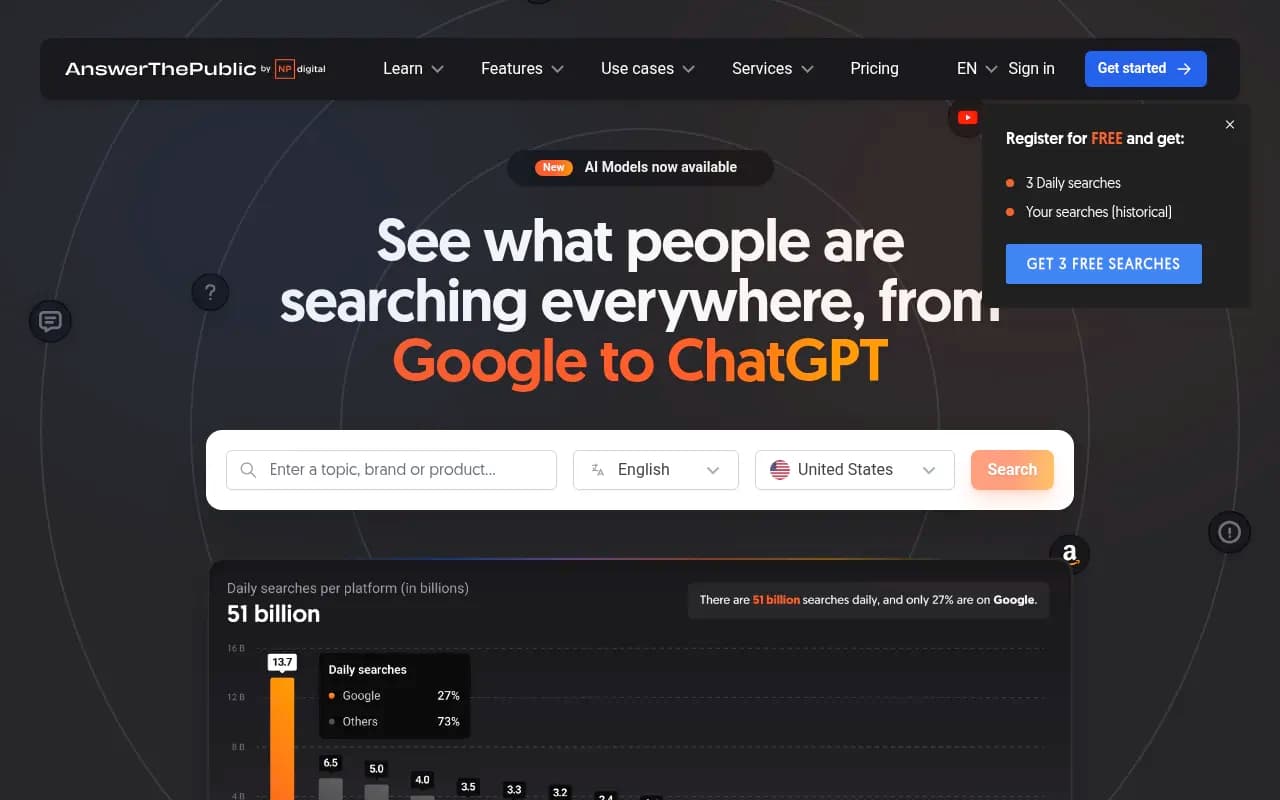
AnswerThePublic is the original question visualization tool, famous for its search wheels that map questions, prepositions, comparisons, and alphabetical queries around a central keyword. Used by 2.7M+ marketers, it transforms autocomplete data from Google and Bing into visual maps that show how people actually search.
The free tier gives you 1 search per day — enough to explore a topic but not enough to build a content strategy. Paid plans ($99-399/mo) unlock unlimited searches, CSV exports, search volume data, and comparison tracking over time. The visualizations are iconic and intuitive, making it easy to spot patterns and content gaps at a glance.
What makes it different from AlsoAsked: AnswerThePublic shows a broader range of query types (questions, prepositions, comparisons, alphabetical) in one view, while AlsoAsked focuses specifically on PAA branching. The trade-off: AnswerThePublic's data is flatter (no branching relationships), and the free tier is more restrictive (1 search/day vs AlsoAsked's 10 credits/month).
Best for: Visual learners who want to see the full landscape of how people search for a topic. Great for brainstorming and presentations. Less useful if you need deep branching relationships or want to track changes over time without paying $99+/mo.
Pricing: Free tier (1 search/day). Individual $99/mo, Pro $199/mo, Expert $399/mo.
Trade-offs: Expensive for what you get — most competitors offer more features for less. The 1 search/day free limit is restrictive. No clustering, no AI visibility tracking, no content creation tools.
kwrds.ai
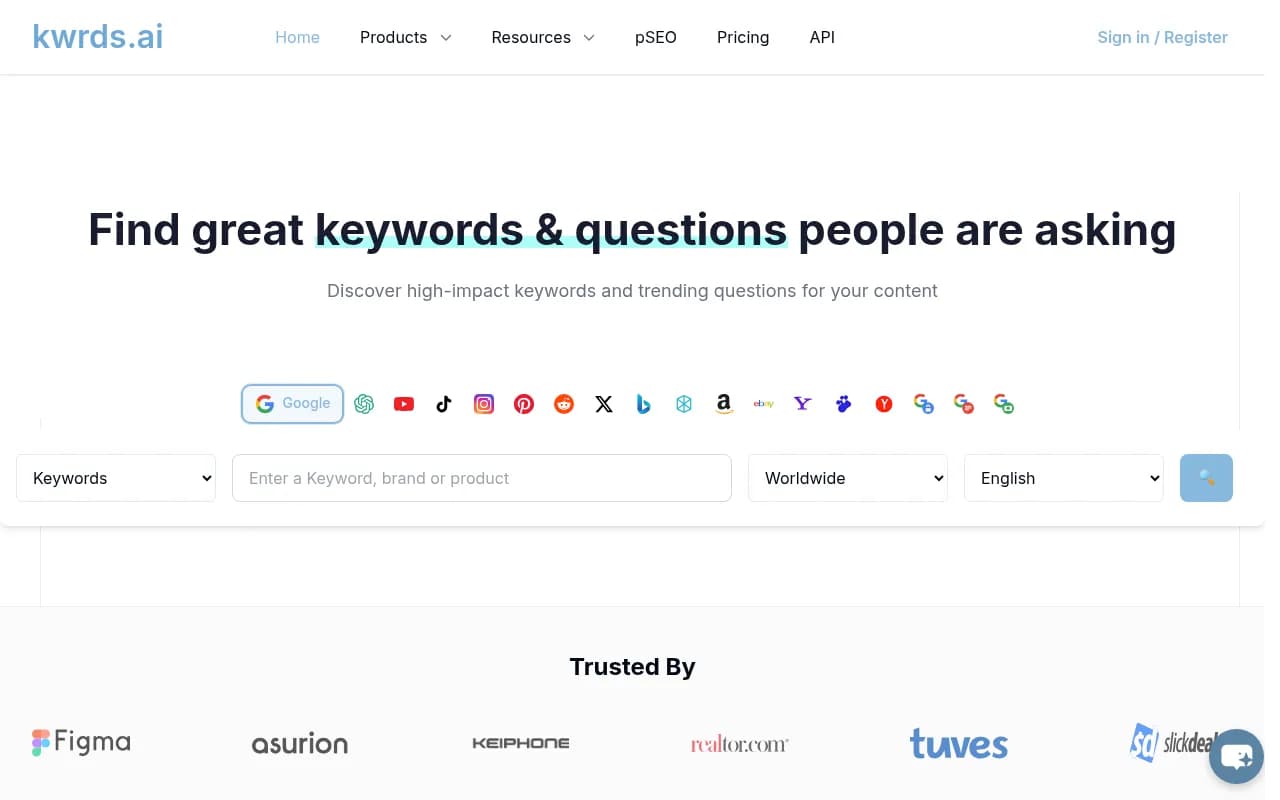
kwrds.ai is a multi-platform keyword research tool that goes beyond Google to surface questions and keywords from 18+ platforms: Google, ChatGPT, YouTube, TikTok, Reddit, Perplexity, Instagram, Pinterest, Amazon, Bing, and more. It's designed for marketers who need to understand how people search across different channels, not just traditional search engines.
The free tier gives you unlimited keyword ideas — a genuinely useful starting point. The Pro plan ($39/mo) adds 1,500 queries with search volumes, 500 AI research queries, and clustering. The platform supports 150+ countries and multiple languages, making it useful for international campaigns.
What makes it different: multi-platform coverage means you can research YouTube questions, TikTok trends, Reddit discussions, and ChatGPT prompts in one tool. This is valuable if your content strategy spans multiple channels. The AI research queries help you understand how AI models interpret and answer questions about your topic.
Best for: Multi-channel marketers who need keyword research across social media, e-commerce, and AI platforms. If you're creating content for YouTube, TikTok, and Reddit alongside traditional SEO, kwrds.ai covers all the bases.
Pricing: Free tier (unlimited keyword ideas). Pro $39/mo (1,500 queries, 500 AI research queries, clustering). Custom API plans available.
Trade-offs: Less visual than AlsoAsked. The free tier doesn't include search volumes. Multi-platform coverage is broad but not as deep as platform-specific tools.
KeywordsPeopleUse
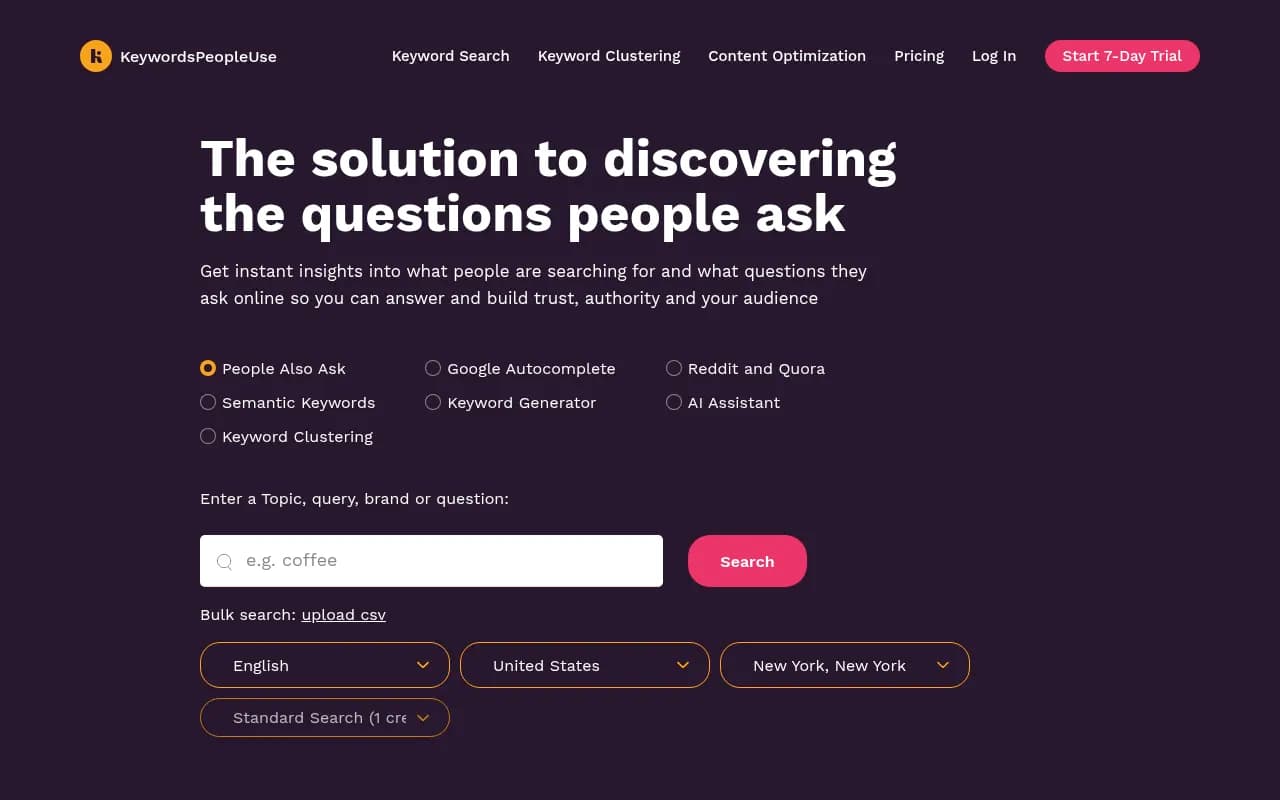
KeywordsPeopleUse mines People Also Ask results, Google autocomplete, Reddit, and Quora to uncover real user questions. Used by 15,000+ marketers in 150 countries, it's designed to help you discover what people are actually searching for and asking in forums, then build topical authority around those questions.
The platform includes PAA extraction, Google autocomplete, Reddit and Quora mining, semantic keyword discovery, keyword clustering, and an AI assistant for content ideation. The 7-day free trial lets you test the full feature set before committing.
What makes it different: forum mining (Reddit and Quora) surfaces questions that don't always show up in PAA but represent real user pain points. The semantic keyword feature finds related terms and concepts that help you build comprehensive topic coverage. The AI assistant helps you turn questions into content outlines.
Best for: Content marketers building topical authority who want to combine PAA data with forum insights. If you're creating in-depth guides and want to cover every angle of a topic, KeywordsPeopleUse helps you find the questions traditional tools miss.
Pricing: 7-day free trial. Lite $15/mo (200 credits), Standard $35/mo (500 credits), Pro $55/mo (1000 credits). Annual billing saves 20-27%.
Trade-offs: Less visual than AlsoAsked. The credit system can feel limiting if you're researching multiple topics. No AI visibility tracking or content creation tools.
How to Choose the Right AlsoAsked Alternative
If you need AI search visibility and GEO optimization: Promptwatch is the only platform that tracks how ChatGPT, Claude, and Perplexity cite your brand, identifies content gaps, generates AI-optimized content, and monitors crawler logs. It's the action platform, not just a monitoring dashboard.
If you want a generous free tier: Answer Socrates gives you unlimited searches and clustering without credit limits. It's the best free alternative if you're on a tight budget.
If you need an all-in-one marketing platform: Semrush combines question research with SEO, content, PPC, social, and AI visibility — but you'll pay $165+/mo for the breadth.
If you want to go from research to published content fast: Frase integrates question research, AI writing, and optimization in one workflow. You research, write, and optimize in the same tool.
If you need accurate data and competitive intelligence: Ahrefs has the largest backlink index and keyword database, plus Brand Radar for basic AI visibility tracking.
If you're a visual learner: AnswerThePublic's search wheels are iconic and intuitive, but the 1 search/day free limit and $99+/mo pricing make it expensive for what you get.
If you need multi-platform coverage: kwrds.ai researches questions across Google, YouTube, TikTok, Reddit, ChatGPT, and 13+ other platforms — useful for multi-channel strategies.
If you want forum insights alongside PAA data: KeywordsPeopleUse mines Reddit and Quora to surface questions traditional tools miss.
The right choice depends on your workflow, budget, and whether you're optimizing for traditional search, AI search, or both. In 2026, the smartest move is picking tools that help you create content that ranks everywhere people look for answers — not just Google's blue links.