Key Takeaways
- Promptwatch is the best alternative if you need AI search visibility tracking, content gap analysis, and optimization tools beyond just keyword discovery—it shows you what's missing and helps you fix it with AI-generated content grounded in 880M+ citations
- Semrush offers the most comprehensive all-in-one platform combining traditional SEO with AI visibility tracking, though its GEO features use fixed prompts and lack the depth of specialized platforms
- AlsoAsked and AnswerThePublic are strong free alternatives focused purely on question discovery from Google's People Also Ask data, with visual mapping and clustering capabilities
- Ahrefs provides enterprise-grade SEO tools with Brand Radar for AI search monitoring, but lacks content generation and has limited AI traffic attribution
- QuestionDB and Keyword Sheeter are budget-friendly options for high-volume keyword generation from multiple sources including Reddit and Quora
Answer Socrates has built a reputation as a solid free keyword research tool that scrapes Google autocomplete data to generate hundreds of long-tail keyword ideas, clusters them by topic, and tracks basic LLM brand visibility. But it's far from the only option—and depending on your needs, it might not even be the best one.
If you're looking for alternatives, you're probably hitting one of these pain points: Answer Socrates' LLM tracking is basic (no content gap analysis or optimization recommendations), the free tier is limited to 100 searches per month, there's no crawler log visibility to see how AI engines discover your content, and the platform focuses on keyword discovery rather than helping you actually rank in AI search results.
Let's break down the best alternatives based on what you actually need to accomplish.
Promptwatch

Promptwatch is the top alternative if you're serious about AI search visibility and want more than just monitoring. While Answer Socrates shows you what questions people ask, Promptwatch shows you which prompts your competitors rank for but you don't—then helps you fix it.
The core difference: Answer Socrates is a discovery tool that stops at showing you keywords and basic LLM mentions. Promptwatch is an optimization platform built around the action loop: find content gaps through Answer Gap Analysis, generate AI-optimized content with the built-in writing agent (grounded in 880M+ citations analyzed), and track your visibility improvements across 10 AI models including ChatGPT, Claude, Perplexity, Gemini, and Google AI Overviews.
Key advantages over Answer Socrates:
- AI Crawler Logs: See exactly when ChatGPT, Claude, and Perplexity crawlers hit your site, which pages they read, and errors they encounter—Answer Socrates has no crawler visibility at all
- Content Gap Analysis: Identifies specific topics, angles, and questions AI models want answers to but can't find on your site, showing you exactly what content to create
- AI Content Generation: Built-in writing agent creates articles, listicles, and comparisons engineered to get cited by AI models—not generic SEO filler
- Citation & Source Analysis: See which pages, Reddit threads, YouTube videos, and domains AI models actually cite in responses
- Reddit & YouTube Insights: Surface discussions that directly influence AI recommendations—a channel Answer Socrates completely ignores
- ChatGPT Shopping Tracking: Monitor when your brand appears in ChatGPT's product recommendations and shopping carousels
- Prompt Intelligence: Volume estimates, difficulty scores, and query fan-outs showing how one prompt branches into sub-queries
- Page-Level Tracking: See exactly which pages get cited, how often, and by which models—then connect visibility to revenue with traffic attribution
Answer Socrates gives you keyword ideas and basic clustering. Promptwatch gives you the full picture: what's missing, how to fix it, and whether it's working. It's the only platform rated as a "Leader" across all categories in a 2026 comparison of 12 GEO platforms.
Pricing: Essential $99/mo (1 site, 50 prompts, 5 articles), Professional $249/mo (2 sites, 150 prompts, 15 articles, crawler logs), Business $579/mo (5 sites, 350 prompts, 30 articles). Free trial available.
Best for: Marketing teams, SEO professionals, and agencies that want to actually improve AI search visibility—not just monitor it. If you need to understand how AI engines discover your content and get actionable recommendations for ranking better, Promptwatch is the clear choice.
Semrush
Semrush is the Swiss Army knife alternative—an all-in-one digital marketing platform that combines traditional SEO tools with newer AI visibility tracking. Used by 10M+ marketers and 35% of Fortune 500 companies, it offers 8 toolkits covering SEO, content, PPC, social media, local search, and AI search optimization.
Compared to Answer Socrates, Semrush is far more comprehensive but also more expensive. Where Answer Socrates focuses narrowly on keyword discovery and basic LLM tracking, Semrush gives you keyword research plus backlink analysis, site audits, rank tracking, content optimization, competitor analysis, and AI visibility monitoring across ChatGPT, Perplexity, and Gemini.
The trade-off: Semrush's AI features are less sophisticated than specialized GEO platforms. Its AI visibility tracking uses fixed prompts rather than custom queries, lacks crawler log visibility, has no Reddit or YouTube tracking, and doesn't offer content gap analysis or AI-powered content generation. You're getting breadth, not depth.
Key advantages over Answer Socrates:
- Comprehensive keyword database with billions of keywords, search volume, CPC data, and difficulty scores
- Full backlink analysis and link building tools
- Technical site audits that identify crawlability issues
- Position tracking for traditional search rankings
- Content optimization scoring and real-time recommendations
- PPC research and ad intelligence
- Social media management and scheduling
- Local SEO tools including Google Business Profile optimization
Where it falls short vs specialized GEO platforms: Fixed prompts for AI tracking, no custom query monitoring, no crawler logs, no Reddit/YouTube insights, no content generation for AI search, limited AI traffic attribution.
Pricing: From $165/mo (Starter), $290/mo (Pro+), $580/mo (Advanced). Enterprise custom pricing. 7-day free trial available.
Best for: Teams that need an all-in-one platform combining traditional SEO with basic AI visibility tracking. If you're already invested in the Semrush ecosystem and want to add AI monitoring without switching tools, it's a solid choice—but if AI search optimization is your primary focus, specialized platforms like Promptwatch offer far more depth.
Ahrefs
Ahrefs is another enterprise-grade all-in-one SEO platform, used by 44% of Fortune 500 companies. Like Semrush, it combines traditional SEO tools with newer AI search monitoring through Brand Radar—but with some key differences in approach and pricing.
Compared to Answer Socrates, Ahrefs offers significantly more depth in traditional SEO (it has the web's largest backlink index) plus basic AI visibility tracking. Where Answer Socrates gives you keyword ideas and clustering, Ahrefs gives you keyword research plus backlink analysis, content gap analysis (for traditional search), rank tracking, site audits, and Brand Radar for monitoring mentions in AI responses.
The limitation: Ahrefs' Brand Radar uses fixed prompts and doesn't support custom query tracking, has no crawler log visibility, lacks Reddit/YouTube tracking, and offers no content generation or optimization recommendations for AI search. You're getting powerful traditional SEO tools with AI monitoring bolted on—not a purpose-built GEO platform.
Key advantages over Answer Socrates:
- Largest backlink index (over 40 trillion links) for comprehensive link analysis
- Keyword database with billions of keywords across 243 countries
- Content gap analysis showing keywords competitors rank for but you don't (traditional search)
- Site audit tool identifying technical SEO issues
- Rank tracking with SERP feature monitoring
- Content Explorer for finding top-performing content in any niche
- Brand Radar for AI search monitoring across multiple models
Where it falls short vs specialized GEO platforms: Fixed prompts only (no custom queries), no crawler logs, no Reddit/YouTube insights, no AI content generation, limited traffic attribution for AI search.
Pricing: From $83/mo (Lite plan)—Starter $29/mo (very limited), Standard $166/mo, Advanced $333/mo, Enterprise custom pricing. Annual billing saves 20%. Free trial available.
Best for: SEO professionals and agencies that prioritize backlink analysis and traditional search optimization but want basic AI visibility monitoring. If you're already using Ahrefs for SEO and want to add AI tracking without switching platforms, Brand Radar is a convenient add-on—but for serious AI search optimization, you'll need a specialized tool.
AlsoAsked
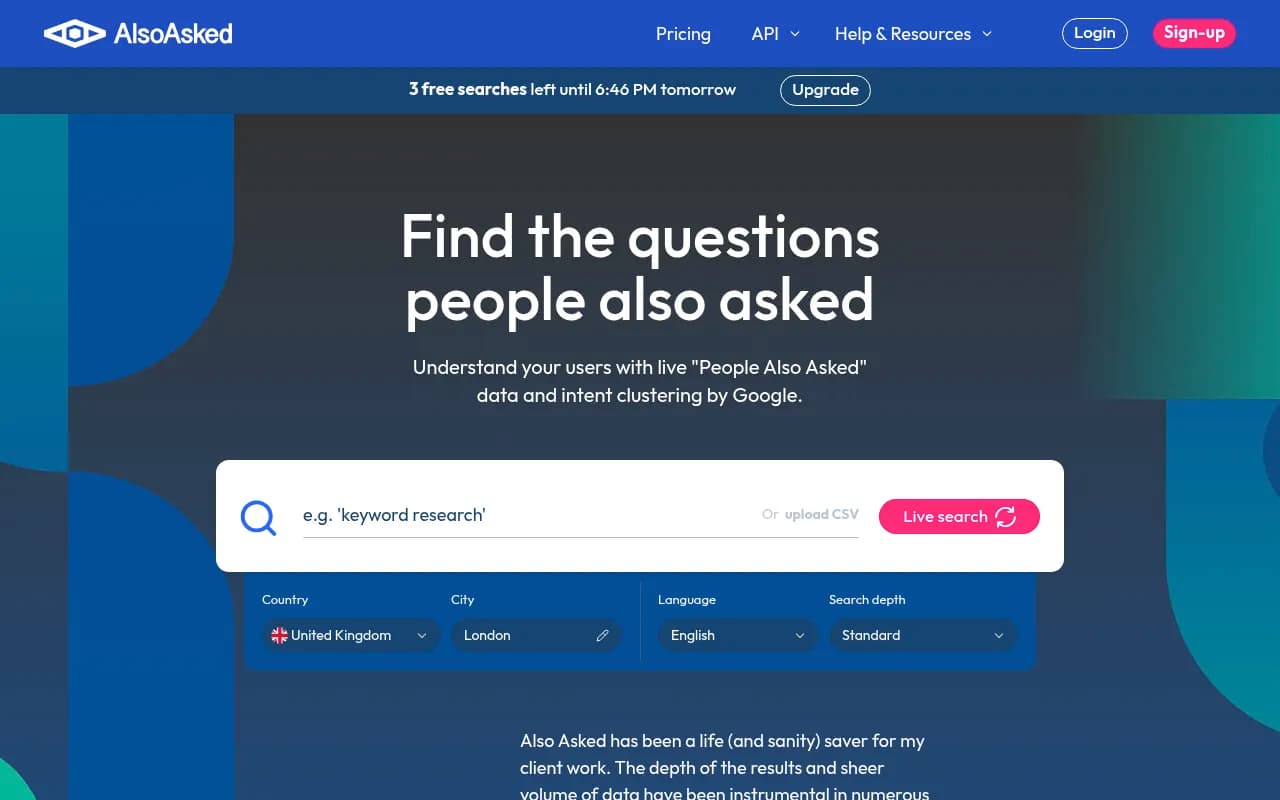
AlsoAsked is a focused alternative that extracts real-time "People Also Ask" questions from Google to map search intent and uncover content gaps. It's closer to Answer Socrates in scope—both focus on question discovery—but AlsoAsked visualizes the data differently and offers deeper drill-down capabilities.
The key difference: Answer Socrates generates keyword ideas from autocomplete data and clusters them by topic. AlsoAsked specifically targets PAA questions and maps them in a visual tree structure showing how questions branch and connect. You get 150+ questions per query with geo-specific targeting across 130+ countries.
AlsoAsked is stronger than Answer Socrates for understanding question hierarchies and search intent paths. It shows you not just what people ask, but how those questions relate to each other—which is valuable for building comprehensive content that answers multiple related queries. The platform also offers bulk search capabilities and API access on higher plans.
Key advantages over Answer Socrates:
- Visual tree mapping of question relationships
- Deeper drill-down returning 150+ questions per query
- Geo-specific targeting across 130+ countries and cities
- Bulk search capabilities for processing multiple keywords at once
- API access for custom integrations
- Intent clustering by Google's own categorization
Where it falls short: No LLM tracking at all (purely focused on Google PAA data), no keyword difficulty or search volume metrics in lower tiers, no content generation, no crawler visibility.
Pricing: Freemium—Free tier (10 credits) + paid from $12/mo (Basic 100 credits), $23/mo (Lite 300 credits), $49/mo (Pro 1000 credits + API), $99/mo (Agency 3000 credits).
Best for: Content creators and SEO professionals who want to deeply understand question hierarchies and search intent paths. If you're building comprehensive content that needs to answer multiple related questions, AlsoAsked's visual mapping is more useful than Answer Socrates' flat clustering. But if you need AI search visibility tracking, you'll need a different tool.
AnswerThePublic
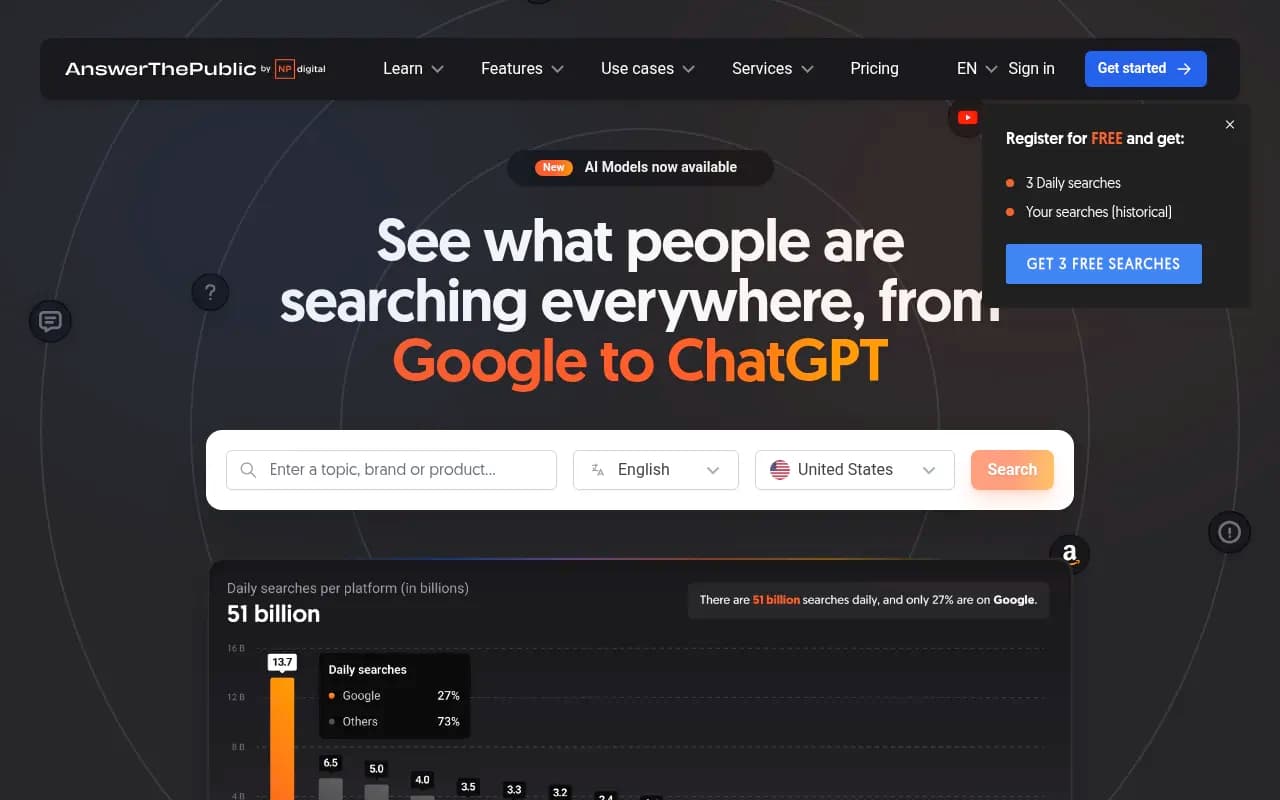
AnswerThePublic is probably the most well-known alternative to Answer Socrates—it's been around longer and has a more polished interface. Like Answer Socrates, it transforms autocomplete data from Google and other search engines into visual maps of questions, prepositions, and comparisons people actually search for.
The comparison: Both tools do essentially the same thing (scrape autocomplete data and visualize questions), but with different presentation styles. AnswerThePublic is famous for its radial visualization wheels showing questions organized by question word (what, why, how, when, where). Answer Socrates uses a more straightforward list/cluster view with recursive search capabilities.
AnswerThePublic used to be completely free with unlimited searches. Now it's limited to 1 search per day on the free tier, making Answer Socrates' free tier (100 searches/month) more generous for regular use. The paid plans are also significantly more expensive than Answer Socrates.
Key advantages over Answer Socrates:
- More polished, visually appealing interface with iconic radial visualizations
- Data from multiple sources beyond just Google (Bing, YouTube, Amazon)
- Comparison queries ("X vs Y" searches)
- Alphabetical listings showing autocomplete suggestions
- CSV and image export for presentations
Where it falls short: Much more expensive ($99/mo vs Answer Socrates' $15/mo), very limited free tier (1 search/day vs 100/month), no LLM tracking, no keyword difficulty or search volume in base plans, no recursive search capabilities.
Pricing: Freemium—Free tier (1 search/day) + paid from $99/mo (Individual), $199/mo (Pro), $399/mo (Expert).
Best for: Marketers and content creators who prioritize visual presentation and need to create client reports or presentations. The radial visualizations are more impressive in meetings than Answer Socrates' plain lists. But for actual working research with high search volume, Answer Socrates' free tier is more practical—and for AI search optimization, neither tool offers what you need.
BuzzSumo
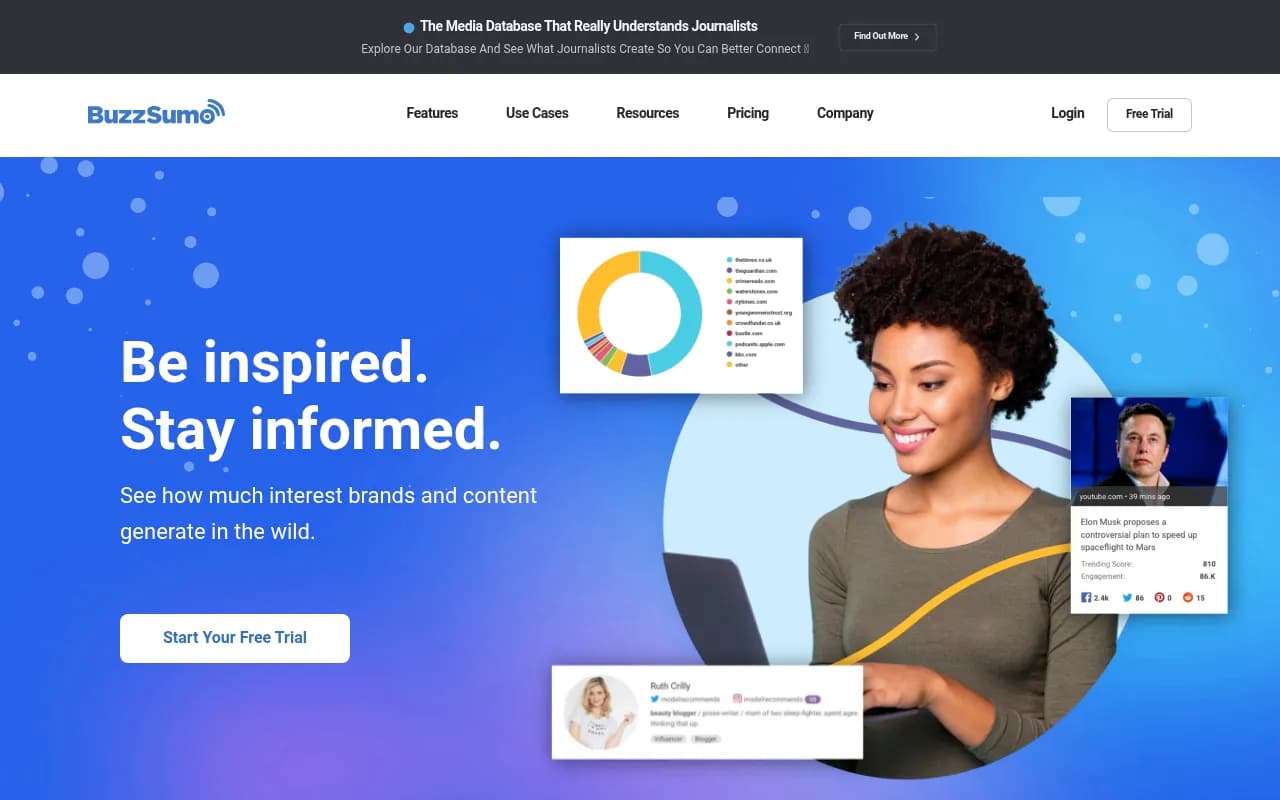
BuzzSumo is a different type of alternative—it's not primarily a keyword research tool, but a content intelligence platform for finding trending topics, analyzing competitor content performance, and identifying influencers for outreach campaigns.
Compared to Answer Socrates, BuzzSumo approaches content research from a different angle. Instead of starting with keyword autocomplete data, it shows you what content is actually performing well (social shares, backlinks, engagement) and helps you understand why. You can see which topics are trending, which headlines work, and which influencers are sharing content in your niche.
The trade-off: BuzzSumo is significantly more expensive than Answer Socrates and doesn't focus on keyword discovery or AI search visibility. It's better for content ideation based on proven performance and influencer outreach, but weaker for understanding search intent or optimizing for AI engines.
Key advantages over Answer Socrates:
- Content performance analysis showing social shares, backlinks, and engagement
- Trending topic discovery across social platforms
- Media database with 700K+ journalists for PR outreach
- Influencer identification and contact information
- Competitor content monitoring
- Content alerts for tracking mentions and trends
- Question analyzer for finding popular questions (similar to Answer Socrates but based on social data)
Where it falls short: Much more expensive ($199/mo minimum), no keyword difficulty or search volume data, no LLM tracking, focused on social performance rather than search optimization.
Pricing: From $199/mo (Content Creation), $299/mo (PR & Comms), $499/mo (Suite), $999/mo (Enterprise). Annual billing with 20% discount. Free trial available.
Best for: PR professionals, content marketers, and social media managers who need to find trending topics, analyze content performance, and identify influencers for outreach. If your content strategy is driven by social proof and influencer partnerships rather than search optimization, BuzzSumo offers capabilities Answer Socrates doesn't. But for pure keyword research and AI search visibility, it's overkill and overpriced.
QuestionDB
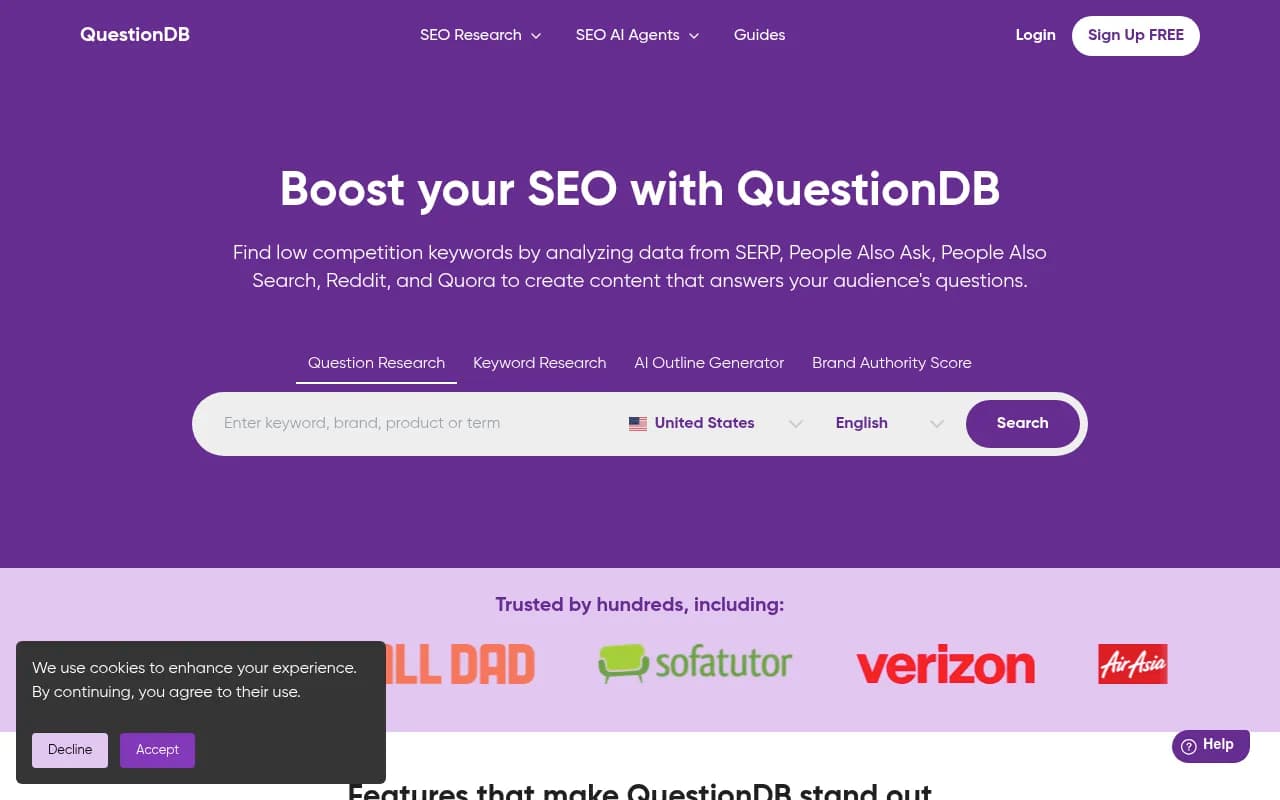
QuestionDB is a budget-friendly alternative focused on finding low-competition keywords by analyzing real questions from Google SERP, People Also Ask, Reddit, and Quora. It's similar to Answer Socrates in scope but adds Reddit and Quora data—which is increasingly important since AI models often cite these platforms.
The comparison: Both tools help you discover questions people ask, but QuestionDB casts a wider net by including Reddit and Quora alongside Google data. This is valuable because ChatGPT, Claude, and Perplexity frequently cite Reddit discussions and Quora answers in their responses. Answer Socrates only looks at Google autocomplete.
QuestionDB also provides keyword difficulty scores, search volume data, and CPC metrics—features that Answer Socrates lacks in its free tier. The free plan is more limited (5 searches/month vs 100), but the paid plans are cheaper ($9.99/mo vs $15/mo).
Key advantages over Answer Socrates:
- Reddit and Quora question data (important for AI search optimization)
- Keyword difficulty scores included
- Search volume and CPC data
- Lower paid plan pricing ($9.99/mo vs $15/mo)
- AI outline and meta description generator
- Content analysis tools
Where it falls short: More limited free tier (5 searches/month vs 100), no clustering or recursive search, no LLM tracking, simpler interface.
Pricing: Freemium—Free plan (5 searches/mo) + paid from $9.99/mo (Solo 100 searches), $29.99/mo (Business 400 searches), $69.99/mo (Enterprise 1000 searches).
Best for: SEO professionals and content creators on a budget who want keyword difficulty and search volume data included, plus Reddit/Quora insights that influence AI responses. If you're optimizing for AI search and want to see what questions people ask on platforms AI models actually cite, QuestionDB is more relevant than Answer Socrates. But for high-volume keyword generation with clustering, Answer Socrates' free tier is more generous.
Keyword Sheeter
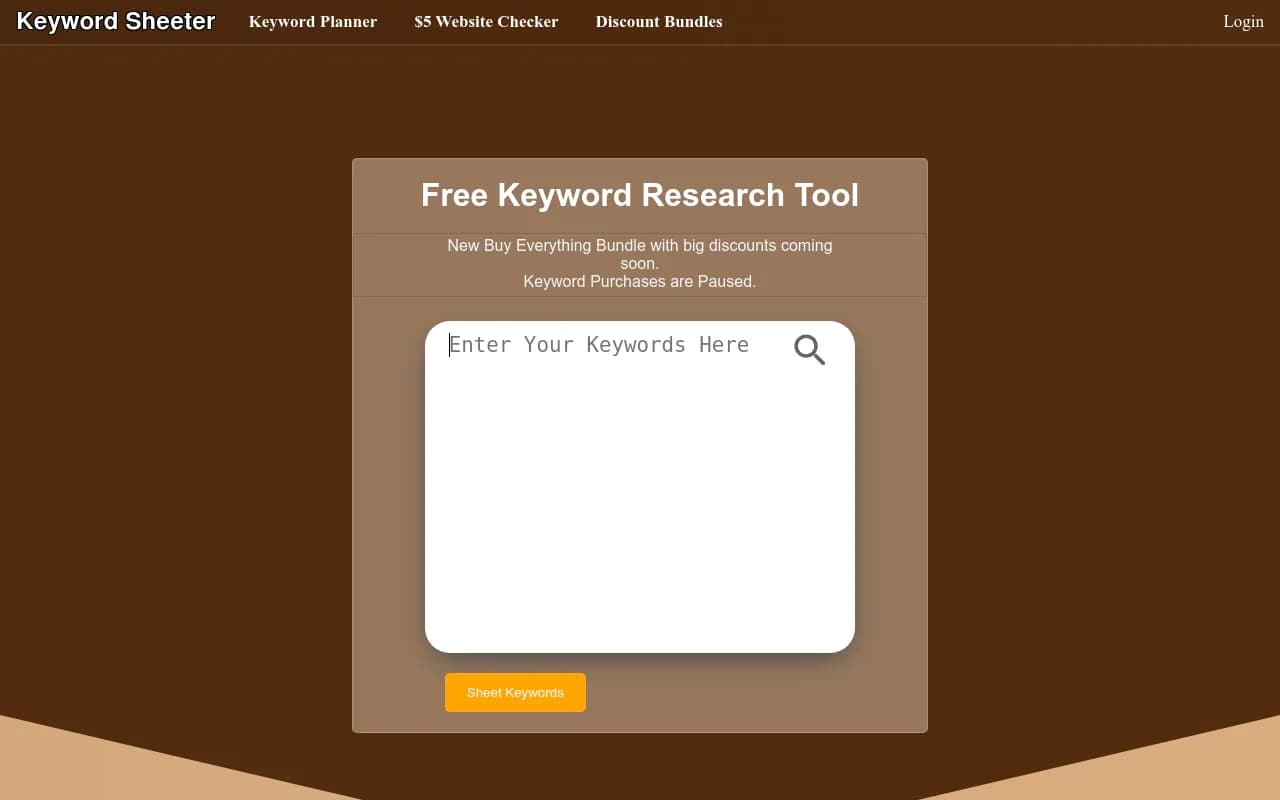
Keyword Sheeter is the speed demon alternative—a free tool that rapidly generates thousands of keyword suggestions by scraping Google autocomplete data at high volume. It's built for SEO professionals who need raw keyword ideas fast, without the polish or clustering features of Answer Socrates.
The comparison: Both tools scrape Google autocomplete, but Keyword Sheeter prioritizes volume and speed over organization. Where Answer Socrates gives you 100 searches/month with clustering and LLM tracking, Keyword Sheeter gives you unlimited searches with no clustering—just raw keyword lists you can export and process yourself.
Keyword Sheeter is completely free for the core tool (unlimited keyword generation), but charges per-keyword fees for difficulty scores, search volume, and SERP data. Answer Socrates includes basic metrics in paid plans. The trade-off: Keyword Sheeter is faster and more generous with raw data, but requires more manual work to organize and analyze.
Key advantages over Answer Socrates:
- Unlimited free keyword generation (no monthly search limits)
- Extremely fast scraping (thousands of keywords in seconds)
- Multiple data sources (Google, YouTube, Amazon, News, Images, Books)
- Pay-per-keyword pricing for metrics (only pay for what you need)
- Keyword filtering and export options
Where it falls short: No clustering or organization (just raw lists), no LLM tracking, no recursive search, pay-per-keyword for difficulty/volume data, bare-bones interface.
Pricing: Free core tool + pay-per-keyword reports (difficulty $0.06/kw, volume $0.0012/kw, SERPs $0.012/kw). Subscription: Keyword Planner Basic $9/mo.
Best for: SEO professionals who need high-volume keyword generation and are comfortable organizing raw data themselves. If you're building massive keyword lists for PPC campaigns or content calendars and don't need clustering or AI tracking, Keyword Sheeter's unlimited free tier beats Answer Socrates. But for most users, the lack of organization makes Answer Socrates more practical.
Which Alternative Should You Choose?
The best Answer Socrates alternative depends on what you're actually trying to accomplish:
For AI search visibility and optimization (not just keyword discovery): Promptwatch is the clear winner. It's the only platform that shows you content gaps, helps you create AI-optimized content, tracks crawler logs, and connects visibility to revenue. Answer Socrates and most alternatives stop at keyword discovery—Promptwatch helps you actually rank.
For all-in-one SEO + basic AI tracking: Semrush or Ahrefs if you need comprehensive traditional SEO tools with AI monitoring bolted on. Semrush is better for content and PPC, Ahrefs is better for backlink analysis. Both are expensive and their AI features lag specialized platforms.
For visual question mapping: AlsoAsked if you want to understand question hierarchies and relationships, or AnswerThePublic if you prioritize presentation and client reports. Both are more expensive than Answer Socrates for similar functionality.
For Reddit/Quora insights: QuestionDB is the best choice since it includes platforms AI models actually cite. Important for understanding what influences AI responses.
For high-volume keyword generation: Keyword Sheeter if you need unlimited raw data and are comfortable organizing it yourself. Answer Socrates if you want clustering and organization included.
For content performance and influencer outreach: BuzzSumo, but it's a different category entirely—not really a keyword research alternative.
The bottom line: If you're just looking for a free keyword discovery tool with better features than Answer Socrates, AlsoAsked or QuestionDB are solid choices. But if you're serious about AI search visibility—which is where the future of search is heading—you need a specialized GEO platform like Promptwatch that goes beyond discovery to actually help you optimize and rank.