Key Takeaways
- Promptwatch is the best alternative if you need AI search visibility tracking alongside content optimization — it's the only platform that shows you content gaps in ChatGPT, Claude, Perplexity, and Google AI, then helps you create content that actually gets cited
- Surfer SEO offers the most similar feature set to Clearscope with competitive pricing ($99/mo vs $189/mo) and includes AI writing capabilities
- Frase is ideal for smaller teams and solo creators who want an affordable all-in-one solution starting at $39/mo with research, writing, and optimization in one workflow
- MarketMuse is the enterprise choice for large content teams focused on topical authority and strategic planning, though pricing starts significantly higher
- Semrush Writing Assistant makes sense if you already use Semrush for SEO — it's included in your subscription and integrates with Google Docs and WordPress
Clearscope has been a go-to content optimization platform for SEO teams since it launched, but it's not the only option — and depending on your needs, it might not be the best one. The $189/mo starting price, lack of AI writing features in lower tiers, and focus purely on traditional SEO (without AI search visibility) have pushed many teams to look elsewhere.
The biggest shift in 2026 is that content optimization is no longer just about ranking in Google. ChatGPT, Claude, Perplexity, Gemini, and other AI models are now answering millions of queries that used to go to search engines. If your content isn't visible in these AI responses, you're missing a massive channel. Most Clearscope alternatives still focus only on traditional SEO — but a few have evolved to cover both.
Here's how the top alternatives compare, with honest assessments of what each tool does well and where it falls short.
Promptwatch

Promptwatch isn't a direct Clearscope replacement — it's something different and arguably more important in 2026. While Clearscope helps you optimize content for Google, Promptwatch shows you how to get visible in AI search engines like ChatGPT, Claude, Perplexity, Gemini, Grok, DeepSeek, and Google AI Overviews. It's the only platform that closes the loop: find content gaps, generate optimized content, and track your visibility as AI models start citing you.
The core difference: Clearscope analyzes what's ranking in Google. Promptwatch analyzes what AI models are actually citing in their responses — which pages, Reddit threads, YouTube videos, and domains they trust. It tracks over 1.1 billion citations and shows you exactly which prompts your competitors are visible for but you're not. Then it helps you fix it.
The workflow is built around action, not just monitoring. Answer Gap Analysis shows you the specific topics, angles, and questions AI models want answers to but can't find on your site. The built-in AI writing agent generates articles grounded in real citation data, prompt volumes, and competitor analysis — content engineered to get cited by ChatGPT and other models. Page-level tracking shows which pages are being cited, how often, and by which models. You can even connect traffic attribution (code snippet, GSC integration, or server logs) to see how AI visibility translates to revenue.
Additional capabilities most competitors lack entirely: AI Crawler Logs (real-time logs of ChatGPT, Claude, Perplexity crawlers hitting your site), Prompt Intelligence (volume estimates and difficulty scores for each prompt), Reddit & YouTube Insights (surface discussions that influence AI recommendations), ChatGPT Shopping Tracking (monitor product recommendations), and competitor heatmaps across all major LLMs.
Pricing is significantly lower than Clearscope: Essential $99/mo (1 site, 50 prompts, 5 articles), Professional $249/mo (2 sites, 150 prompts, 15 articles, crawler logs), Business $579/mo (5 sites, 350 prompts, 30 articles). Free trial available.
Best for: Marketing teams, SEO teams, and agencies that want to dominate both traditional search and AI search. If you're still optimizing only for Google in 2026, you're leaving traffic on the table. Promptwatch is the only platform that helps you capture both channels.
Trade-offs: Not a traditional content optimization tool — it won't give you a Clearscope-style content grade for an article you're writing. It's focused on AI search visibility and content gap analysis, not real-time SEO scoring. If you need both, pair it with Surfer or Frase.
Surfer SEO
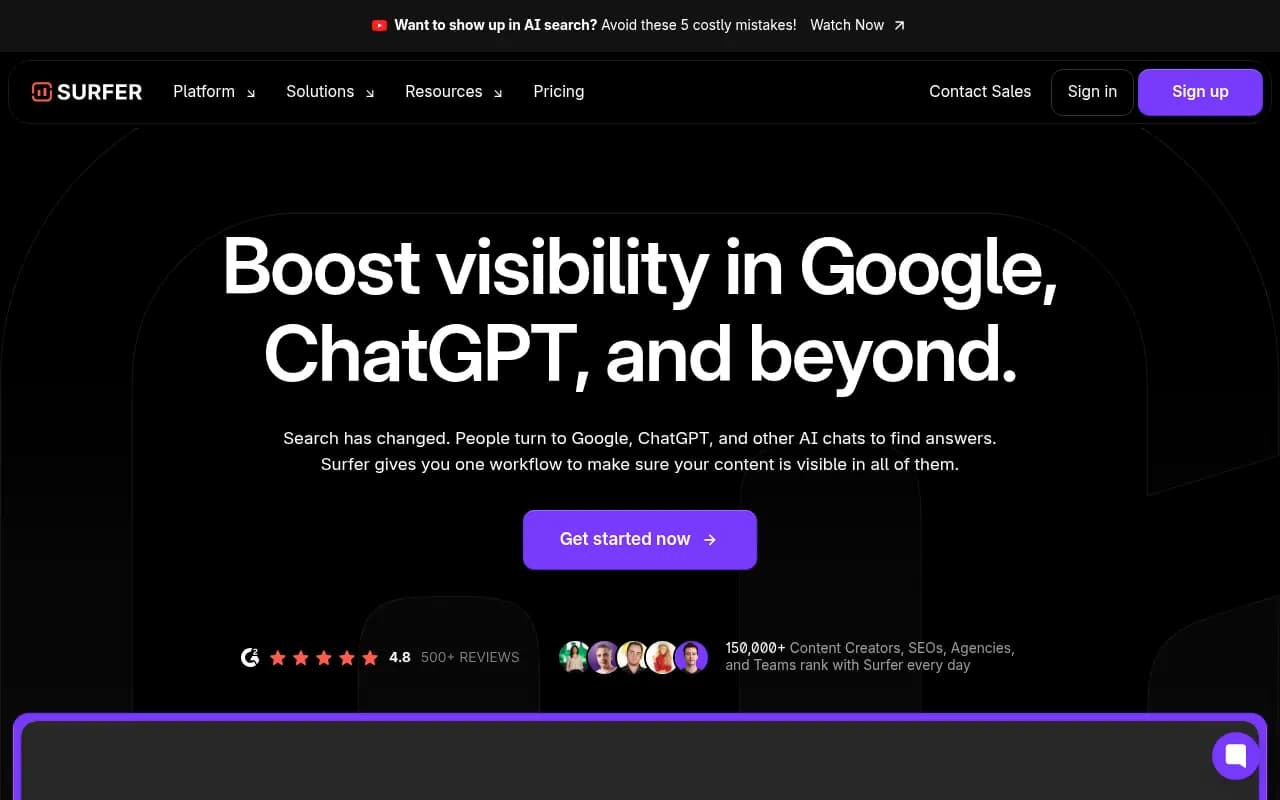
Surfer SEO is the closest direct replacement for Clearscope. It analyzes top-ranking pages, provides keyword recommendations, and gives you a content score as you write. The interface is clean, the data is reliable, and the pricing is more accessible: $99/mo for the Essential plan (billed annually) vs Clearscope's $189/mo.
Surfer's standout feature is Surfer AI, which generates full draft articles optimized for your target keyword. This is a major advantage over Clearscope, which doesn't include AI writing in its lower-tier plans. You can go from keyword to optimized 2,000-word draft in minutes, then refine it with Surfer's content editor. The AI articles cost additional credits, but the workflow is fast.
The Content Editor provides real-time feedback on keyword usage, headings, word count, and readability. It's similar to Clearscope's grading system but feels more granular — you can see exactly which terms you're missing and where to add them. The SERP Analyzer shows you what's working for competitors, and the Outline Builder helps you structure articles before you write.
Surfer also includes a basic keyword research tool, internal linking suggestions, and a plagiarism checker. The Chrome extension lets you analyze any page on the web, which is useful for competitive research.
Best for: Teams that want a Clearscope-like experience with AI writing included and a lower price point. If you're producing 10+ articles per month and need both optimization and drafting, Surfer is hard to beat.
Trade-offs: The AI-generated content can feel formulaic if you don't edit it heavily. Surfer's keyword recommendations are sometimes overly aggressive — you'll get flagged for not using a term enough even when it doesn't fit naturally. The tool also focuses purely on traditional SEO; there's no AI search visibility tracking like Promptwatch offers.
Frase
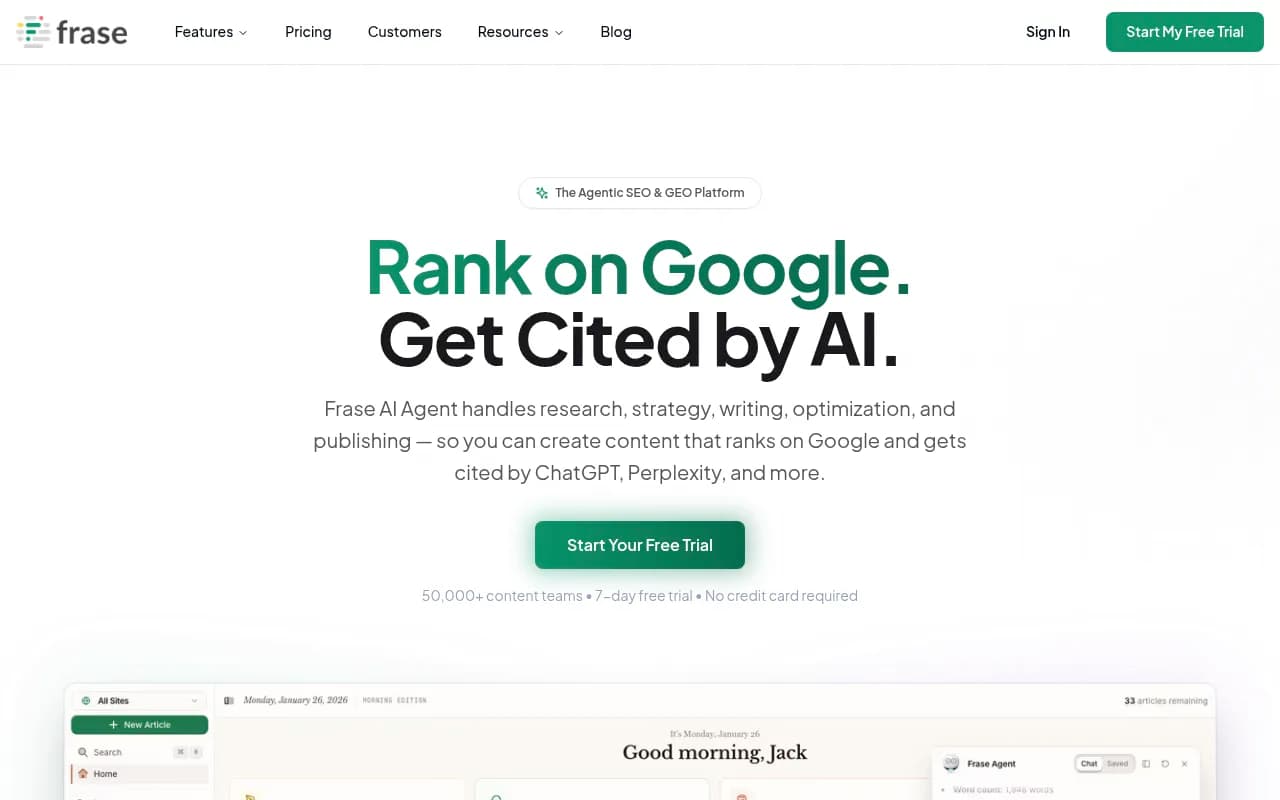
Frase is the budget-friendly all-in-one alternative. At $39/mo for the Starter plan (7-day free trial), it's less than a quarter of Clearscope's price. You get research, outlining, writing, and optimization in a single workflow, which makes it ideal for solo creators, small teams, and agencies managing multiple clients.
The research panel pulls top-ranking content, common questions, and related topics for any keyword. You can drag headings from competitors into your outline, then use Frase's AI writer to generate sections. The content is decent but not as polished as Surfer AI — expect to do more editing. The optimization score is straightforward: it shows you which keywords to include and how your content compares to the top 20 results.
Frase recently added GEO (Generative Engine Optimization) features, which is a step toward AI search visibility. It's not as comprehensive as Promptwatch — you won't get citation tracking, crawler logs, or prompt intelligence — but it does help you structure content for AI-generated responses. This is a smart move and positions Frase as one of the few tools bridging traditional SEO and AI search.
The interface is clean and intuitive. You can create briefs, write drafts, and optimize content without switching tools. The Chrome extension lets you analyze any page, and the WordPress plugin makes publishing easy.
Best for: Freelancers, bloggers, and small content teams that need an affordable tool covering research, writing, and optimization. If you're producing 5-10 articles per month and don't want to pay $189/mo, Frase is the obvious choice.
Trade-offs: The AI writing quality lags behind Surfer and Clearscope. The optimization scoring is less detailed — you get the basics but not the depth of analysis Clearscope provides. GEO features are new and not as mature as Promptwatch's AI visibility platform.
MarketMuse
MarketMuse is the enterprise-grade alternative for teams obsessed with topical authority. It's not just a content optimization tool — it's a content strategy platform. MarketMuse analyzes your entire site, identifies topic clusters, and shows you where you have authority and where you're weak. The Content Brief Builder generates detailed briefs based on competitive analysis and search intent.
The standout feature is Personalized Difficulty, which shows you how hard it will be for your site specifically to rank for a topic. This is huge. Most tools give you generic difficulty scores based on domain authority and backlinks. MarketMuse factors in your existing content and topical authority, so you can prioritize topics you're actually likely to win.
The Content Inventory feature audits your entire site and flags pages that need updates, consolidation, or deletion. This is incredibly useful for large sites with hundreds or thousands of articles. You can see which pages are underperforming, which topics have gaps, and where to focus your efforts.
MarketMuse's AI writing is solid but not the main draw. The real value is in the strategic insights — understanding what content to create, in what order, and how much depth you need to compete.
Best for: Enterprise content teams, large publishers, and agencies managing complex content strategies. If you're producing 50+ articles per month and need to build topical authority across multiple clusters, MarketMuse is worth the investment.
Trade-offs: Pricing is significantly higher than Clearscope. The Standard plan starts around $149/mo, but most teams need Premium or Enterprise, which can run $2,000-5,000+/mo. The interface has a learning curve — it's powerful but not as intuitive as Surfer or Frase. Like Clearscope, it focuses purely on traditional SEO with no AI search visibility tracking.
Semrush Writing Assistant
If you already use Semrush for SEO, the Writing Assistant is included in your subscription. It's not a standalone tool like Clearscope, but it covers the basics: keyword recommendations, readability scoring, tone of voice analysis, and plagiarism detection. The Google Docs, WordPress, and MS Word add-ons make it easy to optimize content wherever you write.
The tool analyzes your target keyword and the top 10 ranking pages, then provides recommendations for related keywords, optimal word count, and readability improvements. The tone of voice checker is unique — it flags sentences that don't match your target tone (casual, formal, etc.), which is useful for maintaining brand consistency.
The main advantage is integration. If you're already using Semrush for keyword research, rank tracking, and site audits, adding the Writing Assistant to your workflow is seamless. You don't need to export data or switch tools.
Best for: Existing Semrush users who want content optimization without paying for a separate tool. If you're on the Guru plan ($249.95/mo), you get 100 checks per month, which is enough for most teams.
Trade-offs: The optimization recommendations are less detailed than Clearscope or Surfer. You get keyword suggestions but not the depth of competitive analysis. The tool is also tied to Semrush's fixed prompt approach for AI search — it doesn't offer the custom prompt tracking or citation analysis that Promptwatch provides.
GrowthBar
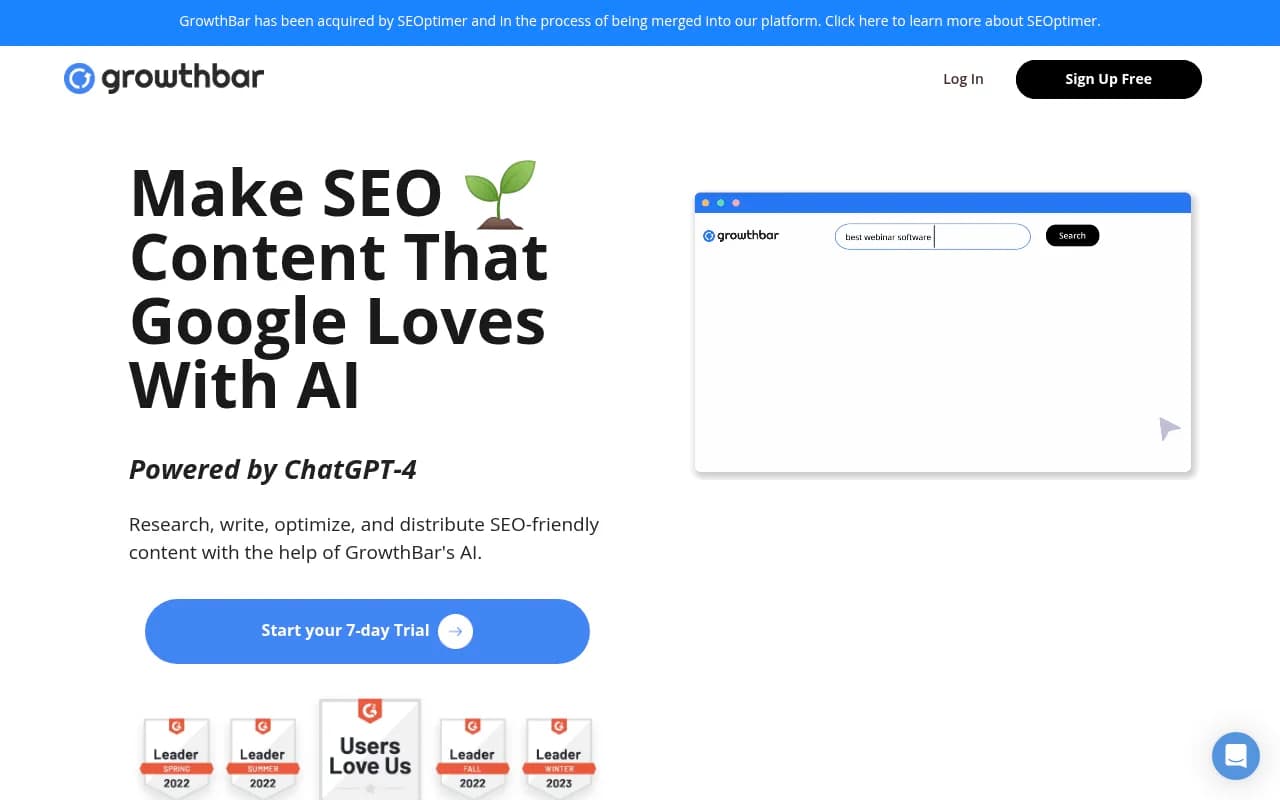
GrowthBar is a lightweight AI writing and SEO tool aimed at bloggers and small teams. At $36/mo (annual billing), it's one of the most affordable options. The tool combines keyword research, competitor analysis, and AI writing powered by GPT-4.
The workflow is simple: enter a keyword, GrowthBar generates an outline based on top-ranking content, then the AI writes a draft. You can edit in the built-in editor or export to Google Docs. The content quality is decent but not as polished as Surfer or Frase — expect to do significant editing.
GrowthBar includes a Chrome extension that shows you keyword data, backlinks, and Google Ads info for any page you visit. This is handy for quick competitive research. The rank tracking feature is basic but functional.
Best for: Solo bloggers and small teams that need a cheap, simple tool for AI writing and basic SEO. If you're just starting out and don't want to spend $100+/mo, GrowthBar is a solid entry point.
Trade-offs: The optimization features are minimal compared to Clearscope. You get keyword suggestions and word count targets, but not the detailed content scoring or real-time feedback. The AI writing is fast but often generic. No AI search visibility tracking.
Content Harmony
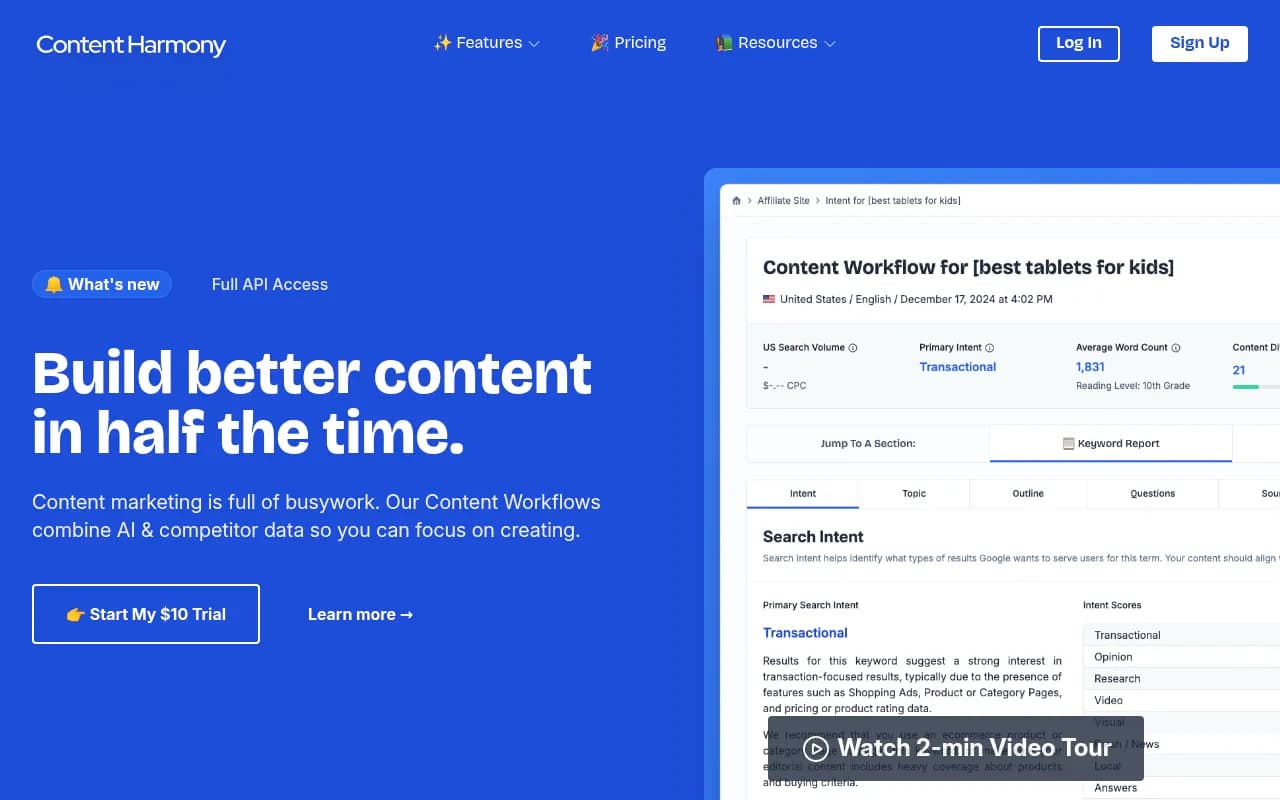
Content Harmony is a content brief builder designed for agencies and SEO teams that produce briefs at scale. It's not a real-time optimization tool like Clearscope — instead, it helps you create detailed briefs that writers can follow. The workflow analyzes search intent, competitor content, and keyword data, then generates a comprehensive brief with headings, questions to answer, and sources to cite.
The standout feature is the brief format itself. Content Harmony briefs are thorough and easy to follow, which makes them ideal for working with freelance writers or offshore teams. You can share briefs via link, and writers have everything they need to create optimized content without asking questions.
The Content Grader lets you score drafts against the brief to ensure they hit all the key points. This is useful for quality control when you're managing multiple writers.
Best for: Agencies and content teams that produce 20+ briefs per month and work with external writers. If you need a standardized brief format and workflow, Content Harmony is purpose-built for that.
Trade-offs: It's not a real-time optimization tool. You create the brief, hand it off, then grade the draft later. If you want live feedback as you write (like Clearscope or Surfer), this isn't it. Pricing is pay-as-you-go, which can add up if you're producing a lot of briefs. No AI search visibility features.
Dashword
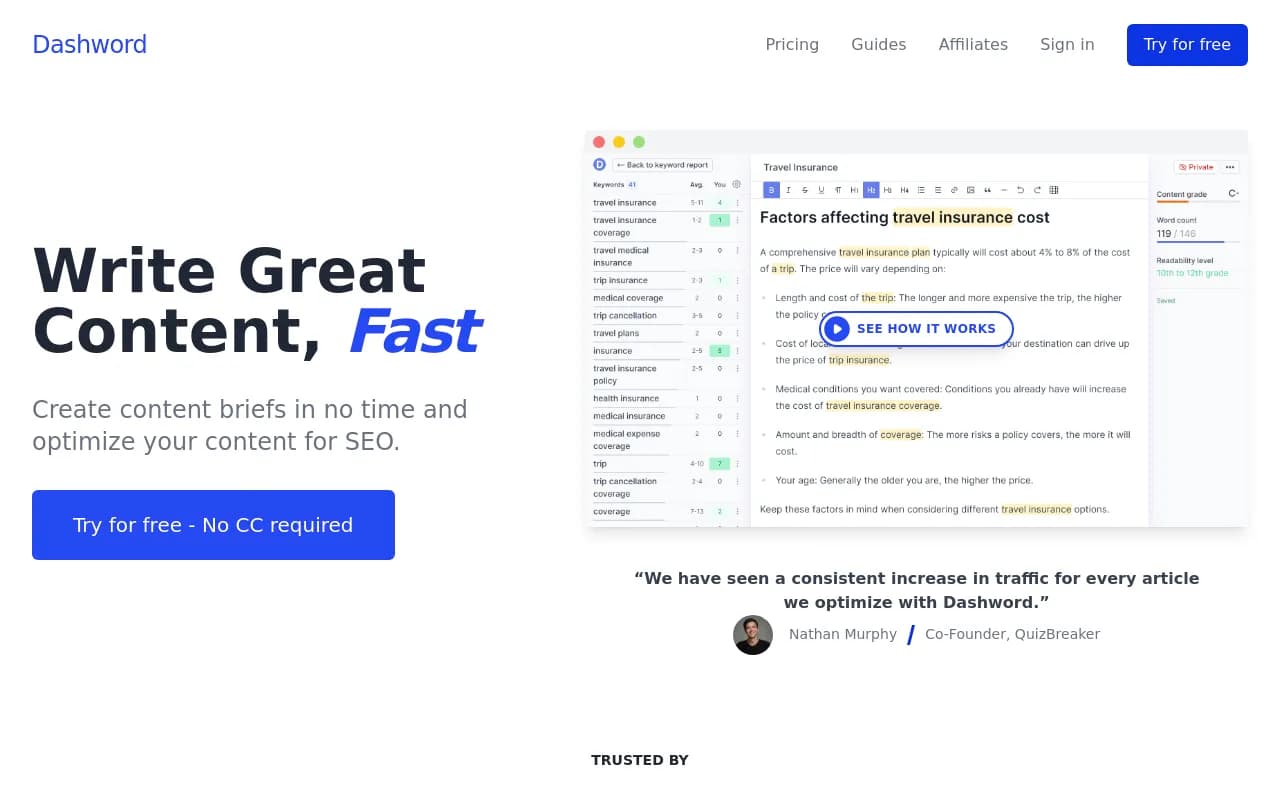
Dashword is a straightforward content optimization tool with a focus on simplicity. At $39/mo, it's priced similarly to Frase but with a more streamlined feature set. You create content briefs, optimize drafts with real-time feedback, and monitor published content for performance drops.
The brief builder compiles competitor outlines, keyword suggestions, and frequently asked questions. You can drag and drop elements into your brief, then share it with writers. The optimization editor provides a content score and keyword recommendations as you write.
The Content Monitoring feature is unique — Dashword tracks your published pages and alerts you if they start losing traffic or rankings. This is useful for identifying pages that need updates.
Best for: Small teams that want a simple, affordable tool without a steep learning curve. If you're overwhelmed by the complexity of MarketMuse or Clearscope, Dashword is a good middle ground.
Trade-offs: The feature set is limited compared to Surfer or Frase. You get the basics — briefs, optimization, monitoring — but not AI writing, advanced keyword research, or strategic planning. No AI search visibility tracking.
How to Choose the Right Clearscope Alternative
The best alternative depends on what you actually need:
If you want to dominate AI search (ChatGPT, Claude, Perplexity) alongside Google: Promptwatch is the only platform that tracks AI visibility, shows you content gaps, and helps you create content that gets cited by AI models. Pair it with Surfer or Frase for traditional SEO optimization.
If you want a direct Clearscope replacement with AI writing included: Surfer SEO is the closest match. Similar features, better pricing, and Surfer AI for generating drafts.
If you're on a tight budget and need an all-in-one tool: Frase gives you research, writing, and optimization for $39/mo. The quality isn't quite Clearscope-level, but it's 80% of the way there at 20% of the price.
If you're managing a large content operation and need strategic planning: MarketMuse is the enterprise choice. Personalized difficulty scoring, topic cluster analysis, and content inventory audits are unmatched.
If you already use Semrush: The Writing Assistant is included in your plan. It's not as robust as Clearscope, but it's free (with your subscription) and integrates seamlessly.
If you're a solo blogger or small team just starting out: GrowthBar is the cheapest option with AI writing. It's basic, but it works.
If you produce briefs at scale for external writers: Content Harmony is purpose-built for agencies that need standardized brief formats and quality control.
If you want something simple and affordable: Dashword covers the essentials without overwhelming you with features.
The content optimization landscape has evolved significantly in 2026. Traditional SEO tools like Clearscope are still valuable, but they're no longer enough. AI search engines are answering millions of queries that used to go to Google, and if your content isn't visible in those responses, you're missing a massive opportunity. The smartest teams are using a combination: a traditional SEO tool (Surfer, Frase, or Clearscope) for Google optimization, and Promptwatch for AI search visibility. That's how you win in 2026.