Key Takeaways
- Frase is the top alternative for SEO-focused content teams who need research, writing, and optimization in one platform—plus AI search visibility tracking across ChatGPT and Perplexity
- Simplified offers the best all-in-one value for solo creators and small teams, combining AI writing with design, video, and social media scheduling starting at $19/month
- Writesonic now focuses on AI search visibility tracking and GEO optimization, making it ideal for brands prioritizing citations in ChatGPT and AI search engines
- Jasper is built for enterprise marketing teams that need brand control, compliance workflows, and 100+ specialized AI agents—but comes with enterprise pricing
- AirOps bridges the gap between content creation and AI search performance, offering end-to-end workflows from gap analysis to citation tracking
Copy.ai was acquired by Fullcast in 2024 and repositioned as a go-to-market (GTM) AI platform focused on sales and marketing automation. If you originally used Copy.ai for AI copywriting, email generation, or content creation, you'll need a different tool. The good news: there are now better alternatives built specifically for content teams, SEO workflows, and AI search visibility.
Here's what to consider when switching: Do you need SEO research and optimization tools, or just fast AI writing? Are you a solo creator or part of a marketing team? Do you care about ranking in traditional Google search, AI search engines like ChatGPT and Perplexity, or both? Your answers will determine which alternative fits best.
Frase
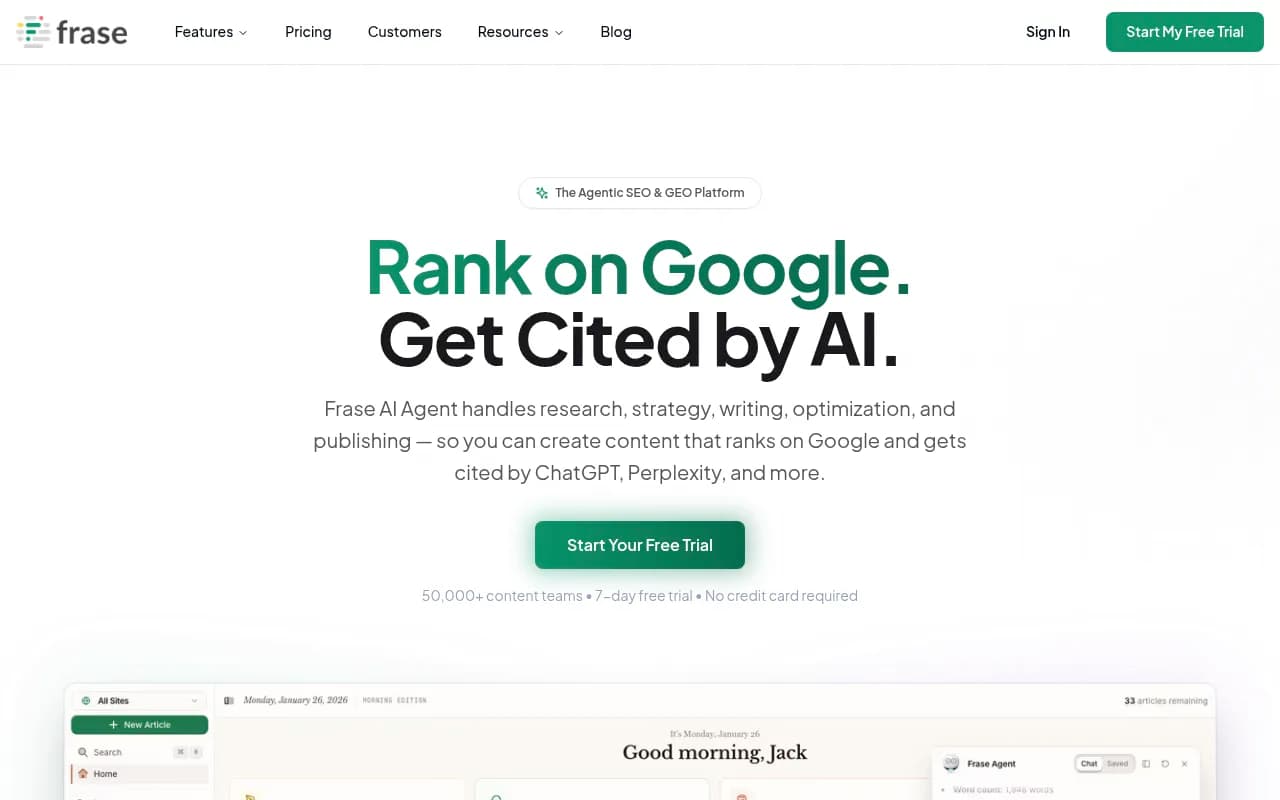
Frase combines AI writing with SEO research and optimization in a single workflow. Unlike Copy.ai's original focus on short-form marketing copy, Frase is built for long-form content that needs to rank. You start with a target keyword, Frase analyzes the top-ranking pages, generates an outline based on competitor content, and then helps you write and optimize the article—all without leaving the platform.
What sets Frase apart is its recent expansion into AI search visibility tracking. The platform now monitors how your content appears in ChatGPT, Perplexity, Google AI Overviews, and seven other AI models. You can see which prompts trigger citations to your site, track competitor mentions, and identify content gaps where AI models recommend competitors but not you. This makes Frase one of the few tools that bridges traditional SEO and Generative Engine Optimization (GEO) in a single platform.
The AI writing quality is strong—Frase uses multiple language models and pulls context from your research panel, so outputs feel grounded rather than generic. The content brief builder is particularly useful: it auto-generates headings, questions, and statistics based on what's already ranking, giving you a clear roadmap before you start writing. The optimization panel shows real-time content scores and suggests missing topics, headers, and keywords as you write.
Pricing starts at $39/month (Starter plan with 7-day free trial), $103/month (Professional), and $239/month (Scale). All plans include unlimited AI writing, SEO research, and optimization. AI search tracking is available on Professional and Scale plans. The main limitation: Frase is overkill if you only need quick social media captions or ad copy. It's designed for content teams producing blog posts, guides, and landing pages that need to perform in search.
Best for: SEO content teams, agencies, and marketers who need research, writing, optimization, and AI search tracking in one platform.
Simplified
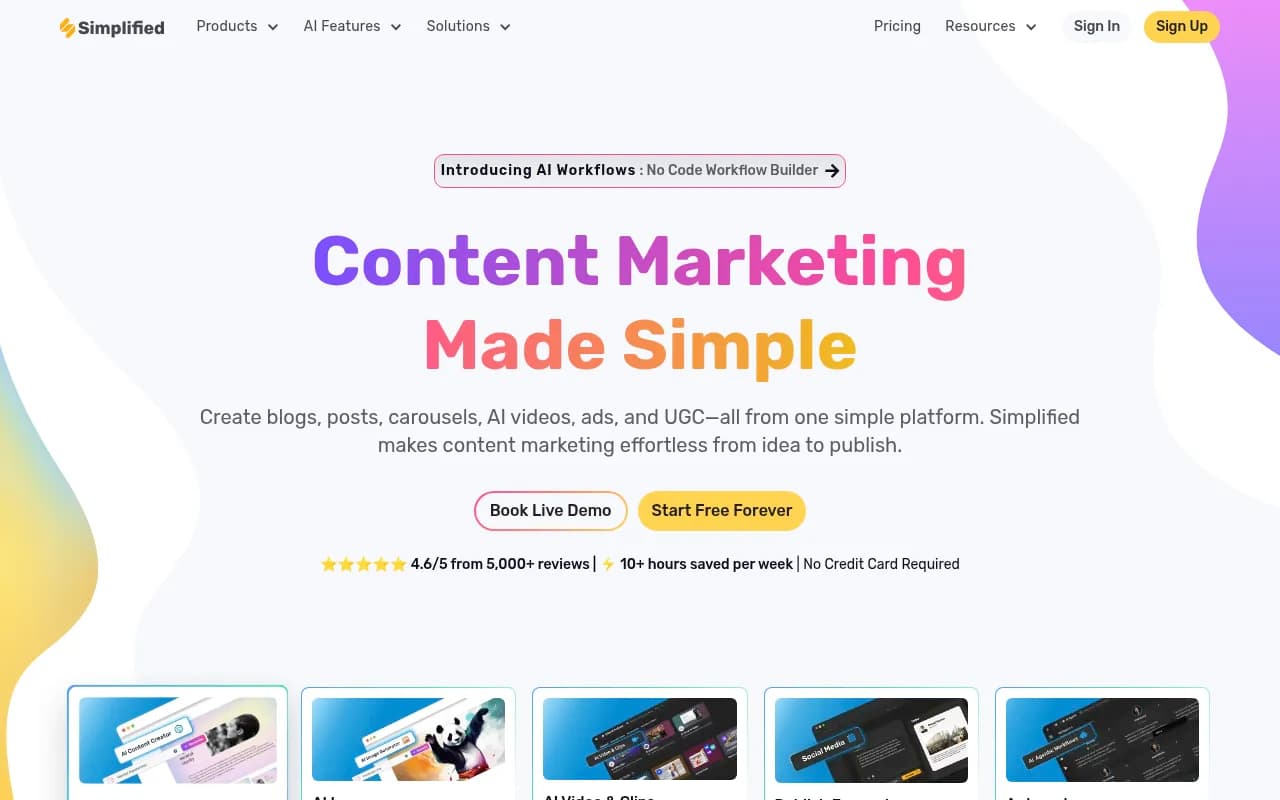
Simplified is an all-in-one marketing platform that combines AI writing with graphic design, video editing, and social media management. If Copy.ai felt too narrow (just writing) or you're tired of juggling five different tools, Simplified consolidates everything into a single workspace. You can write a blog post, design a thumbnail, create a short video, and schedule it to Instagram—all without switching apps.
The AI writing features cover 80+ templates including blog posts, product descriptions, social captions, ad copy, and email sequences. Quality is solid for short-form content, though it's not as SEO-focused as Frase or AirOps. Where Simplified shines is speed and versatility: you can generate a first draft in seconds, then immediately jump into the design editor to create matching visuals. The platform includes 100,000+ free stock images, videos, and audio clips, plus thousands of templates for social posts, presentations, and ads.
The social media scheduler supports all major platforms (Instagram, Facebook, LinkedIn, TikTok, Twitter, Pinterest, YouTube) with calendar view, bulk scheduling, and analytics. The project management features let you organize campaigns, assign tasks to team members, and collaborate in real-time. For solo creators and small teams, this is a massive time-saver—you're not constantly exporting files and switching between Canva, Descript, Buffer, and Google Docs.
Pricing is aggressive: Free tier available, then $19/month (Small Team), $39/month (Business), and $79/month (Growth). Annual billing saves 20%. Enterprise plans available for larger teams. The free tier is surprisingly generous—unlimited design projects, 2,000 AI words per month, and access to the full template library. The main trade-off: Simplified prioritizes breadth over depth. If you need advanced SEO research or AI search tracking, you'll want Frase or Writesonic. But if you need a Swiss Army knife for content marketing, Simplified delivers.
Best for: Solo creators, small marketing teams, and agencies that need design, video, writing, and social scheduling in one affordable platform.
Writesonic

Writesonic started as an AI copywriting tool but pivoted hard into AI search visibility tracking and Generative Engine Optimization (GEO). The platform now monitors how your brand appears across ChatGPT, Perplexity, Google AI Overviews, Claude, Gemini, and six other AI models. If you care about being cited and recommended by AI search engines—not just ranking on Google—Writesonic is one of the most comprehensive tracking platforms available.
The core workflow: Writesonic tracks thousands of prompts related to your industry, shows you which ones mention your brand (or competitors), and identifies content gaps where you're invisible. You can see historical trends, citation sources (which pages AI models are pulling from), and competitor share of voice across different AI platforms. The platform also includes tools for creating and refreshing content specifically optimized for AI citations, though the writing features are less robust than dedicated content platforms like Frase or AirOps.
What Writesonic does well: comprehensive AI search monitoring, competitor analysis, and citation tracking. The dashboard shows exactly where you're winning and losing in AI-generated responses. You can filter by AI platform, prompt category, and geography to understand how different models represent your brand. The platform also tracks Reddit mentions and user-generated content that influences AI recommendations—a channel most competitors ignore.
The main limitation: Writesonic is now primarily a monitoring and tracking platform, not a full content creation suite. If you need advanced SEO research, content briefs, or high-volume article generation, you'll want to pair it with another tool. Pricing details aren't publicly listed—contact their sales team for a quote. Expect pricing similar to other GEO platforms (likely $200-500/month for small teams, custom pricing for enterprise).
Best for: Brands and marketing teams focused on AI search visibility, citation tracking, and understanding how ChatGPT and Perplexity represent their brand.
AirOps
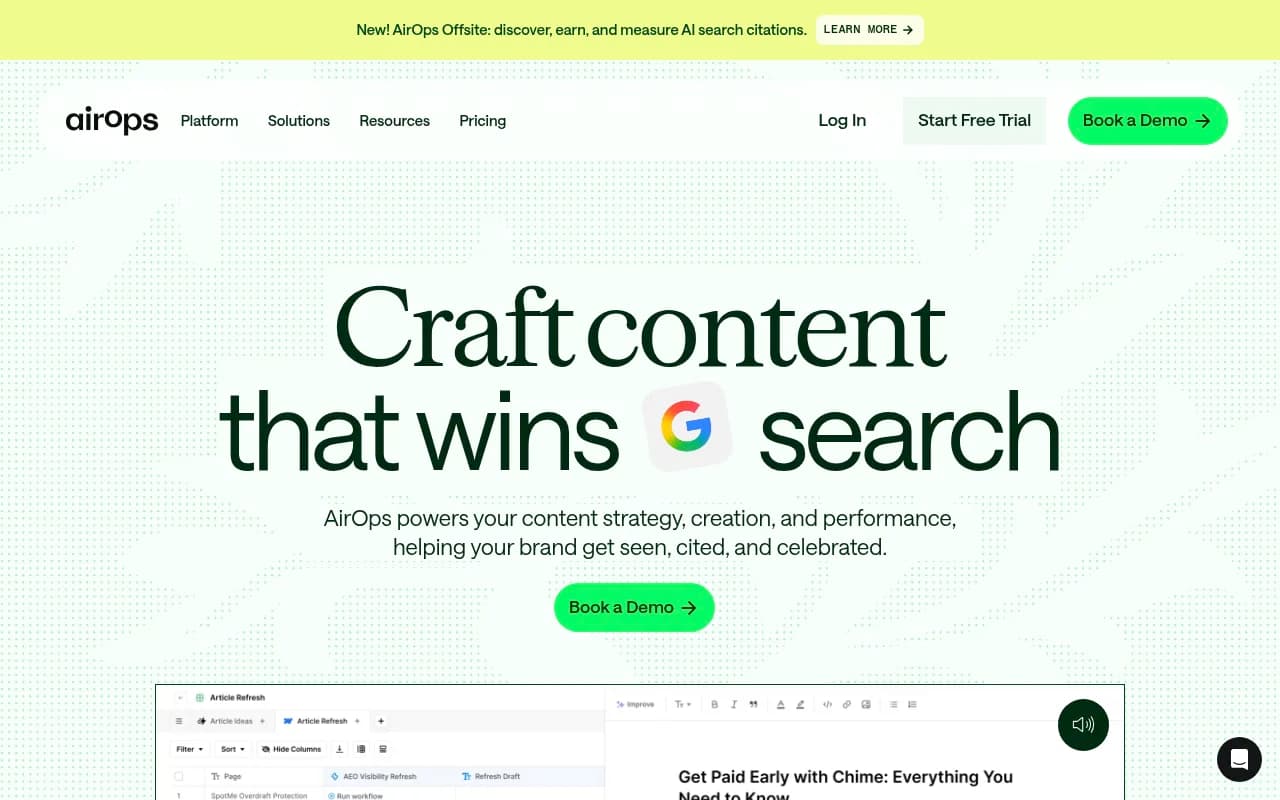
AirOps is an end-to-end content engineering platform that connects AI search insights to content creation and performance tracking. Used by Webflow, Chime, Ramp, and Carta, it's designed for marketing teams that want to increase citations and visibility in AI search engines while also producing high-quality content at scale.
The platform starts with AI search monitoring: track how your brand appears in ChatGPT, Perplexity, Google AI Overviews, and other AI models. AirOps shows you which prompts trigger citations, identifies content gaps where competitors are mentioned but you're not, and surfaces Reddit discussions and YouTube videos that influence AI recommendations. This is similar to Writesonic's tracking, but AirOps goes further by helping you act on the insights.
The content creation workflow is where AirOps differentiates itself. The platform includes AI-powered writing tools that generate articles, listicles, and comparison pages grounded in real citation data and competitor analysis. You're not just writing generic SEO content—you're creating content engineered to get cited by AI models. AirOps also includes content optimization features, suggesting improvements to existing pages based on what AI engines are looking for.
Case study results are strong: Webflow increased AI-attributed signups by 6% in days and 5x'd their content refresh velocity. Chime went from 24 to 68 priority citations in AI search results. These aren't vanity metrics—teams are seeing real traffic and conversion impact from improving AI search visibility.
Pricing: Free tier (1,000 tasks/month), then $199/month (Starter: 10,000 tasks/month). Scale and Enterprise plans available with custom pricing. The free tier is useful for testing workflows, but serious content teams will need a paid plan. The main trade-off: AirOps is more complex than simple writing tools like Rytr or Simplified. There's a learning curve, but the payoff is a complete system for AI search optimization.
Best for: Content teams and agencies that want to increase AI search citations while also producing high-quality, optimized content at scale.
Scalenut
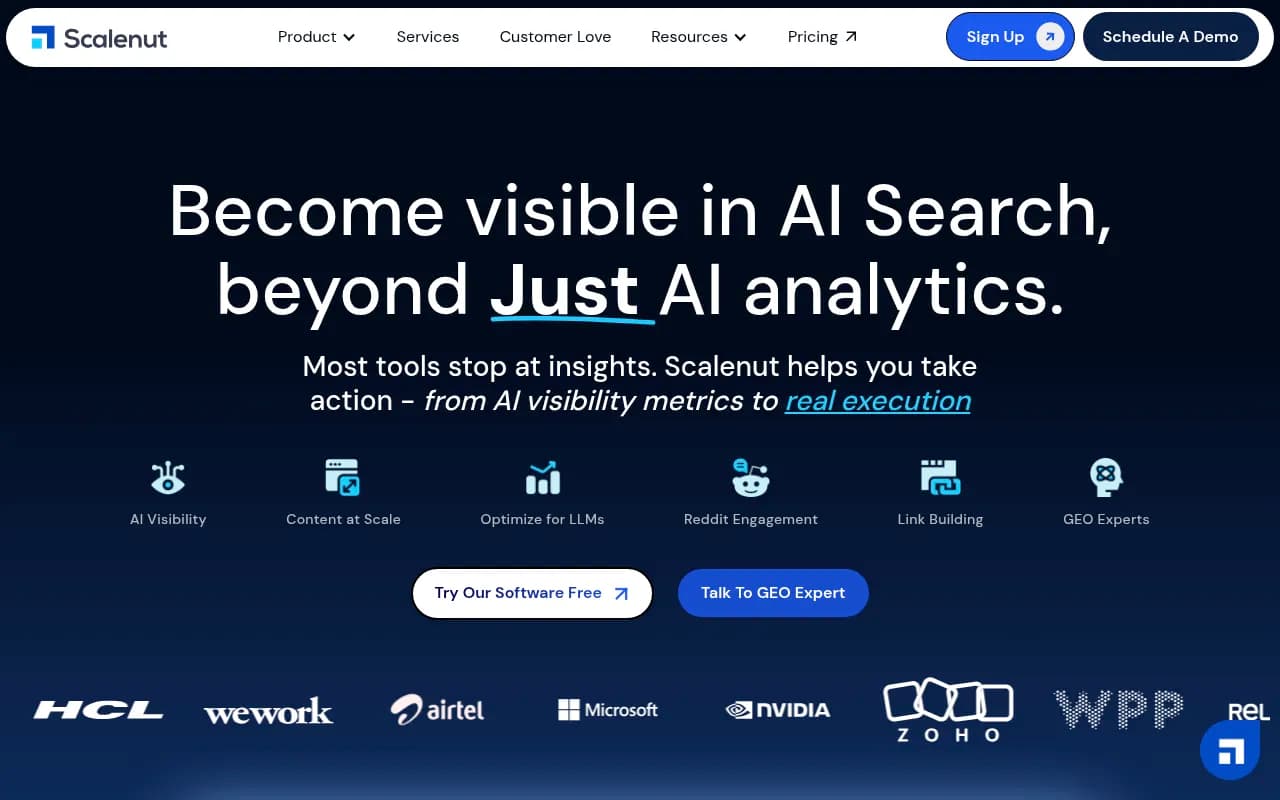
Scalenut is an AI-powered SEO and content marketing platform that recently added AI search visibility tracking to its feature set. The platform combines traditional SEO tools (keyword research, content briefs, optimization) with newer GEO capabilities (AI citation tracking, prompt coverage, competitor analysis across ChatGPT and Perplexity).
The workflow: start with keyword research and content planning, generate AI-written drafts using Scalenut's built-in writing engine, optimize for both Google and AI search engines, and track performance over time. Scalenut shows you brand mentions, historical trends, prompt coverage, and competitor share across multiple AI platforms. The platform also includes a content audit tool that analyzes your existing pages and suggests improvements to increase AI citations.
What sets Scalenut apart is the combination of traditional SEO and AI search optimization in a single platform. You're not choosing between ranking on Google or getting cited by ChatGPT—you're optimizing for both simultaneously. The GEO score feature evaluates how well your content is structured for AI citations, similar to how traditional SEO tools score content for search engines.
Scalenut also offers managed GEO services starting around $3,000/month, where their team handles strategy and execution for you. This is useful for companies that want AI search visibility but don't have the internal resources to manage it.
Pricing: Usage-based starting around $39-79/month for basic plans, $149-499/month for full platform access including AI search tracking. 7-day free trial available. The main limitation: Scalenut tries to do everything, which means some features feel less polished than specialized tools. The AI writing quality is decent but not as strong as Jasper or Frase. The AI search tracking is comprehensive but not as detailed as Writesonic or AirOps.
Best for: Marketing teams that want a single platform for traditional SEO and AI search optimization, with the option to upgrade to managed services.
Jasper
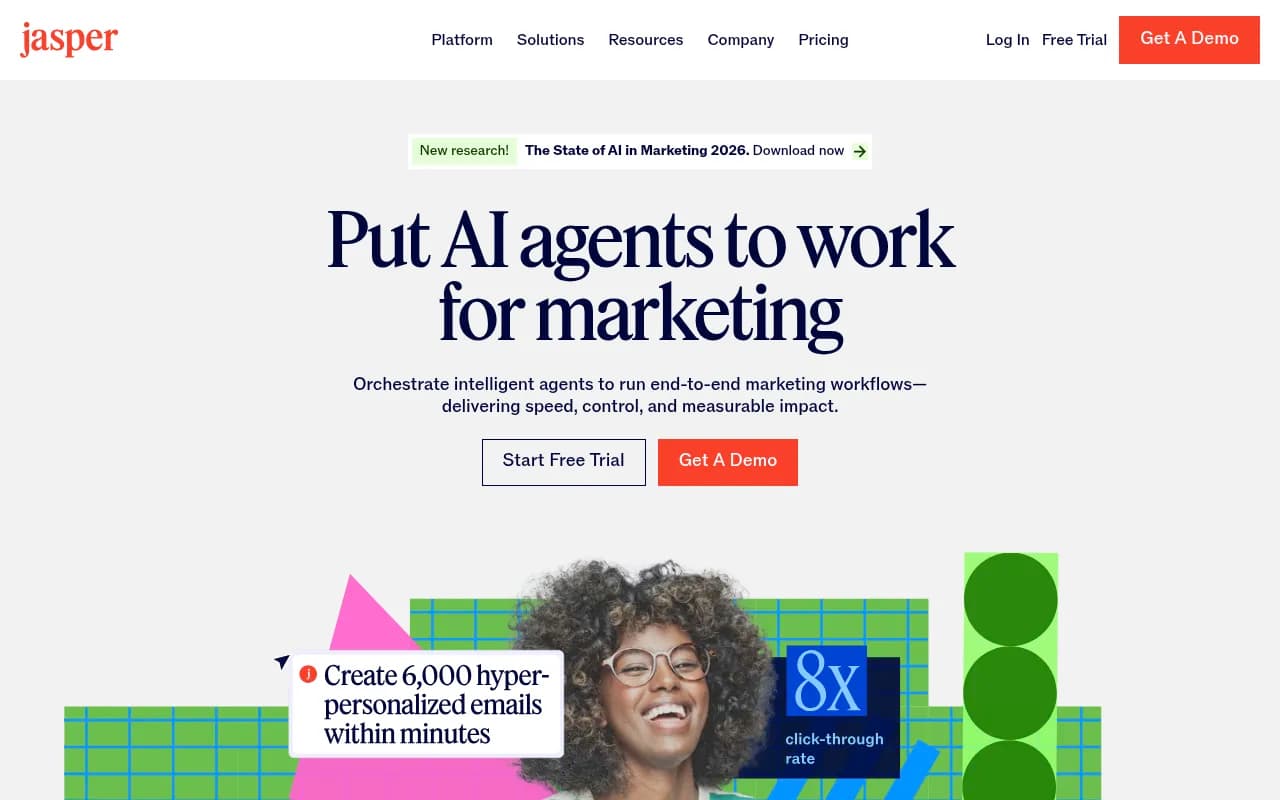
Jasper is an enterprise AI marketing platform built for large marketing teams that need brand control, compliance workflows, and the ability to automate content at scale. It's significantly more expensive than other alternatives, but offers features that smaller tools can't match: 100+ specialized AI agents, content pipelines that automate entire workflows, and brand intelligence features that ensure every piece of content matches your style guide and visual guidelines.
The platform includes Jasper IQ, a proprietary context hub that stores brand voice, visual guidelines, style guides, audience insights, and marketing best practices. Every AI agent and workflow pulls from this knowledge base, ensuring consistency across all content. This is critical for enterprise brands where off-brand content can damage reputation or violate compliance requirements.
Jasper's AI agents are specialized for specific marketing tasks: email campaigns, social media posts, product descriptions, ad copy, blog posts, and more. You can build custom agents in Jasper Studio (a no-code interface) or use pre-built templates. The content pipelines feature connects data sources, creative workflows, and distribution channels in a single automated system—useful for teams producing hundreds of assets per month.
The main trade-offs: Jasper is expensive (starting at $59/month for Creator, $249/month for Pro teams, custom enterprise pricing), and it's overkill for solo creators or small teams. The platform is designed for companies with 10+ marketers, strict brand guidelines, and high-volume content needs. If you're a freelancer or small agency, you'll get better value from Simplified or Frase.
Jasper also doesn't include AI search visibility tracking or GEO features. It's focused on content creation and brand consistency, not monitoring how AI engines cite your content. If AI search visibility matters, pair Jasper with a tracking tool like Writesonic or AirOps.
Best for: Enterprise marketing teams at mid-to-large companies that need brand control, compliance workflows, and the ability to automate high-volume content production.
Rytr
Rytr is a straightforward AI writing assistant focused on short-form content. It's one of the most affordable options on this list, with a generous free tier and paid plans starting at low monthly rates. If you need quick social media captions, email responses, product descriptions, or ad copy—and don't need SEO research or AI search tracking—Rytr is a solid budget-friendly choice.
The platform offers 40+ content templates covering common marketing use cases: blog intros, Facebook ads, Instagram captions, email subject lines, product descriptions, and more. You select a template, provide a few inputs (topic, tone, keywords), and Rytr generates multiple variations. The interface is clean and beginner-friendly—no learning curve, just pick a template and go.
Rytr's AI quality is decent for short-form content, though it's not as sophisticated as Jasper or Frase for long-form articles. The tool is best for generating first drafts quickly, which you then edit and refine. It's not designed for SEO optimization, content research, or AI search visibility—it's purely a writing assistant.
The main appeal is price and simplicity. Rytr is accessible anywhere you write (browser extension available), and the free tier includes enough credits for casual use. Paid plans are affordable compared to enterprise platforms like Jasper or comprehensive tools like Frase. The trade-off: you're getting basic AI writing without the advanced features that content teams need for SEO, optimization, or AI search performance.
Best for: Freelancers, solo creators, and small businesses that need affordable AI writing for short-form marketing content without advanced SEO or tracking features.
How to Choose the Right Copy.ai Alternative
The best alternative depends on what you actually need:
For SEO-focused content teams: Frase is the clear winner. You get research, writing, optimization, and AI search tracking in one platform. It's designed for producing blog posts and guides that rank on Google and get cited by ChatGPT.
For solo creators and small teams on a budget: Simplified offers the best value. You get AI writing, design, video, and social media scheduling for $19-39/month. It's not as SEO-focused as Frase, but it replaces 4-5 tools with one affordable platform.
For brands prioritizing AI search visibility: Writesonic or AirOps. Both platforms track citations across ChatGPT, Perplexity, and other AI engines. AirOps goes further by helping you create content optimized for AI citations, while Writesonic focuses more on monitoring and competitor analysis.
For enterprise marketing teams: Jasper is built for large organizations that need brand control, compliance workflows, and the ability to automate high-volume content production. It's expensive, but offers features smaller tools can't match.
For traditional SEO + AI search optimization: Scalenut combines both in a single platform. It's not the best at either individually, but it's convenient if you want one tool for both Google rankings and AI citations.
For budget-conscious users who just need AI writing: Rytr is the most affordable option. It's not designed for SEO or AI search tracking, but it's perfect for quick social media posts, emails, and ad copy.
The landscape has shifted significantly since Copy.ai's early days. AI writing tools are no longer just about generating text—they're about optimizing for search engines (both traditional and AI-powered), tracking performance, and integrating with broader marketing workflows. Choose the tool that matches where you're actually trying to win: Google search, AI search, or both.