Key takeaways
- Surfer SEO is the most direct upgrade from Dashword if you want more data depth and AI search tracking, but you'll pay significantly more for it.
- Frase and NeuronWriter are the closest price-matched alternatives -- both start around $39/mo and cover research, briefs, and optimization in one workflow.
- Clearscope and MarketMuse are better fits for enterprise content teams where quality consistency matters more than cost.
- Rankability and Search Atlas are worth looking at if you're an agency managing multiple clients and need AI search (AEO) tracking alongside traditional SEO.
- Promptwatch is in a different category entirely -- it's the right choice if your priority is understanding and improving how AI models like ChatGPT and Perplexity mention your brand, rather than optimizing content for Google rankings.
- Content Harmony is the best pick if brief quality is your bottleneck and you want a focused, no-bloat tool for that specific job.
Dashword is a solid, no-frills content optimization tool. It does three things: builds content briefs, scores your content in real time as you write, and monitors published pages for traffic drops. At $39/month, it's one of the more affordable options in this space, and the free trial with no credit card required makes it easy to test.
So why are people looking for alternatives?
A few common reasons come up. The keyword data and NLP analysis in Dashword is functional but not as deep as competitors like Surfer or Clearscope. The AI writing features are limited compared to tools that have invested heavily in generation. There's no real topical authority mapping. And for teams that now care about AI search visibility -- whether their content gets cited by ChatGPT or appears in Perplexity -- Dashword doesn't offer anything there.
If any of those gaps match what you're running into, here's an honest look at the alternatives.
The alternatives
Surfer SEO
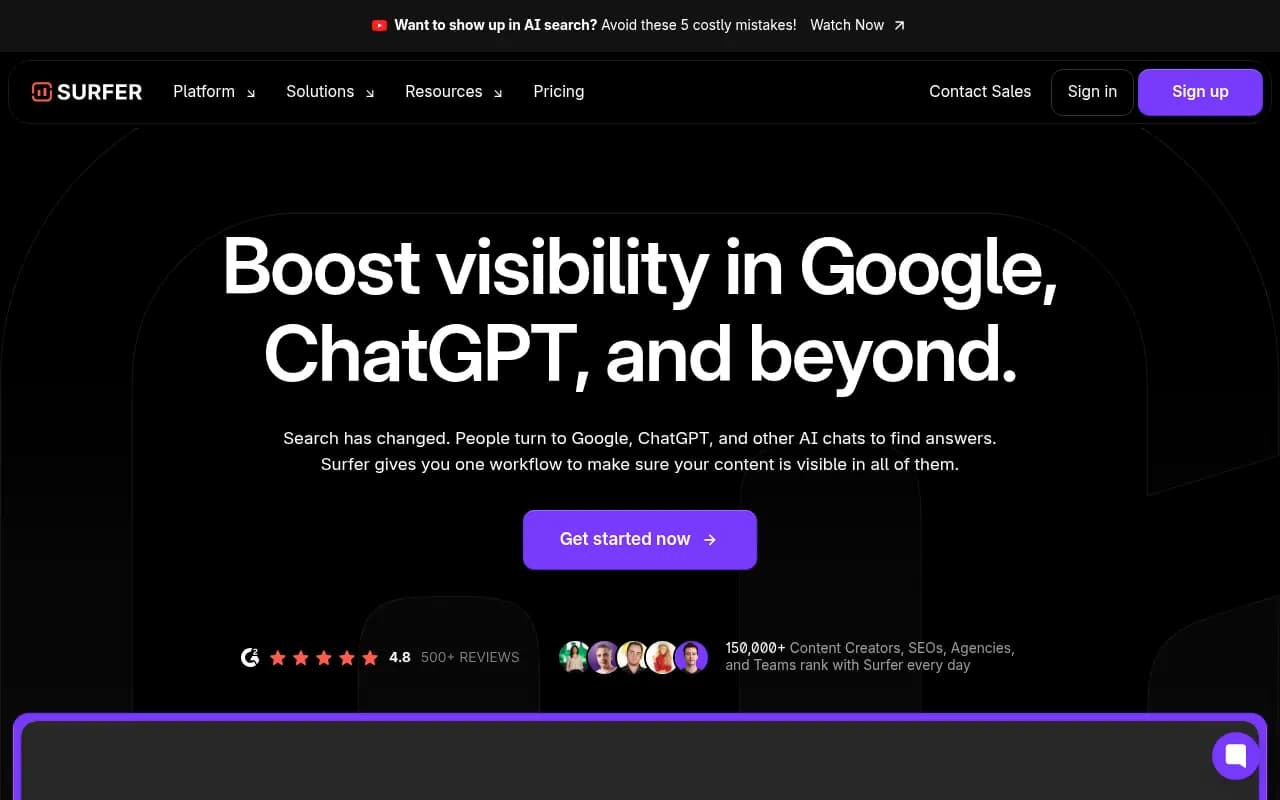
Surfer is the most well-known content optimization platform in this space, and for good reason. Its Content Editor is genuinely useful: it analyzes the top-ranking pages for your target keyword, extracts NLP terms, and gives you a real-time score as you write. The data feels more granular than Dashword's -- you get word count targets, heading structure suggestions, and term frequency guidance that's grounded in what's actually ranking.
Where Surfer has moved beyond pure content optimization is its AI search tracking. The platform now positions itself as an "AI visibility platform," tracking how content performs in ChatGPT, Perplexity, and Gemini alongside Google. This is a meaningful addition for teams that want one tool covering both traditional and AI search -- though the AI tracking features are newer and less mature than dedicated tools built specifically for that purpose.
The Surfer AI article generation feature is capable, though it costs additional credits on top of your plan. The Topical Map tool is genuinely useful for planning content clusters rather than just individual articles.
The main downside is price. Surfer starts at $99/month (billed annually) for the Essential plan -- more than double Dashword's entry point. The Advanced plan at $179/month is where most serious teams land. If you're a solo operator or small team on a budget, that's a real jump.
Pricing: $99/mo (Essential), $179/mo (Advanced), $299/mo (Max). 7-day money-back guarantee.
Best for: Content teams that want the most established optimization workflow in the market and are willing to pay for it. Also a reasonable choice if you want basic AI search visibility alongside content optimization without managing two separate tools.
Promptwatch

Promptwatch is not a Dashword alternative in the traditional sense -- it doesn't help you write or optimize content for Google rankings. But it belongs in this list because the question many content teams are now asking isn't just "how do I rank on Google?" but "how do I get cited by ChatGPT and Perplexity?"
That's exactly what Promptwatch is built for. It tracks your brand's visibility across 10 AI models (ChatGPT, Claude, Gemini, Perplexity, Grok, DeepSeek, Copilot, Mistral, Meta AI, and Google AI Overviews), shows you which prompts your competitors appear for that you don't, and then helps you do something about it. The Answer Gap Analysis identifies the specific topics and questions AI models want to answer but can't find on your site. The built-in content agent then generates articles grounded in real citation data -- content engineered to get cited, not just to rank.
It also has features most competitors in the AI visibility space don't: real-time AI crawler logs (so you can see when ChatGPT or Claude actually reads your pages), Reddit and YouTube citation tracking, ChatGPT Shopping monitoring, and traffic attribution that connects AI visibility to actual revenue.
If you're using Dashword purely for Google SEO and that's working fine, you may not need Promptwatch yet. But if AI search is already driving traffic in your category -- or you're watching competitors get cited in ChatGPT responses while you're invisible -- this is the tool to look at.
Pricing: From $99/mo (Essential, 1 site, 50 prompts), $249/mo (Professional), $579/mo (Business). Free trial available.
Best for: Marketing and SEO teams that want to understand and improve their brand's presence in AI-generated responses. Especially relevant for brands in competitive categories where AI search is already influencing purchase decisions.
Rankability
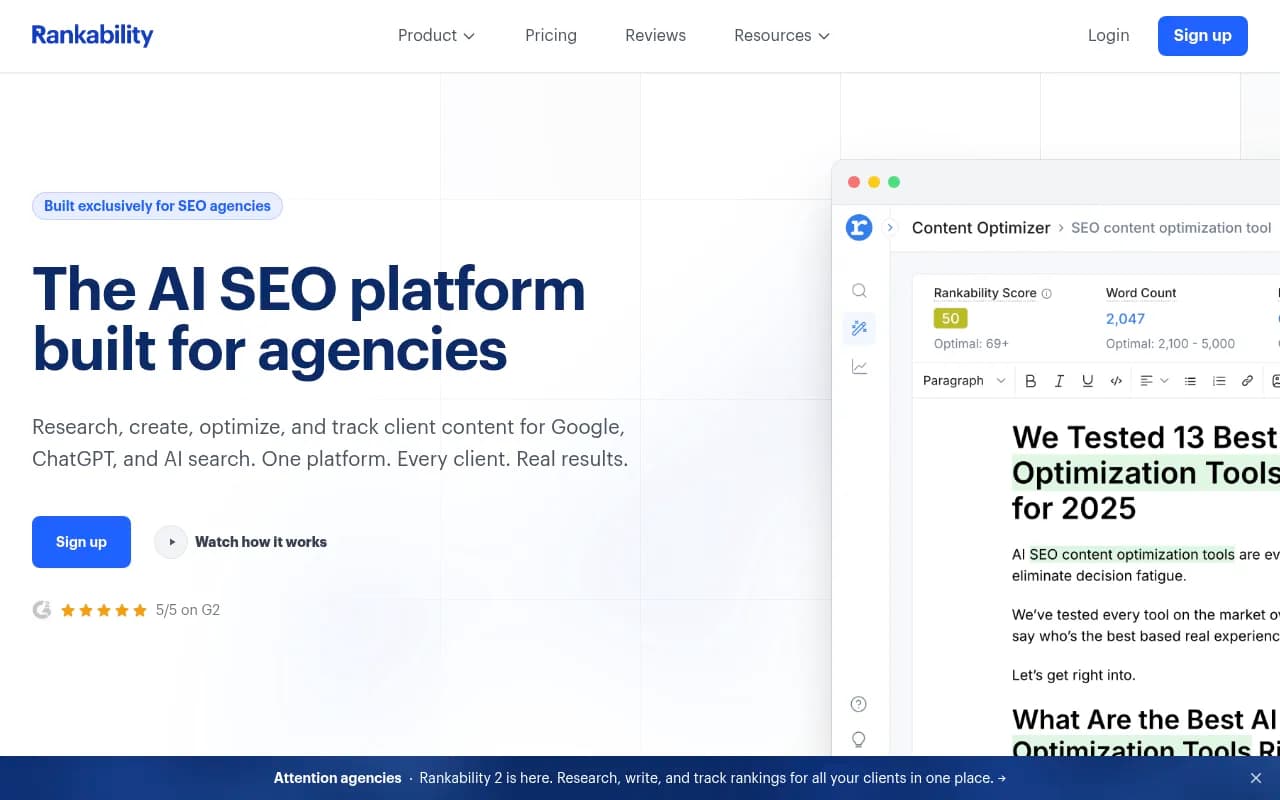
Rankability is positioned squarely at agencies, and it shows in the feature set. It combines keyword research, NLP-based content optimization, brief generation, and AI search tracking (AEO) in one connected workflow. The multi-client dashboard is clean, and the team collaboration features are better than most tools in this price range.
The AEO tracking -- monitoring how clients appear in ChatGPT, Gemini, and Perplexity -- is a genuine differentiator compared to Dashword. For agencies whose clients are starting to ask "why aren't we showing up in AI answers?", Rankability gives you something to show them.
Compared to Dashword, the content brief quality is stronger, with more competitor data and NLP guidance. The optimization scoring is more detailed. But the interface is more complex, and the learning curve is steeper. It's not a tool you hand to a freelance writer and expect them to figure out in an hour.
Pricing: From $149/mo (SEO Specialist) to $449/mo (SEO Master). Free trial available.
Best for: Agencies managing multiple client accounts who need a single platform covering both traditional SEO content work and AI search visibility reporting.
Scalenut

Scalenut has evolved into something more ambitious than a simple content optimization tool. It now offers both a self-serve platform and a managed service model where their team (plus AI agents) handles strategy, content creation, and AI visibility optimization on your behalf. The managed service starts around $3,000/month, which is a completely different budget category.
The self-serve platform covers keyword research, content planning, NLP-based optimization, and AI writing. The interface is reasonably polished and the AI writing quality is decent. For teams that want more AI-assisted writing than Dashword offers, Scalenut is worth testing.
The honest trade-off: Scalenut tries to do a lot, and the breadth sometimes comes at the expense of depth. The optimization scoring isn't as precise as Surfer or Clearscope. The AI writing is useful but not exceptional. It's a reasonable all-in-one choice for teams that don't want to manage multiple specialized tools.
Pricing: Self-serve plans from roughly $39-$79/mo for basic tiers, $149-$499/mo for full platform access. Managed GEO services from ~$3,000/mo.
Best for: Teams that want an all-in-one platform covering content creation and optimization, or businesses that want to outsource the entire SEO and AI visibility function to a managed service.
Frase
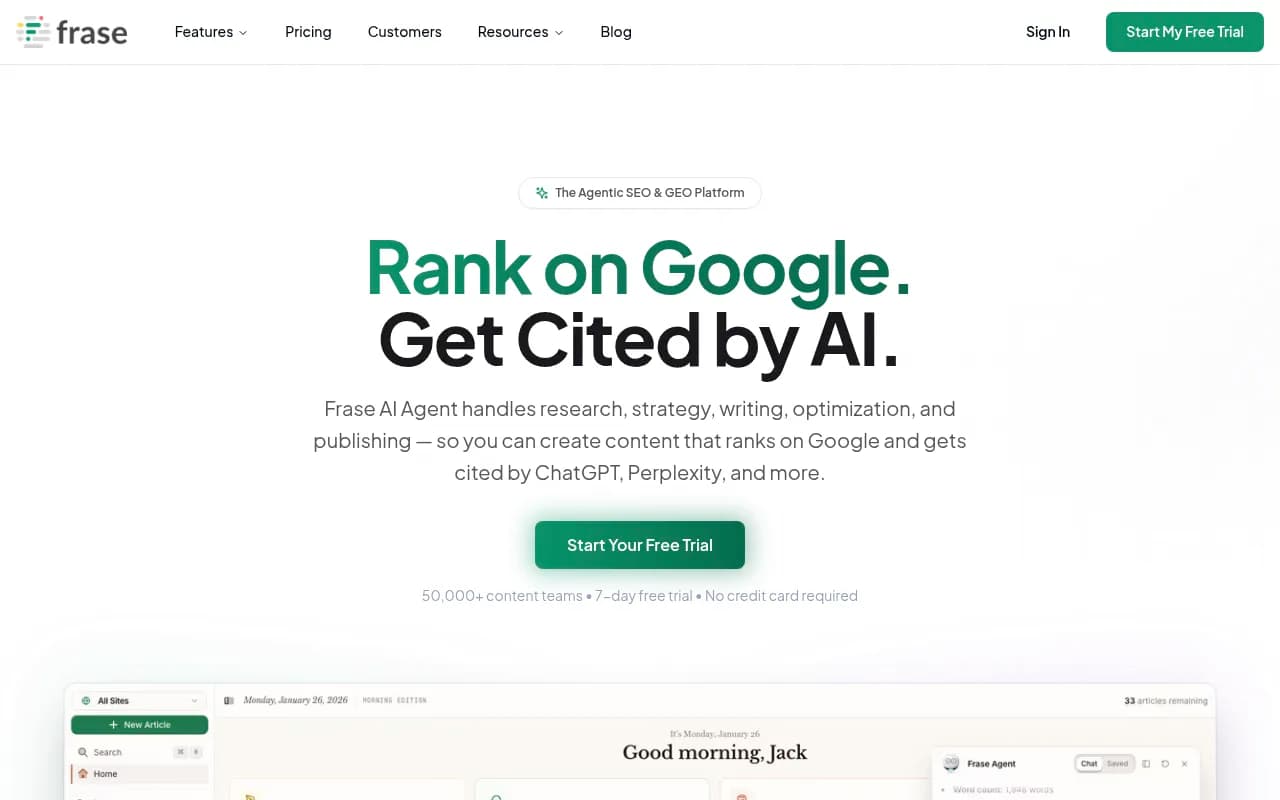
Frase is one of the most direct Dashword alternatives in terms of price and workflow. It starts at $39/month, covers research, brief creation, optimization, and AI writing, and has recently added GEO scoring to track visibility in ChatGPT and Perplexity alongside Google.
The research workflow is one of Frase's strengths. It pulls together SERP data, competitor content, and "People Also Ask" questions quickly, and the brief builder is intuitive. The AI writing assistant is more capable than Dashword's, with an "agentic" mode that can handle more of the content creation process with less manual input.
The GEO Score feature is newer and still developing, but it's a meaningful step toward helping content teams understand AI search performance without switching to a separate tool.
Where Frase falls short compared to Surfer or Clearscope is in the depth of its optimization data. The NLP term suggestions are useful but less comprehensive. For teams producing high-volume content where brief quality is the bottleneck, Frase is a strong choice. For teams trying to squeeze every ranking advantage out of a competitive keyword, you might want more data.
Pricing: $39/mo (Starter), $103/mo (Professional), $239/mo (Scale). 7-day free trial.
Best for: Content teams and freelancers who want a capable all-in-one tool at a reasonable price, especially those who do a lot of research-heavy content and want AI writing assistance built in.
MarketMuse
MarketMuse takes a different approach than most tools in this list. Rather than optimizing individual articles, it focuses on topical authority -- analyzing your entire content inventory, identifying clusters where you already have authority, and showing you where to invest next to maximize ranking potential.
The "personalized difficulty" scoring is genuinely useful: instead of showing you how hard a keyword is to rank for in general, it shows how hard it is for your specific site based on your existing content. That's a meaningful difference for content strategy decisions.
The trade-off is complexity and price. MarketMuse is not a quick tool to pick up. The free plan is limited, and the Standard plan at ~$149/month is where you get real value. Enterprise pricing goes significantly higher. For a solo content marketer or small team, it's probably overkill.
Compared to Dashword, MarketMuse is less focused on the brief-and-optimize workflow and more focused on strategic planning. If you're trying to figure out what to write, MarketMuse is excellent. If you know what you're writing and just need to optimize it, other tools are faster.
Pricing: Free plan available. Standard from ~$149/mo. Premium/Enterprise pricing on request.
Best for: Content strategists and larger teams who want to make data-driven decisions about which topics to pursue, not just how to optimize individual pieces.
Clearscope

Clearscope has a reputation for being the tool that enterprise content teams trust when quality consistency really matters. The content grading is clean and easy to understand -- writers can see their score improve in real time without needing to understand the underlying methodology. That simplicity is a feature, not a limitation.
The platform has expanded to cover AI search visibility alongside Google, tracking how content performs in ChatGPT and Gemini. The topic exploration feature helps teams build content clusters rather than chasing individual keywords.
The main barrier is price. At $189/month for the Essentials plan, Clearscope is significantly more expensive than Dashword. There's no free trial, though demos are available. For teams where the cost is justified by the volume of content being produced, it's worth it. For smaller teams or individuals, it's hard to make the math work.
Compared to Dashword, Clearscope's optimization guidance is more detailed and the interface is cleaner for writers who aren't SEO experts. The content monitoring is less prominent than Dashword's dedicated monitoring feature, though.
Pricing: From $189/mo (Essentials). Business and Enterprise plans with custom pricing.
Best for: Enterprise content teams and larger agencies where writer adoption and content quality consistency are the primary concerns.
NeuronWriter
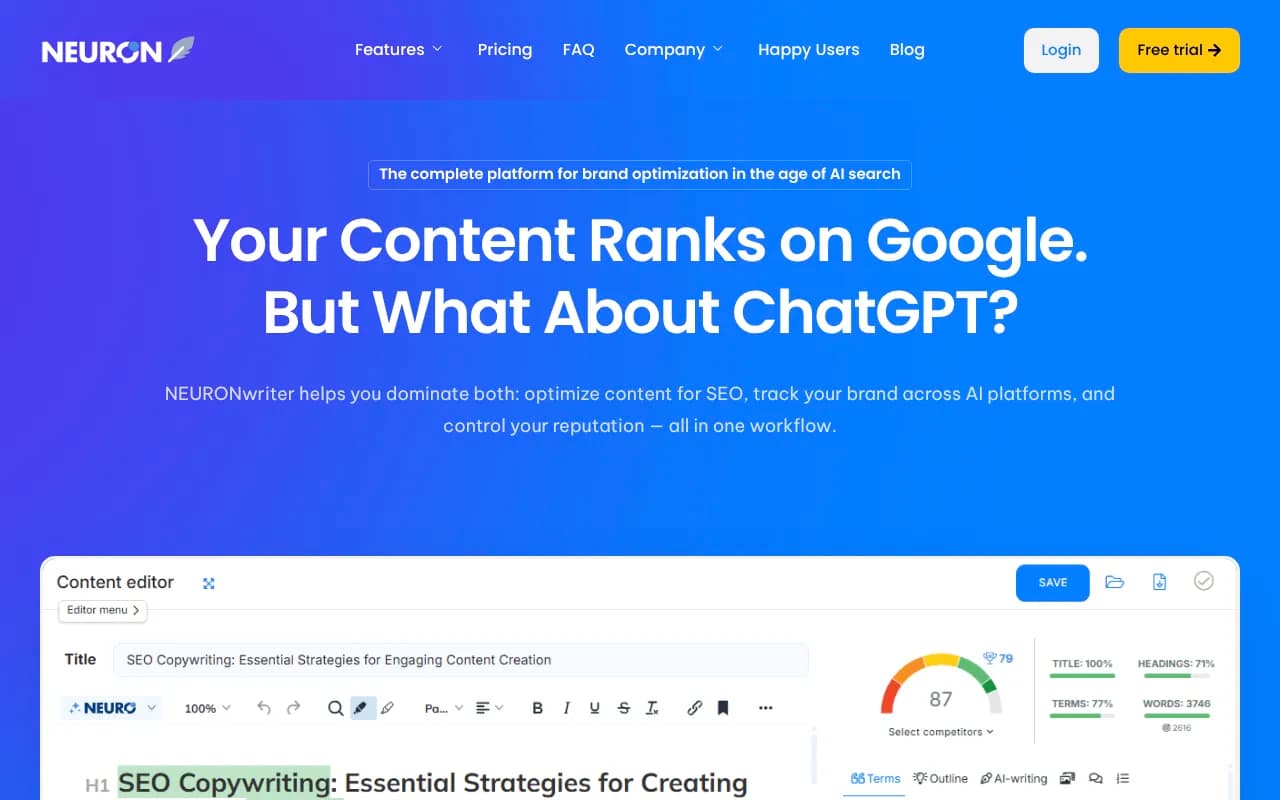
NeuronWriter is the budget-friendly option that punches above its weight. Starting at $19/month on annual billing, it covers semantic SEO analysis, competitor research, NLP term suggestions, and AI writing -- more than Dashword at a lower price point.
The semantic analysis is solid. NeuronWriter pulls NLP terms from top-ranking pages and gives you clear guidance on which terms to include and how often. The competitor outline analysis is useful for brief creation. WordPress integration and Google Search Console connection make it practical for teams already in that ecosystem.
The interface is functional but not as polished as Surfer or Clearscope. The AI writing quality is decent but not exceptional. And the platform has recently added AI brand monitoring features, though these are less developed than dedicated tools.
For freelancers, small agencies, or teams that need to optimize a high volume of content without a large budget, NeuronWriter is genuinely good value. It's not trying to be Surfer -- it's trying to give you 80% of the functionality at 20% of the price, and it mostly succeeds.
Pricing: From $19/mo (annual) or $23/mo (monthly). Gold plan at $57/mo annual is the recommended tier for most users.
Best for: Freelancers, small teams, and budget-conscious agencies who want solid NLP-based optimization without paying Surfer or Clearscope prices.
Search Atlas

Search Atlas is the most ambitious tool in this list in terms of scope. It's positioned as an all-in-one SEO automation platform -- covering technical SEO, content creation, link building, local SEO, and AI search visibility in one dashboard. The OTTO SEO agent can deploy technical fixes automatically, which is something no other tool here does.
For content optimization specifically, Search Atlas has a content editor with NLP guidance and brief generation. But content optimization is one feature among many rather than the core focus. If you're looking for a Dashword replacement purely for content briefs and optimization scoring, Search Atlas is probably more than you need.
Where it makes sense is for agencies or brands that are currently paying for multiple tools -- a rank tracker, a technical SEO tool, a content optimizer, an AI visibility tracker -- and want to consolidate. The $99/month Starter plan is reasonable for what you get, though the Growth plan at $249/month is where the more powerful features unlock.
Pricing: From $99/mo (Starter), $249/mo (Growth), $399/mo (Pro). 7-day free trial.
Best for: Agencies and brands that want to consolidate multiple SEO tools into one platform, particularly those that need technical SEO automation alongside content optimization.
Content Harmony
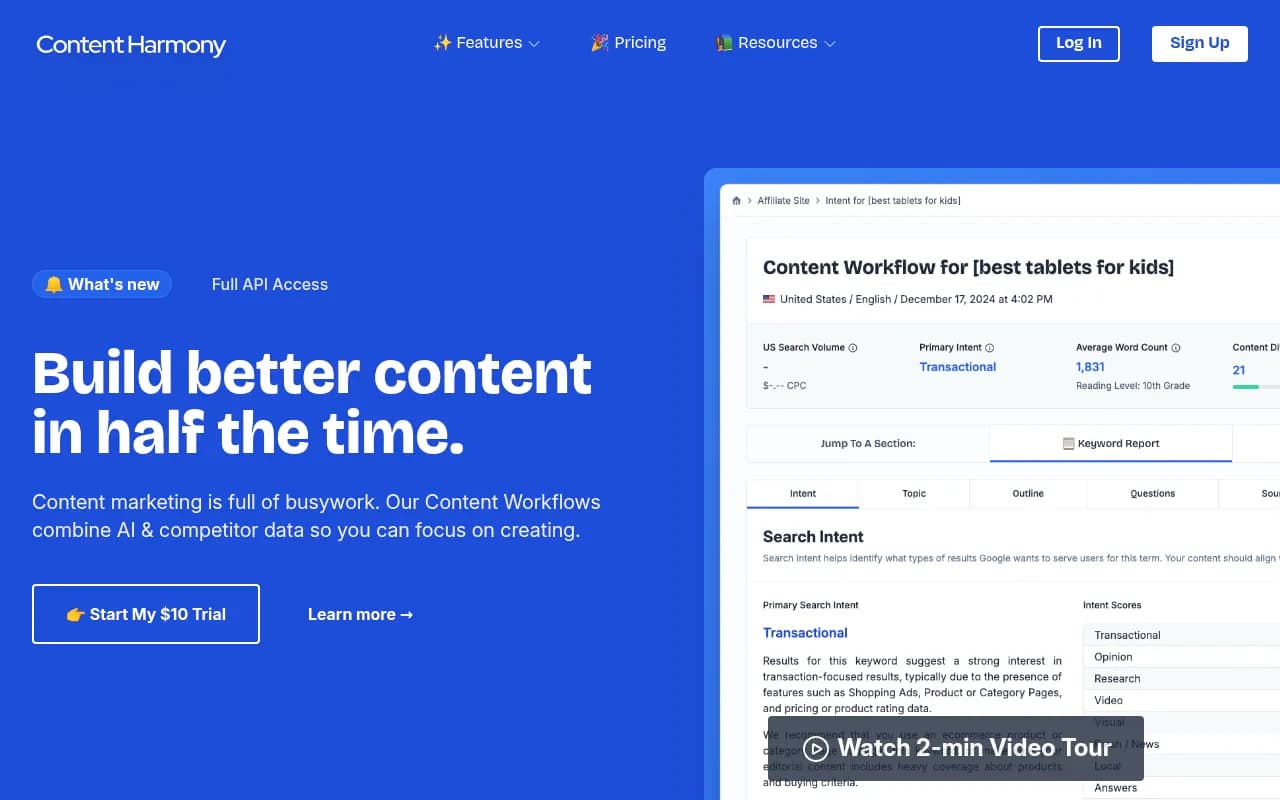
Content Harmony does one thing and does it well: content briefs. If the bottleneck in your content workflow is brief quality -- if your writers are producing mediocre content because they don't have enough context, structure, or keyword guidance -- Content Harmony is worth a serious look.
The keyword reports are detailed, covering search intent analysis, competitor content structure, overlapping entities, and related questions. The brief builder is designed around how content strategists actually work, not how software engineers think they work. The content grader checks drafts against the topic model before publishing.
What Content Harmony doesn't do: it's not an AI writing tool, it doesn't have AI search visibility tracking, and it doesn't monitor published content for traffic drops the way Dashword does. It's a focused tool for a specific part of the workflow.
The pricing model is also different -- workflow-based rather than a flat monthly fee. The $50/month plan gives you 5 workflows, and $99/month gets you 12. For teams producing a high volume of content, this can add up, but the $10 trial for 10 workflows makes it easy to test.
Pricing: $10 trial for 10 workflows, then from $50/mo (5 workflows) or $99/mo (12 workflows).
Best for: Content teams and agencies where brief quality is the primary bottleneck, and who want a focused tool rather than an all-in-one platform.
Which tool should you pick?
Here's a quick way to think through the decision:
If you're leaving Dashword because the data isn't deep enough and you can afford to spend more, Surfer SEO is the natural upgrade. It's the most established tool in this space with the most comprehensive optimization data.
If you're leaving Dashword because the price is fine but you want better AI writing assistance and research tools, Frase is the closest match at the same price point.
If budget is the main constraint and you want more features for less money, NeuronWriter at $19-57/month is hard to beat.
If you're an agency managing multiple clients and need AI search tracking alongside traditional SEO, look at Rankability or Search Atlas -- both are built for that use case.
If content quality consistency is the priority and budget isn't a constraint, Clearscope is what most enterprise teams land on.
If you're trying to understand and improve how your brand appears in ChatGPT, Perplexity, and other AI models -- which is a different problem than ranking on Google -- Promptwatch is the right tool. It's not a content optimizer in the traditional sense; it's an AI search visibility platform that helps you find gaps, create content that gets cited, and track the results.
The honest answer is that most teams in 2026 probably need two tools: one for traditional content optimization (any of the above), and one for AI search visibility. Those are increasingly different problems requiring different approaches.