Key Takeaways
- Frase is the best alternative if you need deep SERP research and GEO optimization alongside content creation — it tracks visibility across Google, ChatGPT, and Perplexity with an agentic workflow that tells you exactly what to do next
- Writesonic offers the most comprehensive AI search visibility tracking with monitoring across 10+ AI platforms, plus built-in content generation and refresh tools
- Scalenut combines AI content creation with managed GEO services, making it ideal for teams that want expert-led strategy alongside self-service tools
- Promptwatch is the only platform rated as a "Leader" across all GEO categories — it doesn't just track AI visibility, it helps you fix gaps with content generation, crawler logs, and citation analysis
- Koala AI delivers the fastest workflow for SEO content at the lowest price point, with one-click article generation and WordPress publishing starting at $9/month
Junia AI has built a strong reputation among content creators for its end-to-end SEO workflow — keyword research, content generation, internal linking, image creation, and WordPress publishing all in one platform. But it's not the only option, and depending on your specific needs, you might find a better fit elsewhere.
Some creators need deeper SERP analysis and competitor research. Others want AI search visibility tracking to see how ChatGPT and Perplexity mention their brand. Teams at larger companies need collaboration features and brand voice controls. And budget-conscious bloggers just want the fastest, cheapest way to generate publish-ready articles.
Here's how the top alternatives stack up against Junia AI across these different use cases.
Frase
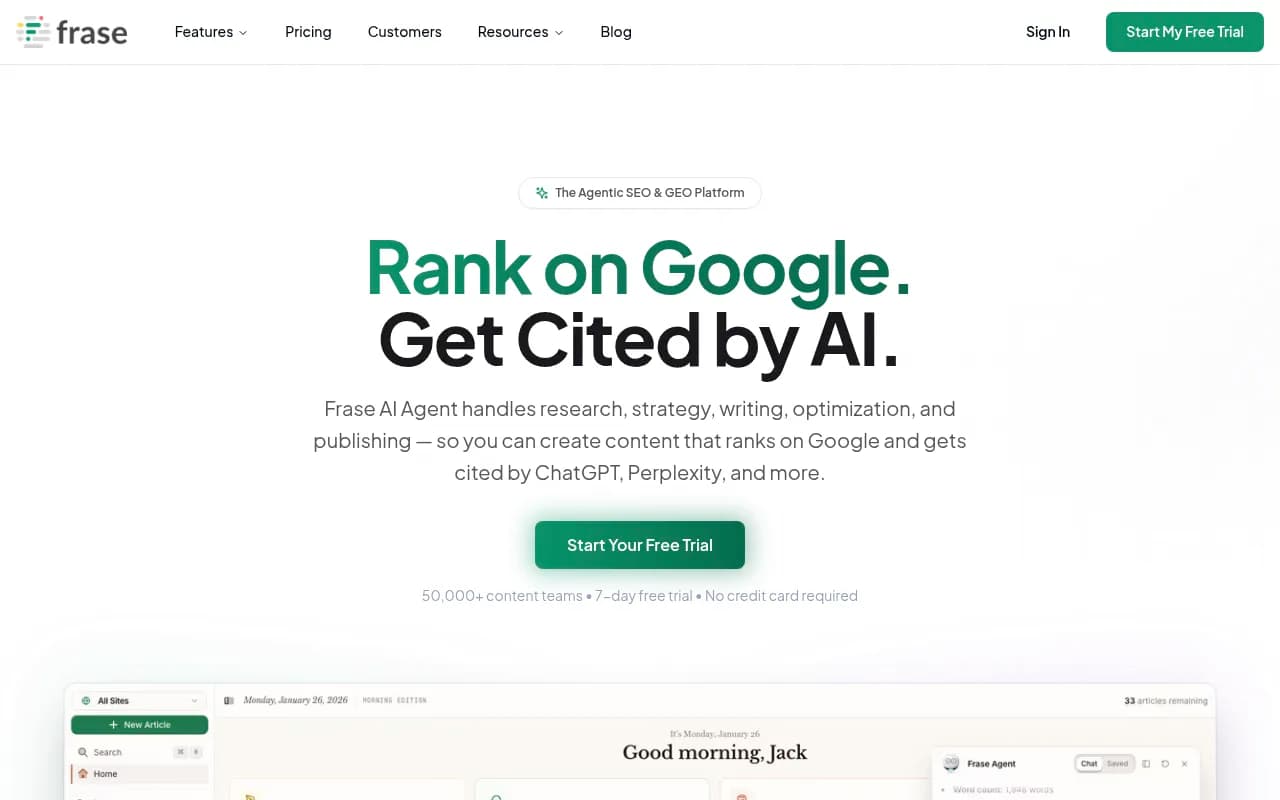
Frase positions itself as an "agentic SEO & GEO platform" — it doesn't just help you create content, it researches your market, tracks your visibility across Google and AI search engines, and tells you exactly what to do next. This is a significant step beyond Junia AI's content-first approach.
The core workflow starts with SERP analysis: Frase pulls the top 10 ranking pages for your target keyword, analyzes their structure, identifies content gaps your competitors miss, and generates an SEO brief with an outline optimized for both traditional search and AI citations. The research depth here is stronger than Junia AI's keyword analysis — you get specific topic targets, heading recommendations, and GEO structure suggestions based on what AI models actually cite.
Once you have the brief, Frase's AI writer generates the first draft. The output quality is comparable to Junia AI, but the real difference is in the optimization layer. Frase includes a content editor with real-time SEO scoring, topic coverage analysis, and suggestions for improving AI citation readiness. You can see exactly which topics you're missing and which sections need more depth.
The GEO tracking is where Frase pulls ahead. It monitors your brand visibility across Google, ChatGPT, and Perplexity, showing you which prompts mention your brand and which don't. This is functionality Junia AI doesn't offer at all. For teams that want to rank in AI search results, not just traditional Google, this is a major advantage.
Pricing starts at $39/month for the Starter plan (7-day free trial available), which is slightly higher than Junia AI's $34/month Creator plan. The Professional plan at $103/month adds team collaboration and more advanced features. For solo creators focused purely on content output, Junia AI might be more cost-effective. But for teams that need research depth, GEO tracking, and optimization tools, Frase is worth the premium.
Best for: Content teams and SEO professionals who want deep competitor research, AI search visibility tracking, and optimization tools in one platform. Not ideal for solo bloggers who just want fast article generation.
Writesonic

Writesonic has evolved from a basic AI copywriting tool into a full AI search visibility platform. The current version focuses heavily on GEO (Generative Engine Optimization) — tracking how your brand appears across ChatGPT, Perplexity, Claude, Gemini, and 10+ other AI platforms.
Unlike Junia AI, which focuses on creating content that ranks in traditional search, Writesonic helps you understand and optimize for AI search engines. You can track specific prompts to see when AI models mention your brand, analyze citation gaps, and get recommendations for content that will boost your AI visibility. This includes monitoring Reddit threads and YouTube videos that influence AI recommendations — channels most competitors ignore.
The content creation side is still strong. Writesonic's AI writer generates long-form articles optimized for both SEO and AI citations, with built-in tools for content refresh and optimization. The quality is comparable to Junia AI, but the workflow is more focused on closing visibility gaps rather than bulk content production.
One unique feature: Writesonic tracks AI crawler logs in real-time, showing you exactly which pages ChatGPT, Claude, and Perplexity are reading on your site. You can see errors they encounter, how often they return, and which content they cite most frequently. This level of technical insight is rare in AI content platforms.
Pricing isn't publicly listed on the main site, but based on the platform's positioning and feature set, expect it to be in the mid-to-high range — likely more expensive than Junia AI's $34-59/month plans. The value proposition is different: Junia AI helps you create more content faster, while Writesonic helps you understand and optimize your AI search presence.
Best for: Brands and agencies that want comprehensive AI search visibility tracking alongside content creation. Overkill if you only care about traditional Google rankings.
Scalenut

Scalenut combines self-service AI content tools with managed GEO services, making it a hybrid between a DIY platform like Junia AI and a full-service agency. The platform tracks AI visibility across Google, ChatGPT, Perplexity, and AI Overviews, then provides actionable recommendations for content gaps and optimization opportunities.
The content creation workflow is similar to Junia AI: keyword research, AI-generated outlines, long-form article writing, and SEO optimization. The quality is solid, and the platform includes features like content audits and GEO scoring to help you improve existing pages. Where Scalenut differs is in the managed service layer — you can hire their team to handle strategy, content creation, and optimization for you.
This makes Scalenut appealing for teams that want expert guidance but don't have in-house SEO or GEO expertise. The managed services start around $3,000/month, which is a significant jump from Junia AI's self-service pricing. But for companies that need hands-on support, it's a viable alternative to hiring a full-time specialist.
The self-service platform pricing starts around $39-79/month for basic plans, with full platform access at $149-499/month. This is higher than Junia AI, but you're getting more advanced tracking and optimization features. The 7-day free trial lets you test the platform before committing.
One downside: Scalenut's interface is more complex than Junia AI's streamlined workflow. If you just want to generate articles quickly, Junia AI's one-click approach is faster. But if you need deeper insights into what's working and what's not, Scalenut's analytics are more comprehensive.
Best for: Marketing teams that want AI search visibility tracking plus the option for managed services. Not ideal for solo creators who prefer a simple, fast workflow.
Promptwatch

Promptwatch is the only AI search visibility platform rated as a "Leader" across all GEO categories in a 2026 comparison of 12 platforms. The core difference: most competitors are monitoring-only dashboards that show you data but leave you stuck. Promptwatch is built around taking action — it shows you what's missing, then helps you fix it.
The workflow starts with Answer Gap Analysis, which shows exactly which prompts competitors are visible for but you're not. You see the specific content your website is missing — the topics, angles, and questions AI models want answers to but can't find on your site. This is more actionable than Junia AI's keyword research because it's based on real citation data from 880M+ analyzed citations.
Once you know the gaps, Promptwatch's built-in AI writing agent generates articles, listicles, and comparisons grounded in prompt volumes, persona targeting, and competitor analysis. This isn't generic SEO filler — it's content engineered to get cited by ChatGPT, Claude, Perplexity, and other AI models. The quality is comparable to Junia AI, but the targeting is more precise.
The tracking layer is where Promptwatch excels. You get real-time crawler logs showing when ChatGPT, Claude, Perplexity, and other AI engines hit your website — which pages they read, errors they encounter, how often they return. Page-level tracking shows exactly which pages are being cited, how often, and by which models. You can close the loop with traffic attribution (code snippet, GSC integration, or server log analysis) to connect visibility to actual revenue.
Additional capabilities include prompt intelligence (volume estimates and difficulty scores), citation and source analysis, Reddit and YouTube insights, ChatGPT Shopping tracking, competitor heatmaps, and multi-language/multi-region monitoring. The platform monitors 10 AI models: ChatGPT, Perplexity, Google AI Overviews, Google AI Mode, Claude, Gemini, Meta/Llama, DeepSeek, Grok, Mistral, and Copilot.
Pricing starts at $99/month for the Essential plan (1 site, 50 prompts, 5 articles), $249/month for Professional (2 sites, 150 prompts, 15 articles, crawler logs), and $579/month for Business (5 sites, 350 prompts, 30 articles). This is significantly higher than Junia AI's $34-59/month range, but you're getting a complete GEO platform, not just a content generator.
The trade-off: Promptwatch is overkill if you only care about traditional SEO and don't need AI search visibility tracking. But if you want to rank in ChatGPT, Claude, and Perplexity — and you want tools to actually make it happen — Promptwatch is the most complete solution available.
Best for: Brands and agencies that want to dominate AI search with a platform that tracks visibility, identifies gaps, generates optimized content, and measures results. Not necessary if you only care about Google rankings.
Copy.ai

Copy.ai has pivoted from a simple AI copywriting tool to a full GTM (go-to-market) AI platform focused on marketing automation. The current version is less about content creation and more about orchestrating AI agents to run end-to-end marketing workflows.
This makes Copy.ai a poor direct alternative to Junia AI. If you're looking for a tool to generate SEO-optimized blog posts, Copy.ai's current positioning is too broad and enterprise-focused. The platform is designed for marketing teams at mid-to-large companies that want to automate campaigns across channels, not for content creators who need to publish articles quickly.
That said, Copy.ai still includes AI writing capabilities. You can generate marketing copy, emails, social media posts, and blog content. The quality is decent, but the workflow is more fragmented than Junia AI's streamlined process. You won't get the same level of SEO optimization, keyword research, or internal linking automation.
Pricing isn't clearly listed for the content creation features, but the platform's enterprise focus suggests it's more expensive than Junia AI. The free plan offers basic writing generators, but the full platform requires a paid subscription.
Best for: Marketing teams that need AI-powered campaign automation across multiple channels. Not ideal for content creators who just want to generate blog posts.
GrowthBar
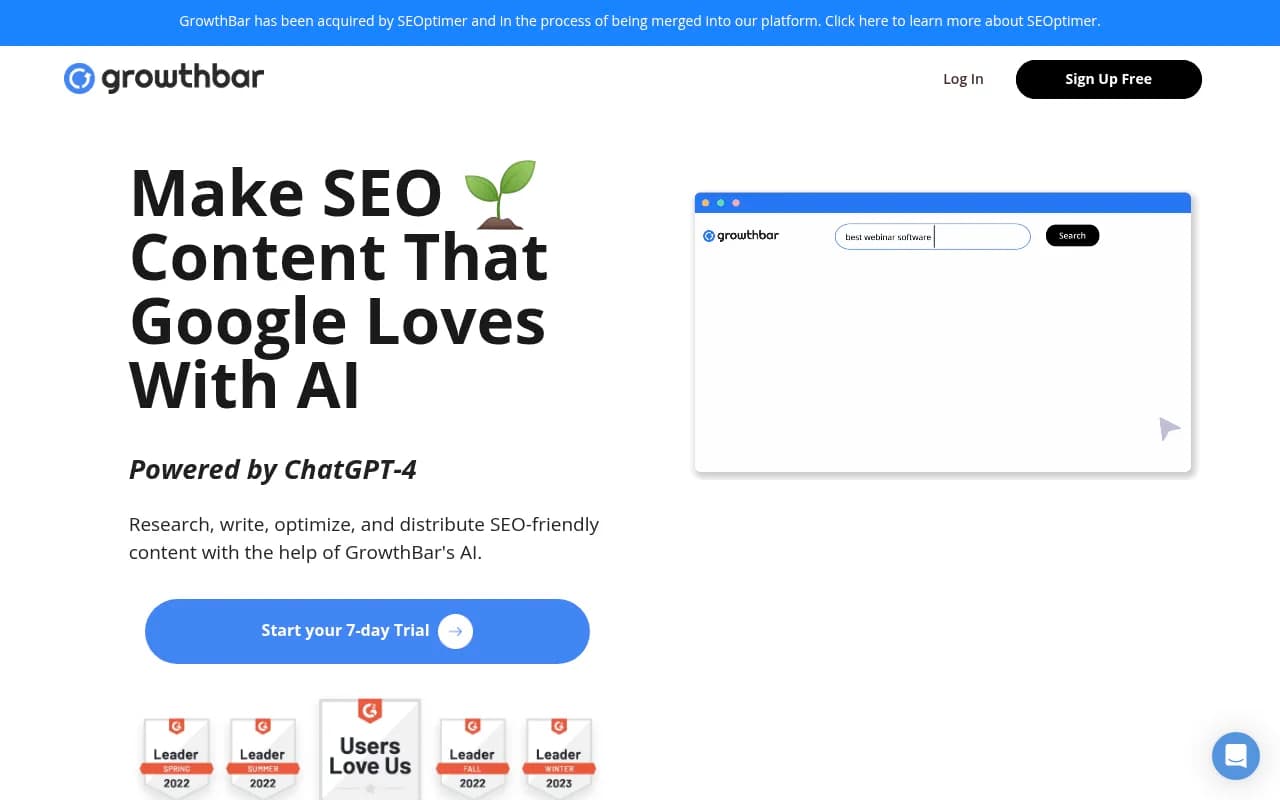
GrowthBar is a Chrome extension and web app that combines keyword research, competitor analysis, and AI content generation. It's powered by GPT-4 and focuses on helping bloggers and content teams write SEO-optimized articles 10x faster.
The workflow is similar to Junia AI: enter a keyword, get an optimized outline based on SERP analysis, then let the AI write the full article. GrowthBar includes features like competitor backlink analysis, keyword difficulty scoring, and rank tracking. The content quality is solid, and the platform integrates with WordPress for one-click publishing.
Where GrowthBar differs from Junia AI is in the research depth. The Chrome extension lets you analyze any page or search result directly in your browser, which is useful for quick competitor research. The downside is that the interface feels more fragmented — you're switching between the extension, the web app, and your WordPress site, rather than working in one unified platform like Junia AI.
Pricing starts at $36/month (annual billing) for the Standard plan, which is comparable to Junia AI's $34/month Creator plan. The Pro plan at $74.25/month and Agency plan at $149.25/month add more features and higher usage limits. A 7-day free trial is available.
GrowthBar is a solid alternative if you want strong keyword research and competitor analysis alongside AI content generation. But if you prefer a streamlined, all-in-one workflow, Junia AI's interface is more cohesive.
Best for: Bloggers and content teams that want deep keyword research and competitor analysis alongside AI writing. The Chrome extension is useful for quick SERP analysis.
Jasper
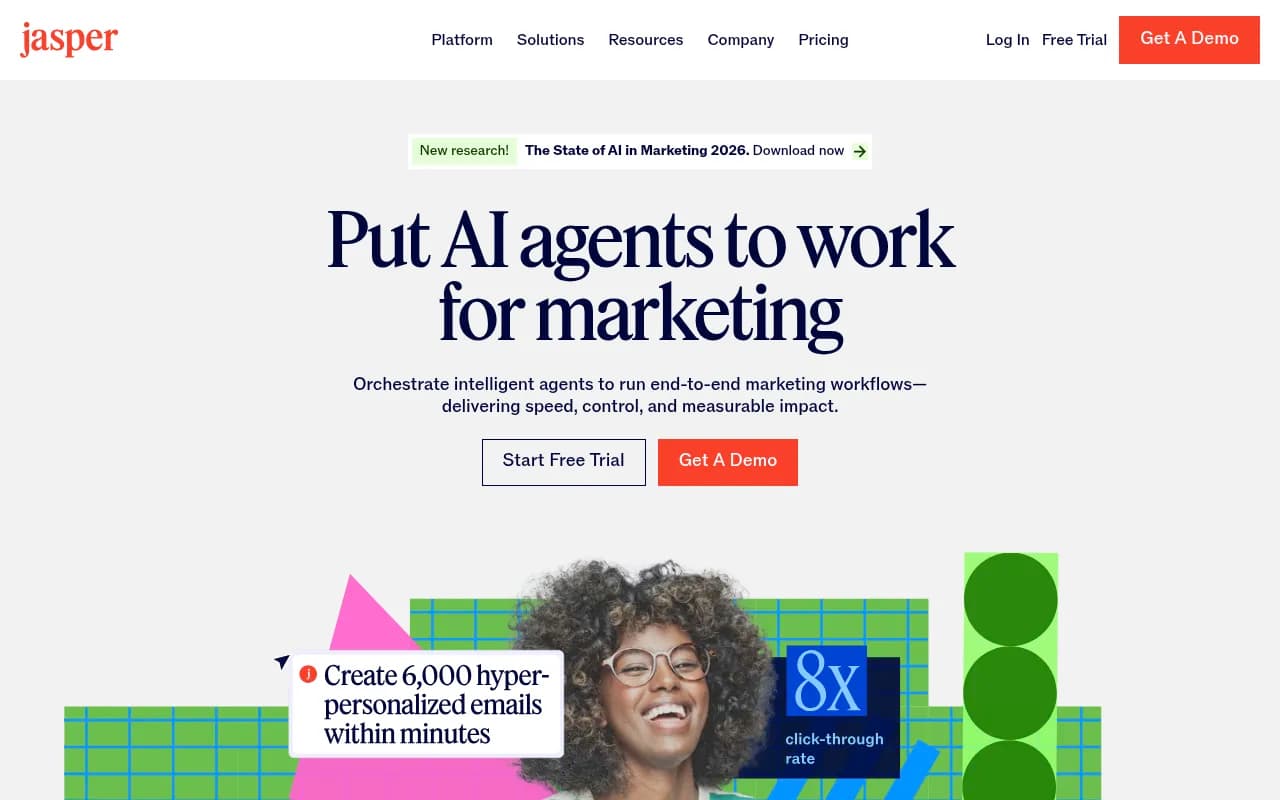
Jasper is an enterprise AI marketing platform designed for teams at mid-to-large companies. It's significantly more expensive and feature-rich than Junia AI, with 100+ specialized AI agents, content pipelines, brand intelligence features, and team collaboration tools.
The content creation capabilities are strong. Jasper can generate long-form articles, marketing copy, social media posts, and more. The platform includes brand voice training, style guide enforcement, and visual guidelines to ensure consistency across all content. This level of brand control is overkill for solo creators but valuable for teams that need to maintain a consistent voice across multiple writers.
Jasper also includes content pipelines that automate the entire content lifecycle — from data input to creation to distribution. This is far beyond what Junia AI offers, but it's also far beyond what most content creators need. The platform is designed for marketing teams that produce high volumes of content across multiple channels, not for bloggers who just want to publish articles.
Pricing starts at $59/month for the Creator plan, but the real value is in the Pro plan at $249/month (for teams up to 5 users) and custom enterprise pricing. This is 4-7x more expensive than Junia AI's $34-59/month range.
The trade-off: Jasper is a better choice for teams that need advanced collaboration, brand control, and multi-channel content automation. But for solo creators or small teams focused on blog content, Junia AI offers a simpler, more affordable workflow.
Best for: Marketing teams at mid-to-large companies that need enterprise-grade brand control, team collaboration, and multi-channel content automation. Overkill for solo bloggers.
Koala AI
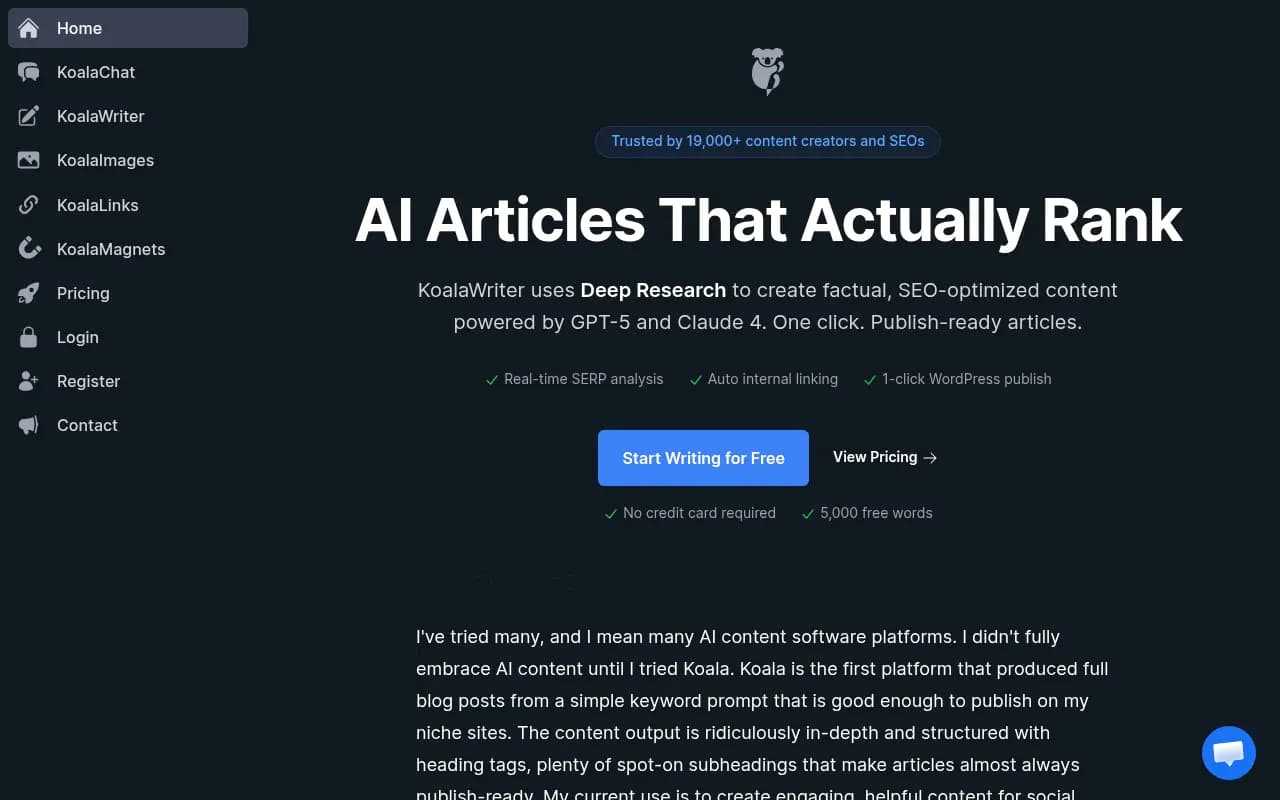
Koala AI is the closest direct alternative to Junia AI in terms of workflow and pricing. It's built specifically for SEO professionals and content creators who want to generate publish-ready articles quickly. The platform includes KoalaWriter for long-form content, KoalaChat for research assistance, and tools for images, internal linking, and lead magnets.
The content generation process is nearly identical to Junia AI: enter a keyword, get an AI-generated outline based on SERP analysis, then let the AI write the full article. Koala AI analyzes the top-ranking pages, identifies key topics and headings, and produces articles that are structured for SEO. The quality is comparable to Junia AI, and users consistently report that the output is publish-ready with minimal editing.
One advantage: Koala AI's pricing is more flexible. The platform offers a freemium model with 5,000 free words, then paid plans starting at $9/month for 15,000 words (Essentials plan). The Starter plan at $25/month for 50,000 words is the sweet spot for most creators. This is significantly cheaper than Junia AI's $34/month Creator plan, especially if you're producing high volumes of content.
The downside: Koala AI's interface is slightly less polished than Junia AI's, and the feature set is more focused on pure content generation. You won't get as many advanced SEO tools or integrations. But if your primary goal is to generate articles quickly and cheaply, Koala AI delivers.
Best for: SEO professionals and content creators who want the fastest, most affordable workflow for generating publish-ready articles. The freemium model and low-cost plans make it ideal for budget-conscious bloggers.
Which Junia AI Alternative Should You Choose?
The best alternative depends on what you need most:
Choose Frase if you want deep SERP research, GEO optimization, and AI search visibility tracking in one platform. It's the best option for teams that need to rank in both Google and AI search engines.
Choose Writesonic if AI search visibility is your top priority. The platform tracks mentions across 10+ AI platforms and helps you optimize content for AI citations.
Choose Scalenut if you want self-service tools plus the option for managed GEO services. It's ideal for teams that need expert guidance alongside software.
Choose Promptwatch if you want the most complete GEO platform available — one that tracks visibility, identifies gaps, generates content, and measures results. It's the only platform that closes the full loop from monitoring to action to results.
Choose Koala AI if you want the fastest, cheapest workflow for generating SEO-optimized articles. The freemium model and low-cost plans make it the best budget alternative.
Stick with Junia AI if you're happy with the current workflow and don't need advanced GEO tracking or team collaboration features. It's still a solid choice for solo creators focused on traditional SEO.
The AI content landscape is evolving rapidly. Traditional SEO is no longer enough — brands need to think about how they appear in ChatGPT, Claude, Perplexity, and other AI search engines. Tools like Promptwatch, Frase, and Writesonic are leading this shift by combining content creation with AI visibility tracking and optimization. If you're serious about staying visible in 2026 and beyond, it's worth exploring these alternatives.