Key takeaways
- Unbounce is the closest direct competitor to Leadpages -- same use case, stronger AI optimization, but pricier starting at ~$74/mo
- Instapage is the enterprise pick for teams running paid ads at scale, with real-time collaboration and deep personalization, but costs more ($99/mo+)
- Landingi and Swipe Pages are the budget-friendly alternatives, both starting at $29/mo with solid feature sets for most small business needs
- ClickFunnels and Systeme.io are better fits if you need full funnel infrastructure (upsells, email, courses) rather than standalone landing pages
- SeedProd is the obvious choice if you're already on WordPress and don't want to pay for a separate hosted tool
- Carrd is the cheapest option by far ($9/year) but only works for simple one-page sites -- not serious lead gen campaigns
Leadpages has been a go-to for small business owners and solo marketers since it launched. At $37/mo, it's genuinely one of the more affordable dedicated landing page builders, and it covers the basics well: drag-and-drop editing, A/B testing, pop-ups, lead capture forms, and a decent template library.
So why are people looking for alternatives? A few common reasons come up. The editor can feel dated compared to newer tools. The A/B testing is limited on lower plans. Some users want more than just landing pages -- they want email automation, full funnels, or deeper analytics baked in. And others are simply shopping around to see if they can get more for less.
Whatever your reason, here's an honest look at what's actually out there.

Unbounce

Unbounce is the most direct Leadpages competitor -- same core use case, similar audience, but with a few meaningful differences. The drag-and-drop builder is more flexible, the template quality is generally higher, and the Smart Traffic feature (which automatically routes visitors to the variant most likely to convert them) is genuinely useful if you're running volume.
Where Unbounce pulls ahead: the AI-powered optimization layer. Smart Traffic learns from visitor behavior and adjusts routing without you having to manually read test results and make changes. Leadpages has A/B testing, but it's more manual. Unbounce also has a cleaner editor with more precise layout control -- pixel-level positioning rather than section-based snapping.
Where it falls short: price. Unbounce starts at around $74/mo, which is about double Leadpages' entry price. For a solo marketer or small business, that gap matters. Unbounce also has conversion limits on lower plans -- if you're driving serious traffic, you'll need to upgrade.
Pricing: ~$74/mo (Build), ~$112/mo (Experiment), ~$187/mo (Optimize). 14-day free trial.
Best for: Marketers and agencies who run paid campaigns regularly, want AI-driven optimization, and can justify the higher price point.
Instapage

Instapage is a step up from both Leadpages and Unbounce in terms of enterprise features. The standout capability is AdMap, which lets you visually map your ad campaigns to specific landing pages -- useful when you're running dozens of ad groups and need message match at scale. The real-time collaboration tools are also genuinely good: multiple team members can leave comments and make edits on a live page, which is rare in this category.
The personalization features are more advanced than Leadpages too. You can dynamically change page content based on the traffic source, audience segment, or UTM parameters -- something Leadpages doesn't do well.
The honest trade-off: Instapage costs significantly more. At $99/mo for the base plan, you're paying nearly three times what Leadpages charges. And some of the more powerful features (like heatmaps and advanced personalization) are locked behind higher tiers. For a small team or solo operator, it's probably overkill.
Pricing: From $99/mo. 14-day free trial.
Best for: Marketing teams at mid-size companies running paid search and social campaigns who need collaboration tools and message-match personalization.
Landingi

Landingi is probably the most underrated tool in this list. It starts at $29/mo -- cheaper than Leadpages -- and includes 300+ templates, A/B testing, pop-ups, and a genuinely useful feature called EventTracker that tracks micro-conversions (button clicks, scroll depth, form interactions) without needing to set up custom events in Google Analytics.
The editor is clean and reasonably fast. It's not as polished as Unbounce, but it's more than good enough for most landing page use cases. The template library is large and covers most industries. Integrations with major email platforms (Mailchimp, ActiveCampaign, HubSpot, etc.) work without issues.
Where Landingi lags: the AI features are basic, and the analytics depth doesn't match Instapage or Unbounce. If you're doing serious CRO work, you'll hit the ceiling. But for spinning up campaign pages quickly and tracking basic conversions, it's a solid, affordable option.
Pricing: Free plan available, paid from $29/mo. 14-day free trial.
Best for: Small businesses and freelancers who want a Leadpages-level tool at a lower price, with better conversion tracking out of the box.
Swipe Pages

Swipe Pages has a specific angle: speed. It builds AMP (Accelerated Mobile Pages) landing pages that load in under 2 seconds on mobile, served from Google's cache. If you're running mobile ad campaigns -- especially Google Ads -- that load time difference can meaningfully affect your Quality Score and cost per click.
The builder is straightforward and the templates are clean. It's not trying to be an all-in-one platform; it's focused on fast, mobile-optimized pages for performance marketers. The AI landing page builder (called Genie) can generate a page from a business description, which speeds up the initial setup.
The limitation is scope. Swipe Pages doesn't have the depth of A/B testing tools or the analytics that Unbounce or Instapage offer. And AMP, while fast, has some restrictions on what you can embed or animate. If your campaigns are primarily desktop, the core differentiator matters less.
Pricing: From $29/mo (annual billing). 14-day free trial.
Best for: Performance marketers running mobile Google Ads campaigns where page speed directly affects ad costs and conversion rates.
HubSpot Marketing Hub
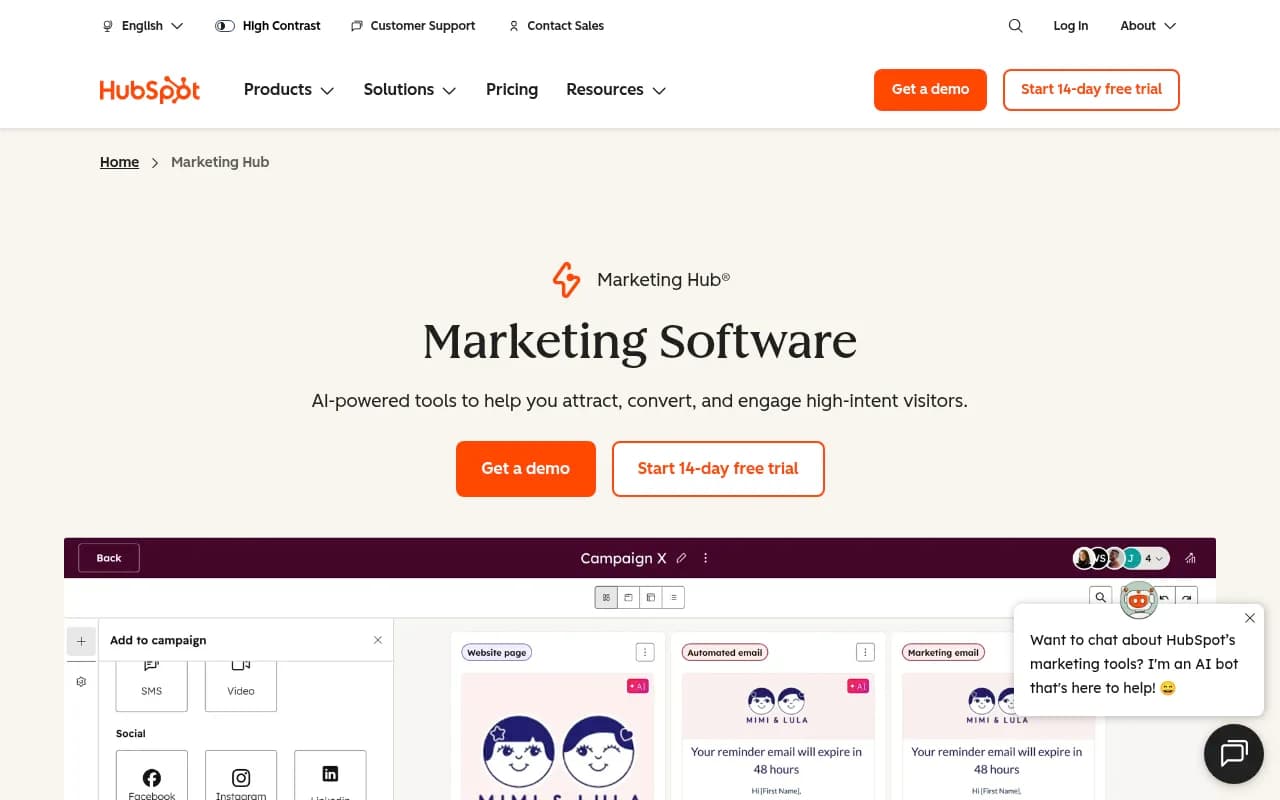
HubSpot is a different category of tool entirely. It's not a landing page builder that happens to have some marketing features -- it's a full marketing platform where landing pages are one component among many. You get email marketing, CRM, forms, workflows, social media management, and AI-powered content tools all connected to the same database.
The landing page builder itself is decent but not exceptional. It's more constrained than Leadpages or Unbounce in terms of design flexibility. Where HubSpot wins is the data layer: because your landing pages, emails, CRM contacts, and analytics all live in the same system, you can see the full picture of how a lead moved from page visit to closed deal.
The pricing is where things get complicated. The free tier is genuinely useful for small teams, and the Starter plan at $15/mo per seat is reasonable. But the Professional tier -- where you get the automation and advanced features that make HubSpot worth it -- starts at $890/mo for 3 seats. That's a completely different budget conversation than Leadpages.
Pricing: Free tier available. Starter from $15/mo/seat. Professional from $890/mo (3 seats). Enterprise from $3,600/mo.
Best for: Growing marketing teams that want everything in one platform and are willing to pay for the CRM and automation layer, not just landing pages.
ClickFunnels

ClickFunnels is built around a different mental model than Leadpages. Where Leadpages thinks in pages, ClickFunnels thinks in funnels -- sequences of pages designed to move someone from awareness to purchase, including upsell pages, order forms, thank-you pages, and email follow-ups.
If you're selling digital products, courses, or coaching programs, ClickFunnels makes a lot of sense. The funnel templates are purpose-built for those use cases, and the built-in email automation, membership site features, and affiliate management mean you can run a lot of your business from one tool.
The trade-off: it's more expensive ($97/mo monthly or $81/mo annual) and more complex than Leadpages. If you just need a landing page to capture leads for a service business, ClickFunnels is overkill. The page editor is also less refined than Unbounce or Instapage -- it's functional but not elegant.
Pricing: From $81/mo (annual) or $97/mo (monthly). Free trial available.
Best for: Course creators, coaches, and digital product sellers who need a full funnel infrastructure rather than standalone landing pages.
GetResponse

GetResponse started as an email marketing platform and added landing pages as a feature over time. That history shows in how it's structured: the landing page builder is solid but secondary to the email and automation tools.
The value proposition is consolidation. If you're currently paying for an email marketing tool separately from a landing page builder, GetResponse lets you do both from one subscription starting at $13.30/mo. The landing page builder includes AI copy generation, a decent template library, and basic A/B testing. It also includes webinar hosting, which is unusual at this price point.
What you give up: the landing page builder isn't as powerful as dedicated tools. The design flexibility is more limited, and the conversion optimization features (like Smart Traffic in Unbounce) don't exist here. It's a reasonable compromise if you want to simplify your stack, not the right choice if landing page performance is your primary concern.
Pricing: Free plan (up to 500 contacts). Paid from $13.30/mo.
Best for: Small businesses and solopreneurs who want email marketing and landing pages in one tool and don't need advanced CRO features.
SeedProd
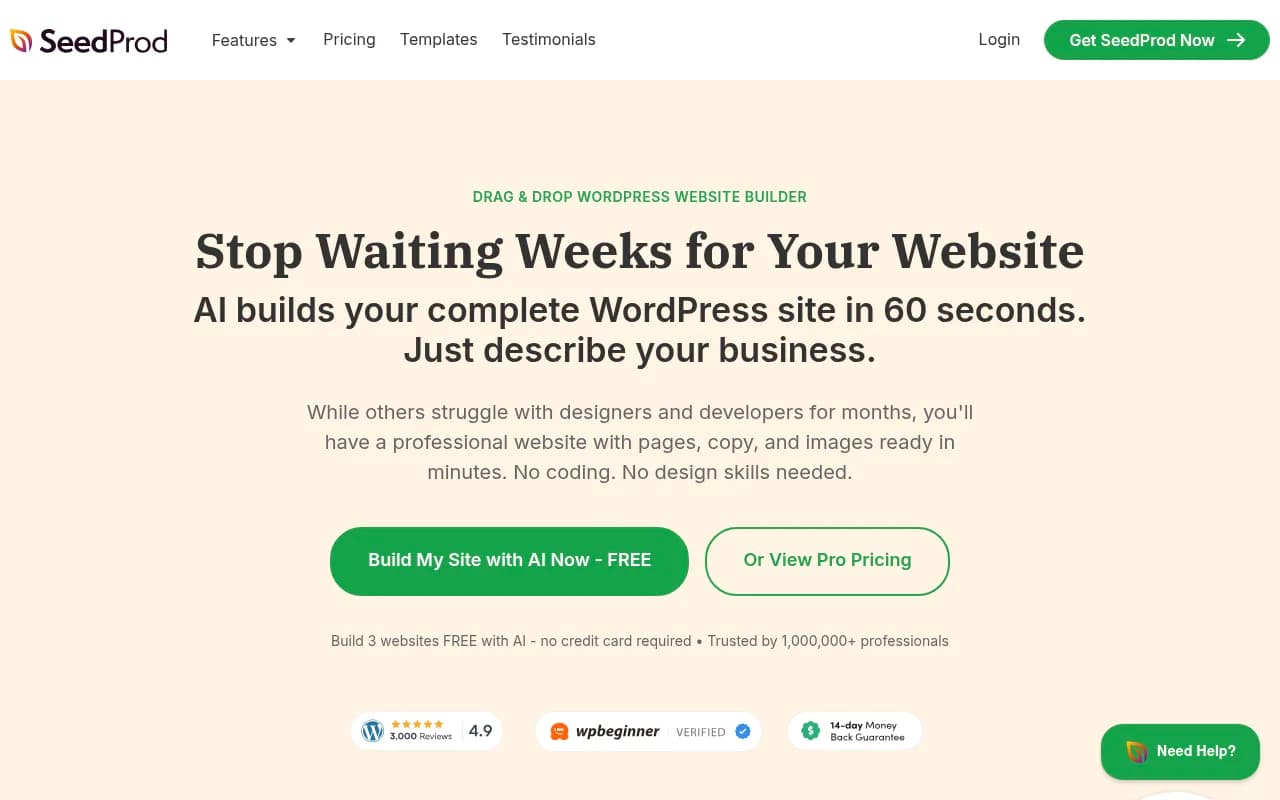
SeedProd is the WordPress-native option. If your site runs on WordPress and you'd rather not pay for a separate hosted landing page platform, SeedProd is the most capable plugin in this category. It has a full drag-and-drop builder, 200+ templates, WooCommerce support, a theme builder for full site editing, and AI site generation that can spin up a complete WordPress site from a text description.
The pricing is dramatically cheaper than any hosted tool: plans start at $39.50/year (not per month -- per year). For WordPress users, that's a compelling number.
The catch: it only works on WordPress. If you're not on WordPress, it's not an option. And because it's a plugin rather than a hosted platform, you're responsible for your own hosting performance -- page speed depends on your server, not SeedProd's infrastructure. For high-traffic campaigns, that matters.
Pricing: Free tier available. Pro from $39.50/year.
Best for: WordPress site owners who want a capable landing page builder without adding another monthly SaaS subscription.
Systeme.io
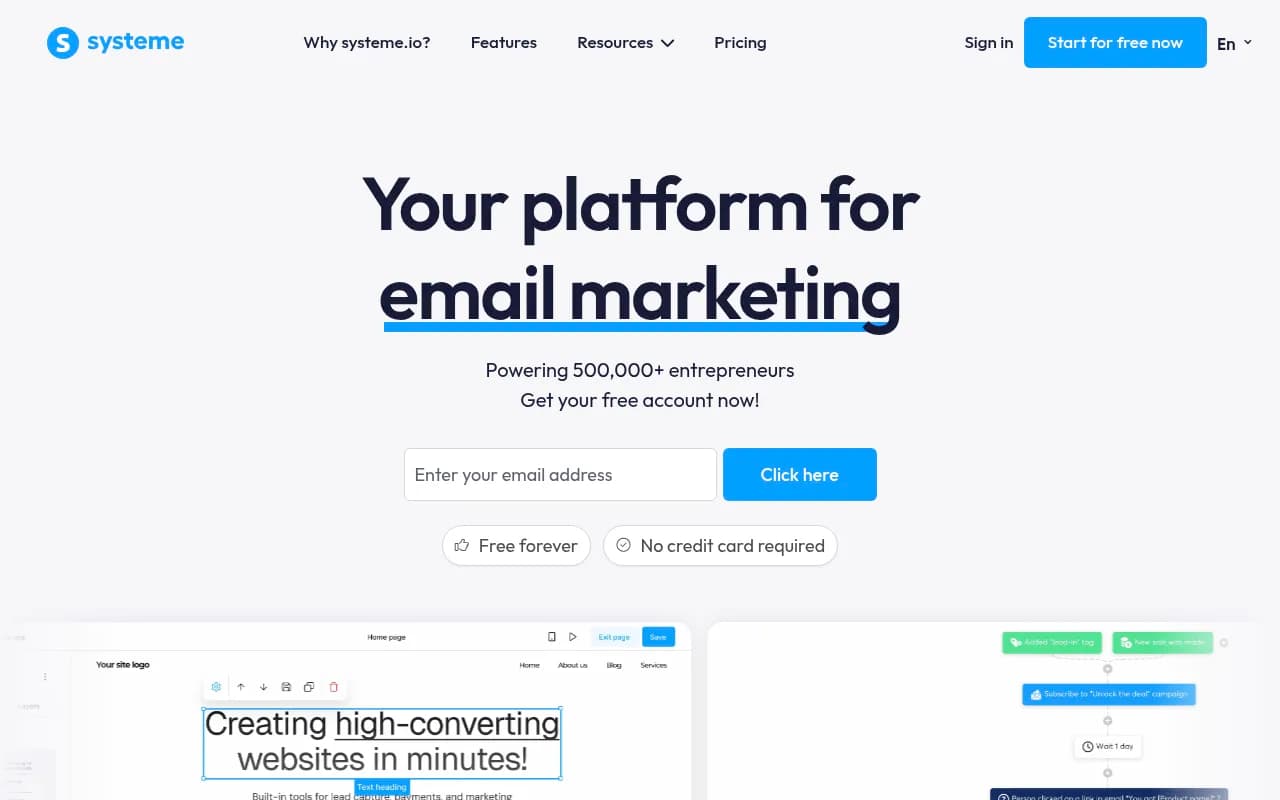
Systeme.io is the budget ClickFunnels. It covers a similar range of features -- sales funnels, email marketing, online courses, affiliate management, automation workflows -- but starts with a genuinely free forever plan and paid tiers from $17/mo. For solopreneurs and early-stage creators, that's a remarkable amount of functionality for the price.
The landing page builder is functional but basic. You won't get the design flexibility of Leadpages or Unbounce. The templates are limited and the editor is less polished. But if your goal is to launch a course, sell a digital product, and build an email list -- all from one tool -- Systeme.io handles that workflow without requiring you to stitch together multiple subscriptions.
The free plan is surprisingly generous: up to 2,000 contacts, 3 sales funnels, 1 course, and unlimited emails. For someone just starting out, that's enough to validate a business idea before spending anything.
Pricing: Free forever plan. Startup $17/mo, Webinar $47/mo, Unlimited $97/mo.
Best for: Solopreneurs and course creators who want an all-in-one platform at the lowest possible price and can accept a less polished landing page editor.
Carrd
Carrd is in a different league from everything else on this list -- simpler, cheaper, and more limited by design. It builds beautiful, fully responsive one-page sites. That's it. No multi-step funnels, no A/B testing, no advanced analytics.
What it does well: the output looks genuinely good. The templates are clean and modern, and the editor is fast. For a personal landing page, a simple product launch page, or a link-in-bio page, Carrd is hard to beat at $9/year for the Pro Lite plan.
The limitations are real though. It's one page only. Forms require a Pro plan. There's no native A/B testing, no pop-ups, no conversion tracking beyond Google Analytics. If you're running paid campaigns and need to optimize for conversions, Carrd isn't the right tool.
Pricing: Free (3 sites). Pro Lite $9/year, Pro Standard $19/year, Pro Plus $49/year.
Best for: Freelancers, creators, and individuals who need a simple, good-looking one-page site and don't need conversion optimization features.
How to choose
The right tool depends on what you're actually trying to do:
If you want a direct Leadpages upgrade with better optimization and are willing to pay more: go with Unbounce. The Smart Traffic feature alone justifies the price difference if you're running consistent paid traffic.
If you're running paid ads with a team and need collaboration, personalization, and message match at scale: Instapage is the right call, despite the higher cost.
If you want Leadpages-level features at a lower price: Landingi at $29/mo is the most straightforward swap. Swipe Pages is the better pick if mobile ad speed is your priority.
If you need more than landing pages -- email automation, courses, full funnels -- the answer depends on your budget. ClickFunnels for serious funnel builders, GetResponse for email-first teams, Systeme.io for bootstrapped solopreneurs.
If you're on WordPress: SeedProd at $39.50/year is the obvious choice. Nothing else in the WordPress ecosystem comes close at that price.
If you just need something simple and free: Carrd works for basic one-page sites. Don't overcomplicate it.
Leadpages sits in a reasonable middle ground -- not the cheapest, not the most powerful, but a solid all-rounder. The alternatives above are worth considering when you've outgrown it, need something more specialized, or just want to spend less.