Key takeaways
- Most AI visibility platforms are monitoring dashboards — they show you where you're invisible but leave you to figure out the fix yourself.
- The platforms that stand out in 2026 combine tracking with content gap analysis and content generation in a single workflow.
- Promptwatch is the only platform in this comparison rated as a "Leader" across all evaluation categories, largely because it closes the loop from gap identification to content creation to traffic attribution.
- Pricing ranges from free tiers to $500+/month for enterprise plans — but price alone is a poor proxy for value. What matters is whether the tool helps you act on the data.
- If you're an agency or a brand managing multiple sites, the differences between platforms become significant fast — particularly around crawler logs, multi-region support, and white-label reporting.
Traditional SEO metrics are becoming less useful by the month. Zero-click searches now account for around 60% of Google queries. Gartner projected that search engine volume would decline 25% by 2026 as users shift to AI chatbots. And research from Magenta Associates found that 66% of UK senior decision-makers now use tools like ChatGPT, Copilot, and Perplexity to research suppliers — with 90% trusting those recommendations.
If your brand isn't showing up in those AI-generated answers, you're losing buyers you never even knew were looking.
That's what AI visibility platforms are built to solve. But the market has exploded in the last 18 months, and the quality varies enormously. Some tools are genuinely useful. Others are glorified dashboards that show you a number going down with no clear path to fixing it.
This guide evaluates 12 platforms in depth so you can make a confident decision.
What to look for in an AI visibility platform
Before getting into the tools, it's worth being clear about what actually matters. The feature lists can get long, but most of what separates good platforms from mediocre ones comes down to a few things:
Coverage across AI engines. ChatGPT gets the most attention, but buyers use Perplexity, Claude, Gemini, Grok, and Google AI Overviews too. A platform that only monitors one or two engines gives you an incomplete picture.
Prompt intelligence. Knowing you appear in 40% of AI responses is useful. Knowing which prompts drive that visibility — and which ones competitors are winning that you're not — is what lets you act.
Content gap analysis. The best platforms don't just show you where you're missing. They show you why and point to specific topics, angles, and questions your content isn't covering.
Content generation. A smaller number of platforms go further and help you create content engineered to get cited. This is where the real ROI gap between tools opens up.
Traffic attribution. Visibility scores are vanity metrics unless you can connect them to actual traffic and revenue. Look for platforms that offer code snippet tracking, GSC integration, or server log analysis.
Crawler log access. Understanding how AI bots crawl your site — which pages they read, how often, what errors they hit — is a significant advantage most platforms don't offer.
With that framework in mind, here's how 12 platforms stack up.
The platforms evaluated
1. Promptwatch
Promptwatch is the most complete platform in this comparison. It monitors 10 AI engines (ChatGPT, Perplexity, Claude, Gemini, Grok, DeepSeek, Copilot, Mistral, Meta AI, and Google AI Overviews), but what separates it from the rest of the field is what happens after you see the data.
The core workflow is a three-step loop: find gaps, create content, track results. The Answer Gap Analysis shows you exactly which prompts competitors rank for that you don't — not as a vague category, but as specific questions and topics your site isn't addressing. The built-in AI writing agent then generates articles, listicles, and comparisons grounded in citation data from 880M+ citations analyzed. And page-level tracking shows you which pages are getting cited, how often, and by which models.
On top of that, Promptwatch offers real-time AI crawler logs (showing you exactly which pages ChatGPT, Claude, and Perplexity are reading and what errors they hit), Reddit and YouTube insights, ChatGPT Shopping tracking, competitor heatmaps, and multi-language/multi-region monitoring.
Pricing starts at $99/month for the Essential plan (1 site, 50 prompts, 5 articles), $249/month for Professional (2 sites, 150 prompts, 15 articles, crawler logs), and $579/month for Business (5 sites, 350 prompts, 30 articles). Agency and enterprise pricing is available separately.

2. Profound
Profound targets enterprise marketing and research teams. It covers 9+ AI engines and goes deep on brand sentiment, share of voice, and competitive benchmarking. The reporting is genuinely impressive — it's built for teams that need to present AI visibility data to executives and want clean, structured outputs.
The limitation is that Profound stops at measurement. There's no content gap analysis, no content generation, and no crawler log access. You get a very clear picture of where you stand; you're on your own for what to do about it. Pricing starts around $499/month, which is on the higher end for a monitoring-only tool.
Profound

3. Peec AI
Peec AI is a solid mid-market option. It covers ChatGPT, Perplexity, Claude, and a handful of other engines, with clean dashboards and reasonably fast data refresh rates. The pricing is more accessible than Profound, starting around €89/month, which makes it a reasonable entry point for teams that want structured monitoring without enterprise-level spend.
Like Profound, Peec is primarily a monitoring platform. It doesn't offer content generation or gap analysis, and crawler logs aren't part of the feature set. For teams that just need to track visibility and report on it, it does the job well.

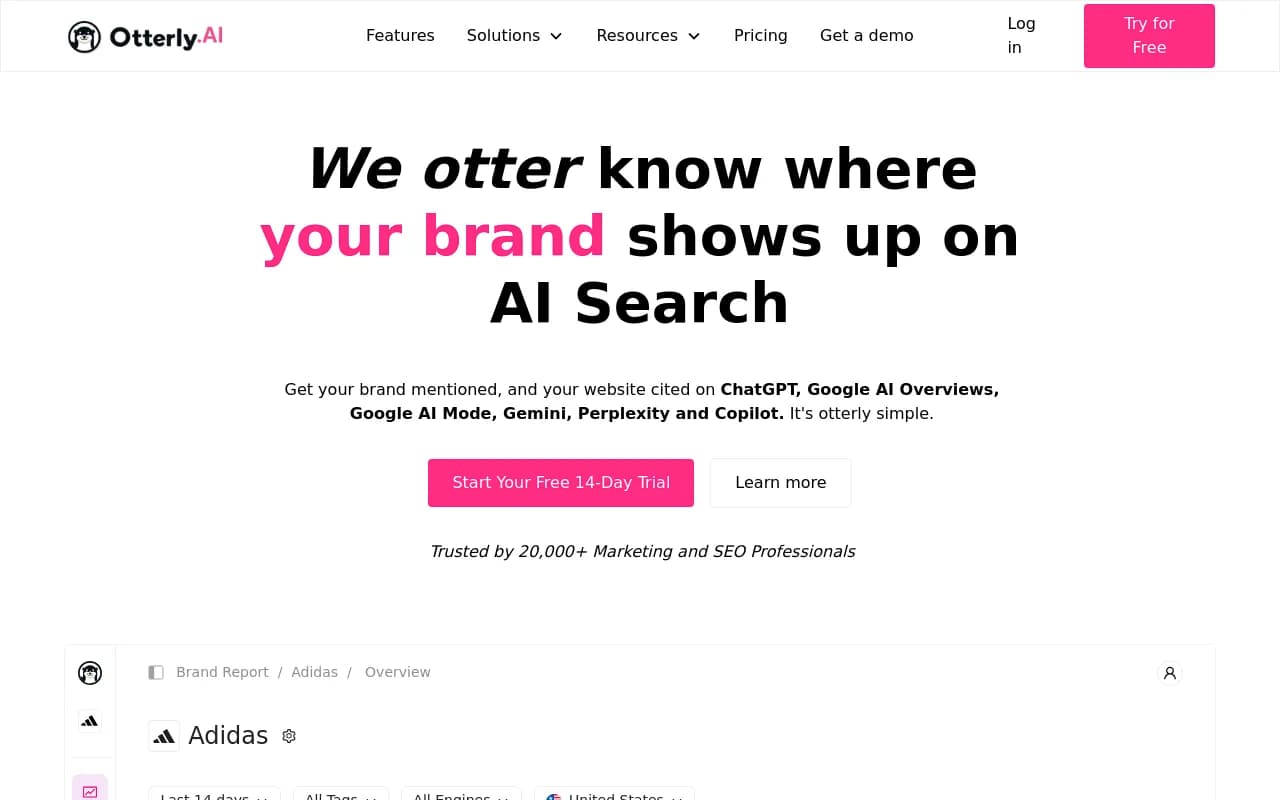
4. Otterly.AI
Otterly is the budget-friendly end of the serious AI visibility market. Plans start at $29/month, and for that price you get brand mention tracking across ChatGPT, Perplexity, and Google AI Overviews, with basic competitor comparison.
The trade-off is depth. Otterly doesn't offer prompt volume data, content gap analysis, crawler logs, or traffic attribution. It's a reasonable starting point for small teams or solo marketers who want to understand whether they're showing up in AI responses at all — but if you need to act on that data, you'll quickly hit the ceiling.
Otterly.AI

5. Scrunch AI
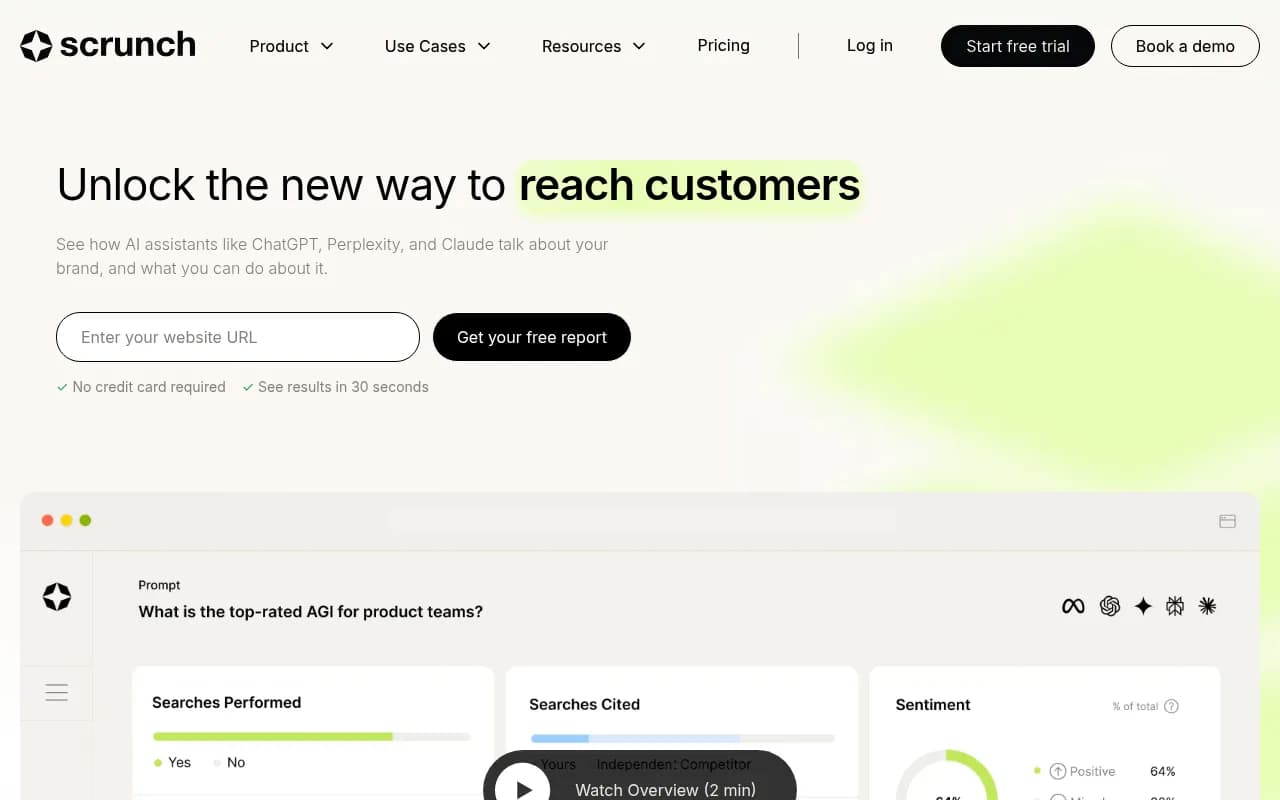
Scrunch AI sits between Otterly and Profound in terms of depth and price. It tracks brand mentions across major LLMs, offers competitive benchmarking, and has a reasonably clean interface. The platform has been building out its feature set steadily, and it's worth evaluating if you're in the mid-market.
The gap analysis capabilities are limited compared to Promptwatch, and there's no built-in content generation. But for teams that primarily need monitoring and competitive context, it's a credible option.
6. AthenaHQ
AthenaHQ focuses on AI search visibility tracking with a clean, research-oriented interface. It's monitoring-focused — good for understanding your current position across AI engines and tracking changes over time. The platform doesn't offer content optimization or generation capabilities, which limits its usefulness for teams that want to move from insight to action.

7. Search Party
Search Party is more agency-oriented than most tools in this list. It's built around workflow automation and client reporting rather than deep prompt analytics. If you're an agency managing AI visibility for multiple clients and need clean deliverables, it's worth a look. But it lacks the prompt volume metrics and content gap analysis that make platforms like Promptwatch more actionable.
Search Party
8. Semrush
Semrush has added AI visibility features to its existing SEO platform, including some tracking of brand mentions in AI Overviews. For teams already deep in the Semrush ecosystem, this is a convenient addition. The limitation is that Semrush uses fixed prompt sets, which means you're tracking a predetermined list of queries rather than discovering new ones. There's no AI traffic attribution, no crawler logs, and no content generation specifically engineered for AI citation.
9. Ahrefs
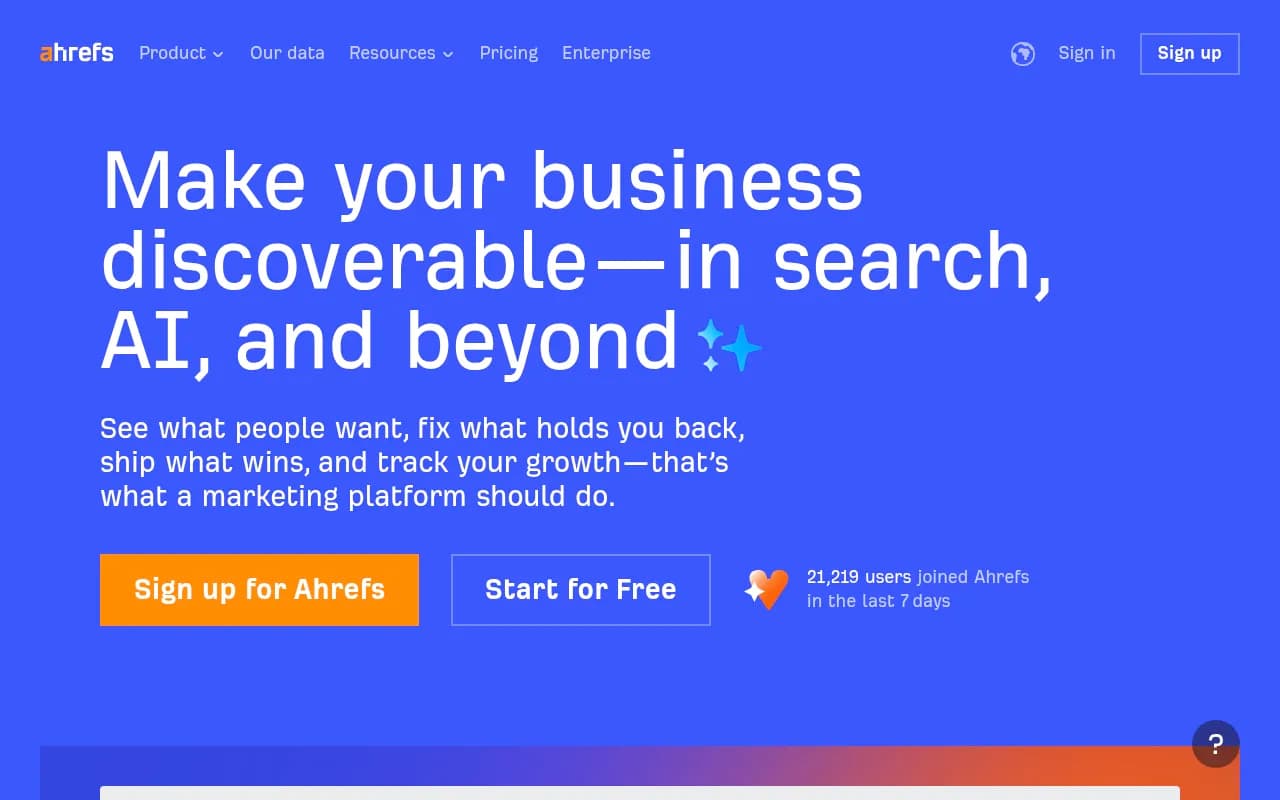
Ahrefs launched its Brand Radar feature to track AI visibility, and it integrates reasonably well with the existing Ahrefs workflow. Like Semrush, the prompts are fixed — you can't surface new gaps or discover what competitors are winning that you're not. There's no AI traffic attribution, which makes it hard to connect visibility to business outcomes.
10. Brandlight.ai
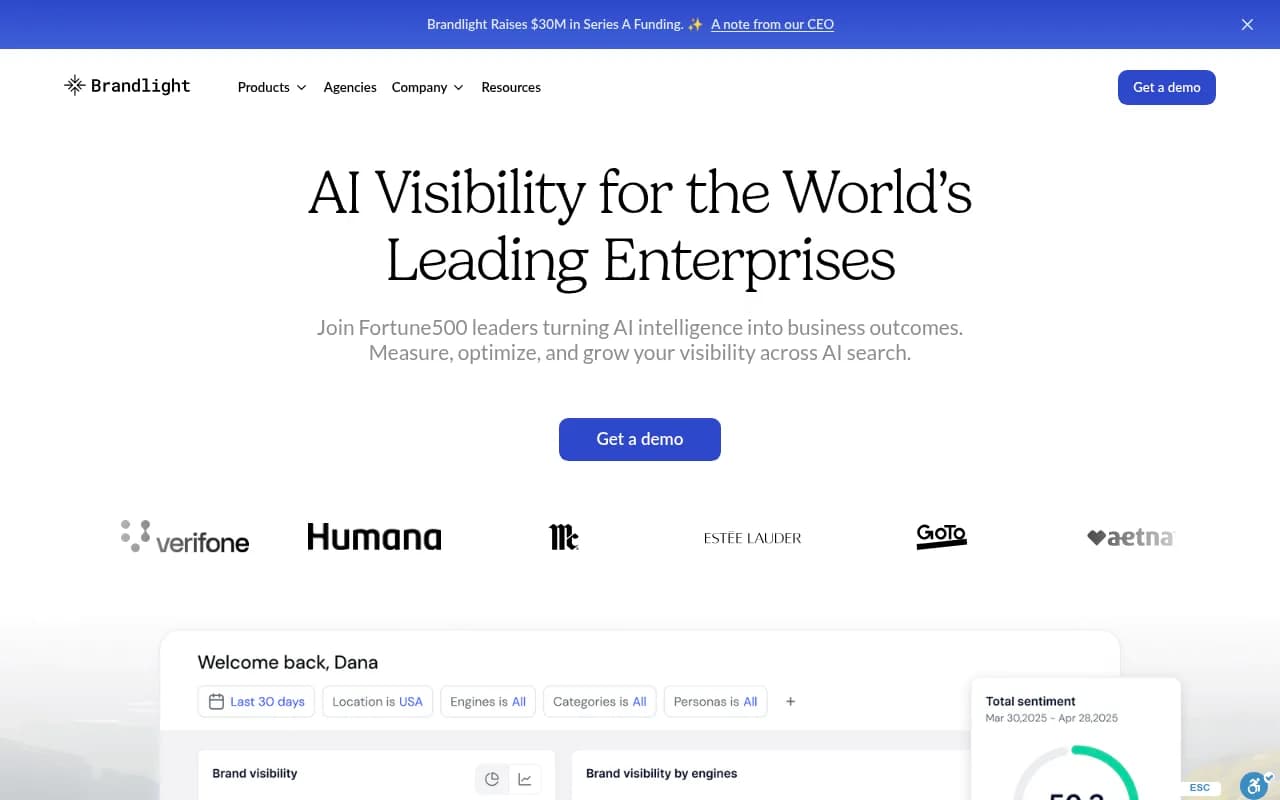
Brandlight.ai focuses on tracking how AI engines discover and recommend brands. It's a narrower tool than most on this list — useful for reputation monitoring and understanding brand sentiment in AI responses, but not built for the full optimization workflow. Missing: crawler logs, content generation, traffic attribution.
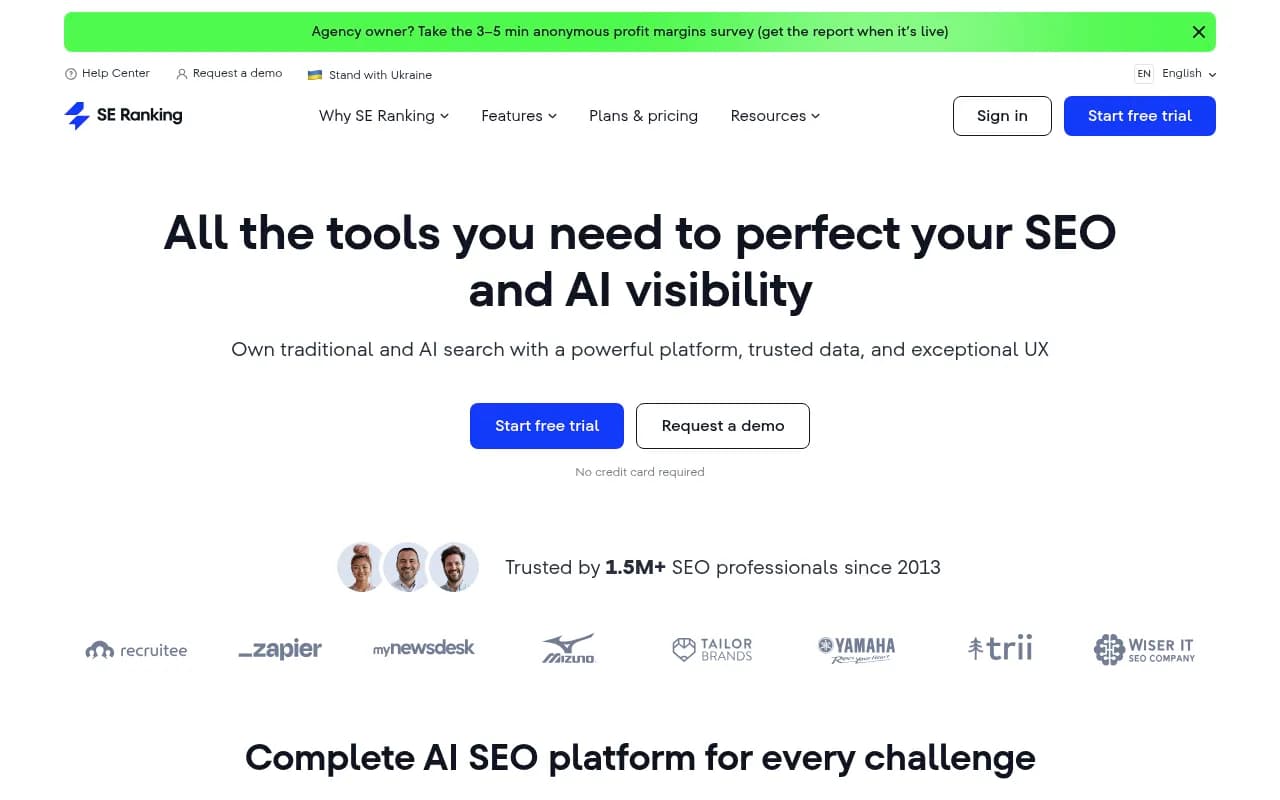
11. SE Ranking (SE Visible)
SE Ranking's AI visibility module (branded as SE Visible) tracks brand mentions in AI search engines and integrates with the broader SE Ranking platform. It's a reasonable add-on for existing SE Ranking customers, but as a standalone AI visibility tool it's limited. The data is useful for monitoring; the platform doesn't help you act on it.
12. Otterly.AI (additional note)
Worth noting separately: Otterly has a second product tier that adds some competitive tracking features. Even at higher tiers, the platform remains monitoring-focused. It's a good tool for what it does — it just doesn't do the hard part.
Side-by-side comparison
| Platform | AI engines covered | Content gap analysis | Content generation | Crawler logs | Traffic attribution | Reddit/YouTube tracking | Starting price |
|---|---|---|---|---|---|---|---|
| Promptwatch | 10 | Yes | Yes (AI writing agent) | Yes | Yes (3 methods) | Yes | $99/mo |
| Profound | 9+ | No | No | No | No | No | ~$499/mo |
| Peec AI | 5+ | No | No | No | No | No | €89/mo |
| Otterly.AI | 3 | No | No | No | No | No | $29/mo |
| Scrunch AI | 5+ | Limited | No | No | No | No | Custom |
| AthenaHQ | 4+ | No | No | No | No | No | Custom |
| Search Party | 4+ | No | No | No | No | No | Custom |
| Semrush | 2-3 (fixed prompts) | No | No | No | No | No | Add-on |
| Ahrefs Brand Radar | 2-3 (fixed prompts) | No | No | No | No | No | Add-on |
| Brandlight.ai | 4+ | No | No | No | No | No | Custom |
| SE Visible | 3+ | No | No | No | No | No | Add-on |
How to choose the right platform for your situation
The right tool depends heavily on what you're trying to accomplish and where you are in your AI visibility journey.
If you're just starting out and want to understand the basics
Otterly.AI at $29/month is a reasonable starting point. You'll see whether your brand appears in AI responses and get a rough competitive comparison. Don't expect to be able to act on the data in any structured way — but for a first look at your AI visibility, it works.
If you need enterprise-grade reporting for executive stakeholders
Profound's depth and reporting quality make it the strongest option for teams that need to present AI visibility data to C-suite or board-level audiences. The price reflects that positioning. Just be prepared to handle the "what do we do about it" question separately.
If you want to actually improve your visibility, not just measure it
This is where Promptwatch is in a different category from everything else on this list. The combination of Answer Gap Analysis, AI-grounded content generation, and traffic attribution means you can run a complete optimization cycle — find what's missing, create content to fill the gap, and verify that it's working. Most platforms stop at step one.
For marketing teams, SEO teams, and agencies that want to connect AI visibility to revenue, Promptwatch is the most complete option available.
If you're an agency managing multiple clients
Look carefully at multi-site pricing, white-label reporting options, and API access. Promptwatch's Business plan covers 5 sites with custom agency pricing available. Search Party has some agency-specific workflow features. Peec AI's per-site pricing can get expensive at scale.
The monitoring-only trap
One pattern worth calling out explicitly: most platforms in this market are built around the assumption that visibility data is the end product. You get a dashboard, you see a score, you report it to your team. That's monitoring.
The problem is that monitoring doesn't move the needle. Knowing you appear in 12% of AI responses for your target prompts is useful context. Knowing exactly which prompts you're losing to competitors, having a tool that generates content specifically designed to win those prompts, and then seeing your score improve as AI models start citing your new pages — that's optimization.
The distinction matters because the time investment is completely different. A monitoring tool requires someone to interpret the data and figure out what to do. An optimization platform like Promptwatch gives you the interpretation and the action in the same workflow.
A note on data quality
One thing that doesn't get discussed enough in platform comparisons is how platforms actually collect their data. Most tools query AI engines directly — they send prompts and record what comes back. The quality of this data depends on how many prompts they run, how often, and across how many models.
Promptwatch has processed over 1.1 billion citations, clicks, and prompts. That scale matters for the accuracy of prompt volume estimates, difficulty scores, and competitive benchmarks. Smaller platforms with less data history will give you directionally useful information, but the precision of the insights is lower.
What's coming in 2026
A few trends worth watching as you make your platform decision:
AI shopping is becoming a real channel. ChatGPT's product recommendation and shopping carousel features are growing, and brands that appear in those results are seeing measurable traffic. Promptwatch already tracks ChatGPT Shopping — most other platforms don't.
Query fan-outs are becoming more important. When a user asks an AI a question, the model often breaks it into sub-queries before generating an answer. Understanding how your target prompts fan out into sub-queries helps you prioritize content creation. This is a relatively new feature area, and Promptwatch's prompt intelligence module covers it.
AI crawler behavior is getting more complex. Different AI engines crawl websites differently, at different frequencies, with different error patterns. The brands that understand their crawler logs will have a meaningful advantage in getting new content indexed and cited quickly.
Final recommendation
If you're evaluating AI visibility platforms in 2026, the honest answer is that most of them will show you the same basic picture: here's where you appear, here's where competitors appear, here's the gap. The difference is what happens next.
For teams that want to close that gap rather than just measure it, Promptwatch is the clearest choice. The action loop — gap analysis, content generation, traffic attribution — is what makes it an optimization platform rather than a reporting tool. The pricing is also more accessible than Profound at the mid-market level, while offering significantly more capability than Otterly or Peec at the entry level.
That said, if your primary need is executive reporting and you have a separate team to handle content strategy, Profound's depth is genuinely impressive. And if budget is the primary constraint, Otterly gives you a real starting point for under $30/month.
The worst outcome is picking a monitoring-only tool, watching your visibility score, and wondering why nothing is improving. Make sure whatever platform you choose gives you a path to action, not just a dashboard.