Key takeaways
- Most AI visibility platforms are monitoring dashboards — they show you data but stop short of helping you act on it
- Promptwatch is the only platform in this comparison rated as a "Leader" across all categories, because it closes the loop from gap analysis to content creation to traffic attribution
- Profound is the strongest enterprise monitoring option but costs significantly more and lacks content generation
- Peec AI and Otterly.AI are solid entry points for teams that just need to start tracking, but both hit walls quickly when you want to do something about what you find
- The right choice depends on whether you need to measure AI visibility or actually improve it — those are different problems
Why this comparison exists
Search traffic is changing fast. According to NP Digital's analysis of 50 B2B companies, organic leads dropped 47% between January and October 2025 for many brands. Meanwhile, research from Magenta Associates found that 66% of UK senior decision-makers now use AI tools like ChatGPT, Copilot, and Perplexity to research suppliers — and 90% trust what those systems recommend.
So brands are scrambling to understand: am I showing up when buyers ask AI for recommendations? And if not, what do I do about it?
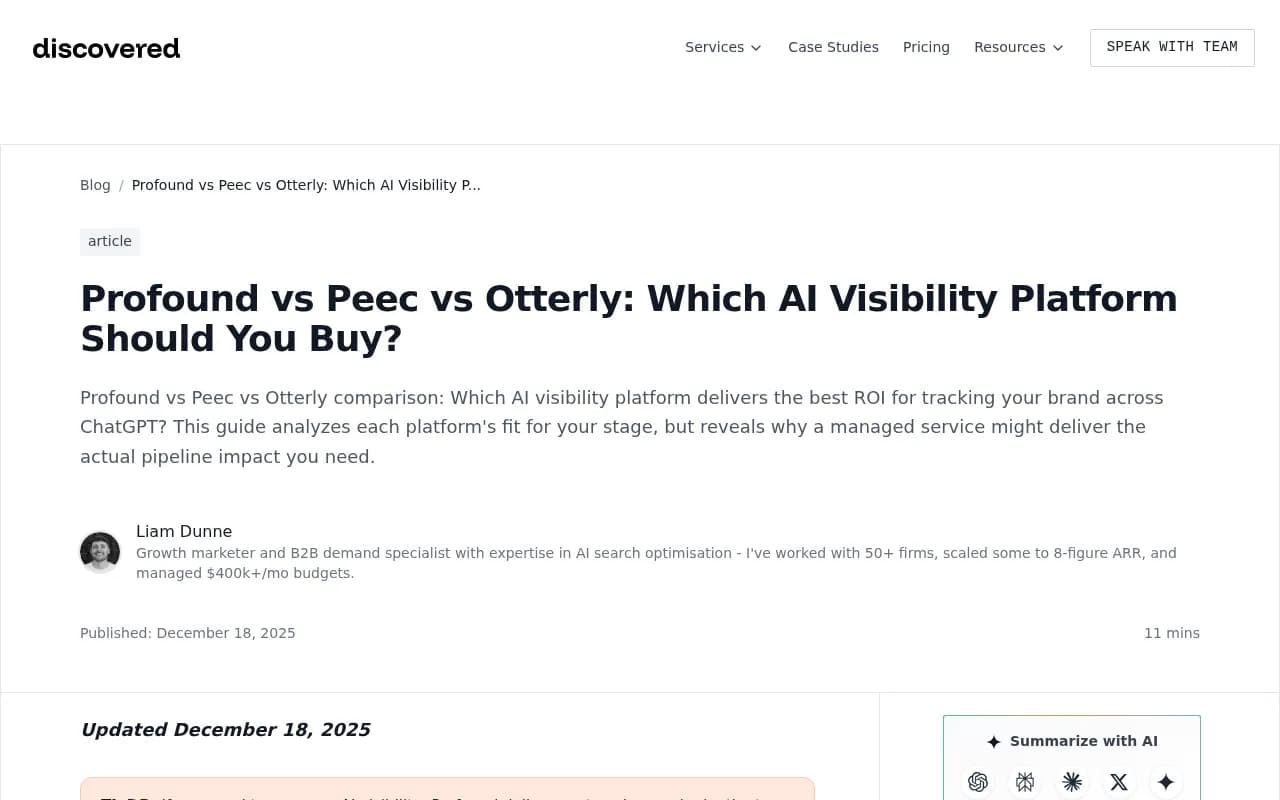
That's created a wave of "AI visibility" tools. Some are genuinely useful. Some are dashboards dressed up as strategy. This guide cuts through the noise and ranks four of the most-discussed platforms — Promptwatch, Profound, Peec AI, and Otterly.AI — by what they actually do, not just what they claim.
The core problem with most AI visibility tools
Before getting into the platforms, it's worth naming the pattern you'll see again and again in this space: monitoring-only tools.
These tools query ChatGPT, Perplexity, Claude, or Google AI Overviews with your tracked prompts, record whether your brand appears, and show you a dashboard. That's genuinely useful — knowing you're invisible is better than not knowing. But it's step one of a three-step process.
Step two is figuring out what to do about it. Step three is doing it and measuring whether it worked.
Most platforms stop at step one. That's the real differentiator in this market, and it's why the rankings below look the way they do.
Platform-by-platform breakdown
Promptwatch
Promptwatch is the most complete platform in this comparison. It's used by 6,700+ brands and agencies including Booking.com and Center Parcs, and it's the only tool here that covers the full cycle: find gaps, create content, track results.

What makes it different in practice:
The Answer Gap Analysis shows you exactly which prompts competitors are getting cited for but you're not. Not just "you're missing visibility" — it shows the specific topics, questions, and angles that AI models want answers to but can't find on your site. That's actionable in a way that a visibility score isn't.
From there, the built-in AI writing agent generates articles, listicles, and comparisons grounded in real citation data. Promptwatch has processed over 880 million citations, so when it generates content, it's working from what actually gets cited by ChatGPT, Claude, and Perplexity — not generic SEO filler.
Then you track results at the page level: which pages are being cited, how often, by which models. And you can close the loop with traffic attribution via a code snippet, Google Search Console integration, or server log analysis.
A few other things worth knowing: Promptwatch logs AI crawlers in real time (which pages ChatGPT or Perplexity bots are reading, errors they hit, how often they return). It tracks Reddit and YouTube discussions that influence AI recommendations. It monitors ChatGPT Shopping carousels. It gives you prompt volume estimates and difficulty scores so you can prioritize.
Pricing starts at $99/month for the Essential plan (1 site, 50 prompts, 5 articles), $249/month for Professional (2 sites, 150 prompts, crawler logs, city-level tracking), and $579/month for Business (5 sites, 350 prompts). There's a free trial.
The honest caveat: if you genuinely just want to monitor and have a content team ready to act on the data independently, you're paying for features you won't use at the lower tiers. But for most marketing teams that want to actually move the needle, the full loop is what makes this worth it.
Profound
Profound is the strongest pure-monitoring platform in this comparison. It covers 9+ AI search engines, has solid enterprise features, and is the go-to recommendation in several agency-focused roundups.
Profound

What it does well: deep analytics, brand configuration for agencies, and a pitch environment that lets you demo AI visibility to clients. If you're an agency selling GEO services and need to show clients what's happening across AI engines, Profound's reporting is genuinely impressive.
What it doesn't do: help you fix what you find. There's no content generation, no answer gap analysis that tells you what to write, no AI crawler logs, no Reddit/YouTube tracking. You get excellent data about where you stand — and then you're on your own to act on it.
Pricing starts at $499/month, which is the highest entry point in this comparison. For enterprise teams with dedicated content resources who just need the measurement layer, that might be fine. For everyone else, you're paying a premium for monitoring without the execution layer.
Peec AI
Peec AI is a European platform (GDPR-compliant by default) that covers the mid-market well. It's faster to set up than Profound and cheaper, with pricing starting around €89/month.

It tracks brand mentions across ChatGPT, Perplexity, Claude, and a handful of other models. The interface is clean and the onboarding is quick — you can be tracking within a day rather than a week.
The limitations are real though. No content generation. No crawler logs. No Reddit or YouTube tracking. No ChatGPT Shopping monitoring. No traffic attribution. It's a monitoring tool, and a decent one, but it hits a ceiling fast when you want to do more than watch.
For European companies that are just starting to measure AI visibility and want something affordable and compliant, Peec AI is a reasonable starting point. Just know you'll likely outgrow it.
Otterly.AI
Otterly.AI is the most affordable option here, with plans starting around $29/month. It tracks brand mentions across ChatGPT, Perplexity, and Google AI Overviews, and it has a GEO audit feature that gives you some basic optimization guidance.
Otterly.AI

For small teams or solo marketers who want to dip a toe into AI visibility tracking without a big commitment, Otterly is a reasonable choice. The price point is genuinely low, and the core monitoring works.
But the gaps are significant at any serious scale. No visitor analytics, no crawler logs, no content generation, no prompt volume data, no competitor heatmaps. The GEO audit gives you a checklist rather than a content strategy. If you're running a brand that depends on AI search visibility, you'll hit the limits of Otterly quickly.
Feature comparison table
| Feature | Promptwatch | Profound | Peec AI | Otterly.AI |
|---|---|---|---|---|
| AI models tracked | 10+ | 9+ | ~5 | 3 |
| Prompt volume & difficulty scores | Yes | No | No | No |
| Answer gap analysis | Yes | No | No | No |
| Built-in content generation | Yes | No | No | No |
| AI crawler logs | Yes | No | No | No |
| Reddit & YouTube tracking | Yes | No | No | No |
| ChatGPT Shopping tracking | Yes | No | No | No |
| Traffic attribution | Yes | No | No | No |
| Competitor heatmaps | Yes | Yes | Limited | No |
| Multi-language/region | Yes | Yes | Yes | Limited |
| Starting price | $99/mo | $499/mo | €89/mo | $29/mo |
| Free trial | Yes | Yes | Yes | Yes |
| GDPR-native | Yes (Dutch) | No | Yes (EU) | No |
How to choose
The decision comes down to one question: do you need to measure AI visibility, or improve it?
If you just need to measure — you have a content team ready to act, a clear strategy, and you just need data — Profound is the most thorough monitoring option, though you'll pay for it. Peec AI is a reasonable alternative if you're in Europe or price-sensitive.
If you need to improve AI visibility — find gaps, create content that gets cited, track whether it's working — Promptwatch is the only platform here that does all three. The action loop (gap analysis → content generation → result tracking) is what separates it from the rest.
Otterly.AI makes sense as an entry point for very small teams or as a way to get buy-in before committing to a larger platform. But treat it as a starting point, not a destination.
A note on the broader market
These four platforms aren't the only options. The AI visibility space has exploded in 2025-2026, and there are now dozens of tools claiming to solve this problem.
A few worth knowing about:
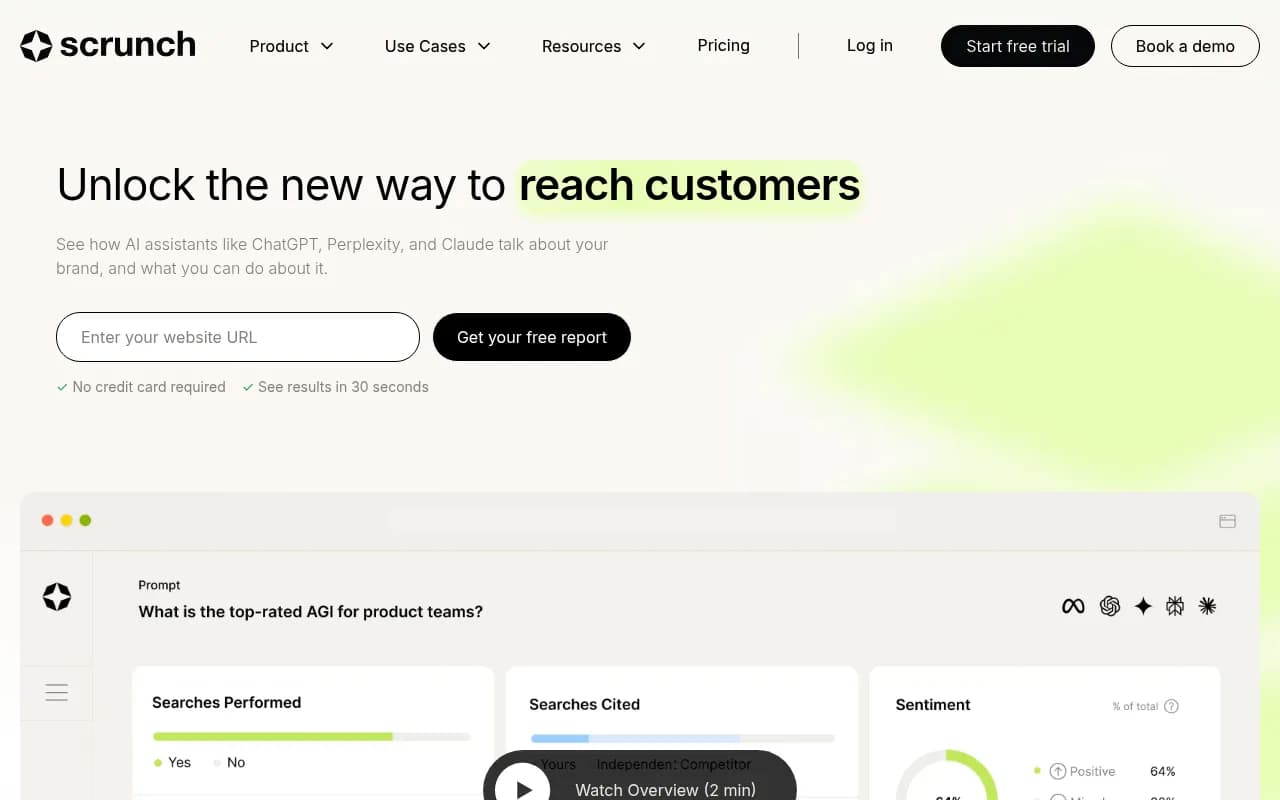
Scrunch AI covers AI search visibility tracking with a focus on enterprise brands.

AthenaHQ is monitoring-focused and lacks content optimization capabilities.
Semrush has added AI search features to its existing platform, but uses fixed prompts and lacks AI traffic attribution — it's a useful addition if you're already a Semrush customer, not a reason to switch.
Ahrefs Brand Radar has fixed prompts and no AI traffic attribution either. Same story — useful if you're already in the ecosystem.
The pattern holds across most of these: monitoring is table stakes now. The question is what comes after the dashboard.
What the data actually shows
Promptwatch has processed over 1.1 billion citations, clicks, and prompts. That's not a marketing number — it's the foundation of why its content generation and gap analysis work better than competitors. When you're generating content designed to get cited by AI models, the quality of the underlying citation data matters enormously.
The research from Similarweb's 2025 Generative AI Report puts this in context: AI platforms generated over 1.1 billion referral visits in June 2025, up 357% year-over-year. That's the traffic opportunity sitting behind AI visibility. A monitoring tool tells you whether you're capturing it. A platform like Promptwatch helps you actually capture it.
Bottom line
Most AI visibility tools are solving the easy part of the problem. Knowing you're invisible in ChatGPT is useful. Knowing which prompts your competitors rank for but you don't, generating content engineered to close those gaps, and tracking whether that content actually gets cited — that's the harder and more valuable problem.
Promptwatch is the only platform in this comparison built around that full loop. Profound is the best choice if you specifically need enterprise-grade monitoring without the optimization layer. Peec AI and Otterly.AI are reasonable starting points for teams with limited budgets or limited immediate needs.
The AI search landscape is moving fast enough that "we'll figure out optimization later" is a real risk. The brands building AI visibility now are the ones that will be cited when buyers ask ChatGPT for recommendations six months from now.