Key takeaways
- Most AI visibility platforms are monitoring-only dashboards -- they show you where you're invisible but don't help you fix it.
- Promptwatch is the only platform in this comparison rated as a leader across all categories, combining tracking, content gap analysis, and AI content generation in one loop.
- Profound is the strongest enterprise-grade option if you need deep analytics and don't mind the price tag ($499/month).
- Otterly.AI and Peec AI are solid entry points for smaller teams or those just getting started with AI search monitoring.
- Traditional SEO tools like Semrush and Ahrefs have added AI search features, but they're still catching up on depth and actionability.
Why this category suddenly matters
A year ago, most marketing teams had never heard of "AI visibility." Now it's one of the fastest-growing line items in digital marketing budgets -- and for good reason.
When someone asks ChatGPT "What's the best project management tool for remote teams?" or Perplexity "Which CRM should a B2B startup use?", those answers don't come from a ranked list of blue links. They come from whatever the AI model has learned to trust. If your brand isn't in that answer, you're invisible to a growing chunk of your potential buyers.
Gartner predicted search engine volume would decline 25% by 2026 as users shift to AI chatbots. That's not a future concern anymore -- it's happening now. Research from Magenta Associates found that 66% of UK senior decision-makers already use AI tools like ChatGPT and Perplexity to research suppliers, and 90% trust those recommendations.
So the question isn't whether AI visibility matters. It's which platform actually helps you improve it.
That's what this guide is about.
What separates a good AI visibility platform from a mediocre one
Before diving into the tools, it's worth being clear about what to actually evaluate. The marketing copy for most of these platforms sounds nearly identical: "track your brand across ChatGPT, Perplexity, Claude, and more." The real differences show up in a few specific areas.
Monitoring depth vs. optimization capability. Most tools stop at monitoring. They tell you your brand appeared in 12% of relevant AI responses last week. That's useful data, but it doesn't tell you what to do about it. The more valuable platforms identify which prompts your competitors are winning that you're not, and then help you create content to close those gaps.
Platform coverage. There are now 10+ major AI models that matter: ChatGPT, Perplexity, Claude, Gemini, Google AI Overviews, Google AI Mode, Grok, DeepSeek, Meta AI, Copilot, and Mistral. Tools that only cover three or four of these are leaving you with a partial picture.
Prompt intelligence. Not all prompts are equally valuable. A good platform tells you which prompts have high volume, which are winnable, and how one query fans out into related sub-queries. Without this, you're optimizing blind.
Traffic attribution. Knowing you got cited is one thing. Knowing that citation drove 200 visitors who converted at 4% is another. Very few platforms close this loop.
Crawler log access. Understanding how AI bots actually crawl your site -- which pages they read, how often, what errors they hit -- is a layer of insight most platforms don't offer at all.
The top 10 AI visibility platforms compared
1. Promptwatch
Promptwatch is the most complete platform in this category. Where most competitors are monitoring dashboards, Promptwatch is built around an action loop: find gaps, create content, track results.
The Answer Gap Analysis shows you exactly which prompts competitors rank for in AI responses that you don't -- not as a vague insight, but as a specific list of topics and questions your site is missing. The built-in AI writing agent then generates articles, listicles, and comparisons grounded in 880M+ real citation data points. And page-level tracking shows you which specific pages are getting cited, by which models, and how often.
A few things that genuinely set it apart from the field: AI crawler logs (real-time visibility into how ChatGPT, Claude, and Perplexity bots crawl your site), Reddit and YouTube citation tracking (most competitors ignore these entirely), ChatGPT Shopping tracking, and query fan-outs that show how one prompt branches into sub-queries.
It covers 10 AI models, supports multi-language and multi-region monitoring, and integrates with Looker Studio. Pricing starts at $99/month for the Essential plan (1 site, 50 prompts, 5 articles), with Professional at $249/month and Business at $579/month. A free trial is available.
In a 2026 comparison of 12 GEO platforms, it was the only tool rated as a "Leader" across all categories.

2. Profound
Profound is the strongest pure-enterprise option in this space. At $499/month, it's not cheap, but the analytics depth is real -- it covers 9+ AI engines, provides detailed citation tracking, and offers competitive benchmarking that enterprise teams will find genuinely useful.
The main limitation is the same one that affects most competitors: it's primarily a monitoring tool. It tells you what's happening but leaves content creation, schema implementation, and authority-building to your team. If you have the internal bandwidth to act on the data, Profound is excellent. If you don't, you'll end up with a very expensive dashboard.
Profound

3. Peec AI
Peec AI positions itself as the mid-market option, and it mostly delivers on that promise. Starting at €89/month, it offers solid brand mention tracking across ChatGPT, Perplexity, and Claude, with a reasonably clean interface and decent speed.
It's a good fit for teams that want to get started with AI visibility monitoring without committing to enterprise pricing. The trade-off is that optimization features are limited -- you get the data, but the path from "we're invisible here" to "we fixed it" is still largely manual.

4. Otterly.AI
Otterly is the budget-friendly entry point in this category, starting at $29/month. For teams that just want to check whether their brand shows up in AI responses without a major investment, it works fine.
Coverage includes ChatGPT, Perplexity, and Google AI Overviews. The interface is straightforward. But at this price point, you're getting monitoring, not optimization. No content gap analysis, no AI writing tools, no crawler logs. It's a reasonable starting point, not a long-term solution for teams serious about improving their AI visibility.
Otterly.AI

5. Semrush (AI Toolkit)
Semrush has been adding AI search features to its traditional SEO platform, and the integration is convenient if you're already a Semrush user. You can track brand mentions in AI responses alongside your traditional keyword rankings, backlink data, and site audit results -- all in one place.
The downside is that Semrush uses fixed prompts rather than letting you define your own, which limits how targeted your monitoring can be. There's also no AI traffic attribution, so you can see AI mentions but can't connect them to actual revenue. For teams that want a single platform for both traditional SEO and basic AI monitoring, it's a reasonable choice. For teams that want to go deep on AI visibility specifically, it's not enough.
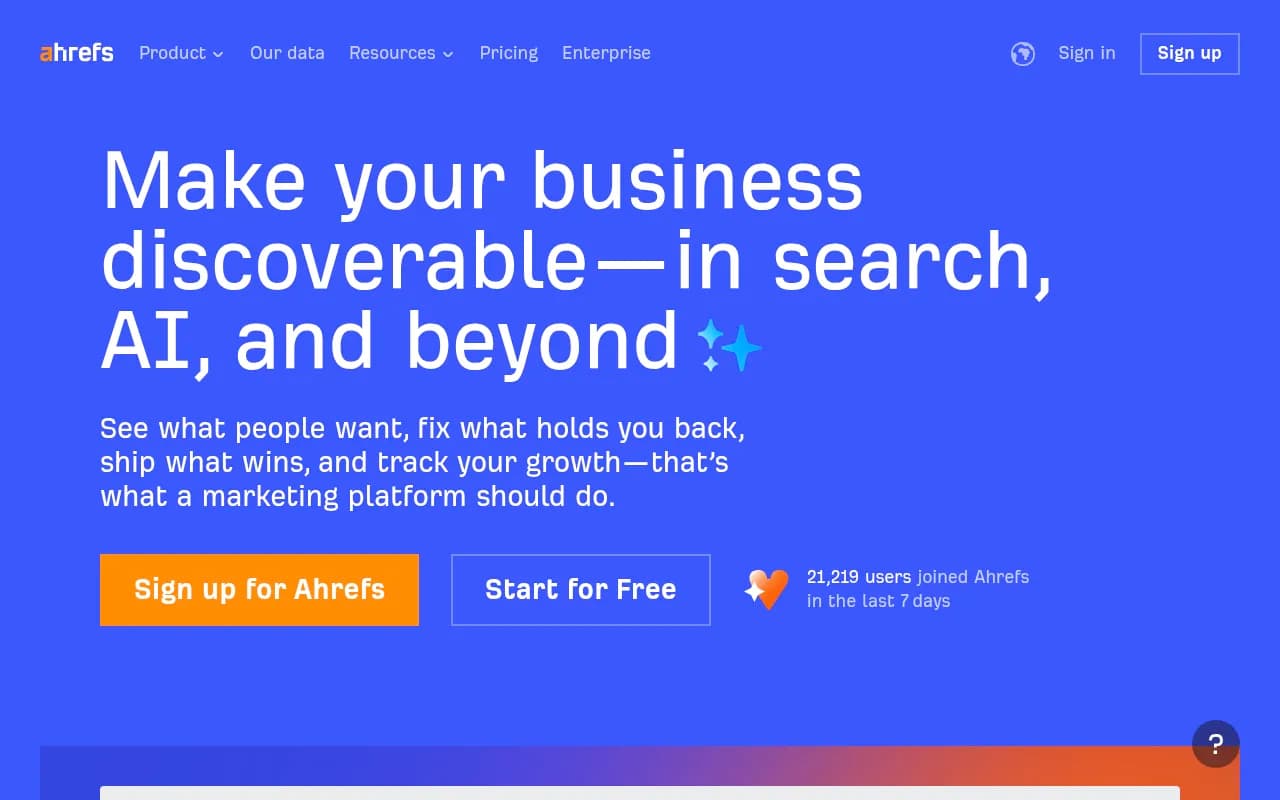
6. Ahrefs (Brand Radar)
Ahrefs added Brand Radar as part of its AI search tracking push, and like Semrush, the appeal is consolidation -- one platform for traditional SEO and AI monitoring. The data quality is solid, as you'd expect from Ahrefs.
But Brand Radar has the same structural limitations: fixed prompts, no AI traffic attribution, and no content optimization tools built around AI citation data. It's a useful add-on for existing Ahrefs users, not a reason to switch from a dedicated AI visibility platform.
7. SE Ranking (SE Visible)
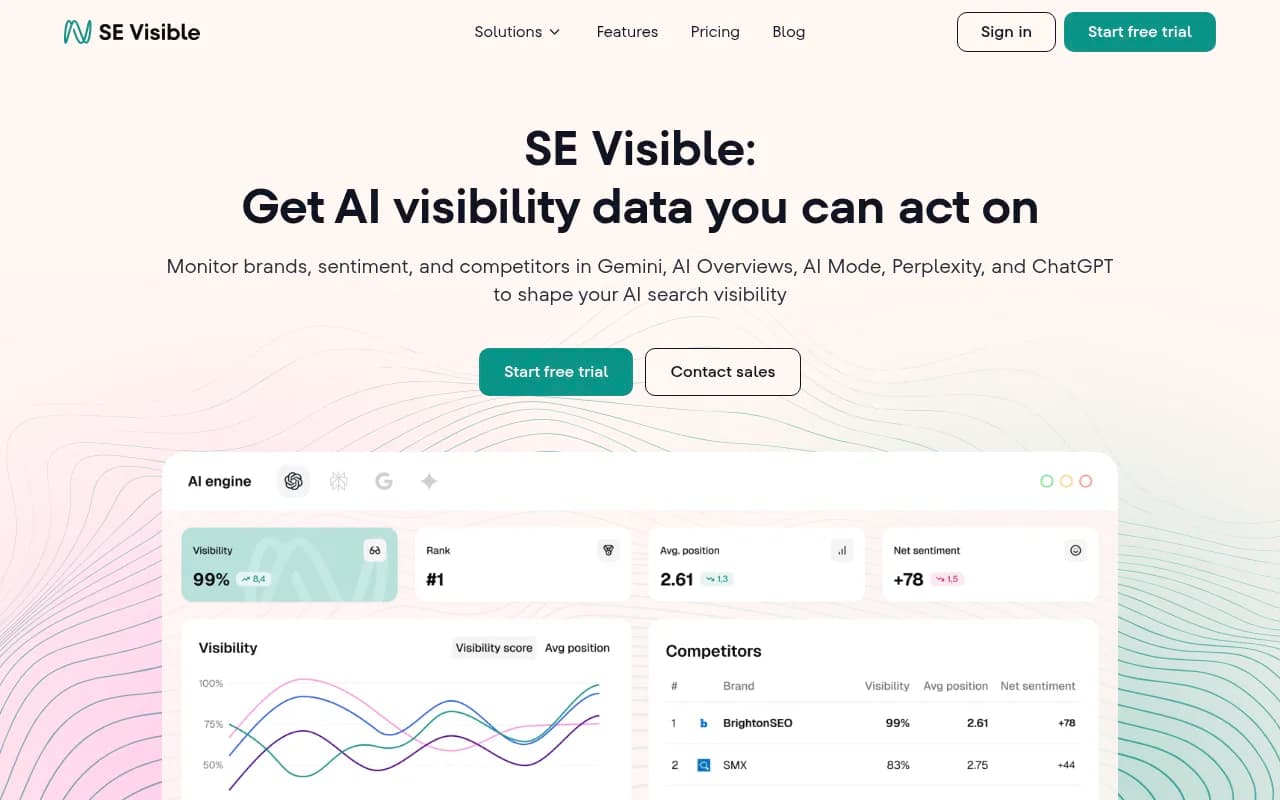
SE Ranking's AI visibility product, SE Visible, tracks brand mentions across AI search engines and presents the data clearly. It's a reasonable mid-tier option for teams that want more than Otterly but less than Profound.
The platform covers the major AI engines and provides competitive benchmarking. Where it falls short is in the optimization layer -- like most competitors, it monitors well but doesn't help you act on what it finds.
8. AthenaHQ
AthenaHQ is a monitoring-focused platform with a clean interface and good coverage of major AI engines. It's particularly strong on competitive analysis -- seeing how your brand stacks up against competitors across different AI models is straightforward.
The gap is optimization. AthenaHQ doesn't offer content generation, crawler logs, or traffic attribution. It's a solid choice for teams that want structured competitive monitoring and have the resources to act on the insights themselves.

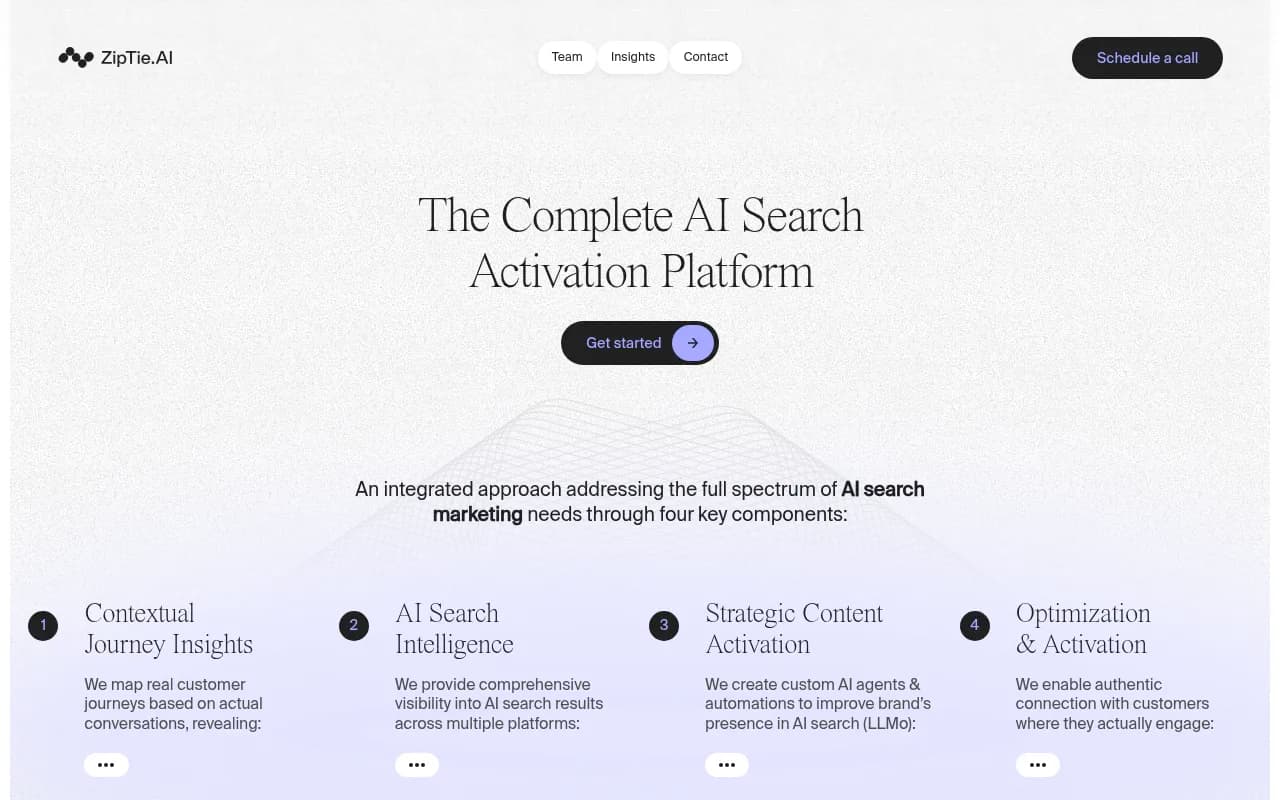
9. ZipTie
ZipTie is one of the more interesting newer entrants in this space. It covers ChatGPT, Perplexity, and Google AI Overviews, and includes a content optimization module that goes beyond pure monitoring. The "deep analysis" positioning is accurate -- it provides more granular data than most budget tools.
It's a good fit for action-oriented teams that want optimization guidance without the enterprise price tag. The main limitation is platform coverage -- it's strong on the major three AI engines but doesn't match the breadth of platforms like Promptwatch or Profound.
10. Scrunch AI
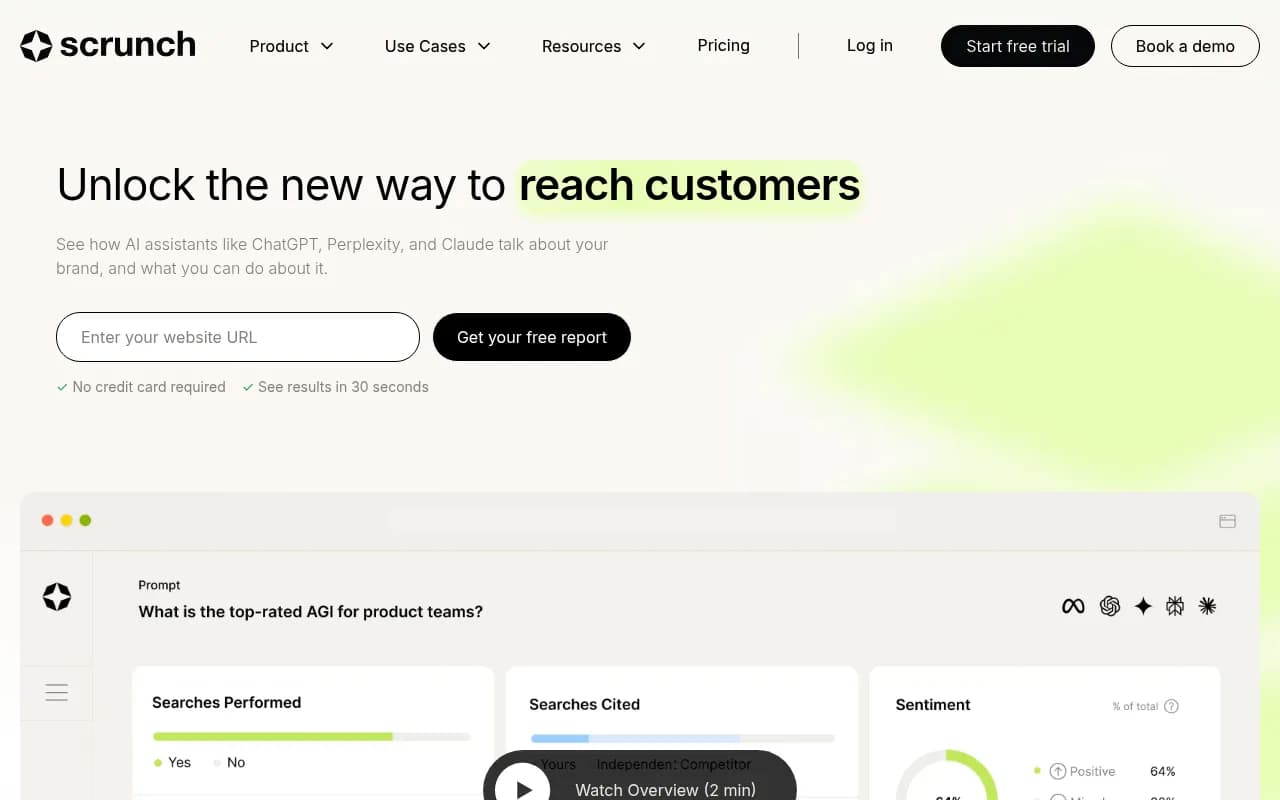
Scrunch AI rounds out this list as a solid mid-tier option with decent coverage and a clean reporting interface. It tracks brand mentions across the major LLMs and provides competitive benchmarking.
Like most tools in this tier, it's primarily a monitoring platform. The data is useful; the path to improvement is still manual. Worth considering for teams that want structured AI visibility reporting without the complexity of a full optimization platform.
Head-to-head comparison
| Platform | Starting price | AI models covered | Content generation | Crawler logs | Traffic attribution | Reddit/YouTube tracking |
|---|---|---|---|---|---|---|
| Promptwatch | $99/mo | 10 | Yes (built-in AI writer) | Yes | Yes (GSC, snippet, logs) | Yes |
| Profound | $499/mo | 9+ | No | No | No | No |
| Peec AI | €89/mo | 3-5 | No | No | No | No |
| Otterly.AI | $29/mo | 3 | No | No | No | No |
| Semrush AI Toolkit | Bundled | 3-4 (fixed prompts) | No | No | No | No |
| Ahrefs Brand Radar | Bundled | 3-4 (fixed prompts) | No | No | No | No |
| SE Visible | Bundled | 4-5 | No | No | No | No |
| AthenaHQ | Custom | 5+ | No | No | No | No |
| ZipTie | Custom | 3 | Partial | No | No | No |
| Scrunch AI | Custom | 4-5 | No | No | No | No |
How to choose the right platform for your situation
The right tool depends on what you actually need to do with the data.
If you're a marketing or SEO team that wants to improve AI visibility, not just measure it, Promptwatch is the clear choice. The action loop -- find gaps, generate content, track results -- is what makes it an optimization platform rather than a monitoring dashboard. Most competitors leave you stuck after step one.
If you're an enterprise team with dedicated content resources and need the deepest possible analytics, Profound is worth the $499/month. The data depth is real, and if you have the internal team to act on it, the monitoring quality is excellent.
If you're just getting started and want to understand the basics before committing budget, Otterly.AI at $29/month is a reasonable starting point. You won't be able to optimize from it, but you'll get a sense of where you stand.
If you're already deep in the Semrush or Ahrefs ecosystem, their AI features are worth turning on -- just understand they're supplementary, not a replacement for a dedicated AI visibility platform.
If you're an agency managing multiple clients, look at platforms with multi-site support and white-label reporting. Promptwatch's agency and enterprise tiers are built for this; Profound also has agency options.
The monitoring-only trap
One pattern worth naming explicitly: most of the platforms in this space are monitoring-only tools, and that's a real limitation.
Knowing that your brand appears in 8% of relevant AI responses while your top competitor appears in 34% is useful information. But it doesn't tell you which specific content gaps are causing that difference, what topics you need to cover to close it, or how to write content that AI models will actually cite.
The platforms that only monitor leave you with data and no clear path forward. You end up exporting CSVs, trying to reverse-engineer what's working for competitors, and writing content based on guesswork.
The platforms that go further -- identifying specific prompt gaps, generating content grounded in citation data, and tracking whether that content actually gets cited -- are the ones that turn AI visibility from a metric into a competitive advantage.
That's the core distinction to keep in mind as you evaluate options.
What to look for in 2026 and beyond
A few trends worth watching as this category matures:
ChatGPT Shopping is becoming a real channel. As AI models integrate more commerce features, appearing in product recommendations and shopping carousels is becoming as important as appearing in informational responses. Very few platforms track this yet.
AI crawler behavior is getting more sophisticated. The bots that AI models use to crawl and index content are evolving quickly. Understanding which pages they read, how often, and what errors they encounter is going to become a standard part of technical SEO -- not a niche capability.
Traffic attribution will become table stakes. Right now, most platforms can't tell you whether an AI citation actually drove traffic or revenue. That's going to change as the category matures, and the platforms that solve attribution first will have a significant advantage.
Multi-language and multi-region monitoring will matter more. AI search isn't just an English-language phenomenon. Brands operating in multiple markets need visibility data across languages and regions, not just a single market view.
The platforms that invest in these capabilities now will be the ones worth using in 2027. The monitoring-only tools will either add optimization features or get left behind.