Key takeaways
- Most AI visibility platforms are monitoring dashboards: they show you where you're invisible but leave you to figure out what to do next.
- Promptwatch is the only platform in this comparison rated as a "Leader" across all categories in a 2026 review of 12 GEO tools -- it tracks, identifies gaps, generates content, and closes the loop with traffic attribution.
- Profound and Scrunch have strong analytics but come with higher price points and no built-in content generation.
- Otterly.AI and Peec AI are good entry points for teams that just need monitoring; both lack crawler logs, content generation, and AI traffic attribution.
- AthenaHQ sits in the middle -- solid monitoring, no optimization.
- LLM coverage varies significantly: some platforms charge per model as add-ons; others include all models from the base tier.
AI search has gone from "interesting experiment" to "where a meaningful chunk of your traffic decisions get made." ChatGPT, Perplexity, Gemini, and friends now answer questions that used to drive organic clicks -- and the brands they cite are the ones that win. If your brand isn't showing up in those answers, you're not losing a ranking. You're losing the conversation entirely.
That's what AI visibility platforms are built to solve. But the category has exploded fast, and there's a wide gap between platforms that genuinely help you improve visibility and platforms that just tell you how bad things are.
This guide breaks down six of the most talked-about platforms in 2026: Promptwatch, Otterly.AI, Peec AI, Profound, AthenaHQ, and Scrunch. We'll cover what each one actually does, where it falls short, and which type of team it's right for.
What these platforms actually do (and what separates them)
Before getting into individual tools, it's worth being clear about the core job: AI visibility platforms query LLMs with prompts relevant to your industry, then track whether your brand appears in the responses, how often, and in what context.
The monitoring part is table stakes. Where platforms diverge is everything that comes after:
- Do they tell you why you're not appearing?
- Do they show you what content you're missing?
- Do they help you create that content?
- Do they connect visibility to actual website traffic and revenue?
Most platforms stop at step one. A few go further. That distinction matters a lot when you're trying to justify the spend to a CMO.
The platforms, one by one
Promptwatch
Promptwatch is the platform that's hardest to categorize as "just a tracker" because it's genuinely built around the full optimization cycle. The core workflow is: find gaps, create content, track results.
The Answer Gap Analysis shows you exactly which prompts competitors are getting cited for but you aren't -- not as a vague "you're missing topics" warning, but as specific prompts with volume estimates and difficulty scores. From there, the built-in AI writing agent generates articles, listicles, and comparison pages grounded in citation data from over 880 million citations analyzed. This isn't generic SEO content; it's engineered to match what AI models actually want to cite.
On the tracking side, Promptwatch monitors 10 LLMs: ChatGPT, Claude, Gemini, Perplexity, Grok, DeepSeek, Copilot, Mistral, Meta AI, and Google AI Overviews. Page-level tracking shows which specific pages are being cited, how often, and by which models. The AI crawler logs feature -- which most competitors lack entirely -- shows real-time logs of AI crawlers hitting your site, which pages they read, and what errors they encounter.
A few things that stand out versus the competition: Reddit and YouTube tracking (AI models cite these heavily, and most platforms ignore them), ChatGPT Shopping tracking for e-commerce brands, and traffic attribution via GSC integration, code snippet, or server log analysis. That last one is what lets you actually close the loop between AI visibility and revenue.
Pricing starts at $99/month for the Essential tier (1 site, 50 prompts, 5 articles), $249/month for Professional (2 sites, 150 prompts, 15 articles, crawler logs), and $579/month for Business (5 sites, 350 prompts, 30 articles). Agency and enterprise pricing is custom. A free trial is available.

Otterly.AI
Otterly.AI is probably the most accessible entry point in this comparison. At $29/month, it's the cheapest option, and it earned a Gartner Cool Vendor designation in 2025 -- which is notable for a young category.
The platform tracks brand mentions across ChatGPT, Perplexity, and a handful of other models, with Gemini and Google AI Overviews available as add-ons. The interface is clean and relatively easy to set up, which makes it popular with smaller teams and agencies that want to show clients something quickly.
The limitations are real, though. There are no crawler logs, no content generation, no prompt volume data, and no traffic attribution. You can see that you're not appearing in AI responses, but Otterly.AI won't tell you why or help you fix it. For teams that genuinely just need a monitoring dashboard and have their own content operation, that's fine. For teams that want to actually improve their visibility scores, it's a starting point, not a solution.
Otterly.AI

Peec AI
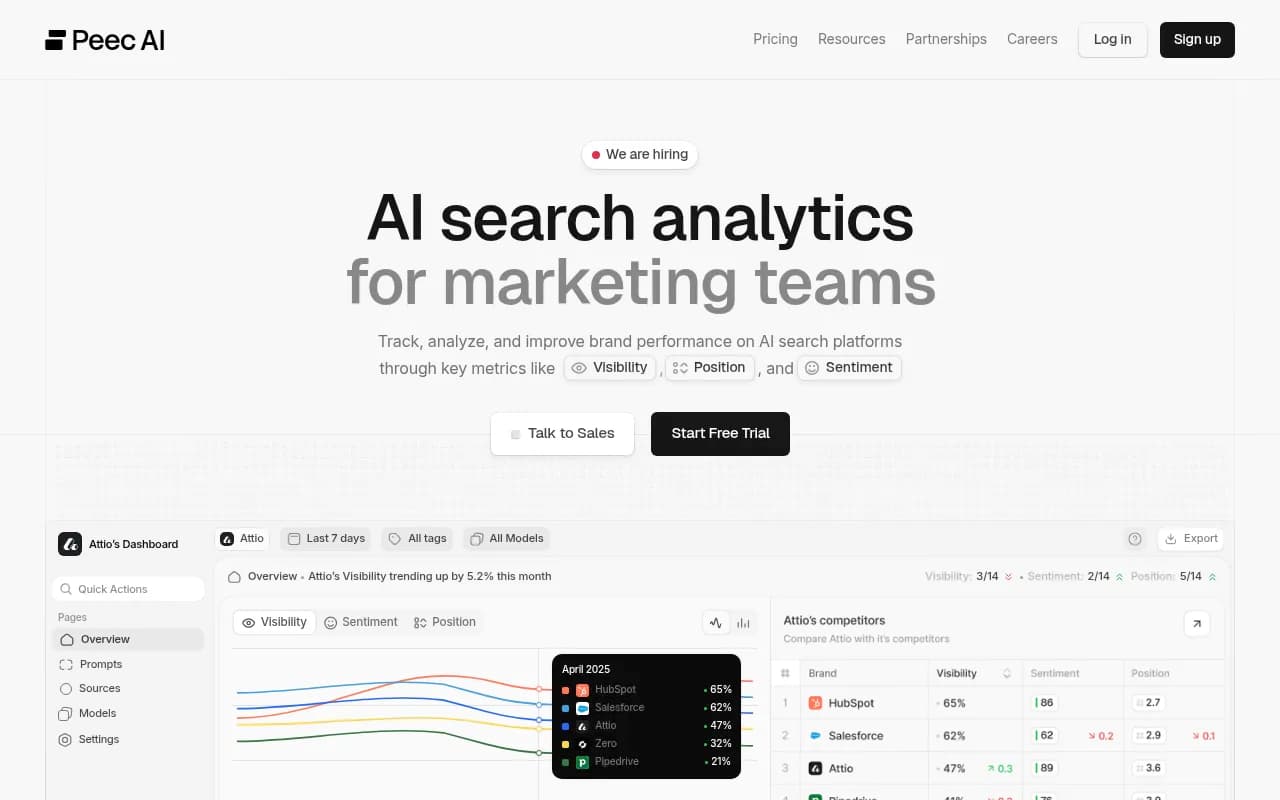
Peec AI takes a flexible approach to model coverage -- you can add or remove LLMs based on what you actually need, which keeps costs down if you only care about a subset of models. The base plan starts around €85/month and includes unlimited seats, which is a meaningful differentiator for larger teams.
The platform tracks brand mentions, share of voice, and citation rates across its supported models. It's reasonably solid for pure monitoring, and the multi-seat model makes it easier to roll out across a marketing team without per-user pricing headaches.
Like Otterly.AI, though, Peec AI is fundamentally a monitoring tool. There's no content generation, no crawler log visibility, and no built-in way to turn the data into action. The add-on model for LLMs can also get expensive quickly if you want full coverage across all major AI engines.
Profound
Profound is the most enterprise-focused platform in this group. It monitors up to 10 LLMs, has a strong research layer with prompt volume data, and the analytics depth is genuinely impressive -- particularly for teams that need to present detailed AI visibility reports to stakeholders.
The starting price is $99/month, but the plans that unlock the full feature set are meaningfully more expensive. Profound has been used by larger brands that need rigorous data, and the platform's prompt volume estimates help prioritize which queries to focus on.
The gap is on the action side. Profound is excellent at showing you the data; it's not built to help you create content that improves that data. There's also no Reddit or YouTube tracking, no ChatGPT Shopping monitoring, and no built-in content generation. For an enterprise team with a dedicated content operation that just needs the intelligence layer, Profound is a strong choice. For a team that needs end-to-end optimization, it's half the picture.
Profound
AthenaHQ
AthenaHQ sits in a similar position to Profound -- solid monitoring, good LLM coverage, but no real optimization layer. The platform tracks brand mentions and share of voice across major AI engines and provides competitive benchmarking data.
Where AthenaHQ has invested is in the analytics and reporting side, making it reasonably popular with agencies that need to show clients where they stand relative to competitors. The API access (though API-only, with no full UI) is useful for teams that want to pipe data into their own reporting infrastructure.
The absence of content generation, crawler logs, and traffic attribution means AthenaHQ tells you what's happening but not what to do about it. It's a monitoring platform that happens to have good data.

Scrunch
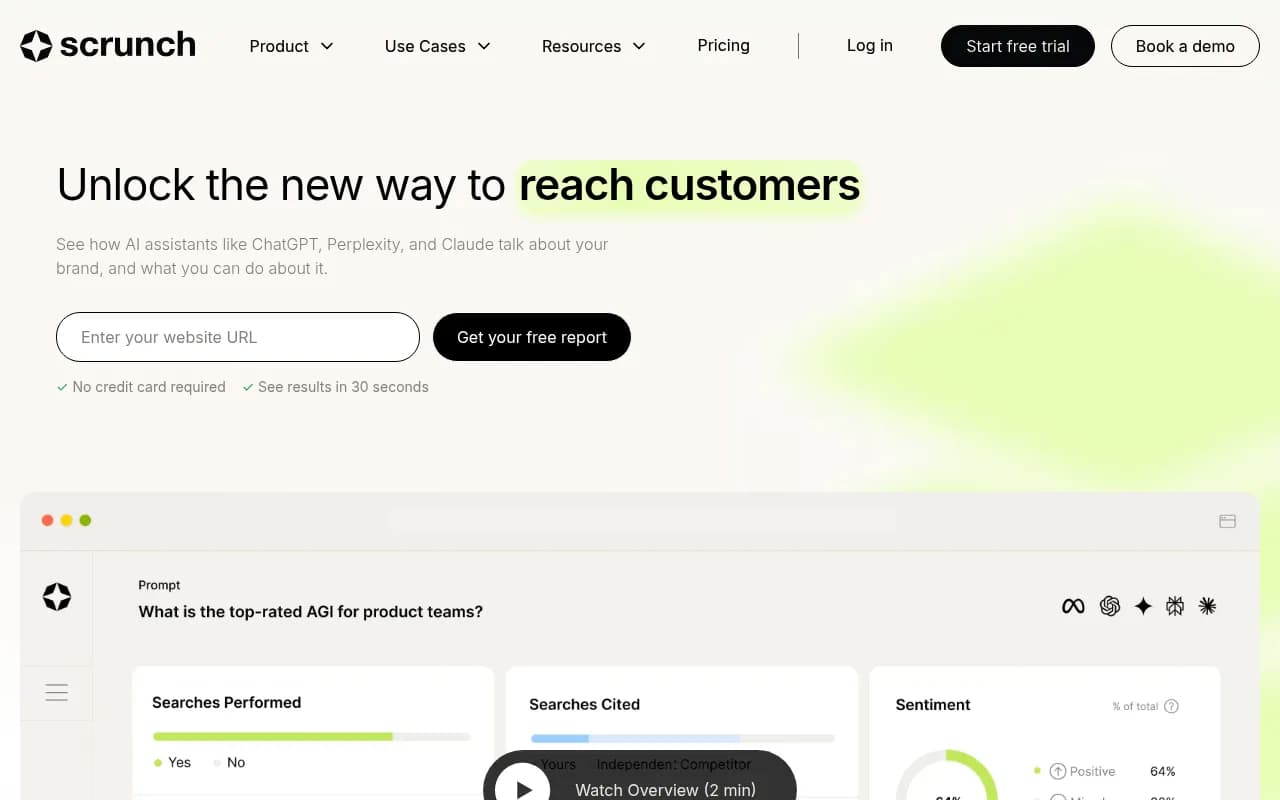
Scrunch (also known as Scrunch AI) covers a solid range of LLMs and has a reasonably deep feature set for brand monitoring. It tracks mentions, sentiment, and share of voice, and the enterprise tier includes Google AI Mode tracking.
The platform is positioned more toward brand monitoring and PR use cases than pure SEO/GEO optimization. That makes it a reasonable fit for communications teams that want to understand how AI models are describing their brand, but less useful for SEO teams trying to improve citation rates through content.
Like the other monitoring-focused tools in this comparison, Scrunch doesn't offer content generation or crawler log visibility. The pricing is on the higher end for what you get relative to Promptwatch's feature set.
Feature comparison table
| Feature | Promptwatch | Otterly.AI | Peec AI | Profound | AthenaHQ | Scrunch |
|---|---|---|---|---|---|---|
| LLMs tracked | 10 | 4 base + add-ons | Up to 10 (add-on) | Up to 10 | 10 | 9 |
| Starting price | $99/mo | $29/mo | ~€85/mo | $99/mo | Custom | Custom |
| Content generation | Yes (built-in AI writer) | No | No | No | No | No |
| Answer gap analysis | Yes | No | No | Limited | No | No |
| AI crawler logs | Yes | No | No | No | No | No |
| Prompt volume data | Yes | No | Limited | Yes | No | No |
| Traffic attribution | Yes (GSC, snippet, logs) | No | No | No | No | No |
| Reddit/YouTube tracking | Yes | No | No | No | No | No |
| ChatGPT Shopping | Yes | No | No | No | No | No |
| Page-level citation tracking | Yes | No | No | Limited | No | No |
| Free trial | Yes | Yes | Yes | Yes | No | No |
| Full UI (no API-only) | Yes | Yes | Yes | API only | API only | API only |
How to choose
The right platform depends almost entirely on what you need to do with the data.
If you need full-cycle optimization -- finding gaps, creating content, tracking results, and connecting visibility to revenue -- Promptwatch is the only platform in this comparison that covers all of it. The combination of Answer Gap Analysis, built-in content generation, crawler logs, and traffic attribution is genuinely unique in the category. The 6,700+ brands using it (including Booking.com and Center Parcs) suggest it's not just a feature list.
If you need enterprise-grade analytics and have your own content team, Profound is worth a serious look. The data depth is real, and if you're presenting AI visibility reports to a board or C-suite, Profound's research layer is strong.
If you're on a tight budget and just need to start monitoring, Otterly.AI at $29/month is a reasonable starting point. You'll outgrow it quickly if you want to actually improve your visibility, but it's a low-risk way to get data in front of stakeholders.
If you need multi-seat access without per-user pricing, Peec AI's model is attractive for larger teams. Just go in knowing it's a monitoring tool.
If you're an agency focused on competitive benchmarking, AthenaHQ's reporting capabilities are solid. The API-only access is a limitation for teams that want a full UI experience.
If your use case is more brand monitoring and PR than SEO/GEO, Scrunch's sentiment and mention tracking may fit better than a pure citation-rate tool.
The monitoring vs. optimization gap
It's worth being direct about something: the gap between "monitoring" and "optimization" in this category is large, and most platforms sit firmly on the monitoring side.
Knowing that you appear in 12% of relevant AI responses while your top competitor appears in 34% is useful information. But it doesn't tell you which content to create, which prompts to target, or whether the content you've already published is being crawled by AI engines at all. That's the gap most platforms leave open.
The platforms that are starting to close it -- Promptwatch being the clearest example -- are the ones building content generation and traffic attribution directly into the monitoring workflow. The logic is simple: if you can see the gap, generate content to fill it, and then watch your citation rate improve, you have a feedback loop. Without that loop, you're just watching a dashboard.
A note on LLM coverage
One thing that's easy to miss when comparing these platforms: LLM coverage isn't just about the number of models. It's about which models matter for your audience.
If your customers are primarily using ChatGPT and Google AI Overviews, a platform that covers those two well is more valuable than one that covers 10 models superficially. Conversely, if you're a global brand and need to track DeepSeek (dominant in certain markets), Grok, or Mistral, you need a platform that actually supports those models -- not just lists them as "coming soon."
Promptwatch, Profound, and AthenaHQ all cover 10 models. Otterly.AI and Peec AI require add-ons for full coverage, which can meaningfully change the effective price.
Bottom line
The AI visibility platform category is maturing fast, and the monitoring-only tools that dominated 2024 are starting to look thin compared to platforms that help you actually do something with the data.
For most marketing and SEO teams in 2026, the question isn't whether to track AI visibility -- it's whether your platform helps you improve it. If the answer is no, you're paying for a dashboard that tells you how much ground you're losing.
Promptwatch is the clearest choice for teams that want the full loop. Profound is the right call for enterprise analytics without content generation. Otterly.AI works if budget is the primary constraint and you just need to start somewhere. The others fill specific niches but don't change the fundamental dynamic.
Pick the tool that matches where you are today -- but make sure you have a path to optimization, not just observation.