Key Takeaways
- Promptwatch — Best for AI search visibility and GEO optimization. Goes beyond traditional keyword research to help you rank in ChatGPT, Claude, and Perplexity with content gap analysis and AI-powered writing tools.
- Semrush — Comprehensive all-in-one platform combining traditional SEO with AI search tracking. More expensive but offers broader marketing capabilities beyond keyword research.
- Mangools KWFinder — Most affordable option at $29/month with intuitive interface. Great for beginners who want simple keyword difficulty scores without bulk SERP analysis.
- AlsoAsked — Specialized tool for mapping search intent through "People Also Ask" questions. Perfect complement to traditional keyword research, not a replacement.
- KeywordChef — Built specifically for content publishers. Automatically filters junk keywords and highlights forum-dominated SERPs for quick wins.
LowFruits carved out a niche by focusing on what actually matters: finding keywords you can rank for by analyzing SERP weaknesses instead of trusting keyword difficulty scores. But it's not the only tool taking this approach, and depending on your workflow, budget, or broader marketing needs, you might find a better fit elsewhere.
The core problem LowFruits solves is real — traditional keyword difficulty metrics from tools like Ahrefs or Semrush often mislead you into chasing impossible keywords or ignoring genuine opportunities. LowFruits addresses this by bulk-analyzing actual search results to spot low-authority sites, forums, and other weak spots. But this manual SERP analysis approach has limitations, especially as search evolves beyond Google into AI platforms like ChatGPT and Perplexity.
Here's how the alternatives stack up.
Promptwatch

If you're still optimizing exclusively for Google in 2026, you're missing half the picture. Promptwatch addresses the elephant in the room that LowFruits and most traditional keyword tools ignore: AI search engines now handle millions of queries daily, and they don't work like Google.
LowFruits shows you where Google's SERPs are weak. Promptwatch shows you where you're invisible in ChatGPT, Claude, Perplexity, Gemini, and eight other AI models — then helps you fix it. The platform tracks 1.1 billion+ citations and prompts to identify exactly which content gaps are costing you AI visibility.
The difference is the action loop. Most competitors (including LowFruits) stop at showing you data. Promptwatch's Answer Gap Analysis reveals specific prompts your competitors rank for but you don't, then its AI writing agent generates content engineered to get cited by AI models. You're not guessing what to write — you're creating content based on 880M+ analyzed citations, real prompt volumes, and competitor insights.
Additional capabilities that matter: AI crawler logs show you when ChatGPT, Claude, and Perplexity crawl your site (and what errors they hit). Prompt Intelligence gives you volume estimates and difficulty scores for AI queries. Reddit and YouTube tracking surfaces discussions that influence AI recommendations — channels LowFruits doesn't touch. ChatGPT Shopping tracking monitors product recommendations.
The trade-off: Promptwatch doesn't do traditional Google SERP analysis the way LowFruits does. If you only care about Google rankings and have zero interest in AI search, this isn't your tool. But if you're thinking six months ahead, AI visibility is becoming non-negotiable. Pricing starts at $99/month (Essential plan with 1 site, 50 prompts, 5 AI-generated articles), with Professional at $249/month adding crawler logs and deeper tracking.
Best for: Marketing teams and agencies preparing for the AI search shift. Anyone who wants to rank in ChatGPT and Perplexity, not just Google.
Semrush
Semrush is the 800-pound gorilla of SEO platforms — used by 10M+ marketers and 35% of Fortune 500 companies. It does everything: keyword research, backlink analysis, site audits, rank tracking, content optimization, PPC research, social media management, and now AI search monitoring through its AI Visibility toolkit.
Compared to LowFruits, Semrush takes the opposite approach. LowFruits is laser-focused on bulk SERP analysis to find weak keywords. Semrush gives you keyword difficulty scores, SERP features data, and competitive analysis — but you're trusting its metrics rather than manually analyzing each SERP. The keyword database is massive (billions of keywords across 130+ countries), and the filtering options are sophisticated.
The AI Visibility addition (tracking ChatGPT, Perplexity, and Gemini) puts Semrush ahead of LowFruits in forward-looking capabilities, but it's not as deep as specialized GEO platforms like Promptwatch. Semrush uses fixed prompt sets rather than custom tracking, and it lacks content gap analysis or AI-specific optimization recommendations.
Where Semrush wins: breadth. If you need rank tracking, backlink monitoring, technical SEO audits, content planning, and keyword research in one platform, Semrush delivers. The interface is polished, the data is reliable, and the integrations are extensive. You're paying for an all-in-one solution.
The downsides: cost and complexity. Plans start at $165/month (Starter), with Pro+ at $290/month and Advanced at $580/month. That's 5-10x more expensive than LowFruits. The interface can feel overwhelming if you just want to find easy keywords — there are eight separate toolkits and dozens of features you might never use.
Best for: Established businesses and agencies that need a comprehensive marketing platform and can justify the higher price. Not ideal if you're a solo blogger or small site owner focused purely on finding quick keyword wins.
Ahrefs
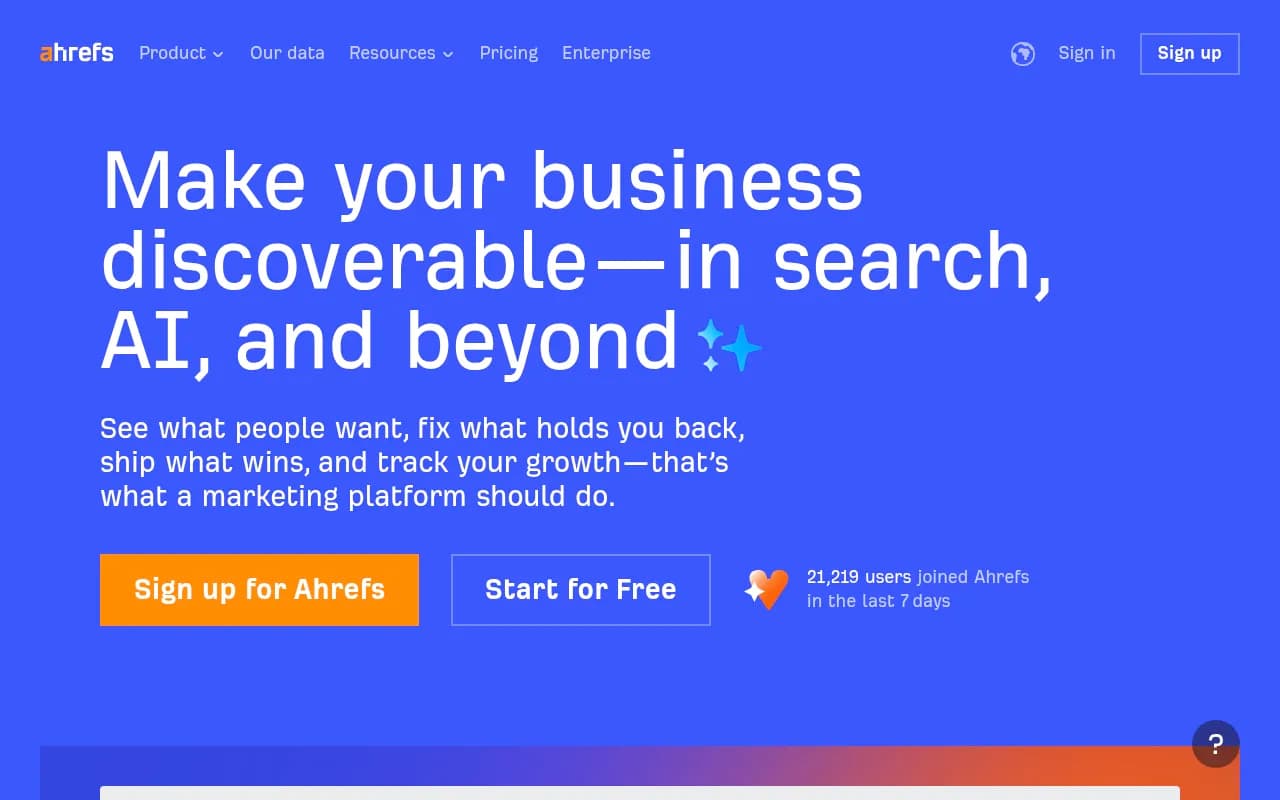
Ahrefs is Semrush's main competitor, also offering a full-stack SEO platform with the web's largest backlink index. Like Semrush, it provides keyword research with difficulty scores, SERP analysis, rank tracking, site audits, and content tools. The interface is cleaner and more intuitive than Semrush, which some users prefer.
Ahrefs recently added Brand Radar for AI search monitoring (tracking mentions in ChatGPT and other AI models), but it's limited compared to specialized GEO platforms. Brand Radar uses fixed prompts and lacks AI traffic attribution or content optimization features.
The keyword research workflow in Ahrefs is strong. Keywords Explorer gives you search volume, difficulty scores, click metrics, and SERP overviews. You can filter by keyword difficulty, search volume, and SERP features. But like Semrush, you're relying on Ahrefs' difficulty calculations rather than doing the manual SERP weakness analysis that LowFruits specializes in.
Ahrefs' Content Explorer is particularly useful — it shows you the most-shared and linked-to content for any topic, helping you understand what's already working. The site audit tool is thorough, and the rank tracker is reliable.
Pricing is comparable to Semrush: Lite plan at $83/month, Standard at $166/month, Advanced at $333/month. There's a very limited Starter plan at $29/month, but it's too restrictive for serious use. Like Semrush, you're paying for a comprehensive platform, not just keyword research.
The trade-off vs LowFruits: Ahrefs gives you more tools and broader capabilities, but it doesn't focus on the specific use case of bulk-analyzing SERPs to find weak spots. If you want to quickly scan 500 keywords to see which ones have forums or low-DA sites ranking, LowFruits is faster. If you want a full SEO toolkit with keyword research as one component, Ahrefs makes sense.
Best for: SEO professionals and agencies that need comprehensive site audits, backlink analysis, and content research alongside keyword discovery. Overkill if you just want to find easy keywords.
Mangools KWFinder
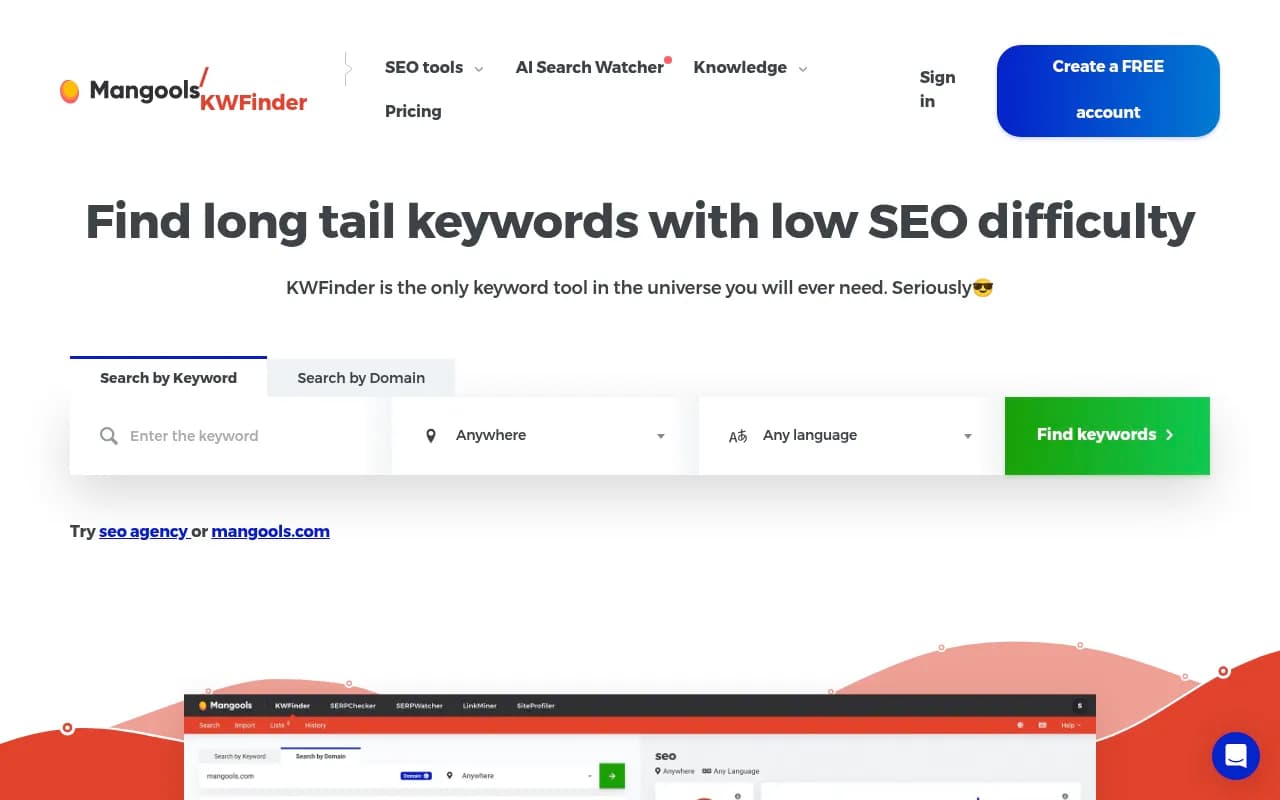
KWFinder is the budget-friendly alternative that prioritizes simplicity over power. At $29/month (billed annually), it's the most affordable option on this list and significantly cheaper than LowFruits' typical credit costs.
The interface is clean and beginner-friendly. You search for a keyword, and KWFinder returns a list with search volume, keyword difficulty scores, and trend data. Click any keyword to see the SERP analysis with domain authority, page authority, citation flow, trust flow, and other metrics for each ranking page.
The keyword difficulty score is KWFinder's main selling point — it's calculated based on the authority of ranking pages and is generally considered more reliable than some competitors. But you're still trusting a score rather than doing the manual SERP analysis that LowFruits enables at scale.
KWFinder includes related keywords, autocomplete suggestions, and questions — helpful for finding variations. The SERP analysis shows you the top 10 results with key metrics, but you're analyzing one keyword at a time, not bulk-checking hundreds of keywords like LowFruits allows.
The Mangools suite also includes SERPChecker (detailed SERP analysis), SERPWatcher (rank tracking), LinkMiner (backlink analysis), and SiteProfiler (website overview). It's a mini version of Ahrefs or Semrush at a fraction of the cost.
Limitations: The Basic plan ($29/month) gives you 100 keyword lookups per day and 200 keyword suggestions per search. That's enough for casual use but restrictive if you're doing heavy research. Premium ($52/month) and Agency ($97/month) plans increase limits. There's no bulk SERP analysis feature like LowFruits offers.
Best for: Beginners, bloggers, and small site owners who want an affordable, easy-to-use keyword tool with decent difficulty scores. Not ideal if you need to analyze hundreds of keywords quickly or want advanced SERP weakness detection.
AlsoAsked
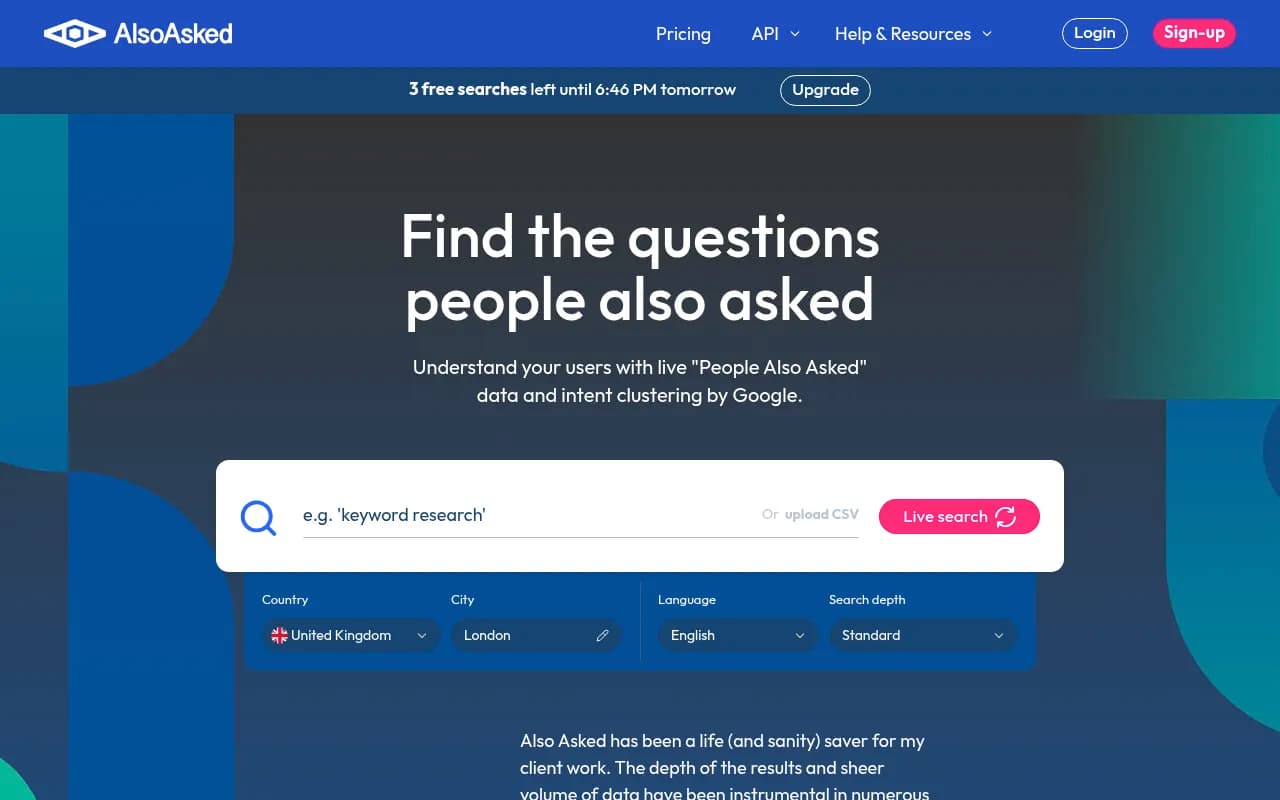
AlsoAsked takes a completely different approach from LowFruits. Instead of analyzing keyword difficulty or SERP weaknesses, it maps search intent by extracting "People Also Ask" questions from Google.
You enter a seed keyword, and AlsoAsked returns a visual tree of related questions that Google shows in PAA boxes. This reveals what users actually want to know about a topic — the angles, concerns, and sub-topics that matter.
The depth options (Standard or Deep) determine how many layers of questions AlsoAsked retrieves. Deep searches can return 150+ questions per query, giving you a comprehensive view of search intent. You can target specific countries and cities for geo-specific insights across 130+ locations.
The bulk search feature (upload CSV with up to 1000 terms) is powerful for content planning at scale. You're not finding low-competition keywords per se — you're discovering content angles and question-based keywords that competitors might miss.
AlsoAsked also offers intent clustering, grouping related questions by theme. This helps you structure comprehensive content that covers all aspects of a topic rather than just targeting one keyword.
The limitation: AlsoAsked doesn't tell you which questions are easy to rank for. You get intent data, not competition analysis. It's a research tool, not a ranking opportunity finder. You'd typically use AlsoAsked alongside a tool like LowFruits or KWFinder — use AlsoAsked to discover question-based keywords, then use another tool to assess difficulty.
Pricing is freemium: 10 free credits, then paid plans from $12/month (Basic with 100 credits) to $99/month (Agency with 3000 credits). Credits are consumed per search, with deeper searches costing more credits.
Best for: Content strategists and writers who want to understand search intent and create comprehensive, question-focused content. Complement to traditional keyword tools, not a replacement.
AnswerThePublic
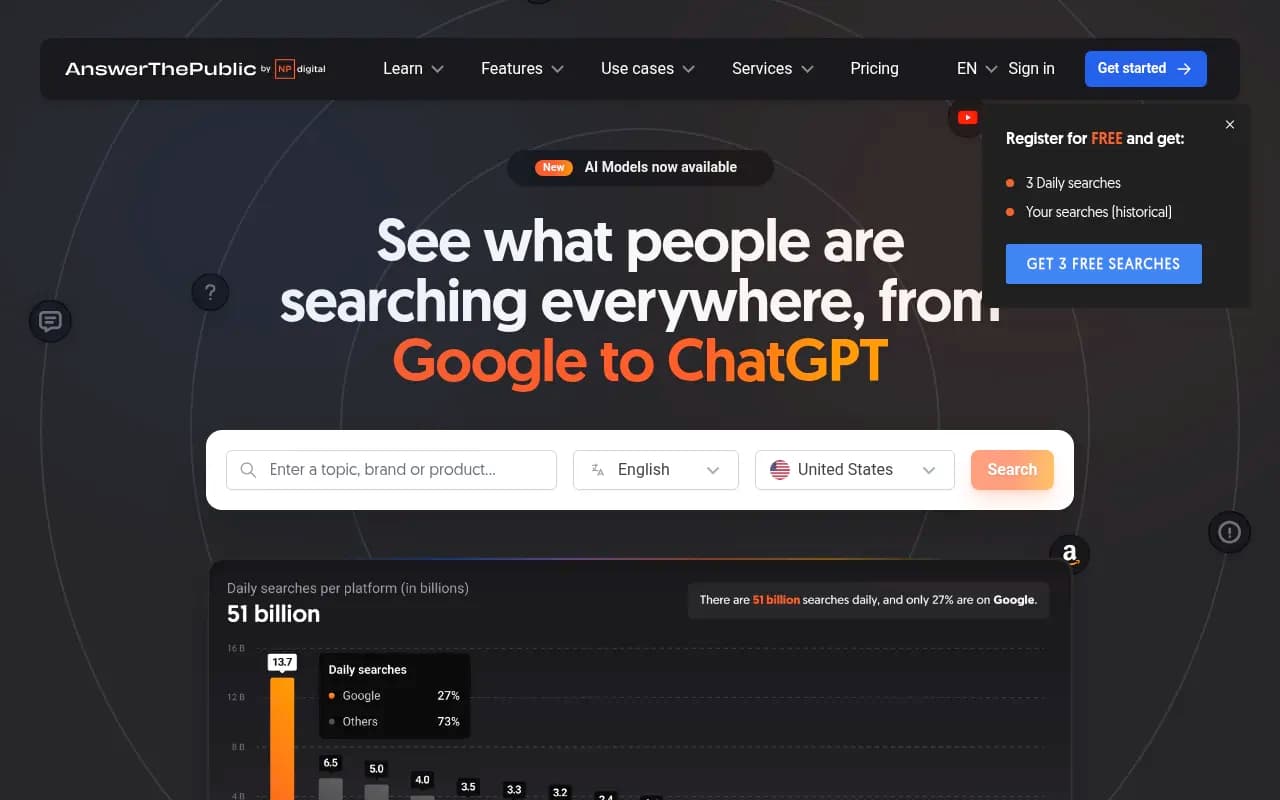
AnswerThePublic is similar to AlsoAsked but visualizes autocomplete data from Google and Bing in distinctive radial charts. You enter a keyword, and it returns questions, prepositions, comparisons, and alphabetical suggestions that people search for.
The visual presentation is AnswerThePublic's signature feature — the wheel-shaped diagrams make it easy to see patterns and relationships between search queries. You can export data as CSV or images for presentations.
Like AlsoAsked, AnswerThePublic focuses on intent discovery rather than competition analysis. It shows you what people are searching for, not whether those searches are easy to rank for. The data comes from autocomplete suggestions, which reflect real user behavior.
AnswerThePublic recently added monitoring capabilities in paid plans, letting you track how search behavior changes over time for your topics. This is useful for identifying emerging trends or seasonal patterns.
The free tier allows one search per day, which is restrictive. Paid plans start at $99/month (Individual), $199/month (Pro), and $399/month (Expert) — significantly more expensive than AlsoAsked for similar functionality. The higher price is harder to justify unless you heavily use the monitoring features or need the visual presentation for client reports.
Best for: Agencies and marketers who want visually impressive keyword research outputs for presentations. The monitoring features add value if you're tracking search trends over time. Expensive compared to AlsoAsked for basic intent research.
KeywordChef
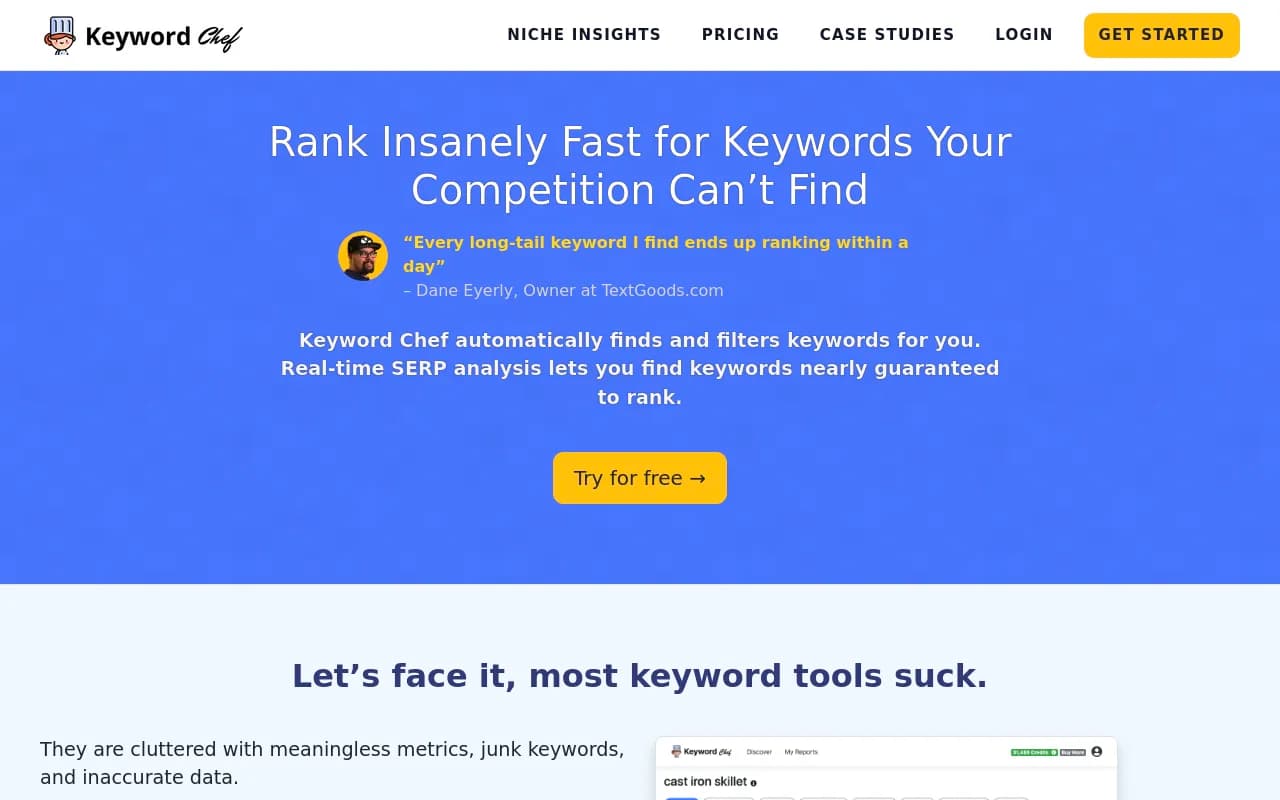
KeywordChef is the closest alternative to LowFruits in philosophy — it's built specifically for content publishers and focuses on finding keywords you can actually rank for, not just generating lists.
The automatic filtering is KeywordChef's main differentiator. It removes junk keywords (navigational queries, brand searches, nonsense phrases) so you only see keywords with real search intent. This saves hours of manual filtering that you'd do with other tools.
The real-time SERP analysis highlights forums, user-generated content, and low-authority sites in search results — exactly what LowFruits does. KeywordChef automatically flags these opportunities, making it easy to spot keywords where you can outrank weak competition.
The wildcard search feature (using asterisks) helps you find specific keyword combinations that competitors miss. This is similar to LowFruits' approach of uncovering long-tail variations.
KeywordChef uses a credit-based system rather than monthly subscriptions. The Niche Insights plan is $97/year, which is more affordable than LowFruits for moderate use. You can analyze SERPs in bulk at no extra charge, which is a key advantage.
The interface is clean and publisher-focused — no unnecessary metrics or features. You search, filter, analyze SERPs, and export. That's it.
Limitations: The keyword database is smaller than major tools like Semrush or Ahrefs. You won't find as many keyword suggestions, but the ones you do find are higher quality due to automatic filtering. There's no rank tracking or site audit features — it's purely keyword research.
Best for: Bloggers and content publishers who want a LowFruits-style workflow at a lower price point. Especially good if you value automatic filtering and don't need the broader SEO features of all-in-one platforms.
RankAtom
RankAtom is an AI-powered keyword research tool that combines keyword discovery with rank tracking and competitor analysis. It's positioned as a simpler, more affordable alternative to enterprise SEO platforms.
The keyword research workflow emphasizes finding low-competition opportunities through real-time SERP analysis. RankAtom analyzes domain authority, page authority, and other metrics to identify weak spots — similar to LowFruits' approach.
The AI component helps with keyword clustering and content suggestions, though it's not as advanced as dedicated AI search platforms like Promptwatch. RankAtom focuses on traditional Google SEO.
The rank tracker is included, which LowFruits doesn't offer. You can monitor your rankings for target keywords and track progress over time. The competitor analysis feature shows which keywords competitors rank for and identifies gaps.
Pricing is annual: $99/year gets you 20,000 keyword credits, 500 rank tracker slots, and 25 competitor analyses. This is competitive with LowFruits' credit-based pricing, though direct comparison is difficult.
The interface is straightforward, though not as polished as major platforms. It's a newer tool, so the feature set is still evolving.
Best for: SEO professionals who want keyword research, rank tracking, and competitor analysis in one affordable package. Good middle ground between single-purpose tools like LowFruits and expensive all-in-one platforms.
How to Choose Your LowFruits Alternative
The right tool depends on what you're actually trying to accomplish:
If you're preparing for AI search and want to rank in ChatGPT, Claude, and Perplexity alongside Google, Promptwatch is the only platform here that addresses this directly. It won't replace your traditional keyword research, but it fills the gap that every other tool on this list ignores.
If you need an all-in-one SEO platform with keyword research as one component, Semrush or Ahrefs make sense despite the higher cost. You're paying for breadth — backlink analysis, site audits, rank tracking, content tools, and more.
If you want the LowFruits workflow at a lower price, KeywordChef is your best bet. It offers similar SERP weakness analysis with automatic filtering, at $97/year instead of pay-per-credit.
If you're on a tight budget and just starting out, Mangools KWFinder at $29/month gives you solid keyword research with decent difficulty scores. You won't get bulk SERP analysis, but you'll get enough to make progress.
If you want to understand search intent and discover question-based keywords, AlsoAsked is the specialized tool for that job. Use it alongside a competition analysis tool, not instead of one.
The landscape is shifting. Traditional keyword difficulty scores are increasingly unreliable, and AI search engines are changing how people find information. Tools that only focus on Google SERPs are missing half the picture. The smartest approach is combining traditional keyword research with AI visibility tracking — which is why platforms like Promptwatch that bridge both worlds are gaining traction.
Don't just replace LowFruits with another tool that does the same thing. Think about where search is going and choose tools that prepare you for that future.