Key Takeaways
- Best overall alternative: Ahrefs offers the most comprehensive feature set with the largest backlink index and keyword database, though at a higher price point ($83-333/mo vs Mangools' $29-97/mo)
- Best budget alternative: Ubersuggest provides similar keyword research capabilities with a free tier and lifetime plans starting at $290, making it more affordable than Mangools for long-term use
- Best for AI search visibility: Promptwatch is the only platform that tracks and optimizes brand mentions in ChatGPT, Claude, Perplexity, and other AI models—a growing channel Mangools doesn't cover
- Best for agencies: SE Ranking combines Mangools-like affordability ($103-579/mo) with white-label reporting and multi-client management features
- Best for finding easy wins: LowFruits specializes in identifying low-competition keywords by analyzing actual SERP weaknesses rather than relying on difficulty scores
Mangools has earned its reputation as a budget-friendly SEO suite with an intuitive interface and solid keyword research capabilities through KWFinder. But as SEO evolves—with AI search engines reshaping how people discover content, enterprise teams needing deeper data, and agencies requiring white-label solutions—many users find themselves outgrowing what Mangools offers. Common reasons to look elsewhere include limited backlink data compared to enterprise tools, no AI search monitoring as ChatGPT and Perplexity gain traction, basic site audit capabilities, and pricing that adds up when you need multiple projects or deeper analysis.
Ahrefs
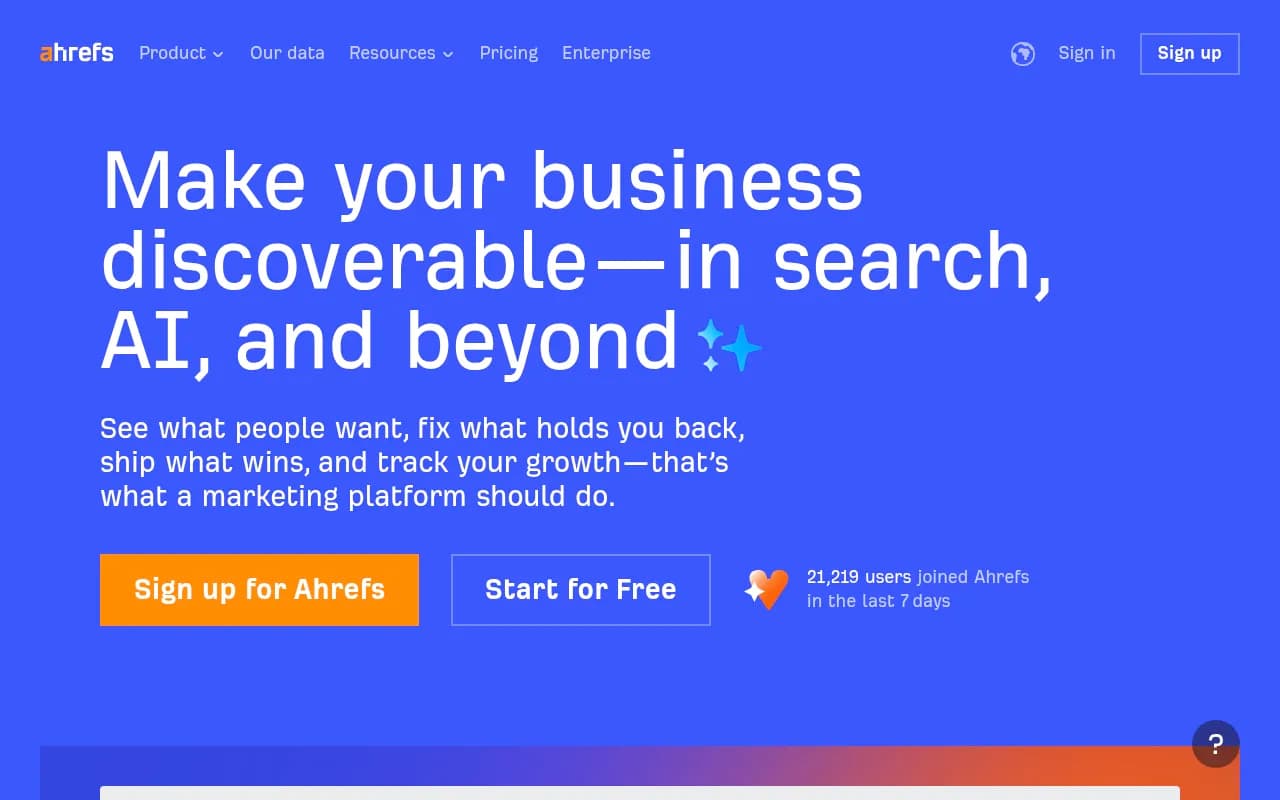
Ahrefs is the most comprehensive alternative to Mangools, offering everything Mangools does plus significantly deeper data and capabilities. Where Mangools excels at simplicity, Ahrefs delivers enterprise-grade intelligence with the web's largest backlink index (over 40 trillion links) and a keyword database covering 188 countries.
What it does better than Mangools: Ahrefs' Site Explorer provides far more detailed backlink analysis—you can see every link pointing to a competitor, analyze anchor text distribution, track new and lost backlinks, and identify link-building opportunities Mangools simply can't surface. The keyword database is also substantially larger, with more accurate search volume data and better international coverage. Ahrefs' Content Explorer lets you find top-performing content across the web by topic, something Mangools lacks entirely. The site audit tool is more thorough, crawling larger sites faster and identifying technical issues Mangools might miss.
What Mangools does better: Interface simplicity and price. Mangools' KWFinder is genuinely easier to use for beginners, with a cleaner UI that doesn't overwhelm. At $29-97/mo, it's also 3-4x cheaper than Ahrefs' $83-333/mo plans. For small sites or freelancers who don't need enterprise-level backlink data, Mangools offers better value.
Key differentiators: Ahrefs recently added Brand Radar for tracking brand mentions in AI search engines like ChatGPT and Perplexity, though it uses fixed prompts and lacks the depth of specialized GEO platforms. It also includes content creation workflows, PPC research tools, and social media management—making it a true all-in-one platform rather than just an SEO suite.
Pricing comparison: Ahrefs starts at $83/mo (Lite) vs Mangools' $29/mo (Basic). The gap widens at higher tiers—Ahrefs Standard is $166/mo vs Mangools Premium at $52/mo. Annual billing saves 20% on both.
Best for: Agencies, in-house SEO teams at mid-to-large companies, and anyone who needs the most complete backlink and keyword data available. If you're doing serious link building or competitive analysis, Ahrefs is worth the premium. If you're a solopreneur or small business focused on keyword research and rank tracking, Mangools' simplicity and price make more sense.
Semrush
Semrush is the closest thing to an all-in-one digital marketing platform, combining traditional SEO tools with PPC research, content marketing, social media management, and emerging AI search tracking. It's used by 10M+ marketers and 35% of Fortune 500 companies, making it the enterprise standard.
What it does better than Mangools: Semrush covers far more ground—you get keyword research, backlink analysis, site audits, rank tracking, plus PPC competitor research, social media scheduling, content optimization, and local SEO tools all in one platform. The keyword database is massive (25B+ keywords), and the competitive intelligence features are deeper—you can see competitors' ad copy, landing pages, and budget estimates, not just their organic keywords. Semrush's Position Tracking tool monitors rankings across desktop, mobile, and local search, with more granular location targeting than Mangools' SERPWatcher.
What Mangools does better: Ease of use and focus. Semrush's interface is cluttered with features most users never touch, while Mangools keeps things simple. KWFinder's keyword difficulty score is also more intuitive than Semrush's, which can be misleading. And at $29-97/mo, Mangools is significantly cheaper than Semrush's $165-580/mo plans.
Key differentiators: Semrush recently added AI search tracking for ChatGPT, Perplexity, and Gemini, though it uses fixed prompts and lacks the customization of specialized GEO platforms. The real differentiator is breadth—if you need SEO, PPC, content, and social tools in one place, Semrush delivers. But if you only need SEO, you're paying for features you won't use.
Pricing comparison: Semrush starts at $165/mo (Starter) vs Mangools' $29/mo (Basic). The gap is even wider at higher tiers—Semrush Pro+ is $290/mo vs Mangools Premium at $52/mo. Semrush offers a 7-day free trial; Mangools gives you 10 days plus a 48-hour money-back guarantee.
Best for: Marketing teams that need SEO, PPC, content, and social tools in one platform. If you're running paid ads alongside organic search, Semrush's PPC research features alone justify the cost. But if you're purely focused on SEO and don't need the extra toolkits, Mangools or a more focused alternative makes more sense.
SE Ranking
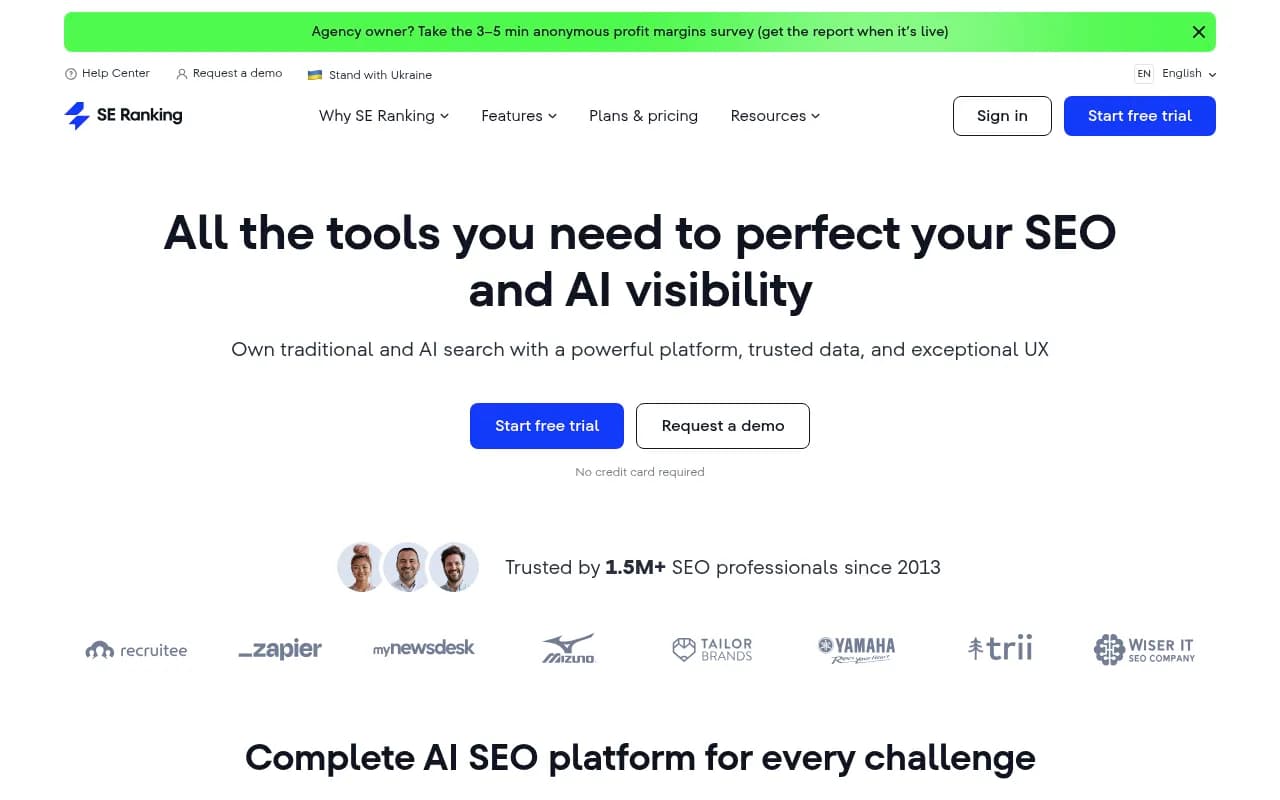
SE Ranking is the middle ground between Mangools' simplicity and Ahrefs' depth, offering a comprehensive SEO platform at a price point closer to Mangools. It's particularly strong for agencies managing multiple clients, with white-label reporting and client management features Mangools lacks.
What it does better than Mangools: SE Ranking's site audit tool is more thorough, crawling larger sites and identifying more technical issues. The backlink checker provides deeper analysis than Mangools' LinkMiner, with better historical data and more filtering options. SE Ranking also includes white-label reporting, allowing agencies to rebrand reports with their own logo and domain—something Mangools doesn't offer at all. The keyword database covers 188 countries with 5.4B keywords, and the rank tracker monitors desktop, mobile, and local rankings with more granular location targeting.
What Mangools does better: User experience and speed. SE Ranking's interface is more complex and takes longer to learn, while Mangools' tools (especially KWFinder) are immediately intuitive. Mangools is also slightly cheaper at the entry level—$29/mo vs SE Ranking's $103/mo (with annual billing).
Key differentiators: SE Ranking recently added an AI Search add-on ($71/mo) for tracking brand mentions in ChatGPT, Perplexity, and other LLMs, though it's an extra cost on top of the base plan. The platform also includes content optimization tools, local SEO features, and automated client reporting—making it a better fit for agencies than Mangools.
Pricing comparison: SE Ranking starts at $103/mo (Core, annual billing) vs Mangools' $29/mo (Basic). However, SE Ranking's Core plan includes more features than Mangools Basic—you get 50 projects vs 1, 1,500 keywords tracked vs 200, and white-label reporting. The Growth plan ($223/mo) is still cheaper than Ahrefs or Semrush while offering similar depth.
Best for: Agencies managing multiple clients who need white-label reporting and client management features. SE Ranking hits the sweet spot between Mangools' affordability and Ahrefs' depth, making it ideal for growing agencies that have outgrown Mangools but don't want to pay Ahrefs prices. Solo freelancers or small businesses are better off with Mangools' simpler, cheaper plans.
Ubersuggest
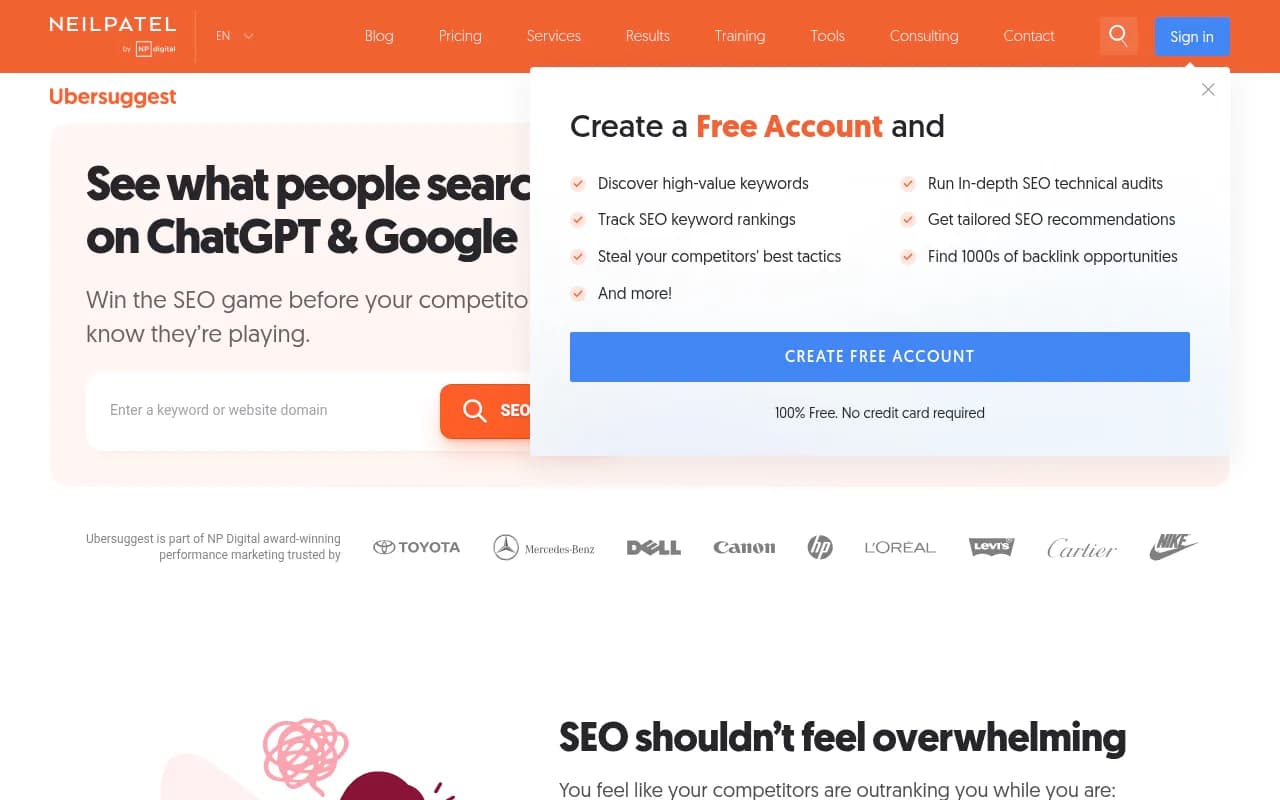
Ubersuggest is Neil Patel's answer to Mangools—a simplified, affordable SEO tool focused on keyword research and competitive analysis. It's the best budget alternative to Mangools, offering a free tier and lifetime plans that eliminate recurring costs.
What it does better than Mangools: Price and accessibility. Ubersuggest's free tier gives you 3 searches per day with limited data—enough for casual users or those just starting out. The lifetime plans ($290-990 one-time payment) eliminate recurring costs entirely, making Ubersuggest cheaper than Mangools over time. Ubersuggest also includes AI-powered content suggestions and a Chrome extension for on-the-fly keyword research, which Mangools lacks.
What Mangools does better: Data accuracy and depth. Mangools' keyword difficulty scores are more reliable, and the SERP analysis in KWFinder provides more actionable insights than Ubersuggest's simplified metrics. Mangools' LinkMiner is also better for backlink analysis—Ubersuggest's backlink data is thinner and less frequently updated. The interface design is cleaner in Mangools, with better data visualization.
Key differentiators: Ubersuggest's lifetime plans are unique in the SEO tool space—pay once, use forever. This makes it the most cost-effective option for long-term users. However, the data quality and feature depth don't match Mangools, let alone Ahrefs or Semrush. Ubersuggest also recently added basic AI search tracking, though it's limited compared to specialized GEO platforms.
Pricing comparison: Ubersuggest offers a free tier (3 searches/day) and lifetime plans from $290 (Individual) to $990 (Enterprise). Monthly subscriptions start at $29/mo, matching Mangools' entry price. Over 12 months, Ubersuggest's Individual lifetime plan ($290) is cheaper than Mangools Basic ($348/year with annual billing). Over 24 months, the savings are even more dramatic.
Best for: Solopreneurs, bloggers, and small businesses on tight budgets who want to avoid recurring costs. If you're just starting out or only need basic keyword research, Ubersuggest's free tier or lifetime plans offer unbeatable value. But if you need accurate data, deeper SERP analysis, or reliable backlink tracking, Mangools is worth the extra cost.
Moz Pro
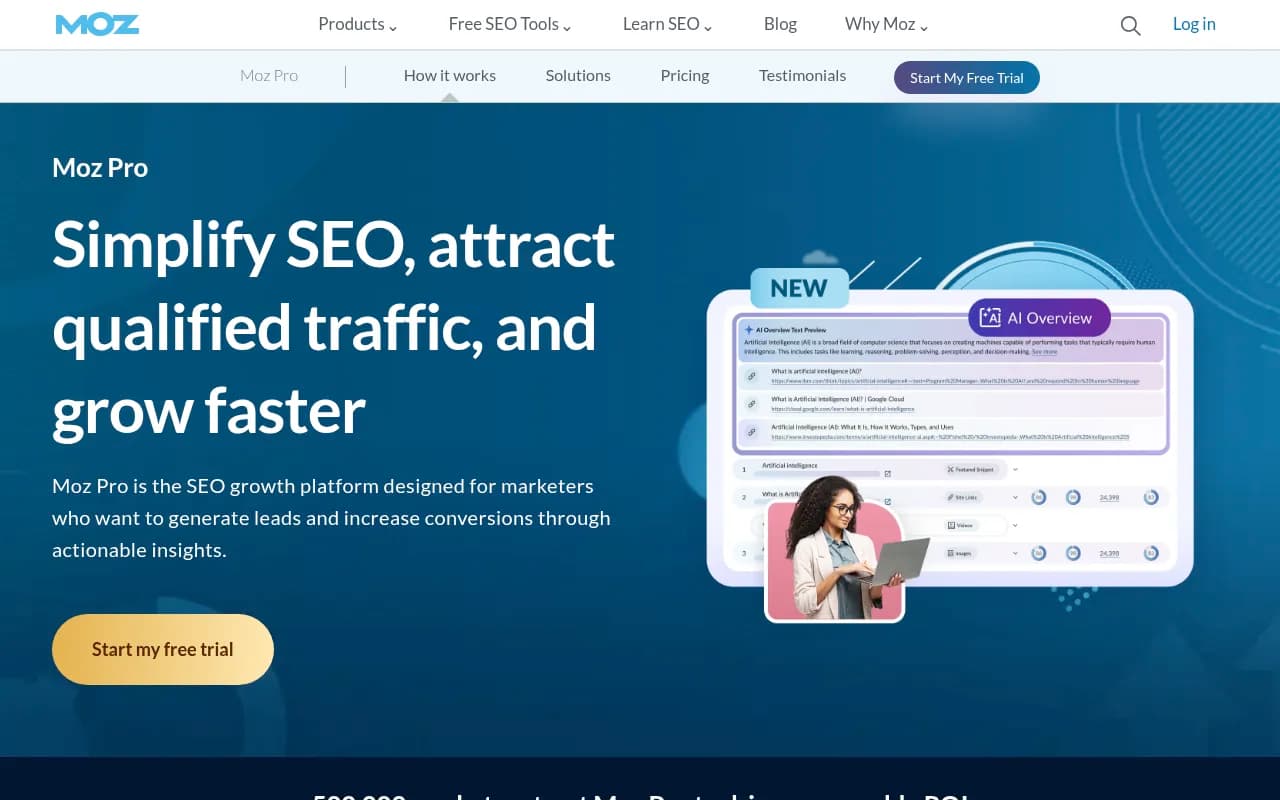
Moz Pro is one of the original SEO platforms, known for its proprietary Domain Authority (DA) metric and strong link-building tools. It's a solid all-around alternative to Mangools, though it's lost ground to Ahrefs and Semrush in recent years.
What it does better than Mangools: Moz's link analysis tools are excellent, with proprietary metrics (Domain Authority, Page Authority, Spam Score) that have become industry standards. The Link Explorer provides detailed backlink data and identifies link-building opportunities Mangools' LinkMiner can't match. Moz's Keyword Explorer also includes unique features like search intent classification and SERP feature tracking (featured snippets, local packs, etc.), giving you a clearer picture of what it takes to rank.
What Mangools does better: Price and simplicity. Moz Pro starts at $49/mo (currently $39/mo with a promotion) vs Mangools' $29/mo, and the higher-tier plans are significantly more expensive—$99-299/mo vs Mangools' $52-97/mo. Mangools' interface is also cleaner and easier to navigate, especially for beginners. KWFinder's keyword difficulty score is more intuitive than Moz's, which can be overly conservative.
Key differentiators: Moz's Domain Authority metric is widely used across the industry, making it valuable for benchmarking and client reporting. Moz also offers strong educational resources (Moz Academy, Whiteboard Friday videos) that help users learn SEO fundamentals. However, Moz's keyword database and backlink index are smaller than Ahrefs or Semrush, and the platform hasn't kept pace with newer features like AI search tracking.
Pricing comparison: Moz Pro starts at $49/mo (Starter) vs Mangools' $29/mo (Basic), though Moz frequently runs promotions bringing the Starter plan down to $39/mo. Higher tiers are $99/mo (Standard), $179/mo (Medium), and $299/mo (Large) vs Mangools' $52/mo (Premium) and $97/mo (Agency). Annual billing saves 20% on both platforms.
Best for: SEO professionals who value Moz's proprietary metrics (DA, PA) and want strong link-building tools. If you're focused on building high-quality backlinks and need detailed link analysis, Moz is a solid choice. But if you're primarily doing keyword research and rank tracking, Mangools offers better value. And if you need the most comprehensive data, Ahrefs is a better investment than Moz.
Promptwatch

Promptwatch is a completely different category of tool—it doesn't compete with Mangools on traditional SEO, but it addresses a growing blind spot: visibility in AI search engines like ChatGPT, Claude, Perplexity, and Gemini. As more people use AI models to research products and make decisions, brands that aren't mentioned in AI responses are losing traffic and revenue.
What it does that Mangools doesn't: Promptwatch tracks how often AI models mention your brand, which prompts trigger those mentions, and what competitors are being recommended instead. It shows you the content gaps that prevent AI models from citing your site, then helps you create content that gets cited. The platform monitors 10 AI models (ChatGPT, Perplexity, Claude, Gemini, Meta AI, DeepSeek, Grok, Mistral, Copilot, Google AI Overviews), tracks real user prompts with volume estimates, and provides AI crawler logs showing when ChatGPT, Claude, and other models visit your site. It also includes an AI writing agent that generates articles, listicles, and comparisons grounded in citation data—content engineered to rank in AI search, not just Google.
Why this matters: Traditional SEO tools like Mangools focus on Google rankings, but AI search is growing fast. ChatGPT alone has 300M+ weekly active users, and Perplexity is processing 100M+ queries per month. If your brand isn't visible in these AI responses, you're missing a massive channel. Promptwatch is the only platform that closes the loop—it shows you where you're invisible, helps you create content to fix it, and tracks the results.
Key differentiators vs competitors: Most AI search tracking tools (Otterly.AI, Peec.ai, AthenaHQ, Search Party) are monitoring-only dashboards—they show you data but leave you stuck. Promptwatch is built around taking action: Answer Gap Analysis shows exactly which prompts competitors are visible for but you're not, the AI writing agent generates content grounded in real citation data (880M+ citations analyzed), and page-level tracking shows which pages are being cited and by which models. It also includes features most competitors lack entirely: AI crawler logs, Reddit and YouTube insights, ChatGPT Shopping tracking, and traffic attribution to connect visibility to revenue.
Pricing comparison: Promptwatch starts at $99/mo (Essential) vs Mangools' $29/mo (Basic), but they serve different purposes. Promptwatch is for AI search visibility; Mangools is for traditional SEO. If you need both, you'll run both tools. Promptwatch's Professional plan ($249/mo) includes crawler logs and state/city tracking, while the Business plan ($579/mo) covers 5 sites and 350 prompts. Annual billing discounts available.
Best for: Brands and agencies that want to be visible in AI search engines, not just Google. If your target audience is using ChatGPT, Perplexity, or Claude to research products or make decisions, Promptwatch helps you get mentioned in those AI responses. It's especially valuable for SaaS companies, e-commerce brands, and service providers in competitive markets where AI recommendations drive purchase decisions. If you're only focused on traditional Google SEO, stick with Mangools. But if you want to own the next wave of search, Promptwatch is the platform to use.
Serpstat
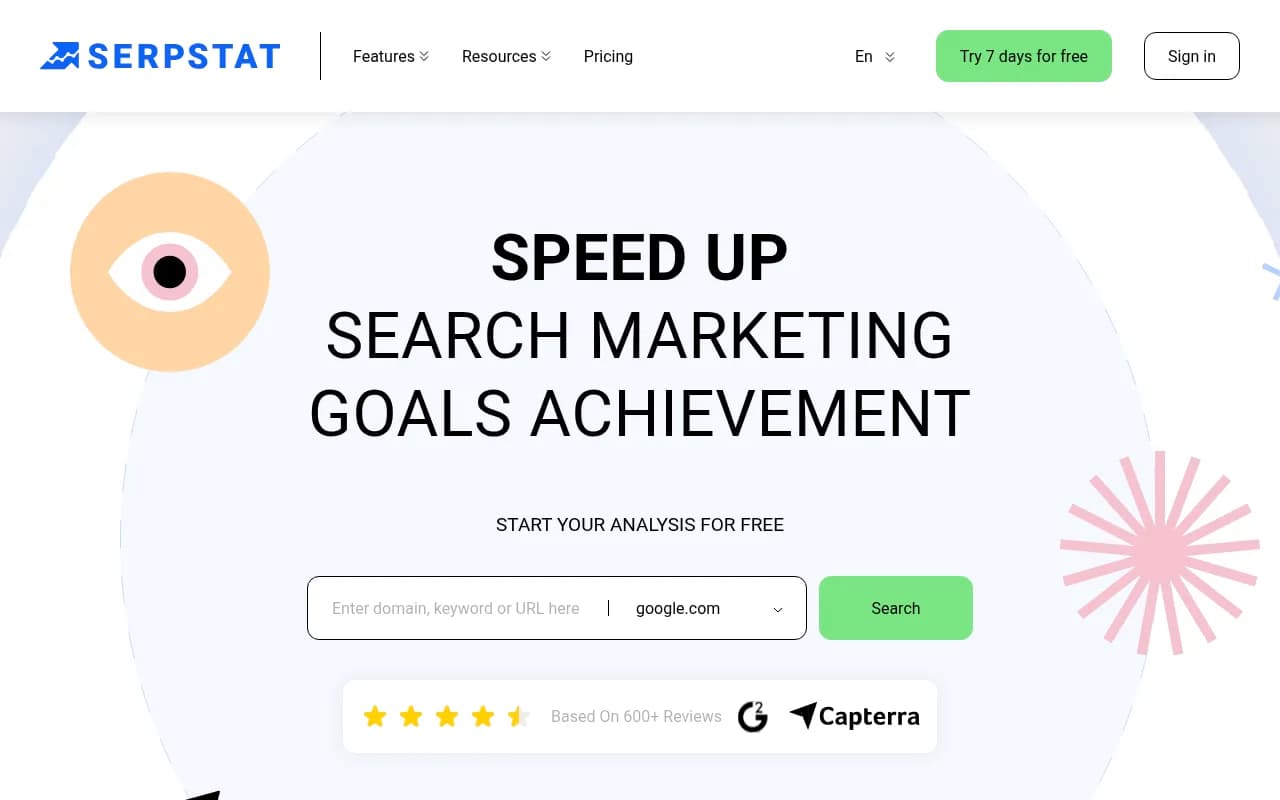
Serpstat is a comprehensive SEO platform that competes with Mangools on price while offering more depth. It's particularly strong for international SEO, with keyword data across 230 countries and a database of 8.62B keywords.
What it does better than Mangools: Serpstat's keyword database is larger (8.62B keywords vs Mangools' undisclosed size), with better international coverage—230 countries vs Mangools' 50+. The site audit tool is more thorough, identifying more technical issues and providing clearer recommendations. Serpstat also includes features Mangools lacks entirely: batch analysis for checking multiple domains at once, missing keywords reports showing terms competitors rank for but you don't, and API access for custom integrations.
What Mangools does better: User experience and speed. Serpstat's interface is cluttered and slower to load, while Mangools' tools are fast and intuitive. KWFinder's keyword difficulty score is also more reliable than Serpstat's, which can be overly optimistic. Mangools' SERPWatcher provides cleaner rank tracking visualizations than Serpstat's Position Tracking tool.
Key differentiators: Serpstat offers lifetime deals occasionally (though not currently available), making it cost-effective for long-term users. The platform also includes unique features like Tree View for visualizing site structure and clustering keywords by search intent. However, Serpstat's backlink data is thinner than Ahrefs or even Mangools, and the platform lacks AI search tracking entirely.
Pricing comparison: Serpstat starts at $69/mo (Lite) vs Mangools' $29/mo (Basic), though Serpstat's Lite plan includes more features—100 projects vs 1, 7,000 keywords tracked vs 200. Higher tiers are $149/mo (Standard), $299/mo (Advanced), and $499/mo (Enterprise) vs Mangools' $52/mo (Premium) and $97/mo (Agency). Serpstat offers a 7-day free trial; Mangools gives you 10 days.
Best for: Agencies and in-house teams managing international SEO campaigns across multiple countries. Serpstat's 230-country coverage and batch analysis features make it ideal for large-scale keyword research and competitor analysis. But if you're focused on a single market or just need basic keyword research and rank tracking, Mangools offers better value and a cleaner experience.
LowFruits
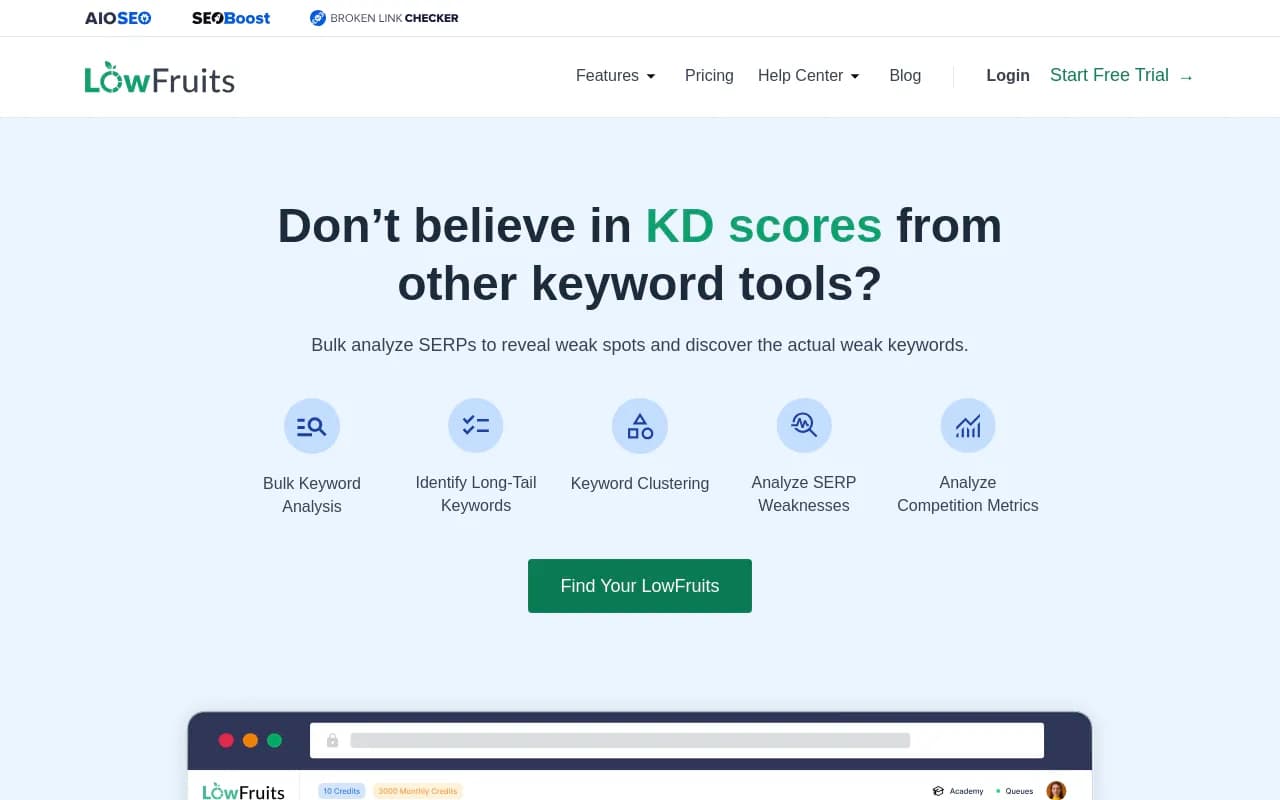
LowFruits is a specialized tool that does one thing exceptionally well: finding low-competition keywords by analyzing actual SERP weaknesses rather than relying on keyword difficulty scores. It's the perfect complement to Mangools (or replacement, if you're focused solely on finding easy wins).
What it does better than Mangools: LowFruits bulk analyzes SERPs to identify weak spots—low-authority sites, thin content, poor title optimization—that signal ranking opportunities. Instead of trusting a keyword difficulty score (which can be misleading), you see the actual competition and decide for yourself. The tool also excels at finding long-tail keywords using wildcard searches (e.g., "best * for *"), surfacing keyword combinations other tools miss. Keyword clustering groups terms by search intent, helping you plan content more efficiently.
What Mangools does better: Breadth of features. LowFruits is laser-focused on keyword research and SERP analysis—it doesn't include rank tracking, site audits, or backlink analysis like Mangools does. KWFinder also provides more keyword metrics (search volume, CPC, PPC competition) in a cleaner interface, while LowFruits focuses purely on SERP weakness indicators.
Key differentiators: LowFruits' wildcard search and SERP weakness analysis are unique in the keyword research space. The tool highlights ranking opportunities other platforms miss by showing you exactly which positions are occupied by low-authority sites. This makes it invaluable for finding quick wins—keywords you can rank for with a single well-optimized article. However, it's a one-trick pony: if you need rank tracking, site audits, or backlink analysis, you'll need another tool.
Pricing comparison: LowFruits offers pay-as-you-go credits starting at $29 or subscriptions from approximately $29-49/mo (Standard) and $79-99/mo (Premium) vs Mangools' $29-97/mo plans. The first analysis is free. If you only need keyword research and SERP analysis, LowFruits is comparable in price to Mangools Basic. But if you need the full SEO suite (rank tracking, site audits, backlinks), Mangools offers better value.
Best for: Content creators, bloggers, and niche site builders focused on finding low-competition keywords to rank quickly. If you're building a new site or targeting long-tail keywords in competitive niches, LowFruits' SERP weakness analysis is invaluable. But if you need a complete SEO toolkit, Mangools or another all-in-one platform makes more sense. Many users run both—LowFruits for keyword discovery, Mangools or Ahrefs for rank tracking and site audits.
Which Mangools Alternative Should You Choose?
The best alternative depends on what you need:
If you need the most comprehensive data and don't mind paying for it: Choose Ahrefs. It has the largest backlink index, the most accurate keyword data, and the deepest competitive intelligence. Yes, it's 3-4x more expensive than Mangools, but if you're doing serious link building or competitive analysis, it's worth every penny.
If you want an all-in-one marketing platform (SEO + PPC + content + social): Choose Semrush. It's overkill if you only need SEO, but if you're running paid ads, managing social media, or coordinating content across channels, Semrush consolidates everything in one place.
If you're an agency managing multiple clients: Choose SE Ranking. It offers Mangools-like affordability with white-label reporting, client management features, and deeper data than Mangools provides. The AI Search add-on also gives you basic AI visibility tracking.
If you're on a tight budget or want to avoid recurring costs: Choose Ubersuggest. The free tier covers basic keyword research, and the lifetime plans ($290-990 one-time) eliminate recurring costs entirely. Data quality isn't as good as Mangools, but the price is unbeatable.
If you want to be visible in AI search engines (ChatGPT, Claude, Perplexity): Choose Promptwatch. Traditional SEO tools like Mangools focus on Google, but AI search is growing fast. Promptwatch tracks brand mentions in AI responses, identifies content gaps, and helps you create content that gets cited by AI models—a channel Mangools doesn't cover at all.
If you're focused on finding low-competition keywords: Choose LowFruits. It analyzes actual SERP weaknesses rather than relying on keyword difficulty scores, helping you find quick wins other tools miss. Use it alongside Mangools (or instead of it, if you only need keyword research).
If you value simplicity and just need solid keyword research and rank tracking: Stick with Mangools. It's affordable, intuitive, and covers the basics well. You don't need Ahrefs' enterprise-grade data or Semrush's 50 toolkits if you're a solopreneur or small business focused on organic search.
The SEO tool landscape is more fragmented than ever, with traditional platforms like Ahrefs and Semrush competing against specialized tools like Promptwatch (AI search) and LowFruits (low-competition keywords). Mangools remains a solid choice for users who want simplicity and affordability, but as your needs grow—whether that's deeper backlink data, AI search visibility, or agency-level features—one of these alternatives will serve you better.