Key Takeaways
- Wynter is the best alternative for B2B SaaS teams who need real ICP feedback fast (12-48 hours) instead of synthetic personas
- Qualtrics and Zappi dominate enterprise market research but require significant budget ($100K+ annually) and longer implementation cycles
- Remesh offers live audience dialogues at scale, combining qualitative depth with quantitative reach for real-time insights
- SurveyMonkey and Attest provide accessible entry points for teams testing messaging and gathering consumer feedback without enterprise complexity
- Upsiide specializes in innovation testing with behavioral science models that predict real-world purchase behavior
Peasy (formerly Deepsona) promises AI-powered market research using synthetic personas — up to 1 million simulated consumers who respond to your surveys, ad tests, and product concepts. The pitch is compelling: get predictive insights before spending on real campaigns, with 74-90% alignment to actual human responses.
But synthetic audiences have limitations. They're modeled on training data, not live market conditions. They can't tell you what your actual ICP thinks right now, or surface unexpected objections that real buyers raise. And for B2B teams, simulating enterprise decision-makers is fundamentally different than testing consumer products.
If you're evaluating Peasy, you're likely asking: Do I need synthetic personas, or do I need real human feedback? Should I invest in a full enterprise insights platform, or start with something simpler? Here are the alternatives that solve different parts of the market research problem.
Wynter
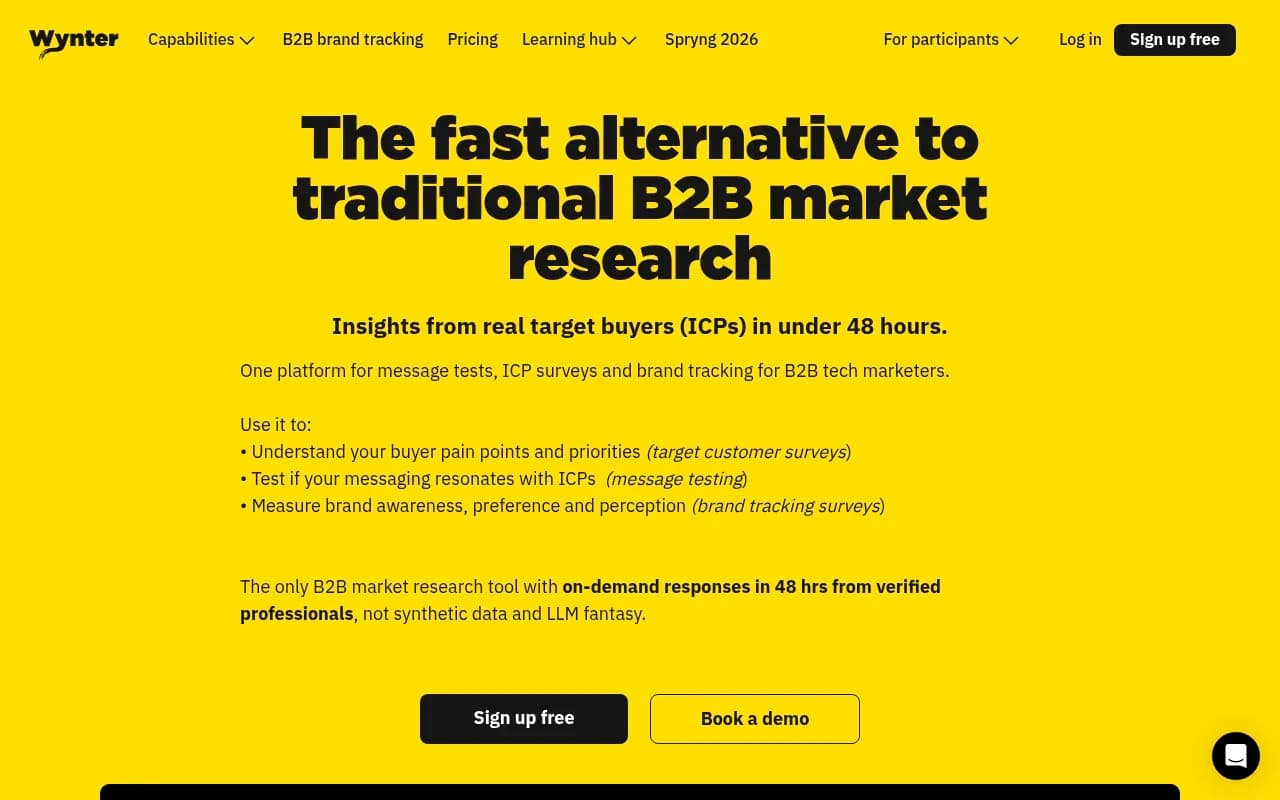
Wynter is the strongest alternative if you're a B2B SaaS company and need feedback from your exact ICP — not synthetic personas, but verified professionals in your target roles. You get qualitative insights in 12-48 hours from Wynter's network of 70,000+ B2B professionals.
Unlike Peasy's simulated audiences, Wynter delivers real responses from real buyers. You can test messaging, run ICP surveys, validate positioning, or track brand awareness among the specific personas you're trying to reach (e.g. VPs of Marketing at mid-market SaaS companies, IT Directors at enterprises with 500+ employees).
The platform is self-serve. You define your audience, upload your messaging or survey questions, and Wynter recruits participants who match your criteria. Results include open-ended feedback, clarity scores, and sentiment analysis. You see exactly what resonates and what confuses your target buyers.
Key differentiators vs Peasy:
- Real human feedback from verified B2B professionals, not AI-generated responses
- Faster turnaround (12-48 hours) than traditional research panels
- Qualitative depth: you get the "why" behind the data, not just simulated scores
- LinkedIn-verified identities ensure you're hearing from actual decision-makers
Pricing: Subscription plans from $798/mo (8 tests/year) to $2,000/mo (20 tests/year), billed annually. Pay-as-you-go tests from $500-$1,500 per test. More expensive than Peasy's usage-based model, but you're paying for real humans, not synthetic data.
Best for: B2B SaaS marketing teams, agencies serving B2B clients, and anyone who needs to validate messaging with actual ICPs before launch. If your buyers are enterprises, Wynter is the only way to get their real feedback at speed.
Qualtrics
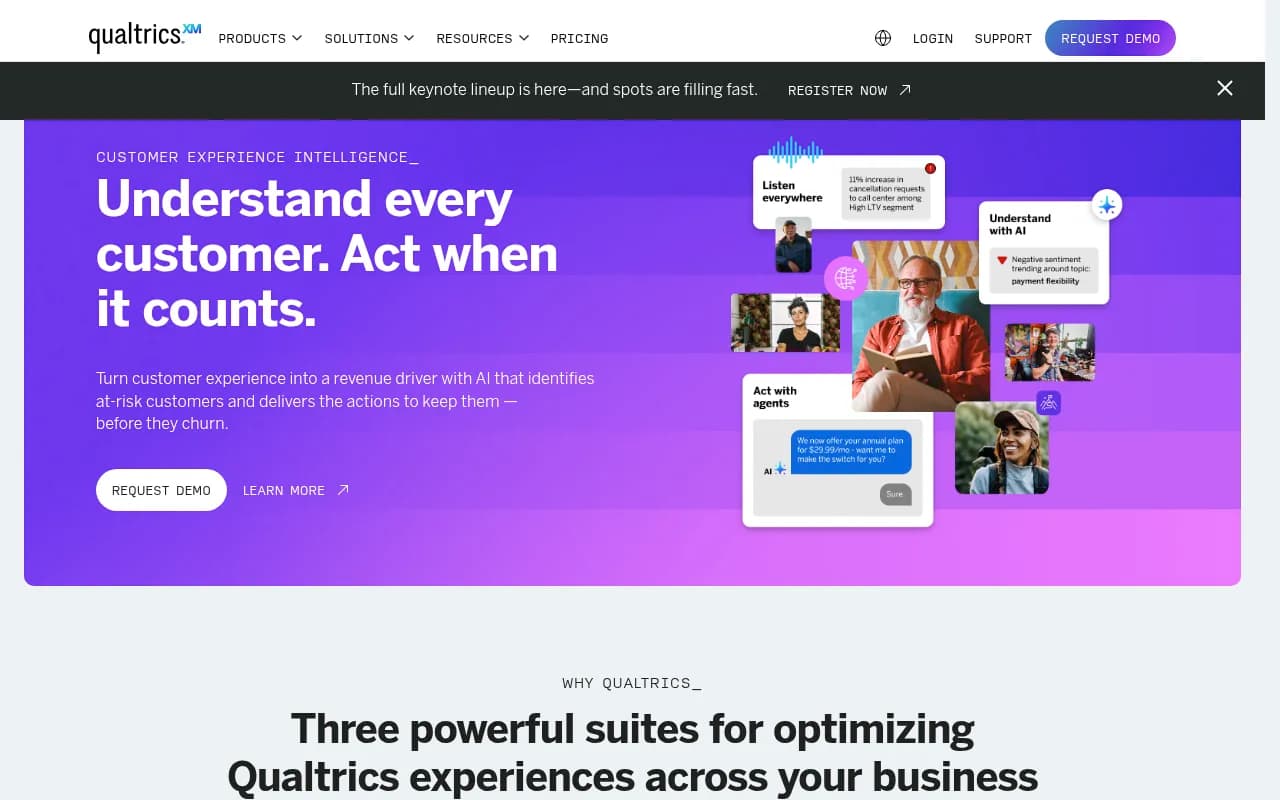
Qualtrics is the enterprise standard for experience management — customer feedback, employee engagement, market research, and brand tracking all in one platform. If Peasy feels too experimental and you need a proven system with deep analytics, Qualtrics is the safe bet.
You get advanced survey logic, sentiment analysis, predictive analytics, and integrations with CRM, marketing automation, and BI tools. Qualtrics handles multi-market research, complex quota sampling, and longitudinal studies that Peasy's synthetic audience model can't support. The platform is built for teams running continuous research programs, not one-off tests.
The trade-off: Qualtrics is expensive and complex. Implementation takes weeks or months. You'll need dedicated research ops to get value from it. But if you're a large brand running dozens of studies per year, the depth and reliability justify the cost.
Key differentiators vs Peasy:
- Real consumer panels and professional respondents, not synthetic personas
- Enterprise-grade analytics, reporting, and integrations
- Supports complex research designs (conjoint, MaxDiff, segmentation studies)
- Proven track record with Fortune 500 brands
Pricing: Custom enterprise pricing. Online research suite starts around $420/mo (billed annually). Free tier available with limited features (100 responses per survey). Expect $50K-$200K+ annually for full platform access.
Best for: Large enterprises, CPG brands, and research teams who need a comprehensive insights platform with real human data. Overkill for startups or teams just testing ad concepts.
SurveyMonkey
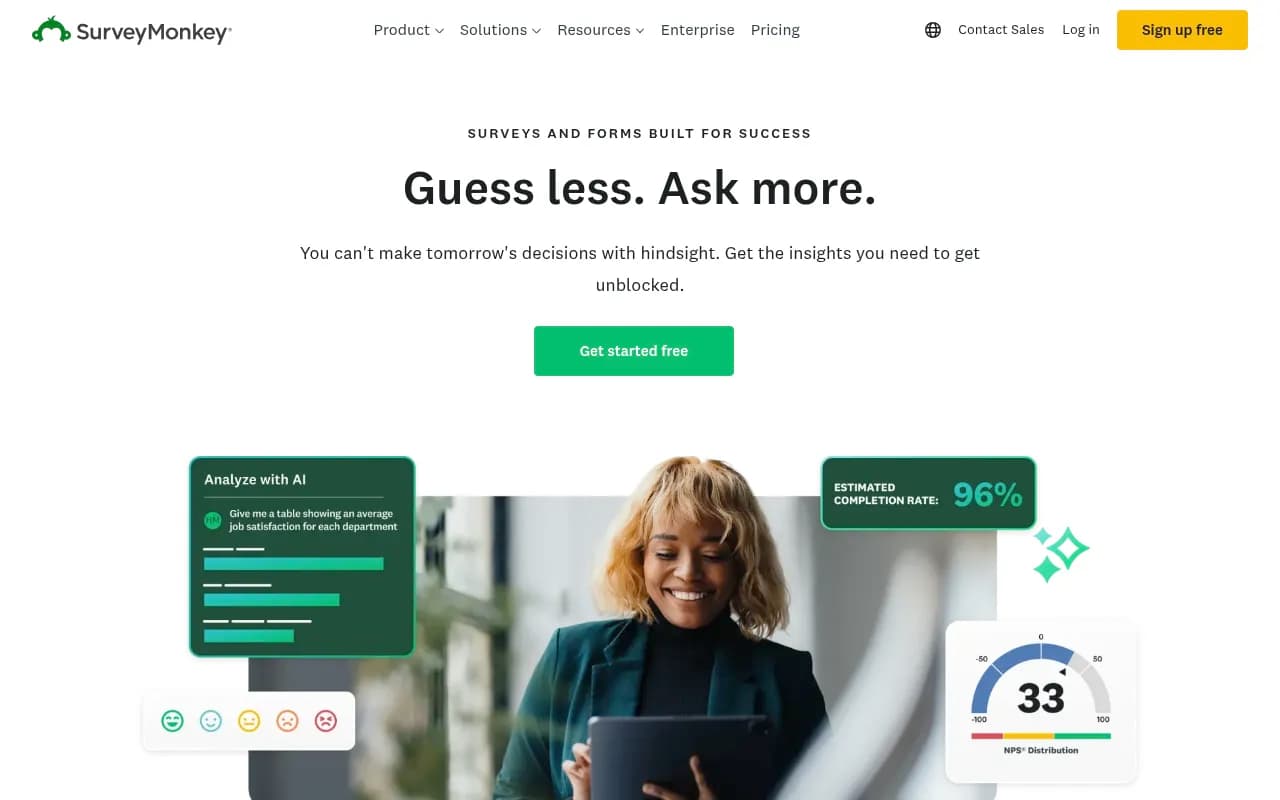
SurveyMonkey is the accessible entry point for market research. If Peasy's synthetic audience approach feels too abstract and you just want to survey real people, SurveyMonkey gives you the tools to do it yourself.
You can create surveys, polls, and forms, then distribute them to your own audience or buy responses from SurveyMonkey's panel of 175 million people worldwide. The platform includes templates, question banks, and basic analytics. It's not as sophisticated as Qualtrics, but it's fast to set up and easy to use.
The limitation: you're responsible for survey design, sampling, and interpretation. SurveyMonkey won't tell you if your questions are biased or if your sample is representative. But for straightforward feedback collection, it works.
Key differentiators vs Peasy:
- Real human responses from actual consumers or your own audience
- Simple, intuitive interface — no learning curve
- Flexible distribution (email, web, social, SMS)
- Access to SurveyMonkey Audience for targeted respondent recruitment
Pricing: Free plan (25 responses per survey). Individual plans from $39/mo. Team plans from $30/user/mo. Enterprise custom pricing. Audience panel responses cost extra (typically $1-$5 per complete).
Best for: Small teams, startups, and marketers who need quick feedback without enterprise complexity. Good for testing messaging, gathering customer satisfaction data, or validating product concepts with real users.
Remesh
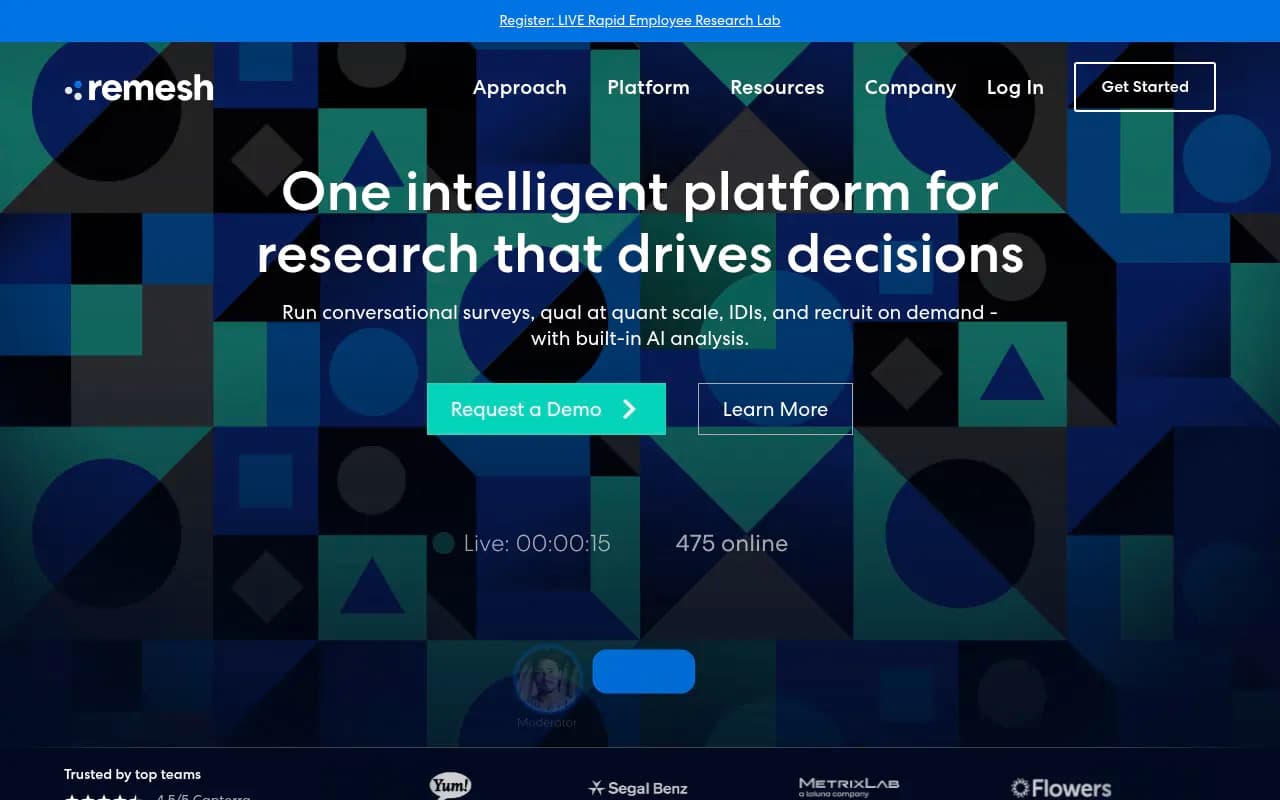
Remesh is the alternative if you want qualitative depth at quantitative scale. Instead of synthetic personas or static surveys, Remesh runs live digital focus groups with hundreds or thousands of real participants simultaneously.
You moderate a live session where participants respond to your questions in real time. Remesh's AI analyzes responses, surfaces themes, and lets you drill into specific topics. You get the richness of qualitative research (open-ended responses, unexpected insights) with the statistical power of large sample sizes.
This is fundamentally different from Peasy's approach. Remesh gives you real human dialogue, not simulated responses. You can test messaging, explore perceptions, and uncover what people really think — with the ability to follow up and probe deeper during the session.
Key differentiators vs Peasy:
- Live audience dialogues with real participants, not synthetic personas
- Real-time AI analysis surfaces themes and sentiment as the session unfolds
- Qualitative depth: you hear the language people use and the objections they raise
- Supports both consumer and B2B research
Pricing: Project-based pricing starting around $3,500 per session. Custom quotes based on participant count and complexity. No free tier. More expensive per study than Peasy, but you're getting live human interaction.
Best for: Brands testing new product concepts, agencies running creative development, and research teams who need qualitative insights at scale. Ideal when you need to understand the "why" behind consumer behavior.
Upsiide
Upsiide is the innovation testing specialist. If you're launching new products, testing packaging, or validating go-to-market strategies, Upsiide predicts real-world consumer behavior through mobile-first surveys that mimic actual decision-making.
The platform uses behavioral science models to simulate how consumers make choices. You test multiple concepts, see which ones drive purchase intent, and understand the trade-offs consumers make. Upsiide's approach is grounded in real human responses, not synthetic data — but the methodology is designed to predict market performance, not just measure preferences.
Brands like Coca-Cola, McDonald's, and Mars use Upsiide to de-risk innovation. You get predictive insights before committing to production or launch.
Key differentiators vs Peasy:
- Real consumer responses using behavioral science models
- Optimized for innovation testing (products, packaging, claims, creative)
- Mobile-first surveys that mimic real shopping behavior
- Proven track record with major CPG brands
Pricing: From $6,000/year. Annual subscription model. Pricing scales based on number of studies and markets. Not charged per idea tested. More expensive than Peasy but includes expert support.
Best for: CPG brands, consumer goods companies, and innovation teams who need to validate product concepts before launch. Particularly strong for physical products and retail environments.
Zappi
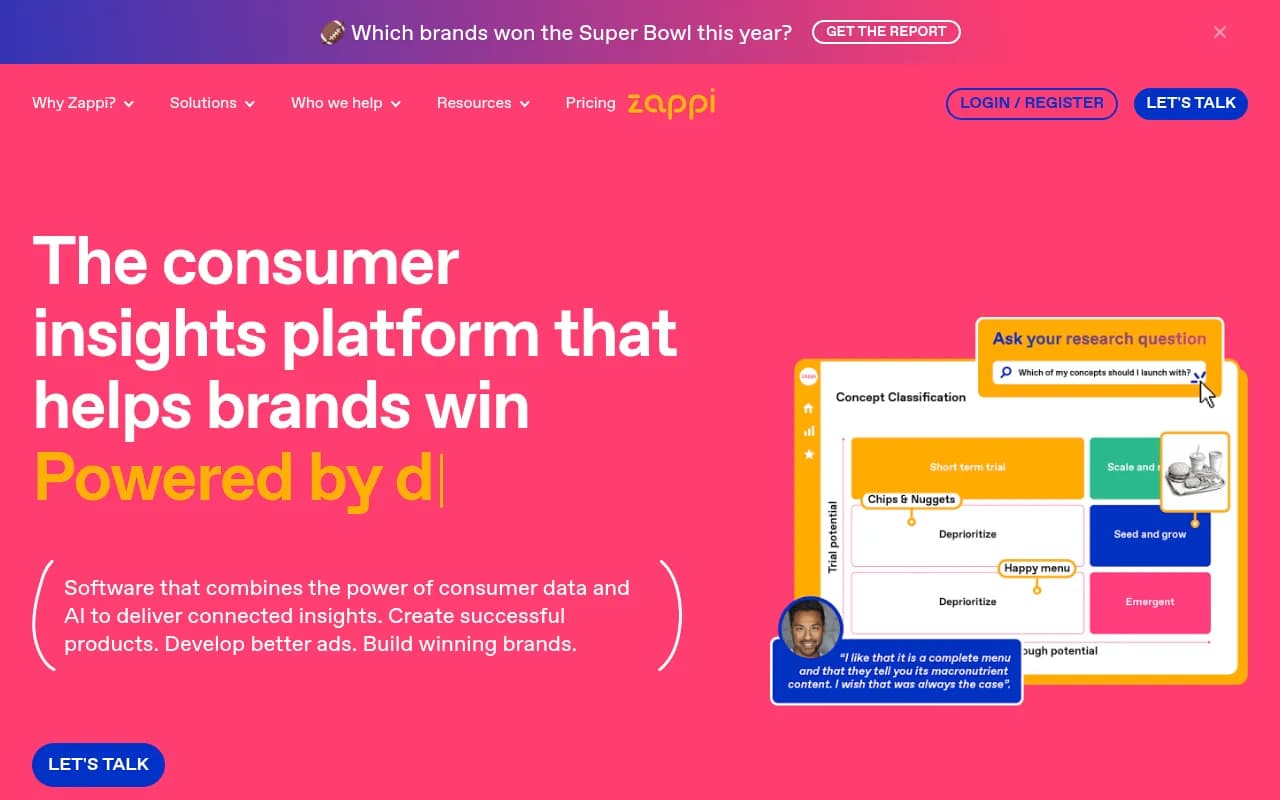
Zappi is the enterprise alternative for brands that need continuous consumer insights across product development, advertising, and brand tracking. It combines AI with real-time consumer feedback to replace traditional research models.
Used by Mars, PepsiCo, and McDonald's, Zappi automates the entire pre-launch testing process. You test ad concepts, optimize creative, validate product innovations, and track brand health — all in one platform. The system is validated to in-market outcomes, so you're not just getting opinions, you're getting predictive data.
Unlike Peasy's synthetic audiences, Zappi uses real consumers. The platform connects past research data with current tests to identify patterns and predict performance. It's built for large brands running dozens of studies per year.
Key differentiators vs Peasy:
- Real consumer feedback, not synthetic personas
- Validated to in-market outcomes (Forrester reports 4-7% increase in new product revenue)
- Comprehensive platform covering innovation, advertising, and brand tracking
- AI-powered insights that learn from your past research
Pricing: Custom enterprise pricing. Annual contracts based on usage volume. Requires sales consultation. Expect $100K+ annually. No free trial.
Best for: Fortune 500 brands, large CPG companies, and enterprises with dedicated research teams. Overkill for startups or small teams.
Attest
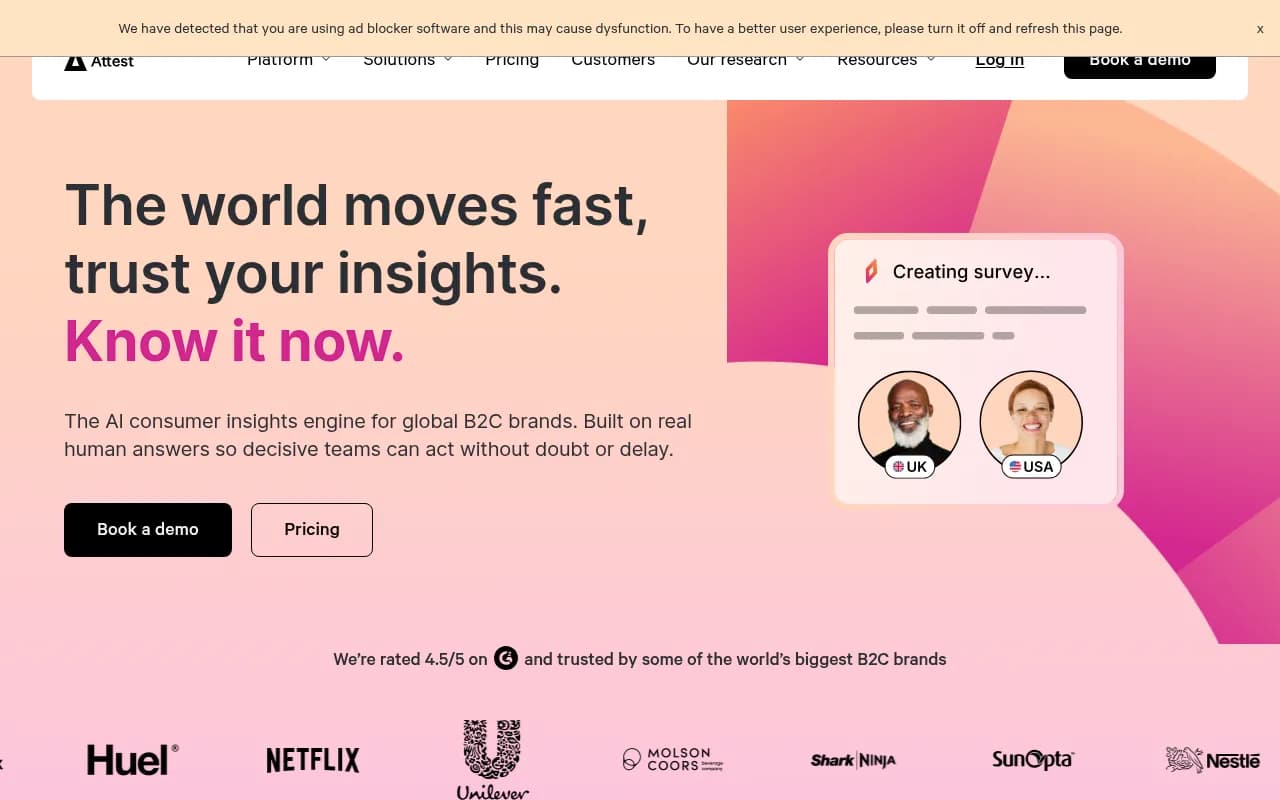
Attest is the consumer insights platform for B2C brands who need real human data across 59 countries. It combines survey tools, brand tracking, competitor analysis, and expert support in one platform.
Trusted by Netflix, Unilever, and Reddit, Attest gives you access to real consumers, not synthetic personas. You can run quantitative surveys, qualitative interviews, or continuous brand tracking. The platform includes AI-powered analysis, but it's grounded in actual human responses.
Attest's pricing is transparent (flat-rate per audience, not per response), and the platform is designed for marketing teams who need insights fast without hiring a research agency.
Key differentiators vs Peasy:
- Real consumer responses from 59 countries
- Combines quantitative and qualitative research in one platform
- Expert support to design studies and interpret results
- Transparent, predictable pricing
Pricing: Custom pricing (estimated $20K-$30K/year for small teams, $100K+ for enterprise). Flat-rate per audience. Demo required for quote.
Best for: B2C brands, consumer goods companies, and marketing teams who need global consumer insights with expert guidance. Good middle ground between DIY tools and full enterprise platforms.
Which Alternative Should You Choose?
Choose Wynter if: You're a B2B SaaS company and need real ICP feedback in 12-48 hours. Synthetic personas can't replicate enterprise buyers — you need verified professionals.
Choose Qualtrics if: You're an enterprise with a dedicated research team and need a comprehensive platform for continuous insights across customer experience, employee engagement, and market research.
Choose SurveyMonkey if: You're a small team or startup who needs to collect feedback quickly without enterprise complexity or cost. Good for straightforward surveys and basic research.
Choose Remesh if: You need qualitative depth at scale — live audience dialogues that uncover the "why" behind consumer behavior, not just simulated scores.
Choose Upsiide if: You're launching new products or testing innovations and need behavioral science models that predict real-world purchase behavior.
Choose Zappi if: You're a large CPG brand or Fortune 500 company running continuous research programs across product development, advertising, and brand tracking.
Choose Attest if: You're a B2C brand who needs global consumer insights with expert support, combining quantitative and qualitative research in one platform.
The core question: Do you need synthetic personas (Peasy's approach), or do you need real human feedback? For most teams, real humans — whether verified B2B professionals (Wynter), live audience dialogues (Remesh), or traditional consumer panels (Qualtrics, Attest, Zappi) — deliver more reliable insights. Synthetic audiences can supplement research, but they shouldn't replace talking to actual buyers.