Key takeaways
- Surfer SEO is the closest direct competitor to SurgeGraph for SERP-based content optimization, but costs significantly more and charges extra for AI-generated articles.
- Frase is the best pick if you want a tighter research-to-writing loop at a lower price point, with growing GEO (AI search) capabilities.
- NeuronWriter is the budget-friendly option for semantic SEO optimization, especially strong on NLP-based content scoring.
- Byword is built for teams that need to produce SEO content at scale with minimal manual effort — think 50+ articles a month.
- Jasper AI is the enterprise play: brand governance, multi-channel campaigns, and AI agents, but it's overkill for most content teams just trying to rank.
- Promptwatch is the right tool if your goal has shifted from ranking in Google to being cited in ChatGPT, Perplexity, and other AI search engines — a different problem that SurgeGraph doesn't solve.
SurgeGraph positions itself as an AI writing tool built specifically for traffic growth. The pitch is compelling: analyze what's already ranking, identify the gaps, and generate content that beats the competition. For a lot of content teams, that workflow makes sense. But people look for alternatives for a few common reasons.
The article limits can feel restrictive. At $49.99/month you get 30 articles, which sounds fine until you're running multiple sites or an agency with several clients. The BYOK (Bring Your Own API Key) option unlocks 2,000 articles but requires you to manage your own OpenAI or Anthropic costs on top. Some users also find the tool's focus on Google SEO increasingly narrow as AI search (ChatGPT, Perplexity, Google AI Overviews) becomes a bigger traffic source. And for teams that need deep keyword research, backlink analysis, or enterprise brand governance, SurgeGraph simply wasn't built for that.
Here's an honest look at the alternatives worth considering.
Surfer SEO
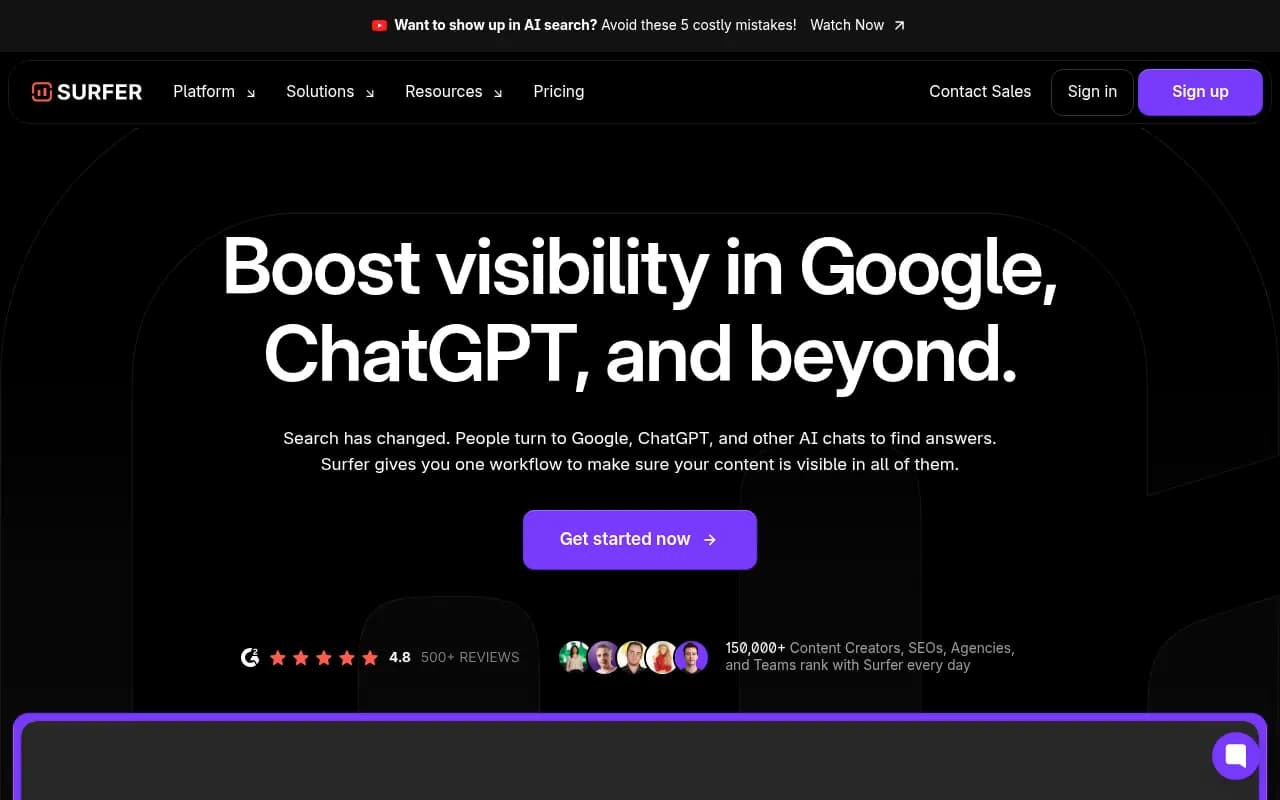
Surfer is probably the most direct comparison to SurgeGraph. Both tools analyze top-ranking pages for a target keyword and use that data to guide content creation. Surfer's Content Editor gives you a real-time score as you write, flagging keyword usage, heading structure, word count, and NLP terms pulled from competitor pages. It's been doing this longer than most, and the SERP analysis is genuinely solid.
Where Surfer pulls ahead: the Content Editor experience is more polished and the scoring model is well-established. The Topical Map feature helps plan clusters of content around a topic, which is useful for building authority systematically. Surfer also has a decent keyword research tool built in.
Where it falls short compared to SurgeGraph: Surfer AI articles cost additional credits on top of your base plan, which means the real cost of generating content at scale adds up fast. The base plans ($99/month for Essential, $179/month for Advanced) are significantly more expensive than SurgeGraph's entry point. If you're primarily looking for AI-generated articles rather than a writing assistant, SurgeGraph gives you more output per dollar.
Surfer has also been adding AI search optimization features, which is worth noting if you care about visibility in ChatGPT and Google AI Overviews. It's not deep yet, but it's moving in that direction.
Pricing: $99/month (Essential), $179/month (Advanced), $299/month (Max). AI article generation costs extra credits.
Best for: Content teams that want a mature, well-tested optimization workflow and are willing to pay more for a polished editor experience. Less ideal if you need high article volume on a budget.
Semrush
Semrush is a different beast entirely. It's not really an AI writing tool -- it's a full digital marketing platform that happens to include content optimization features. If you're comparing it to SurgeGraph purely on content generation, Semrush loses. But if you need keyword research, backlink analysis, competitor traffic data, site audits, and content optimization all in one place, Semrush is hard to beat.
The SEO Writing Assistant is Semrush's answer to tools like SurgeGraph and Surfer. It analyzes top-ranking pages and gives you optimization recommendations as you write. It works, but it's not the core product -- it's one module among dozens. The depth of content optimization isn't as focused as dedicated tools.
Semrush has been building out AI visibility features (tracking brand mentions in ChatGPT, Perplexity, and Gemini), but these use fixed prompts rather than letting you define your own, which limits how useful they are for most brands. It's a monitoring layer, not an optimization workflow.
The pricing is also in a different tier. Starting at $165/month for the Starter plan, Semrush is a significant investment. It makes sense if you're already paying for multiple SEO tools and want to consolidate, but it's expensive if you just need better content.
Pricing: From $165/month (Starter), $290/month (Pro+), $580/month (Advanced). Enterprise custom.
Best for: Marketing teams that need a comprehensive SEO platform and want content optimization as one part of a larger toolkit. Not the right choice if content generation is your primary need.
Writesonic

Writesonic has made an interesting pivot. What started as an AI writing tool has repositioned itself as an AI search visibility and GEO platform -- tracking brand mentions across ChatGPT and 10+ AI platforms, identifying citation gaps, and helping you create content to fix them. That's a notably different direction from SurgeGraph.
If you're using SurgeGraph primarily to create Google-ranking content, Writesonic's current focus might not be what you're looking for. But if you're thinking about the next layer -- not just ranking in Google but getting cited in AI search results -- Writesonic is worth a look. It covers content creation, citation gap analysis, and Reddit/UGC monitoring in one platform.
The honest caveat: Writesonic has changed direction a few times, and the product is still maturing in its GEO positioning. The content creation side is solid (it's been doing that for years), but the AI visibility features are newer and less proven than dedicated GEO platforms.
Pricing: Check the website for current plans -- the product has been actively evolving.
Best for: Teams that want to address both traditional SEO content creation and AI search visibility in one tool, and don't mind being on a platform that's actively developing its feature set.
Frase
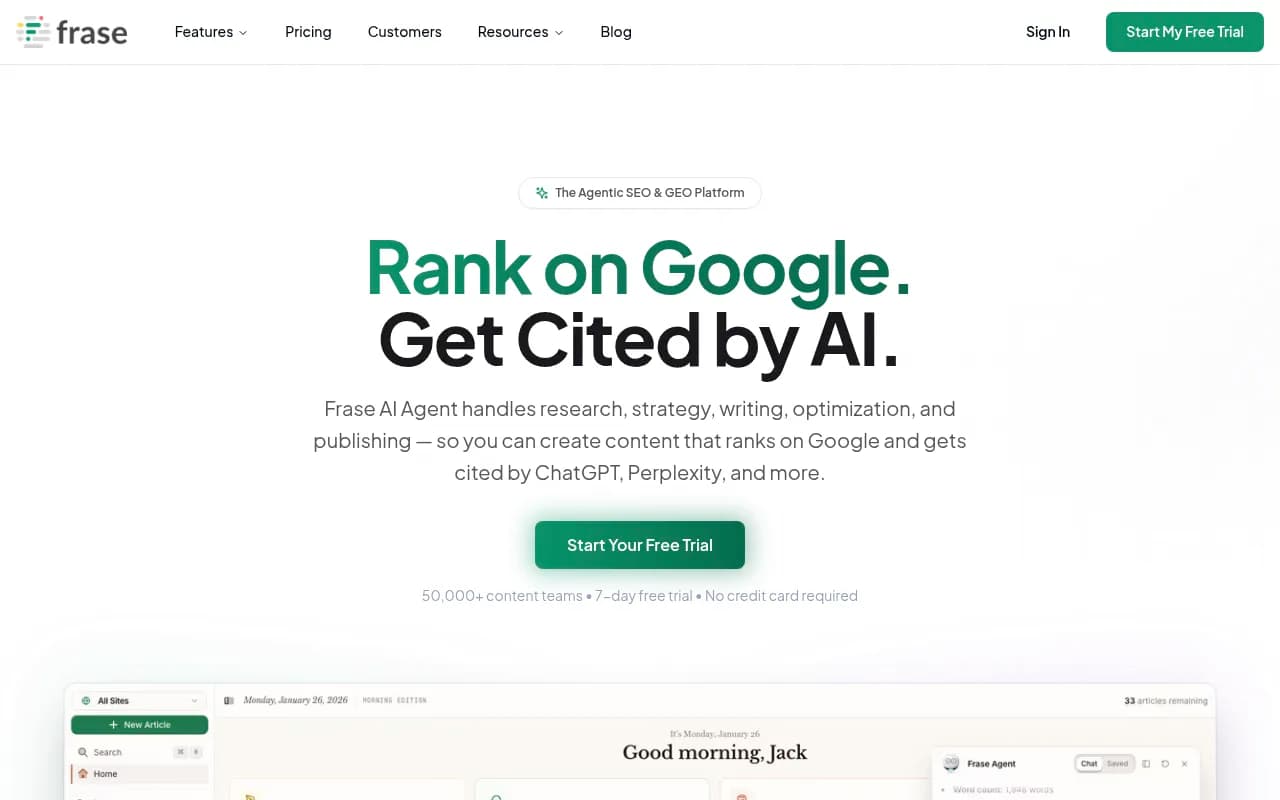
Frase has always been good at the research-to-brief-to-draft workflow, and it's gotten better. The core loop is: enter a keyword, Frase analyzes the top SERP results, identifies content gaps, generates a brief, then helps you write. It's fast, the research is genuinely useful, and the interface is cleaner than most competitors.
What's changed recently is Frase's push into GEO. It now tracks visibility across Google, ChatGPT, and Perplexity, and positions itself as an "agentic SEO & GEO platform." The agentic angle means it can handle more of the workflow autonomously -- research, brief creation, drafting, optimization -- without you manually triggering each step.
Compared to SurgeGraph, Frase is slightly more research-focused and slightly less focused on raw article output volume. The content editor is excellent for working through a single piece carefully. If you're producing 5-10 articles a month and want each one to be well-researched, Frase is a strong choice. If you need to crank out 30+ articles, SurgeGraph's model might suit you better.
Pricing is genuinely competitive: $39/month (Starter), $103/month (Professional), $239/month (Scale). The Starter plan is limited on article count, but the Professional plan is reasonable for most content teams.
Pricing: From $39/month. 7-day free trial, no credit card required.
Best for: Content marketers who want a tight research-to-writing workflow with growing AI search optimization capabilities. Good value at the Professional tier.
NeuronWriter
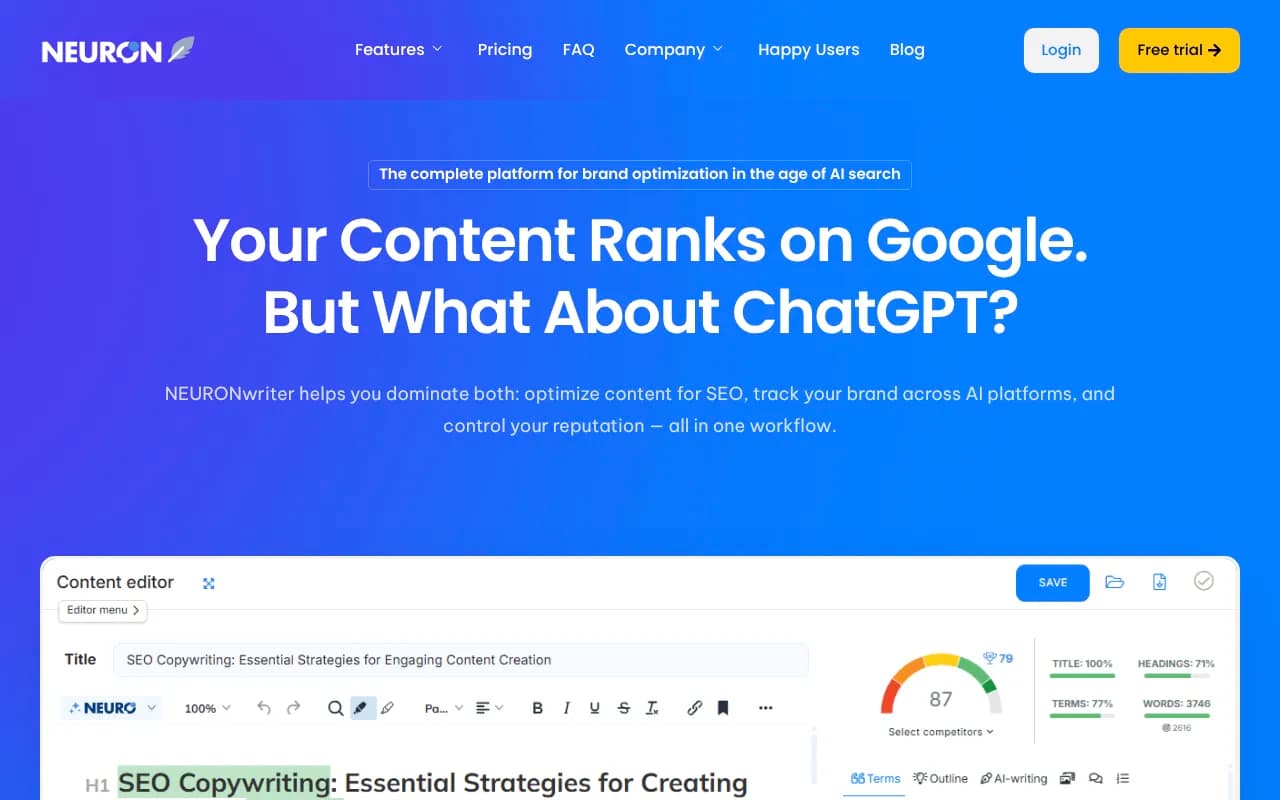
NeuronWriter is the most affordable serious option in this comparison. At $19/month (annual billing), you get semantic SEO analysis, competitor research, NLP-based content scoring, and AI writing assistance. For solo bloggers, small agencies, or teams on tight budgets, it punches well above its price point.
The NLP analysis is where NeuronWriter genuinely shines. It pulls semantic terms from top-ranking pages and shows you exactly which concepts your content needs to cover to compete. The content score updates in real time as you write, which creates a useful feedback loop. It also has WordPress and Google Search Console integrations that work well.
The trade-offs are real though. The AI writing quality isn't as strong as SurgeGraph or Surfer, and the interface feels less polished. The topical authority planning features are more basic. NeuronWriter has been adding AI brand monitoring features (tracking visibility in ChatGPT and other platforms), which is a welcome addition, but it's not as developed as dedicated tools.
For pure SEO content optimization on a budget, NeuronWriter is hard to beat. For teams that need high-quality AI-generated articles at scale, it's not the right fit.
Pricing: From $19/month (annual). 7-day free trial.
Best for: Budget-conscious content teams, solo SEOs, and bloggers who want solid semantic optimization without paying Surfer or SurgeGraph prices.
Byword

Byword is built for one thing: generating SEO-optimized articles at scale, fast. The workflow is keyword in, article out, publish to CMS. It supports WordPress, Webflow, Shopify, Notion, and HubSpot, and the publishing integrations are genuinely seamless. For teams running content programs at volume -- think 50-100+ articles a month -- Byword's model makes sense.
The quality is solid for AI-generated content. Byword uses a mix of models (it mentions GPT-5.4, Claude Opus 4.6, and Gemini 3.1 Pro in its current positioning) and does SERP research before generating each article. The brand voice matching feature helps maintain consistency across large content programs.
Where Byword differs from SurgeGraph: it's less focused on deep competitor analysis and topical authority planning, and more focused on efficient, scalable output. SurgeGraph puts more emphasis on studying what's already ranking and building content strategy around that. Byword is more "give me the article, I'll handle the strategy."
The pricing model is also different. Byword charges per article volume: $99/month for 25 articles, $299/month for 80, $999/month for 300. That's more expensive per article than SurgeGraph at higher volumes, but the publishing automation and CMS integrations add real value for teams managing large sites.
There's a free tier (5 articles) which is genuinely useful for testing.
Pricing: Free (5 articles), then $99/month (25 articles), $299/month (80 articles), $999/month (300 articles).
Best for: Content teams running high-volume SEO programs who need fast, automated article generation with direct CMS publishing. Less ideal for teams that want deep manual control over each piece.
Content at Scale (BrandWell)

Content at Scale has rebranded as BrandWell and made a significant pivot. It started as an AI content generation tool focused on producing long-form, human-like articles at scale. It's now positioning itself as an intent-led go-to-market platform that identifies anonymous website visitors, tracks competitor traffic, and maps buying committees.
That's a very different product from SurgeGraph. If you're looking for a direct content generation alternative, BrandWell's current direction is probably not what you need. The content creation side (RankWell) still exists, but it's now one module within a broader ABM and intent data platform.
The original Content at Scale product was well-regarded for producing long-form content that passed AI detection tools -- useful for teams worried about content authenticity signals. If that's your primary concern, the RankWell component might still be relevant. But the platform has moved upmarket and upmarket in price.
Pricing: From $250/month. 7-day free trial.
Best for: B2B marketing teams that want to combine content creation with intent data and ABM capabilities. Not the right fit if you just need an AI writing tool for SEO content.
SEO Writing AI

SEO Writing AI is the budget-friendly bulk content option. At $14/month (Starter, annual billing), you can generate SEO-optimized articles, auto-publish to WordPress, and run bulk article generation batches. It's popular with bloggers, affiliate marketers, and agencies managing lots of WordPress sites.
The feature set is narrower than SurgeGraph. SEO Writing AI does SERP competitor analysis before generating content, and it has an SEO checker for optimization guidance. The Amazon product integration is useful for affiliate content specifically. But the topical authority planning, content gap analysis, and strategic features that SurgeGraph emphasizes aren't really here.
What it does well: speed and volume at low cost. If you need 50 articles a month and your budget is tight, SEO Writing AI is worth considering. The quality is acceptable for informational content, though it needs more editing than premium tools.
The platform has been adding AI search optimization features (claiming to optimize for ChatGPT and Perplexity citations), but this is still early-stage compared to dedicated tools.
Pricing: Free trial, then from $14/month (Starter), $59/month (Professional), $119/month (Professional Plus). Annual billing.
Best for: Bloggers, affiliate marketers, and small agencies that need high-volume content at low cost, especially for WordPress-heavy workflows.
Jasper AI

Jasper is the enterprise end of this spectrum. It started as an AI writing tool and has evolved into a full marketing platform with 100+ AI agents, content pipelines, brand governance tools, and multi-channel campaign management. The brand voice and style guide features are genuinely impressive -- Jasper can maintain consistent tone and messaging across a large team producing content at scale.
For SEO content specifically, Jasper has SEO, AEO, and GEO solutions, and it integrates with Surfer SEO for optimization scoring. But Jasper itself isn't primarily an SEO content tool -- it's a marketing operations platform that includes SEO as one use case.
Compared to SurgeGraph, Jasper is solving a different problem. SurgeGraph is focused on: analyze competitors, generate optimized content, grow traffic. Jasper is focused on: govern brand voice, automate marketing workflows, produce content across every channel. If you're a solo blogger or small content team, Jasper is overkill and expensive. If you're a mid-market or enterprise marketing team that needs AI across campaigns, social, email, and SEO, Jasper makes more sense.
Pricing: From ~$59/month (Pro, annual billing). Enterprise custom pricing.
Best for: Mid-market and enterprise marketing teams that need AI-assisted content across multiple channels with strong brand governance. Not the right fit for teams focused purely on SEO content production.
Promptwatch

Promptwatch belongs in a slightly different category from the other tools here, but it's worth understanding why.
SurgeGraph and most of the alternatives above are built around Google search: analyze what ranks, create content that ranks better. That's still important. But a growing share of search traffic now flows through ChatGPT, Perplexity, Claude, and Google AI Overviews -- and those systems cite sources differently than Google's algorithm ranks them.
Promptwatch tracks your brand's visibility across 10 AI models, shows you which prompts your competitors appear in but you don't (Answer Gap Analysis), and has a built-in content agent that generates articles specifically engineered to get cited by AI search engines. It also logs AI crawler activity on your site in real time, so you can see which pages ChatGPT and Perplexity are actually reading and which ones they're ignoring.
This isn't a replacement for SurgeGraph -- it's a complement to it, or a next step. If you're already producing good Google-ranking content and want to understand why you're not showing up when someone asks ChatGPT for a recommendation in your category, Promptwatch is the tool for that.
Pricing: From $99/month (Essential), $249/month (Professional), $579/month (Business). Free trial available.
Best for: Marketing teams and SEO professionals who want to understand and improve their visibility in AI search engines, not just Google. Particularly valuable for brands in competitive categories where AI recommendations drive purchase decisions.
How to choose
The right tool depends on what problem you're actually trying to solve.
If you want a direct SurgeGraph alternative with more polish and don't mind paying more, Surfer SEO is the obvious choice. If you want a tighter research-to-writing workflow at a lower price, Frase is worth a serious look. For budget-conscious teams focused on semantic optimization, NeuronWriter at $19/month is hard to argue with. For high-volume content production with automated publishing, Byword handles that better than most.
If you're running an enterprise marketing operation and need AI across every channel, Jasper is the platform for that. And if you're starting to think about AI search visibility -- not just Google rankings -- Promptwatch addresses a problem that none of the other tools in this list are built to solve.
The honest reality is that Google SEO and AI search optimization are becoming two separate disciplines that require different tools and different content strategies. Most teams will need both.