Botric Review 2026
Emerging GEO platform built specifically for AI search visibility, tracking brand mentions and citations across ChatGPT, Perplexity, and other AI engines.
Key takeaways
- Botric combines GEO (Generative Engine Optimization) monitoring with an AI customer support layer -- a combination most pure-play GEO tools don't offer
- Lacks critical capabilities vs Promptwatch: no AI crawler logs, no traffic attribution, no Reddit/YouTube tracking, no ChatGPT Shopping monitoring, no prompt volume/difficulty scoring, no query fan-outs, and only covers 4 AI models vs Promptwatch's 10+
- Monitoring-focused with some content generation; the "fix" side of the loop is thinner than it appears -- no dedicated Answer Gap Analysis or page-level citation tracking at the depth Promptwatch provides
- Pricing starts at $8/month (annual), making it one of the more accessible entry points in the GEO space
- Best suited for small B2B SaaS teams and growth-stage brands that want a single tool for both AI visibility and basic customer support, rather than a deep optimization platform
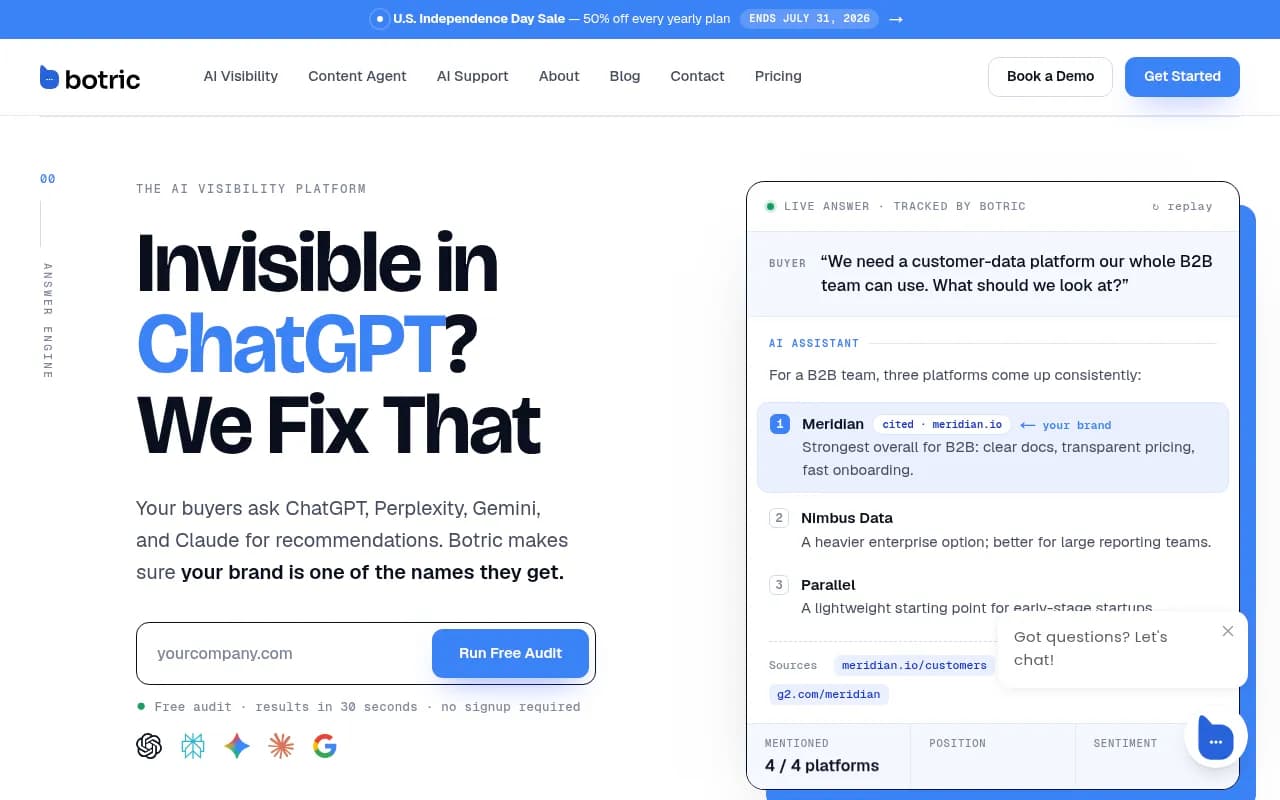
Botric is a relatively new entrant in the GEO space, positioning itself around a two-engine concept: Engine 01 handles AI visibility and citation tracking, Engine 02 deploys AI customer support agents to handle the visitors those citations send. The pitch is that most GEO tools stop at the monitoring layer -- they tell you when you're mentioned but don't help you convert the traffic that follows. Botric tries to close that loop by bundling a chatbot and email agent alongside the visibility tracking.
The platform targets B2B SaaS companies, dev tool vendors, and growth-stage brands that are starting to take AI search seriously. It's not built for enterprise SEO teams running hundreds of prompts across dozens of markets. The customer list on the site -- Grey Aesthetics, Luminary, FAIM.World, Motorenvy -- skews toward small businesses and early-stage startups, which tells you something about where the product is right now.
Botric appears to have launched in 2025 and is still building out its feature set. The 50% Independence Day sale running through July 2026 and the relatively modest customer logos suggest it's in an early growth phase, not a mature platform. That's not necessarily a knock -- early products can move fast -- but it's worth keeping in mind when evaluating depth vs. established competitors.
Key features
Visibility Score (0-100) is Botric's headline metric. It's a composite score built from four components: mention rate (40%), citation rate (25%), position score (20%), and sentiment (15%). The score is calculated per AI platform and as an overall number, updated weekly. Having a single number to track is genuinely useful for reporting to non-technical stakeholders, though the weekly cadence means you won't catch rapid shifts in real time.
Visibility Audit runs a baseline scan across ChatGPT, Perplexity, Gemini, and Claude, mapping how your brand appears (or doesn't) for a set of prompts you define. The audit also benchmarks you against competitors prompt-by-prompt, so you can see where rivals are getting cited and you're not. The onboarding flow shown on the site is slick -- it crawls your site, identifies prompt categories (commercial, comparison, transactional, locational, branded), and surfaces a gap list within seconds.
Citation Tracking monitors which of your pages get cited across the four supported AI engines, which competitors are winning specific prompts, and where the gaps are. Alerts fire when gaps appear. This is table-stakes for any GEO platform, and Botric covers it adequately for the four engines it supports.
Search Readiness is the technical optimization layer. Botric generates schema markup (JSON-LD), helps you publish an llms.txt file, and identifies whether AI crawlers are blocked in your robots.txt. It also flags technical issues like slow LCP and broken canonicals that can hurt AI discoverability. This is a practical feature that many competitors treat as an afterthought.
Content Gap Analysis and Content Agent analyzes your existing content against what AI engines are citing competitors for, then helps generate blog posts and social content to close those gaps. The content generation is positioned as a gap-closing tool rather than a full content production pipeline. It's useful but lighter than what dedicated content optimization platforms offer.
Reddit Agent is an interesting addition. Botric drafts replies to relevant Reddit threads in your brand voice, positioning them as citation seeds for AI engines that pull from Reddit discussions. This is a real tactic -- Perplexity and ChatGPT both surface Reddit content -- but the execution here is essentially a reply drafting tool, not a full Reddit monitoring and analytics layer.
Engine 02: AI Customer Support is the feature that genuinely differentiates Botric from pure GEO tools. Once you're getting AI-referred traffic, Botric deploys chat and email agents trained on your product docs and brand voice. Complex queries escalate to your team with full conversation context. Integrations include Slack and a webhooks API. This is a real product capability, not just a checkbox -- though it's worth noting that dedicated support tools like Intercom or Drift go much deeper on this side.
Onboarding flow deserves a mention because it's genuinely well-designed. The step-by-step audit (onboard, audit, diagnose, plan, fix, content, Reddit, payoff) gives new users a clear path from zero to first actions. The "audit baseline in 30 seconds" claim holds up based on the demo -- it's fast and surfaces actionable output immediately.
Who is it for
Botric fits best for small to mid-size B2B SaaS companies that are just starting to think about AI search visibility and want a single tool that covers both the discovery side (getting cited) and the conversion side (answering questions from AI-referred visitors). A 10-50 person SaaS company with a small marketing team that doesn't have the bandwidth to stitch together a GEO monitoring tool, a content optimization workflow, and a customer support chatbot separately will find the bundled approach appealing.
Growth-stage brands in competitive categories -- CDPs, dev tools, fintech -- where AI search is starting to influence the buying process are the clearest use case. The case studies (a med spa, an AI platform) show Botric works across verticals, not just pure SaaS, which is worth noting for service businesses that want AI visibility.
Who should probably look elsewhere: enterprise marketing teams running large-scale GEO programs across multiple regions and languages, agencies managing 10+ client accounts, or any team that needs deep prompt analytics (volume, difficulty, query fan-outs), AI crawler logs, or traffic attribution connecting AI citations to actual revenue. Botric's current feature depth doesn't support those workflows.
Integrations and ecosystem
Botric's integration footprint is modest. On the customer support side, it connects to Slack for escalation routing and offers a webhooks API for custom tool integrations. There's no native integration with Google Search Console, no Looker Studio connector, and no mention of CRM integrations.
The platform doesn't appear to have a public API for pulling visibility data into external dashboards, which limits its usefulness for teams that want to blend GEO data with other marketing analytics.
There's no browser extension or mobile app mentioned. The product is web-based, accessed at app.botric.ai.
Import/export capabilities aren't detailed on the site, which is a gap for teams that need to share data with clients or feed it into reporting tools.
Pricing and value
Botric's pricing is among the most accessible in the GEO space:
- Free plan: Available, no credit card required. Scope isn't fully detailed but includes a free audit.
- Starter: $8/month billed annually ($96/year). Entry-level access.
- Pro: $45/month billed annually ($540/year). More prompts and features.
- Higher tiers: The Botric vs Peec AI comparison page references a Pro plan at $199/month with 100 prompts and an Enterprise plan at $499/month with 300 prompts -- these may reflect different packaging or an older pricing structure.
There's currently a 50% off annual plans promotion running through July 31, 2026, which brings the effective cost down further.
For comparison, Promptwatch starts at $99/month for 50 prompts across 10 AI models with content generation included, and goes to $249/month for the Professional tier with crawler logs and traffic attribution. Peec.ai and Otterly.AI sit in similar ranges to Botric's mid-tier pricing. At $45/month annually, Botric is genuinely cheap for what it covers -- the question is whether what it covers is enough for your needs.
The bundled AI customer support (Engine 02) adds real value if you'd otherwise pay separately for a chatbot tool. Basic chatbot tools start around $50-100/month, so the bundle math works in Botric's favor for small teams.
Strengths and limitations
What Botric does well:
- The two-engine concept is genuinely differentiated. No other GEO tool bundles AI customer support in the same platform. For small teams that want one tool to handle discovery and conversion, this is a real advantage.
- The onboarding flow and audit experience are polished. Getting from signup to actionable gap list in under a minute is impressive and sets a good first impression.
- The Search Readiness features (schema generation, llms.txt, robots.txt audit) are practical and often overlooked by competitors. Helping users unblock AI crawlers is a concrete, high-impact action.
- Pricing is accessible. At $8-45/month annually, it's within reach for bootstrapped startups and small businesses that can't justify enterprise GEO tool pricing.
- The Reddit Agent, while basic, addresses a real tactic that most GEO platforms ignore entirely.
Where it falls short:
- Model coverage is limited. Botric tracks 4 AI engines (ChatGPT, Gemini, Perplexity, Claude). Promptwatch monitors 10+ including Grok, DeepSeek, Copilot, Meta AI, and Google AI Mode. As AI search fragments across more models, this gap matters.
- No AI crawler logs or traffic attribution. You can't see which AI crawlers are hitting your site, which pages they're reading, or connect AI citations to actual revenue. Promptwatch's crawler log feature and traffic attribution are capabilities Botric doesn't have at all. For teams that want to understand the full journey from crawl to citation to conversion, this is a significant gap.
- No prompt intelligence. There's no volume or difficulty scoring for prompts, no query fan-out analysis showing how one prompt branches into sub-queries. You're flying somewhat blind on which prompts are worth prioritizing.
- No Reddit/YouTube monitoring analytics. The Reddit Agent drafts replies but doesn't monitor Reddit discussions or YouTube content for existing citations or brand mentions the way deeper platforms do.
- No ChatGPT Shopping tracking or entity tracking at the depth that matters for e-commerce or product-led brands.
- Content generation is thin. The Content Agent generates blogs and social posts but lacks the structured brief workflow, brand guidance integration, and citation-grounded content generation that more mature platforms offer.
Bottom line
Botric is a reasonable starting point for small B2B SaaS teams and growth-stage brands that want to get into AI search visibility without a large budget or a complex tool stack. The bundled AI customer support is a genuine differentiator -- if you'd pay separately for a chatbot anyway, the economics make sense.
But if you're serious about GEO as a growth channel, the gaps add up fast. No crawler logs, no traffic attribution, no prompt volume data, only 4 AI models, and limited content optimization depth mean you'll hit the ceiling quickly. Teams that need a full optimization loop -- find gaps, generate content, track results, connect to revenue -- should look at Promptwatch, which covers all of that across 10+ AI models with a more complete action layer.
Best for: Small B2B SaaS teams that want a single affordable tool to start tracking AI citations and handle AI-referred visitor questions, without needing deep analytics or multi-model coverage.
Frequently asked questions
What is Botric?
Which AI platforms does Botric track?
How much does Botric cost?
How long does it take to see results with Botric?
How is Botric different from other GEO tools?
Is there a free trial or free plan?
Similar and alternative tools to Botric