Key takeaways
- Enterprise-grade AI brand monitoring is a different buying category than the $29/mo self-serve tools. Expect $250 to $5,000+ per month, SSO/SAML, SOC 2 Type II, and multi-region deployment as table stakes, not upsells.
- Profound is the most-funded name in the category ($335M raised across five rounds, a $1.8B valuation as of its September 15, 2026 Series D), but its self-serve Starter tier only covers ChatGPT — full model coverage is Enterprise-only, typically $2,000-$5,000+/month.
- Scrunch AI and AthenaHQ both publish credible enterprise proof points (Scrunch's Akamai case study shows a 364% lift in non-branded prompt presence; AthenaHQ bundles multi-model tracking into its Starter tier instead of gating it behind Enterprise).
- Single-platform monitoring is misleading on its own. ChatGPT and Google AI disagree on brand recommendations a large share of the time, and citation behavior can shift overnight — the GPT-5.3 rollout on March 4, 2026 cut average ChatGPT citations per response by roughly 27% across every model simultaneously, with no recovery a month later.
- Monitoring without an action layer just tells you what's broken. If your team can't turn visibility gaps into published content, you're paying for a dashboard, not a fix.
What "enterprise" actually means in this category
Every AI brand monitoring vendor now has an "Enterprise" tier on its pricing page. That word means something different depending on who's selling it. For some it means "talk to sales." For others it means SSO, SOC 2 Type II, multi-brand deployment, and a forward-deployed engineer sitting in your Slack. Before you shortlist anyone, it's worth being precise about what your procurement team is actually going to ask for, because the gap between "Enterprise available" and "Enterprise-ready" is where a lot of six-figure contracts go sideways.
The baseline checklist enterprise IT and security teams tend to require:
- SSO via SAML 2.0 or OIDC, tied to your identity provider, so onboarding and offboarding happen centrally instead of through a shared login
- A current SOC 2 Type II report (not just "SOC 2 compliant" language on a marketing page — ask for the actual report)
- Data residency controls, especially for regulated industries or EU operations
- Contractual SLAs and a real support escalation path, not a community Slack channel
- Programmatic API access for pushing visibility data into your own BI stack rather than relying solely on a vendor dashboard
One buyer's guide put it bluntly: "Ask any vendor for a current SOC 2 report and confirm SSO/SAML directly. 'Enterprise plan available' doesn't guarantee either." That's good advice. Several budget-tier tools have bolted an "Enterprise" label onto their pricing page well before they had the actual compliance work done.
The platforms worth shortlisting
| Platform | Enterprise pricing signal | Model coverage | Compliance | Best fit |
|---|---|---|---|---|
| Profound | Enterprise custom, typically $2,000-$5,000+/mo | Up to 9 engines on Enterprise; Starter is ChatGPT-only | SSO/SAML, SOC 2 | Fortune 500 teams that want the deepest single vendor and can absorb enterprise pricing |
| Scrunch AI | ~$250-$417/mo entry tiers, Enterprise custom | Broader coverage (Claude, Grok, Meta AI, DeepSeek) gated to Enterprise | SOC 2 Type II, SAML/OAuth SSO, RBAC from day one | Teams that need audited security posture right now, not "in progress" |
| AthenaHQ | Starter $295/mo ($245 annual), Enterprise custom | Multi-model on both tiers, no gating | SAML/OIDC SSO on Enterprise, multi-country support | Teams that want broad coverage without paying extra per model |
| Evertune | Pro $800/mo, Enterprise custom | Full coverage plus AI shopping intelligence | Quote-based, no published SSO/SOC2 detail | High-consideration categories (auto, healthcare, B2B software) with $800+/mo budgets |
| Brandwatch | Est. $36K-$150K+/year (procurement data) | Broad social listening, not AI-search native | Enterprise contracts, 4-hour SLA | Brands that need social listening plus AI mentions in one contract |
| Ahrefs Brand Radar | Bundled add-on, Enterprise $1,499/mo | 10+ LLMs on Enterprise | Standard Ahrefs enterprise terms | Teams already living inside the Ahrefs ecosystem |
Profound
Profound is the name that shows up first in almost every 2026 comparison, and the funding numbers explain why. It closed a $180M Series D on September 15, 2026, co-led by Sequoia Capital and Kleiner Perkins, at a $1.8 billion valuation — up from $1 billion just seven months earlier. Total disclosed funding is now roughly $335 million across five rounds since the company's August 2024 founding.
That capital has bought real enterprise traction: named customers include Target, Walmart, Figma, Ramp, MongoDB, and Chime, and Profound claims it serves more than 10% of the Fortune 500 across 700-plus enterprises. The current pricing structure is actually simpler than older comparisons suggest — the free trial gives you 10 one-time ChatGPT prompts, and everything real sits in a single custom-quoted Enterprise tier covering up to nine answer engines (ChatGPT, Perplexity, Google AI Mode, Gemini, Copilot, DeepSeek, Claude, AI Overviews, Exa Search), SSO/SAML, SOC 2, unlimited domains, full API access, and an "Agents" layer for content workflows.
Profound

The honest limitation: there's no self-serve middle tier anymore. If you want more than a ChatGPT snapshot, you're going through sales, and enterprise contracts here commonly land in the $2,000-$5,000+/month range once you add multi-model coverage and agents. If your budget genuinely supports that, Profound's depth is hard to argue with. If it doesn't, you're better served by AthenaHQ or Scrunch.
Scrunch AI
Scrunch is the one I'd point a security-conscious CISO toward first. It's SOC 2 Type II compliant with an audit already completed by an independent third party, offers SAML/OAuth SSO with Okta and Azure AD support, and built role-based access control in from the start rather than bolting it on later. Named enterprise customers include Lenovo, ADP, and Akamai, and Scrunch says it tracks millions of prompts and 6M+ citations weekly across 500+ brands and agencies.
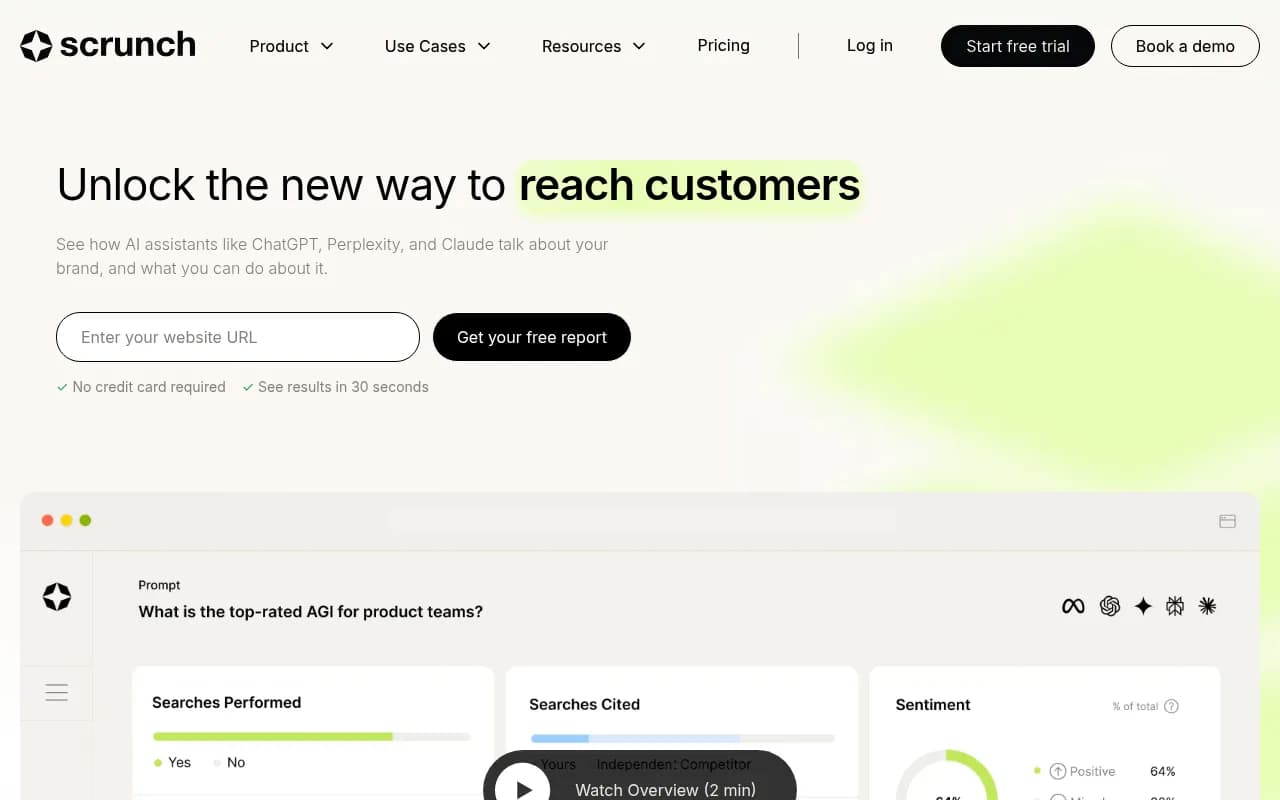
The standout data point is the Akamai case study: a 364% increase in brand presence for non-branded prompts after adoption. That's the kind of number that survives a procurement review, because it's specific and it's tied to a named customer rather than a vague "industry-leading" claim. Enterprise plans come with a forward-deployed engineer for onboarding and a dedicated account team, which matters more than it sounds like it should when you're rolling this out across multiple brands and regions. The catch: broader model coverage (Claude, Grok, Meta AI, DeepSeek) is reportedly gated to Enterprise on Scrunch too, so get the full engine list in writing before you sign anything at the lower Starter/Growth pricing.
AthenaHQ
AthenaHQ is the platform that quietly does the thing most competitors charge extra for: it gives you visibility across ChatGPT, Perplexity, AI Overviews, AI Mode, Gemini, Claude, Copilot, and Grok on both its Starter and Enterprise tiers, rather than gating models by price. Starter runs $295/month ($245 if billed annually) with 3,600 monthly credits, where one credit equals one AI response tracked.

Enterprise adds SAML/OIDC SSO, multi-country support, an Advanced Content Optimization Agent, a proprietary "Athena Citation Engine," a certified GEO/SEO specialist on your account, and BI integrations for Tableau, Power BI, and Looker. If your enterprise concern is less "we need nine-figure vendor stability" and more "we need broad model coverage without paying a surcharge per engine," AthenaHQ is worth a serious look before you commit to Profound-level spend.
Evertune
Evertune positions itself specifically for high-consideration categories: automotive, healthcare, B2B software, anywhere a purchase decision takes weeks or months and AI-assisted research plays a real role. Its Pro plan runs $800/month with 100,000 tracked prompts and 25 AI-optimized articles included, and it has a distinct feature most competitors skip: "Shopping Intelligence," which tracks how AI surfaces pricing, reviews, and product comparisons against competitors.
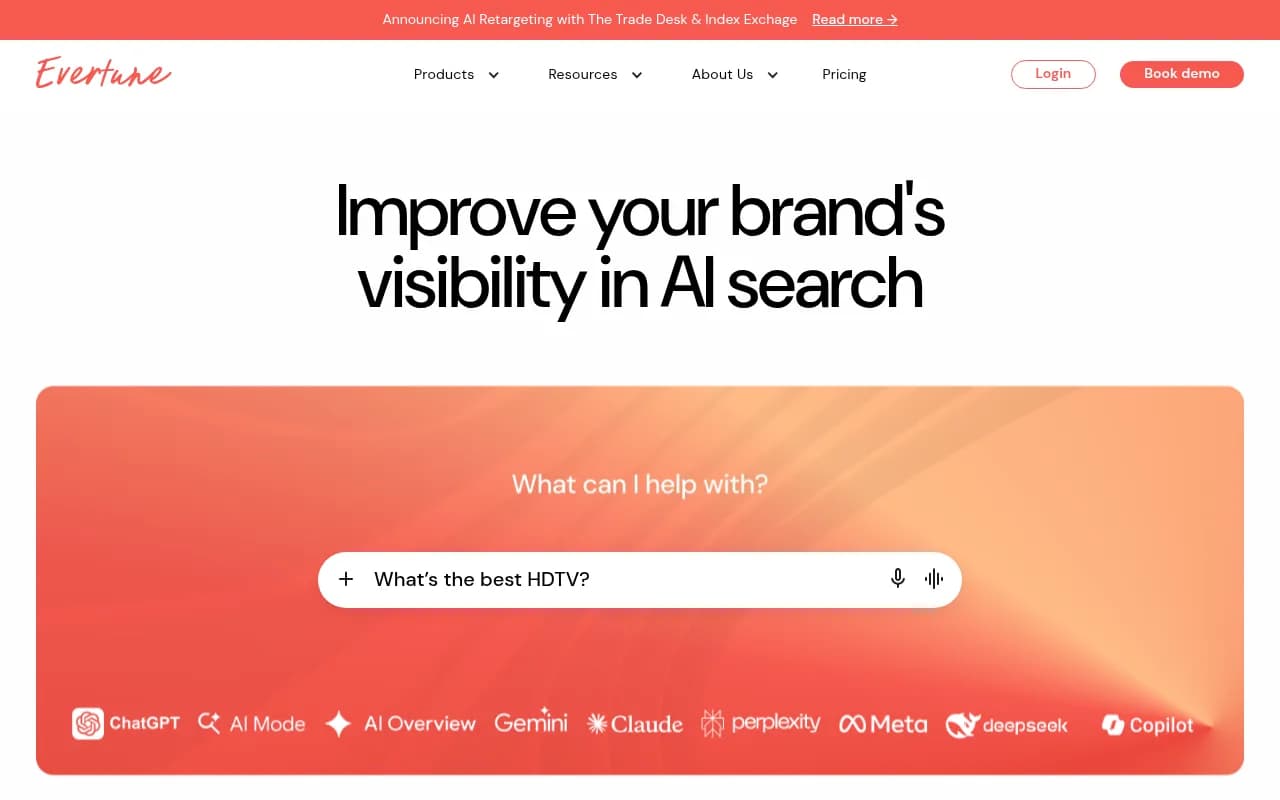
Evertune doesn't publish transparent Enterprise pricing or a detailed SSO/SOC 2 breakdown, which is common at this end of the market but worth flagging to your security team early rather than discovering it mid-contract negotiation.
Brandwatch and Ahrefs Brand Radar
Brandwatch is worth including for a specific reason: it's not AI-search native, and it says so implicitly by how it's positioned — broad social listening and consumer intelligence with AI mentions as one input among many. Third-party procurement data puts entry-level Brandwatch contracts around $36,000/year, with median deals closer to $50,000/year and large implementations exceeding $150,000. Documented outcomes include 23% quarter-over-quarter sales increases and an 85% reduction in reporting time for some customers, plus a Forrester "Strong Performer" rating. If your brand team already runs social listening through Brandwatch and just wants AI mentions folded into the same reporting cadence, this is a reasonable path. If AI visibility is your primary need, a purpose-built platform will get you deeper citation-level data for less money.
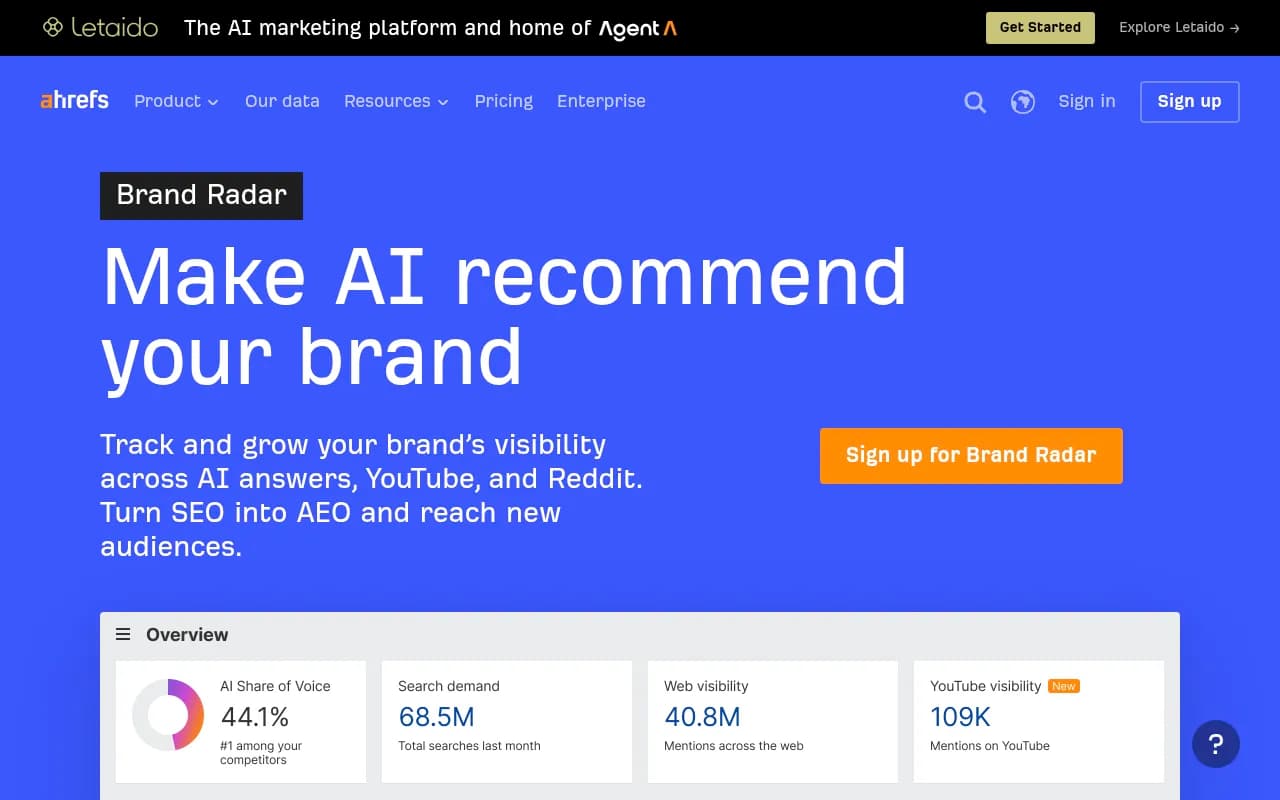
Ahrefs Brand Radar is the pragmatic choice for teams that already pay for Ahrefs. It's bundled into existing plans (Lite at $129/mo through Enterprise at $1,499/mo), and the Enterprise tier covers 10+ LLMs. The tradeoff is that Brand Radar is an add-on to a traditional SEO platform, not a purpose-built AI visibility product, so expect shallower prompt-volume and citation-type analysis than a dedicated tool.
Why single-platform monitoring is a trap
This is the mistake I see enterprise teams make most often: they pick one platform, point it at ChatGPT, and call the AI visibility project done. That's a problem for two reasons.
First, engines disagree with each other constantly. Citation behavior also isn't stable over time even within a single engine. After the GPT-5.3 rollout on March 4, 2026, average citations per ChatGPT response dropped roughly 27% across every model variant (GPT-5.3, GPT-5.4, GPT-5-Mini) at the same time, with no recovery a month later. Reddit's citation share on ChatGPT held steady around 3.8% from mid-July through early August 2026, then collapsed to under 1% within a single week on August 14 — an 86% relative drop — while Google AI Overviews and AI Mode only declined gradually over the same window. If you're monitoring one engine on a monthly snapshot, you'll miss shifts like this entirely, and you'll draw the wrong conclusions about whether your content strategy is working.
Second, ownership of the citation surface is more distributed than most brand teams assume. An analysis of 23,000 LLM citations found 48% came from earned media and only 23% from owned content — meaning a brand team that only optimizes its own website is missing more than three-quarters of what actually influences AI answers. That's a strong argument for platforms that track offsite mentions and third-party citations, not just your own domain's ranking.
On the crawler side, enterprise IT teams should also watch the mix shift happening at the infrastructure level. Meta-WebIndexer went from roughly 2% to nearly 38% of all tracked AI crawler requests between mid-July and August 9, 2026, and OpenAI's share of verified AI crawler traffic fell from 94.8% to 79.8% between early June and early September 2026. If your WAF rules or robots.txt were written with last year's crawler mix in mind, they're already out of date. Promptwatch's data on this shift is worth a look if your security team owns that decision (https://promptwatch.com/data/ai-crawler-traffic).
Monitoring versus doing something about it
The pattern across most vendors in this space, including some of the big names above, is that they're built to answer "are we visible?" A smaller number are built to answer "how do we get more visible, and can you just do it for us?" That distinction matters more at the enterprise level, where a marketing team of six can't manually rewrite 40 product pages every time a citation gap shows up.
This is where Promptwatch approaches the problem differently. Rather than stopping at a dashboard, it pairs crawler-level logs (showing exactly which AI bots hit your pages, what they read, and where they error out) with citation analytics across Reddit, YouTube, and third-party mentions, then closes the loop with Content Agents that plan, write, and publish GEO-optimized pages directly to your CMS on a schedule, plus a prioritized action list (Unified Actions) so your team knows what to fix first. It's used by 1,840+ brands and agencies including Duolingo, Yelp, and Rabobank, rated 4.7/5 on G2, and its dataset spans more than 4.5 billion citations, clicks, and prompts analyzed.

Crisp, one of its customers, saw 2x higher conversion rates from AI traffic compared with traditional channels after scaling to 5-10 published articles per day through the platform's content agents. That's the kind of outcome an enterprise buyer should be pressing every vendor for: not just "can you show me where I'm invisible" but "can you show me what you did about it, and what it was worth."
Common setup mistakes that waste enterprise budgets
- Tracking prompts that already contain your brand name. "Botric AI brand monitoring tool" will almost always return a mention and gives false confidence. Track natural buyer-intent phrasing instead — "how do I know if my brand appears in ChatGPT answers?" is the kind of prompt that actually tests visibility.
- Treating mention count as the whole story. A brand cited in every response but consistently framed as "the budget option" has a positioning problem that a raw mention-count dashboard will never surface.
- Running a one-time audit instead of continuous monitoring. Given how fast citation behavior moves (see the GPT-5.3 drop and the Reddit collapse above), a snapshot from three months ago tells you almost nothing about today.
- Not budgeting for per-model add-on costs. Several vendors advertise a low headline price and then charge extra per additional engine. Get the full model list and total cost in writing before comparing sticker prices across vendors.
How to actually choose
Start with your compliance non-negotiables, not your feature wishlist. If SOC 2 Type II has to exist today, not "on the roadmap," that alone narrows the field to Scrunch AI and Profound quickly. If your budget caps out well under $500/month but you still need broad model coverage, AthenaHQ's Starter tier is the better fit than chasing Profound's Enterprise pricing. If your category is high-consideration and AI shopping behavior matters, Evertune's Shopping Intelligence is a genuine differentiator worth the $800/month entry point.
Whatever you pick, insist on seeing the action layer, not just the dashboard. A platform that tells you exactly where you're losing citation share but can't help you fix it is half a product. For a broader look at the wider category of GEO software, the directory at bestgeosoftware.com is a useful next stop once you've narrowed your enterprise shortlist to two or three vendors.