Key takeaways
- Ahrefs is a full-stack SEO platform that added AI search monitoring; Meridian is built from the ground up for AI search optimization and does nothing else.
- Ahrefs pricing is transparent and starts at $29/mo. Meridian has no public pricing -- you need a demo call, which usually means enterprise-level costs.
- Ahrefs Brand Radar uses fixed prompts for AI tracking, which limits flexibility. Meridian tracks category-level AI visibility with custom prompts and sentiment scoring.
- Meridian pairs monitoring with hands-on expert execution (they call it "agent-powered"). Ahrefs is entirely self-serve -- you get the data, you do the work.
- If you need backlink analysis, keyword research, or site audits, Ahrefs wins by a mile. Meridian doesn't touch traditional SEO at all.
- For pure AI search visibility and optimization, Meridian is more focused -- but you're paying for a service, not just a tool.
Overview
Ahrefs

Ahrefs started as a backlink analysis tool and grew into one of the most widely used SEO platforms on the market. It's used by 44% of Fortune 500 companies, and for good reason -- the backlink index is genuinely massive, the keyword data is solid, and the site audit tool catches things competitors miss. In 2024-2025, Ahrefs started expanding into AI search monitoring with Brand Radar, plus content tools and social media management. It's now positioning itself as an "AI marketing platform," though its roots are firmly in traditional SEO.
The self-serve model is core to what Ahrefs is. You log in, pull your data, and figure out what to do with it. That works well for experienced SEOs and marketing teams who know how to act on the numbers.
Meridian
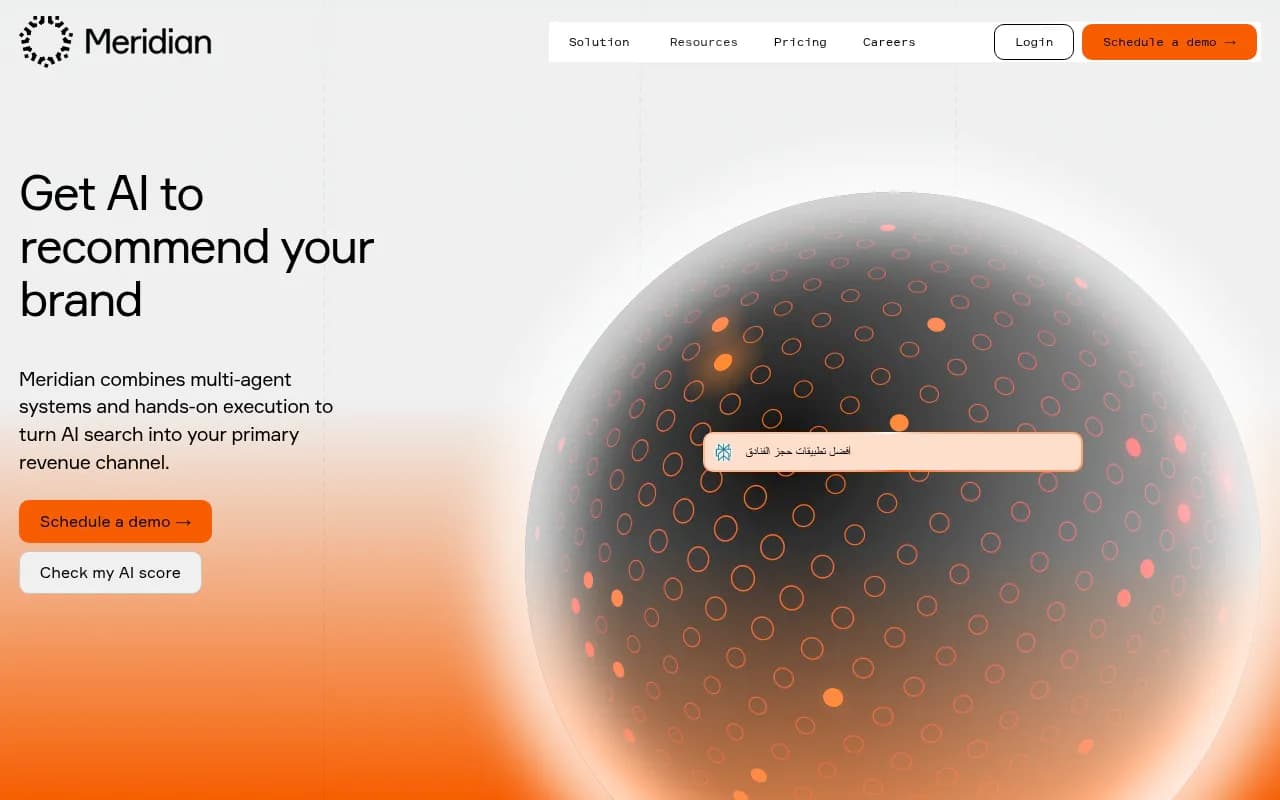
Meridian is a newer, narrower product. It's built specifically for AI search optimization -- tracking how brands appear across ChatGPT, Perplexity, Gemini, Google AI, Claude, Copilot, Grok, DeepSeek, and Meta AI. The pitch is "agentic AI + expert execution": Meridian doesn't just show you a dashboard, it pairs the monitoring data with hands-on work to actually improve your AI search visibility.
The positioning is interesting. Rather than selling you a SaaS tool and leaving you to it, Meridian operates more like a managed service with software underneath. That's a different model entirely from Ahrefs, and it means the comparison here is partly tool vs. tool and partly DIY vs. done-for-you.
Side-by-side comparison
| Feature | Ahrefs | Meridian |
|---|---|---|
| Primary focus | Full-stack SEO + AI search monitoring | AI search optimization only |
| AI models tracked | Limited (Brand Radar) | ChatGPT, Perplexity, Gemini, Claude, Copilot, Grok, DeepSeek, Meta AI, Google AI |
| Prompt customization | Fixed prompts | Custom category-level prompts |
| Sentiment tracking | No | Yes |
| Competitive benchmarking | Yes (traditional SEO) | Yes (AI search) |
| Traditional SEO tools | Full suite (backlinks, keywords, audit, rank tracking) | None |
| Content creation tools | Yes (AI writing, content explorer) | Not self-serve |
| Managed/expert execution | No (self-serve only) | Yes (core part of the offering) |
| Pricing transparency | Yes -- public tiers from $29/mo | No -- demo required |
| Free trial | Yes | No (demo only) |
| API access | Yes (Advanced/Enterprise) | Not publicly documented |
| Target user | SEO teams, marketers, agencies | Mid-market/enterprise brands focused on AI search |
Head-to-head feature deep-dive
AI search monitoring
This is where the comparison gets interesting, because both tools claim to track AI visibility -- but they do it very differently.
Ahrefs Brand Radar monitors how brands appear in AI-generated responses. The limitation is that it uses fixed prompts. You can't define your own queries or track category-specific questions the way your actual customers might ask them. It's a useful signal, but it's not deep enough to build an AI search strategy around.
Meridian tracks visibility at the category level with custom prompts, and adds sentiment scoring on top. So you're not just seeing whether you appear -- you're seeing how positively you're framed, where you rank among competitors, and how that changes over time. The demo UI shows visibility scores, sentiment percentages, and position rankings per query, which is more actionable than a simple mention count.
Verdict: Meridian wins on AI search depth. Ahrefs Brand Radar is a useful addition to an existing Ahrefs subscription, but it's not a replacement for a purpose-built AI visibility tool.
Traditional SEO capabilities
Ahrefs has one of the largest backlink indexes online. The keyword database covers billions of queries across 170+ countries. Site Audit crawls your site and flags technical issues. Rank Tracker monitors your Google positions. Content Explorer surfaces content ideas based on what's already performing. These are mature, well-tested tools that SEOs have relied on for years.
Meridian has none of this. It doesn't do backlink analysis, keyword research, or technical SEO audits. If you need those things -- and most marketing teams do -- Meridian can't replace Ahrefs.
Verdict: Ahrefs wins, and it's not close. Meridian isn't trying to compete here.
Content and optimization tools
Ahrefs has been building out content tools: an AI writing assistant, content gap analysis, and a content explorer that shows what's ranking and getting links. The quality is decent for an SEO-focused workflow, though it's not as deep as dedicated content platforms.
Meridian's approach to content optimization is wrapped into its managed service. The "agent-powered" execution means their team (and AI agents) work on improving your AI search presence, which presumably includes content changes -- but you're not getting a self-serve content editor or gap analysis tool you can run yourself.
Verdict: Depends on what you want. Ahrefs gives you tools to do the work yourself. Meridian does the work for you, but you have less control and visibility into the process.
Competitive analysis
Ahrefs has deep competitive intelligence for traditional search: see any competitor's backlinks, top pages, keyword rankings, and traffic estimates. It's one of the best tools for understanding why a competitor ranks.
Meridian does competitive benchmarking specifically for AI search -- showing how your brand's visibility, sentiment, and position compare to competitors across AI models. That's genuinely useful data that Ahrefs doesn't provide at the same depth.
Verdict: Split. Ahrefs for traditional SEO competitive analysis; Meridian for AI search competitive benchmarking.
Ease of use and onboarding
Ahrefs has a learning curve. The platform is large, the data is dense, and new users often feel overwhelmed. That said, the documentation is excellent, there's a good YouTube channel, and the interface has improved over the years.
Meridian requires a demo call to even get started. There's no self-serve trial, no public pricing, and limited documentation visible from the outside. That's a higher barrier to entry, but it also means you get a human guiding you through setup -- which some teams prefer.
Verdict: Ahrefs is more accessible for individuals and small teams. Meridian's onboarding is more hand-held but also more opaque.
Reporting and integrations
Ahrefs has a solid reporting suite, API access on higher plans, and integrations with Google Search Console and other tools. The data export options are flexible.
Meridian's integrations aren't publicly documented. Given the managed-service model, reporting likely comes through regular check-ins and dashboards rather than raw data exports.
Verdict: Ahrefs wins on transparency and data portability.
Pricing comparison
| Plan | Ahrefs | Meridian |
|---|---|---|
| Entry-level | $29/mo (Starter -- very limited) | Not available |
| Lite/Basic | $83/mo | Not available |
| Standard/Mid | $166/mo | Demo required |
| Advanced/Pro | $333/mo | Demo required |
| Enterprise | Custom pricing | Custom pricing |
| Free trial | Yes | No |
| Annual discount | 20% | Unknown |
Ahrefs pricing is transparent and scales with usage (crawl credits, keywords tracked, users). The $29/mo Starter plan is quite limited -- it's more of a taste than a full product. Most teams end up on Lite ($83/mo) or Standard ($166/mo).
Meridian's pricing opacity is a real friction point. "Schedule a demo" pricing almost always means the cost is higher than most self-serve tools, and it's harder to evaluate ROI before committing. If you're a small business or solo marketer, that alone might rule it out.
If you're evaluating AI search visibility tools and want transparent pricing with a self-serve trial, it's worth looking at Promptwatch -- it covers AI monitoring across 10 models with clear plans starting at $99/mo, and includes content gap analysis and AI writing tools that neither Ahrefs nor Meridian fully replicate.

Pros and cons
Ahrefs
Pros:
- Best-in-class backlink index and keyword database
- Transparent, scalable pricing with a free trial
- Full SEO toolkit in one platform (audit, rank tracking, content, PPC)
- Trusted by Fortune 500 companies with years of track record
- Good documentation and learning resources
Cons:
- Brand Radar (AI search) uses fixed prompts -- limited flexibility
- No sentiment tracking for AI search responses
- No managed execution -- you're on your own with the data
- Can feel expensive for smaller teams, especially as usage scales
- AI search features feel bolted on rather than native
Meridian
Pros:
- Purpose-built for AI search optimization
- Tracks sentiment, visibility scores, and position across major AI models
- Combines monitoring with expert-led execution
- Custom prompt tracking at the category level
- Multi-language support visible in demo (Japanese example on homepage)
Cons:
- No public pricing -- demo required creates friction
- No traditional SEO tools whatsoever
- Limited transparency into methodology and data sources
- No self-serve trial to evaluate before committing
- Newer product with less track record than Ahrefs
Who should pick which tool
Choose Ahrefs if:
- You need a full SEO platform covering backlinks, keywords, technical audits, and rank tracking
- You're an SEO professional or agency managing multiple clients
- You want transparent pricing and a self-serve workflow
- AI search monitoring is a "nice to have" rather than your primary focus
- You're on a budget and need to consolidate tools
Choose Meridian if:
- AI search visibility is your primary concern and you want depth over breadth
- You want expert-led execution, not just a dashboard to stare at
- You're a mid-market or enterprise brand with budget for a managed service
- Sentiment tracking and category-level AI visibility scoring matter to you
- You already have an SEO tool and are looking specifically for AI search coverage
Consider neither if:
- You want AI search monitoring with transparent pricing, content gap analysis, and self-serve optimization tools -- in that case, a dedicated GEO platform like Promptwatch covers more of the AI search stack than either of these options.
Final verdict
Ahrefs and Meridian are solving different problems, which makes this less of a head-to-head fight and more of a "what do you actually need?" question.
Ahrefs is the better all-around SEO tool. If you're doing traditional search marketing and want AI monitoring as part of a broader toolkit, Ahrefs makes sense. The Brand Radar feature is a reasonable starting point, even if it's not the deepest AI visibility product on the market.
Meridian is the better choice if AI search optimization is your primary focus and you want someone to do the work alongside you. The managed-service model is genuinely different from what Ahrefs offers -- but the lack of pricing transparency and no self-serve trial makes it hard to recommend without a direct conversation first.
For most marketing teams, Ahrefs is the safer, more flexible bet. For brands that have decided AI search is their main growth channel and want expert help executing on it, Meridian is worth the demo call.