Key takeaways
- Bear AI starts at $199/mo with transparent, public pricing. Airefs doesn't publish pricing at all -- you need to sign up or book a call to find out what you'll pay.
- Bear AI explicitly targets revenue conversion from AI traffic (lead gen, high-intent visitor identification). Airefs is more focused on content strategy and becoming the "default recommended brand."
- Airefs offers a 7-day free trial. Bear AI does not advertise a free trial, making it harder to evaluate before committing.
- Airefs has a dedicated agency mode and positions itself for teams that want to influence AI answers through off-site content (Reddit, LinkedIn, G2, YouTube). Bear AI is more dashboard-centric.
- Both tools are early-stage products with limited customer bases -- Bear AI lists a handful of startup customers (Peerspace, Wispr Flow, Groww), while Airefs claims 100+ teams.
- Neither tool matches the depth of more mature GEO platforms in terms of model coverage, citation data, or crawler-level insights.
Overview
Bear AI
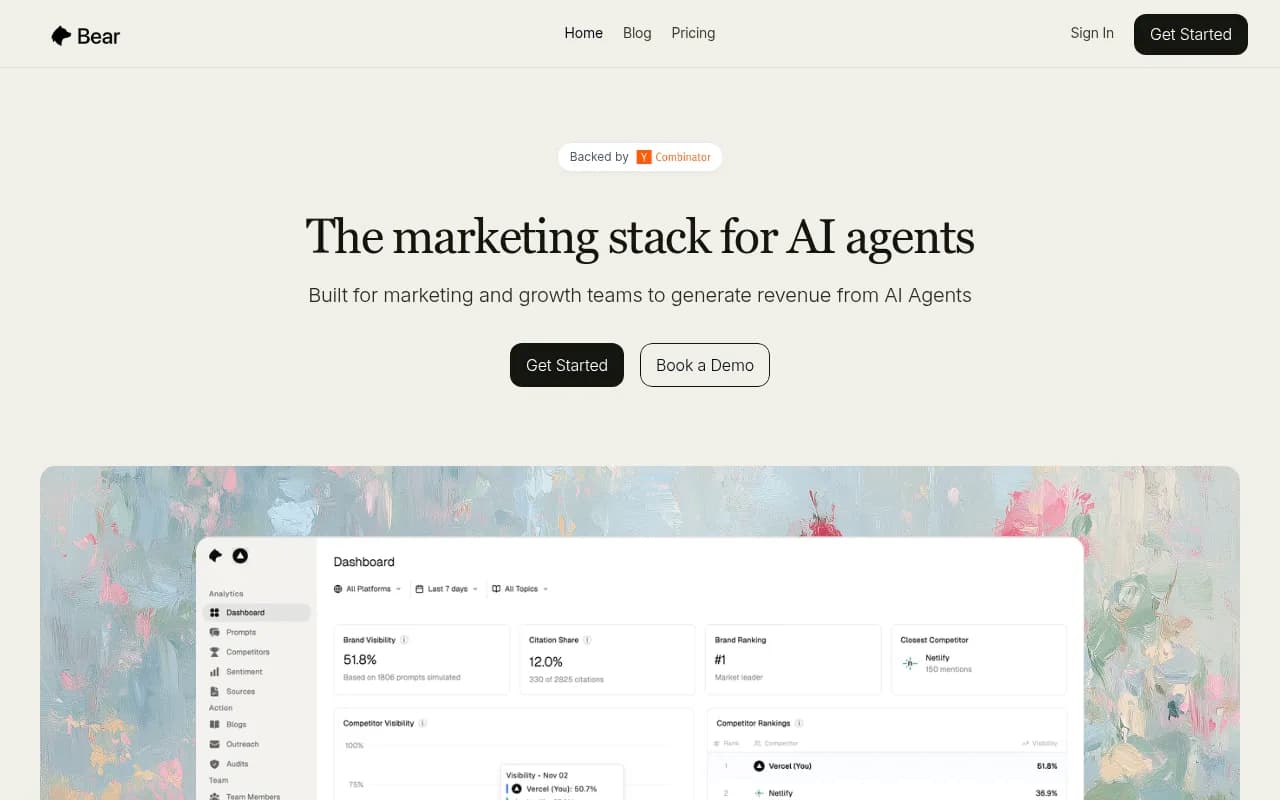
Bear AI bills itself as "the marketing stack for AI agents" -- a platform built to help marketing and growth teams generate revenue from AI-driven traffic. The core pitch is that AI models like ChatGPT, Claude, and Gemini are already sending visitors to your site, and most companies have no idea it's happening. Bear AI tracks which prompts surface your brand, identifies high-intent visitors arriving from AI sources, and provides tools to convert that traffic into leads.
It's backed by Y Combinator, which gives it some credibility as an early-stage startup. Customers include Peerspace, Wispr Flow, and Groww -- a mix of SaaS and marketplace companies. The product is clearly aimed at growth-oriented teams who want to close the loop between AI visibility and actual revenue.
Airefs
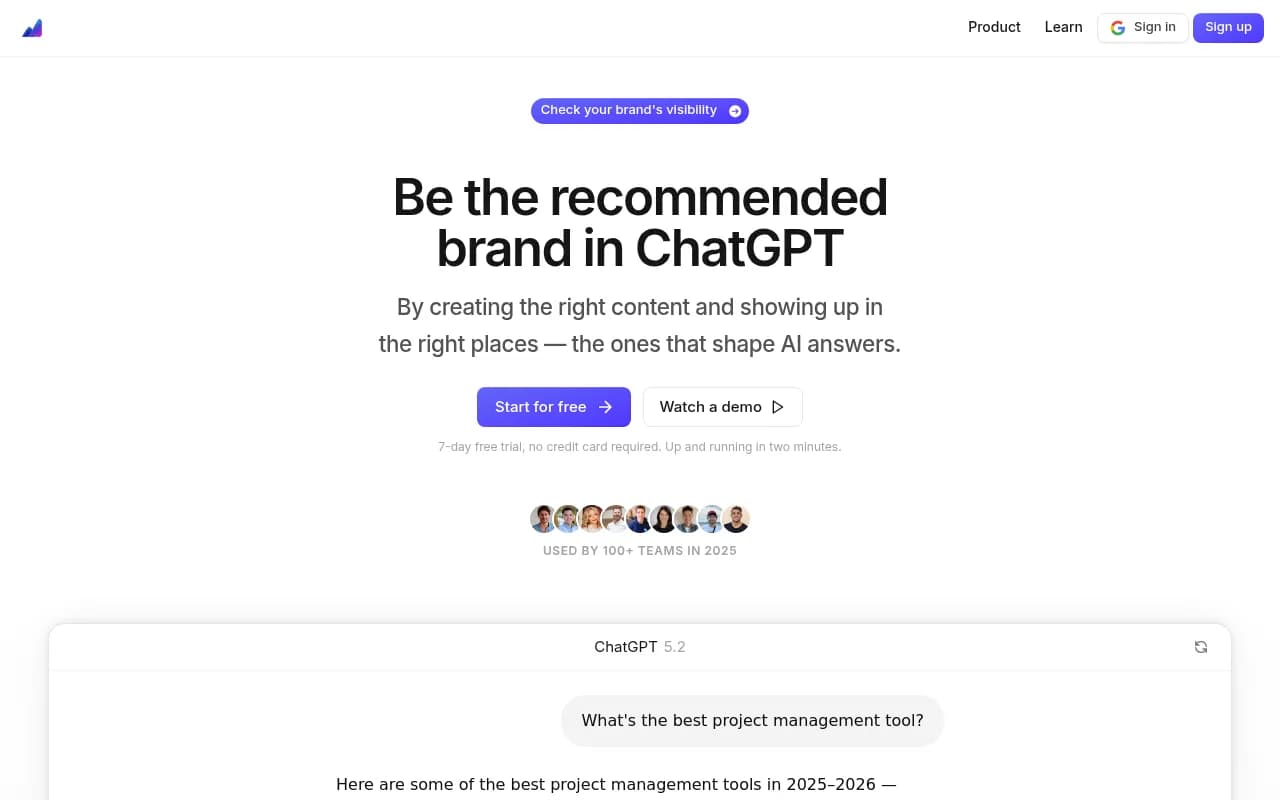
Airefs takes a slightly different angle. The tagline -- "be the recommended brand in ChatGPT" -- signals that the goal isn't just monitoring, it's influence. Airefs tracks where your brand appears in AI answers, but it also helps you figure out what content to create and where to publish it (LinkedIn, Reddit, G2, YouTube) to shape those answers over time.
The product has a dedicated agency mode, suggesting it's been designed with consultants and agencies in mind alongside in-house teams. It claims 100+ teams as users, which is modest but not nothing for a tool at this stage. The 7-day free trial is a meaningful differentiator -- you can actually test it before paying.
Side-by-side comparison
| Feature | Bear AI | Airefs |
|---|---|---|
| Starting price | $199/mo | Not publicly listed |
| Free trial | No | 7-day free trial |
| AI models tracked | Up to 6+ (Enterprise) | ChatGPT, Perplexity (primary) |
| Prompt tracking | 75 (Basic) to unlimited (Enterprise) | Not specified |
| Content generation | 2 blogs/mo (Basic) | Content strategy guidance |
| Off-site content guidance | Limited | Yes (Reddit, LinkedIn, G2, YouTube) |
| Lead generation tools | Yes (Enterprise) | No |
| High-intent visitor ID | Yes | No |
| Agency mode | No | Yes |
| Competitor tracking | Yes | Yes |
| Pricing transparency | Full public pricing | No public pricing |
| YC-backed | Yes | No |
| Customer base | Small (startup logos) | 100+ teams |
Head-to-head feature deep-dive
Prompt tracking and visibility monitoring
Bear AI tracks branded and category prompts across multiple AI models and shows you when and how your brand gets mentioned. The Basic plan covers 75 prompts across 2 AI models -- which is tight if you're in a competitive category with lots of relevant queries. The Enterprise plan removes those limits and adds more models.
Airefs tracks visibility in AI answers with a focus on ChatGPT and Perplexity. It shows mention rates, citation rates, and how those change over time. The interface appears cleaner and more focused, but the model coverage is narrower.
Verdict: Bear AI wins on model breadth at higher tiers. Airefs wins on simplicity and accessibility (free trial).
Content strategy and creation
Bear AI includes blog generation -- 2 posts per month on Basic, more on higher plans. This is a practical feature, but it's not clear how deeply these blogs are grounded in actual citation data or prompt intelligence.
Airefs takes a more opinionated approach. Rather than just generating content for your own site, it identifies the off-site channels that actually influence AI answers -- Reddit threads, LinkedIn posts, G2 reviews, YouTube videos. This is genuinely useful insight. AI models don't just cite company websites; they pull from third-party sources, and Airefs seems to understand that better than most tools at this price point.
Verdict: Airefs has a more sophisticated content strategy angle. Bear AI's blog generation is convenient but less strategic.
Revenue and conversion tools
This is where Bear AI has a clear differentiator. It identifies high-intent visitors arriving from AI sources and provides lead generation tools (on Enterprise) to convert them. If your goal is to connect AI visibility to pipeline, Bear AI is the only one of these two that even tries to close that loop.
Airefs doesn't appear to offer any conversion or lead gen functionality. It's a visibility and content strategy tool, full stop.
Verdict: Bear AI wins decisively here. If revenue attribution matters to you, Airefs doesn't compete.
Competitor analysis
Both tools offer competitor tracking -- you can see how your brand stacks up against competitors in AI answers. Neither appears to offer the depth of heatmap-style competitor comparisons or prompt-level breakdowns that more mature platforms provide, but for basic competitive benchmarking, both cover the basics.
Verdict: Roughly even at this level of the market.
Agency and multi-brand support
Airefs has a dedicated agency mode, which suggests it supports managing multiple clients or brands from a single account. Bear AI's Enterprise plan supports unlimited prompts and more models but doesn't specifically call out agency workflows.
Verdict: Airefs is the better fit for agencies. Bear AI is more suited to in-house teams.
Pricing and transparency
| Plan | Bear AI | Airefs |
|---|---|---|
| Free tier | No | 7-day trial |
| Entry plan | $199/mo (75 prompts, 2 blogs, 2 models) | Not listed |
| Mid tier | Not specified | Not listed |
| Enterprise | Custom (unlimited prompts, 6+ models, lead gen) | Not listed |
Bear AI's pricing is refreshingly transparent. You know exactly what you're getting at $199/mo and can make an informed decision. Airefs hiding its pricing is a real friction point -- it forces you into a sales conversation before you can even evaluate fit. That said, the 7-day free trial partially compensates for this.
Verdict: Bear AI wins on transparency. Airefs wins on trial access.
Ease of getting started
Airefs claims "up and running in 2 minutes" with its free trial. That's a low-friction entry point. Bear AI requires signing up or booking a demo, which adds a step.
Verdict: Airefs is easier to start with.
Pros and cons
Bear AI
Pros:
- Transparent, public pricing -- no guessing games
- Revenue-focused: lead gen and high-intent visitor identification at Enterprise
- YC backing gives some confidence in the team
- Covers 6+ AI models at Enterprise tier
- Tracks prompt-level visibility with trend data
Cons:
- No free trial -- harder to evaluate before buying
- Basic plan is limited (75 prompts, 2 models, 2 blogs)
- Small customer base -- still early in proving itself
- No off-site content strategy guidance
- Agency workflows not explicitly supported
Airefs
Pros:
- 7-day free trial, no credit card friction
- Smart off-site content strategy (Reddit, LinkedIn, G2, YouTube)
- Dedicated agency mode
- Clean, focused interface
- 100+ teams using it -- slightly more traction
Cons:
- No public pricing -- you have to sign up to find out costs
- Narrower AI model coverage (primarily ChatGPT and Perplexity)
- No revenue or lead generation tools
- Prompt volume limits not disclosed
- Less depth on the conversion side
Who should pick which tool
Pick Bear AI if:
- You want to connect AI visibility directly to revenue and leads
- You need transparent pricing before committing
- You're on a growth or demand gen team that cares about pipeline, not just rankings
- You want to track 6+ AI models at Enterprise scale
Pick Airefs if:
- You want to test a tool before paying (the free trial matters to you)
- You're an agency managing multiple clients
- You care about off-site content strategy -- where to publish, not just what to write
- You're primarily focused on ChatGPT and Perplexity
A note on the broader landscape
Both Bear AI and Airefs are early-stage tools solving a real problem, but neither has the scale or feature depth of more established GEO platforms. If you're a larger brand or agency that needs multi-model monitoring across 10+ AI engines, crawler-level insights, prompt volume data, and content generation grounded in 880M+ citations, it's worth looking at Promptwatch -- it covers the full loop from gap analysis to content creation to traffic attribution in a way neither of these tools currently does.

Final verdict
Bear AI and Airefs are solving the same core problem -- AI search visibility -- but from different angles. Bear AI is the better choice if revenue attribution and conversion matter to you, and you want to know upfront what you'll pay. Airefs is the better starting point if you want to test before buying and care about off-site content strategy.
Neither is a mature, full-featured platform yet. Bear AI has the more complete revenue story; Airefs has the smarter content angle. Your choice comes down to whether you're optimizing for pipeline (Bear AI) or presence (Airefs).