Key takeaways
- Bear AI starts at $199/month vs AthenaHQ's $295/month -- a meaningful gap if budget is tight, though AthenaHQ offers a $95 first-month trial price.
- Bear AI's defining angle is revenue conversion: it identifies high-intent visitors coming from AI sources and includes lead gen tools. AthenaHQ doesn't do this at all.
- AthenaHQ covers 8+ LLMs on self-serve; Bear AI's Basic plan only tracks 2 models, with broader coverage locked behind Enterprise pricing.
- AthenaHQ has a stronger enterprise client list (Coinbase, ZoomInfo, SoFi) and more mature executive reporting. Bear AI is earlier-stage and backed by Y Combinator.
- Neither tool is a full optimization platform -- both lean heavily on monitoring and recommendations rather than actually generating content that ranks in AI. If that gap matters to you, it's worth knowing.
- Bear AI is the better fit for growth teams that want to monetize AI traffic. AthenaHQ suits GEO/SEO managers who need a structured command center for tracking and strategy.
Overview
Bear AI
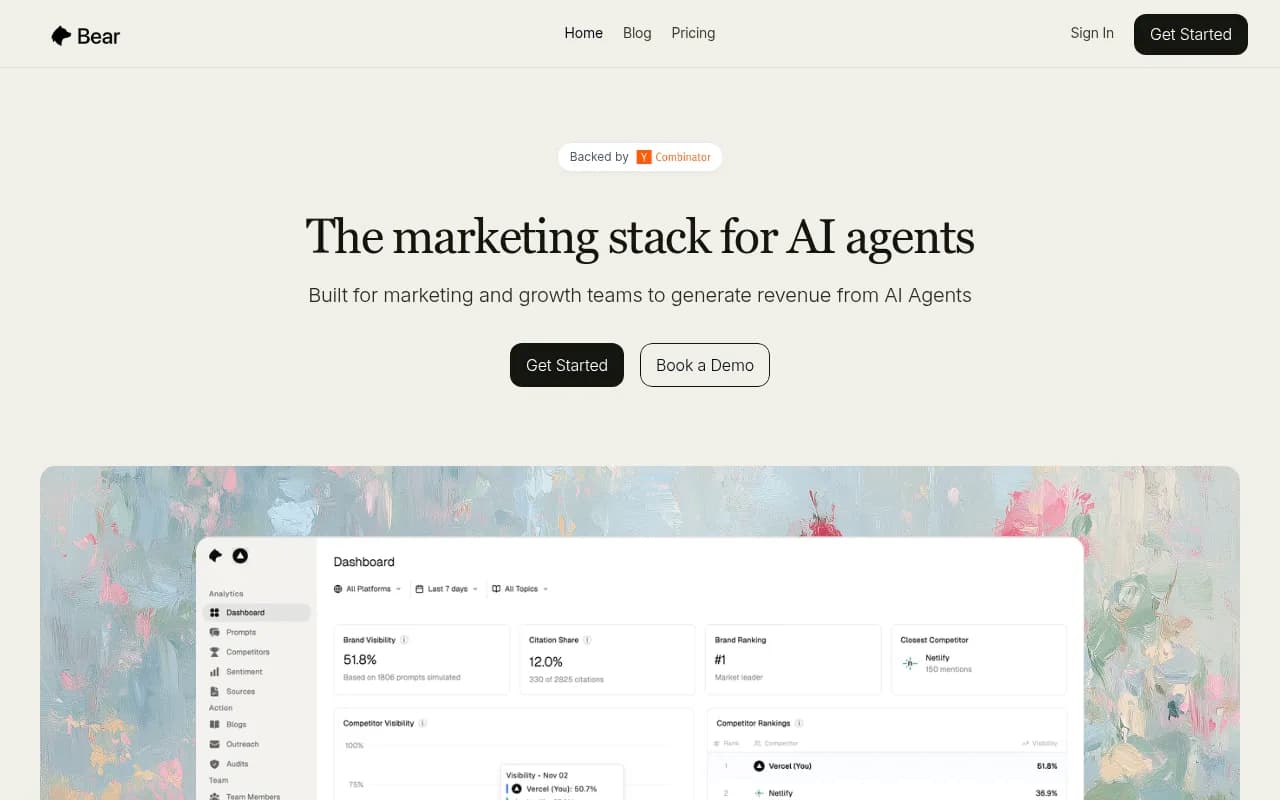
Bear AI pitches itself as "the marketing stack for AI agents" -- which is a deliberately revenue-first framing. Where most GEO tools ask "how visible are you?", Bear AI asks "what are you doing with that visibility?" It tracks how AI models like ChatGPT, Claude, Gemini, and Perplexity discover and recommend your brand, then goes a step further by identifying the actual visitors arriving from those AI sources and giving you tools to convert them. It's backed by Y Combinator and trusted by companies like Peerspace, Groww, and Wispr Flow. The product is relatively young but moving fast.
AthenaHQ

AthenaHQ positions itself as an end-to-end AEO (Answer Engine Optimization) and GEO platform. The focus is on helping marketing, SEO, and content teams understand and improve how their brand appears across AI search engines. It's been featured in Forbes and the Wall Street Journal, and its client list -- Coinbase, ZoomInfo, SoFi, PagerDuty -- signals a clear enterprise orientation. The platform provides a unified command center for GEO workflow management, citation source analysis, and executive-level visibility dashboards. Like Bear AI, it's also Y Combinator-backed.
Side-by-side comparison
| Feature | Bear AI | AthenaHQ |
|---|---|---|
| Starting price | $199/month | $295/month ($95 first month) |
| Free tier | No | No (free audit available) |
| AI models tracked (entry plan) | 2 | 8+ |
| Prompt tracking (entry plan) | 75 prompts | Credit-based (varies) |
| Content generation | Yes (2 blogs/month on Basic) | No (recommendations only) |
| Lead generation / visitor ID | Yes | No |
| Citation source analysis | Yes | Yes |
| Executive dashboards | Limited | Yes |
| Competitor tracking | Yes | Yes |
| AI crawler logs | Not confirmed | Not confirmed |
| Reddit / YouTube tracking | Not confirmed | Not confirmed |
| Annual billing discount | Not confirmed | Yes (~17%) |
| Enterprise plan | Yes (custom) | Yes (custom) |
| Notable clients | Peerspace, Groww, Wispr Flow | Coinbase, ZoomInfo, SoFi |
| Backed by | Y Combinator | Y Combinator |
Head-to-head feature deep-dive
AI model coverage
Bear AI's Basic plan tracks ChatGPT, Claude, Google AI Overviews, and Perplexity -- but only 2 models are included at the $199/month tier. To get 6+ models, you need Enterprise pricing, which means a sales conversation and an unknown cost. That's a real limitation if you want broad coverage without committing to enterprise.
AthenaHQ tracks 8+ LLMs on its self-serve plan. That's a meaningful advantage for teams who want to see the full picture across ChatGPT, Perplexity, Gemini, Claude, and others without having to upgrade.
Verdict: AthenaHQ wins on model breadth at the self-serve level.
Revenue and conversion tools
This is where Bear AI genuinely differentiates itself. The platform identifies visitors arriving from AI sources -- so you can see not just that ChatGPT mentioned you, but that a specific user clicked through and landed on your site. From there, Bear AI provides tools to convert that traffic into leads. No other tool in this comparison does this.
AthenaHQ doesn't have visitor identification or lead generation features. It's focused on the monitoring and strategy side, not the bottom-of-funnel conversion layer.
Verdict: Bear AI wins clearly. If revenue attribution from AI traffic is your goal, AthenaHQ can't match it.
Content generation and optimization
Bear AI includes blog generation -- 2 posts per month on the Basic plan. It's a modest allowance, but it's something. The blogs are presumably informed by the prompt and visibility data the platform collects, which gives them more relevance than generic AI-written content.
AthenaHQ provides "automated content optimization recommendations" -- meaning it tells you what to fix or create, but doesn't write it for you. That's useful for teams with writers, less useful for lean teams that need output.
Worth noting: if content generation for AI search is a serious priority, tools like Promptwatch go much deeper here -- generating articles grounded in 880M+ citation data points, with prompt volume scoring and competitor gap analysis built in.

Verdict: Bear AI has a slight edge for teams that want some content output. Neither tool is a content powerhouse.
Monitoring and prompt tracking
Bear AI's Basic plan includes 75 prompts. That's a reasonable starting point for a focused brand or product. The platform shows trending prompts, how AI agents talk about you, and where you appear in recommendations.
AthenaHQ uses a credit-based model where 1 credit equals 1 AI query. This gives more flexibility -- you can run more queries on high-priority prompts and fewer on lower-priority ones. The platform also provides a "GEO workflow management" command center that structures the monitoring process, which is helpful for teams running systematic optimization programs.
Verdict: AthenaHQ's credit model is more flexible. Bear AI's fixed prompt count is simpler but less adaptable.
Enterprise and team features
AthenaHQ has clearly invested in enterprise readiness. It has executive dashboards for CMO-level reporting, ROI tracking for AI optimization efforts, and a unified command center designed for AEO/GEO managers running organization-wide programs. The client list (Coinbase, ZoomInfo, SoFi, PagerDuty) backs this up -- these are companies with real compliance, reporting, and scale requirements.
Bear AI has enterprise pricing but is earlier in its enterprise journey. The product is more growth-team oriented than enterprise-team oriented. That's not a criticism -- it's just a different target.
Verdict: AthenaHQ is the stronger enterprise choice. Bear AI fits growth and marketing teams at scaling startups.
Citation and competitor analysis
Both platforms offer citation source analysis -- showing which pages, sources, and domains AI models reference when they mention your brand or competitors. Both also provide competitor visibility tracking so you can benchmark your AI presence against rivals.
AthenaHQ's citation analysis is described as a core feature with link building implications, suggesting it goes into some depth about which sources to target. Bear AI's competitor tracking shows how AI agents compare your brand to others, which is useful for positioning.
Verdict: Roughly even. Both cover the basics; AthenaHQ may go slightly deeper on citation strategy.
Pricing comparison
| Plan | Bear AI | AthenaHQ |
|---|---|---|
| Entry / self-serve | $199/month (75 prompts, 2 blogs, 2 AI models) | $295/month ($95 first month, credit-based, 8+ LLMs) |
| Annual discount | Not confirmed | ~17% |
| Enterprise | Custom (unlimited prompts, lead gen, 6+ models) | Custom |
| Free trial | Not confirmed | Free audit (10 min) |
Bear AI is cheaper at the entry level by $96/month. But AthenaHQ's $95 first-month offer effectively makes the first month a low-risk trial. Over a full year, Bear AI at $199/month comes to $2,388 vs AthenaHQ at $295/month ($245 with annual discount) coming to roughly $2,940 -- a difference of about $550/year. Not enormous, but real.
The bigger pricing consideration is what you get for the money. Bear AI's $199 plan only covers 2 AI models. If you need broader coverage, you're looking at Enterprise pricing on Bear AI, which could easily exceed AthenaHQ's self-serve rate.
Pros and cons
Bear AI
Pros:
- Lowest entry price in this comparison at $199/month
- Unique revenue conversion angle -- visitor identification and lead gen from AI traffic
- Blog content generation included (modest but useful)
- Y Combinator backing signals credibility for an early-stage product
- Clear focus on growth teams who want to monetize AI visibility, not just measure it
Cons:
- Only 2 AI models on the Basic plan -- very limited for broad monitoring
- Enterprise required for 6+ models, which means unknown pricing
- Younger product with a smaller client base than AthenaHQ
- No confirmed AI crawler logs or Reddit/YouTube tracking
- Executive reporting is limited compared to AthenaHQ
AthenaHQ
Pros:
- 8+ LLMs tracked on self-serve -- best model coverage at this price tier
- Strong enterprise client list (Coinbase, ZoomInfo, SoFi, PagerDuty)
- Structured GEO command center for systematic optimization programs
- Executive dashboards with ROI tracking
- Featured in Forbes and WSJ -- more established brand in the GEO space
- Annual billing discount (~17%) available
- Free audit to get started without commitment
Cons:
- Higher entry price at $295/month
- No visitor identification or lead generation tools
- No content generation -- recommendations only
- Credit-based model can be harder to predict for budgeting
- Monitoring-focused; doesn't help you act on what you find
Who should pick which tool
Pick Bear AI if:
- You want to connect AI visibility directly to revenue and leads
- Your team is focused on growth and conversion, not just monitoring
- You're a startup or scaling company with a lean marketing team
- Budget is a constraint and you're comfortable starting with 2 AI models
- You want some content output (blogs) included in your plan
Pick AthenaHQ if:
- You need to track 8+ LLMs from day one without enterprise pricing
- You're running a structured GEO program and need a command center
- You're reporting to executives and need dashboards with ROI framing
- You're at an enterprise or mid-market company with real compliance needs
- You want a more established platform with a proven enterprise client base
Final verdict
These two tools are closer in concept than they are in execution. Both track AI visibility, both analyze citations, both show you how competitors appear in AI search. But they diverge sharply on what happens next.
Bear AI bets that the most valuable thing you can do with AI visibility data is convert it into revenue -- and it builds its product around that bet. AthenaHQ bets that the most valuable thing is running a disciplined, organization-wide GEO program -- and its product reflects that.
If you're a growth team at a startup that wants to know which AI-referred visitors to chase, Bear AI is the more interesting choice. If you're a GEO manager at a mid-market or enterprise company who needs to report upward and run a systematic optimization program, AthenaHQ is the more mature platform.
Neither tool is a complete solution for teams that want to both monitor and actively fix their AI visibility gaps -- that's a different category of platform entirely.