Key takeaways
- Profound publishes pricing (Lite from ~$499/mo); Meridian requires a demo call with no public tiers -- making Profound much easier to evaluate before committing.
- Meridian is built around a managed execution model: their team works alongside the AI agents to drive results. Profound is a self-serve SaaS platform where your team runs the workflows.
- Profound has explicit SOC 2 compliance and named enterprise customers (MongoDB, Ramp, Mercury). Meridian's customer base isn't publicly listed, which makes it harder to benchmark.
- Profound's Agent Analytics feature tracks AI crawler behavior on your site. Meridian doesn't appear to offer this -- a meaningful gap if you care about how AI bots are actually indexing your content.
- Both tools include some form of content generation, but Profound's is a self-serve agent workflow (AEO FAQ generator, content agents). Meridian's execution support appears to be more hands-on/managed.
- Neither tool offers a free trial. Both require a sales conversation to get started.
Overview
Meridian
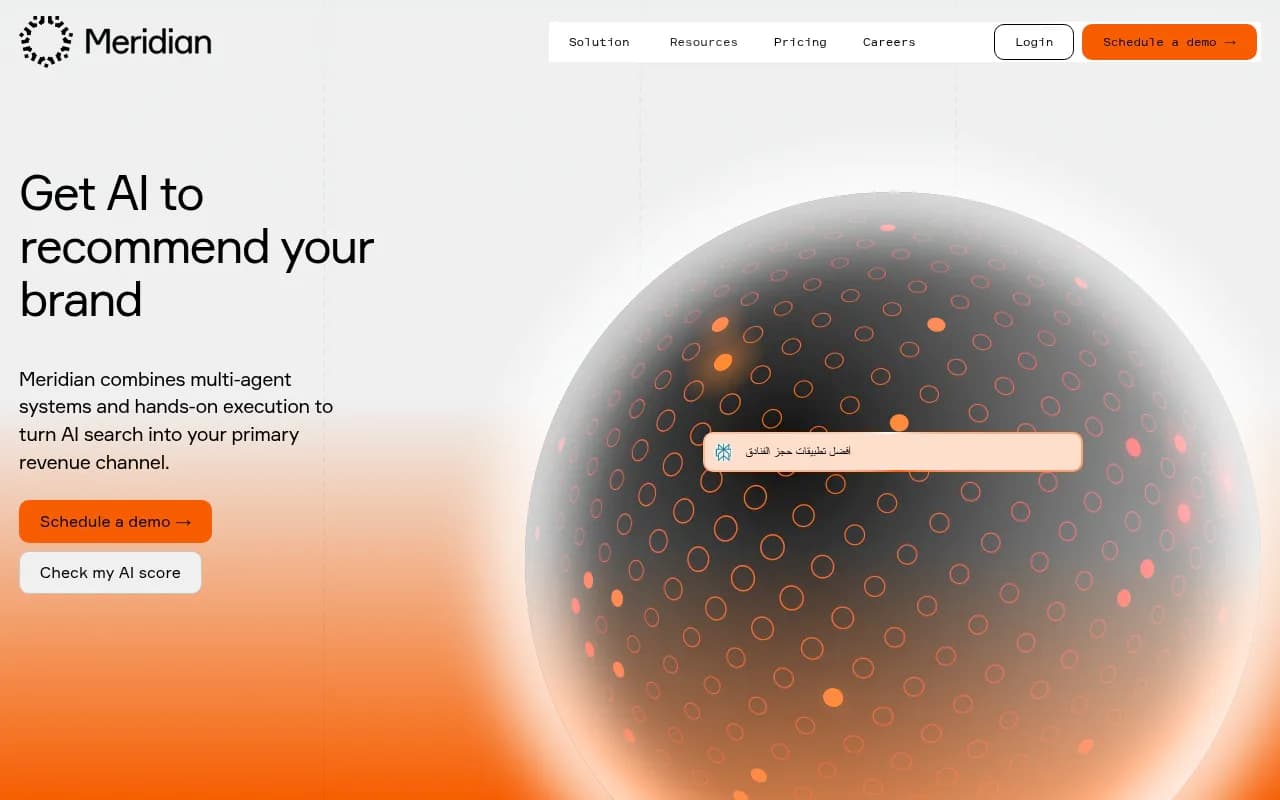
Meridian describes itself as an "agentic AI platform for AI search optimization" -- but the more accurate framing is that it's a growth partner that combines AI tooling with hands-on execution. The pitch is that their team uses multi-agent systems to actively manage your AI search presence, not just report on it. They track visibility scores, sentiment, citations, and competitive positioning across ChatGPT, Perplexity, Gemini, Google AI, Grok, Copilot, Meta AI, DeepSeek, and Claude. The demo-first, no-public-pricing model signals that this is positioned as a premium managed service rather than a self-serve SaaS subscription.
Profound
Profound

Profound is a full-stack Answer Engine Optimization (AEO) platform aimed squarely at enterprise marketing teams. It covers monitoring (Answer Engine Insights), AI crawler tracking (Agent Analytics), prompt volume research, shopping visibility, and content creation via AI agents. Customers like MongoDB, Ramp, and Mercury use it. Profound has SOC 2 compliance, a published pricing page, a developer API, and a growing ecosystem of integrations and agency partners. It's the more structured, enterprise-SaaS option of the two.
Side-by-side comparison
| Feature | Meridian | Profound |
|---|---|---|
| Pricing model | Custom, demo required | Lite ~$499/mo, Advanced ~$449/mo, Enterprise custom |
| Free trial | No | No |
| AI models tracked | 9+ (ChatGPT, Perplexity, Gemini, Claude, Grok, Copilot, Meta AI, DeepSeek, Google AI) | 9+ (same set) |
| Visibility monitoring | Yes | Yes |
| Sentiment tracking | Yes | Yes (brand sentiment in AI responses) |
| Competitive benchmarking | Yes | Yes |
| Prompt volume data | Not confirmed | Yes (named feature) |
| AI crawler / agent analytics | Not confirmed | Yes (named feature) |
| Content generation agents | Managed execution (team-assisted) | Self-serve AI agents (FAQ generator, content workflows) |
| Shopping / product tracking | Not confirmed | Yes (named feature) |
| SOC 2 compliance | Not confirmed | Yes |
| Multi-language / multi-region | Yes (shown in demo: Japanese query example) | Not explicitly confirmed |
| Named enterprise customers | Not publicly listed | MongoDB, Ramp, Mercury |
| API / developer docs | Not confirmed | Yes (docs.tryprofound.com) |
| Agency partner program | Not confirmed | Yes |
| Self-serve vs. managed | Managed (team + agents) | Self-serve SaaS |
Head-to-head feature deep-dive
Monitoring and visibility tracking
Both platforms track brand mentions, visibility scores, and sentiment across the major AI models. Meridian's demo shows a clean UI with visibility scores, sentiment percentages, and position rankings per prompt -- including multi-language queries (there's a Japanese hotel booking example on their homepage). That's a nice signal that they handle international use cases.
Profound's Answer Engine Insights does the same job but with more documented depth: you can see how AI represents your brand across different prompt types, track changes over time, and benchmark against competitors. Profound also has a "Profound Index" -- a public research dataset -- which suggests their underlying data infrastructure is more mature.
Verdict: Roughly even on core monitoring, but Profound has more documented features and a longer track record. Meridian's multi-language support is a genuine differentiator if that's relevant to your market.
Prompt intelligence
This is where Profound pulls ahead clearly. Prompt Volumes is a named, dedicated feature -- you can see what millions of people are actually asking AI engines, with volume estimates to prioritize your strategy. This is the kind of data that separates a monitoring tool from a strategic planning tool.
Meridian doesn't appear to offer prompt volume data as a self-serve feature. You might get this insight through their managed service, but it's not something you can explore independently in a dashboard.
Verdict: Profound wins here. Prompt volume data is genuinely useful for deciding which topics to target, and Profound makes it a first-class feature.
AI crawler / agent analytics
Profound explicitly tracks AI agent behavior on your website -- which pages AI crawlers visit, how often, and what errors they encounter. This is the kind of technical insight that helps you understand why certain pages get cited and others don't.
Meridian's website doesn't mention crawler tracking. This could be a gap in their offering, or it might be something their team handles behind the scenes as part of the managed service. Either way, it's not something you'd have direct visibility into.
Verdict: Profound wins. Crawler analytics is a concrete, self-serve feature that Meridian doesn't appear to match.
Content creation and optimization
Profound has built AI content agents directly into the platform -- the AEO-optimized FAQ generator is the most visible example, but there are broader content workflows that pull from Perplexity research and web scraping to generate optimized content. It's a self-serve workflow your team can run independently.
Meridian's approach is different: they combine AI agents with hands-on execution by their team. This could mean better output quality (humans reviewing AI-generated content is generally a good thing), but it also means you're dependent on their team's bandwidth and turnaround time. Less control, potentially more polish.
Verdict: Depends on what you want. If you want to run content workflows yourself at scale, Profound is the better fit. If you'd rather hand off execution to a team, Meridian's model might suit you.
Competitive benchmarking
Both platforms show how your brand stacks up against competitors in AI responses. Meridian's UI shows position rankings (e.g., "#12 with -2 change") alongside competitor brand logos, which is a clean way to visualize category-level competition.
Profound's competitive analysis is part of its Answer Engine Insights feature, letting you see which brands AI models recommend alongside or instead of yours. The Profound Index also provides public benchmarking data across industries.
Verdict: Roughly equivalent, with Profound having a slight edge due to the public Profound Index research data.
Enterprise readiness
Profound has the clearer enterprise story: SOC 2 compliance, named customers, a published pricing page, developer documentation, and an agency partner program. These are the signals procurement teams and IT security reviewers look for.
Meridian's enterprise readiness is harder to assess. No public customer list, no published compliance certifications, no API documentation. That doesn't mean they don't have these things -- it just means you'd need to ask during a demo, which adds friction to the evaluation process.
Verdict: Profound wins for enterprise buyers who need documented compliance and references.
Pricing comparison
| Plan | Meridian | Profound |
|---|---|---|
| Entry tier | Custom (demo required) | Lite ~$499/mo (3 seats, 24k responses/mo, 2-month history) |
| Mid tier | Custom | Advanced ~$449/mo (details vary) |
| Enterprise | Custom | Custom |
| Free trial | No | No |
| Annual discount | Unknown | Likely (standard SaaS practice) |
Profound's pricing transparency is a real advantage at the evaluation stage. Knowing that the Lite tier starts around $499/month lets you quickly decide if it fits your budget before investing time in a sales process. Meridian's demo-first model means you're committing to a conversation before you know if the price is even in range.
Worth noting: if you're also tracking how your brand appears in AI search results and want to compare platforms, Promptwatch is worth a look -- it starts at $99/month with public pricing and covers monitoring, content gap analysis, and AI content generation in one platform.

Pros and cons
Meridian
Pros:
- Managed execution model means less work for your internal team
- Multi-language and multi-region support (confirmed in demo)
- Clean, intuitive UI based on what's publicly visible
- Covers all major AI models
Cons:
- No public pricing -- requires a demo before you can evaluate cost
- No confirmed AI crawler analytics
- No confirmed prompt volume data as a self-serve feature
- No public customer references or case studies
- No confirmed SOC 2 or other compliance certifications
- Harder to evaluate independently before a sales call
Profound
Pros:
- Published pricing tiers (Lite from ~$499/mo)
- SOC 2 compliant
- Named enterprise customers (MongoDB, Ramp, Mercury)
- Dedicated prompt volume feature
- AI crawler / agent analytics as a named feature
- Self-serve AI content agents
- Developer API and documentation
- Agency partner program
- Active research output (Profound Index, AEO Report)
Cons:
- No free trial
- Entry price (~$499/mo) may be steep for smaller teams
- Self-serve model means your team owns the execution
- Less clear on multi-language / multi-region depth
Who should pick which tool
Choose Meridian if:
- You want a managed service where an expert team handles execution alongside AI agents
- Your internal team is small or doesn't have bandwidth to run a self-serve platform
- You're operating in multiple languages and regions and need that handled out of the box
- You're comfortable with a demo-first sales process and custom pricing
Choose Profound if:
- You want a self-serve platform your team can run independently
- Pricing transparency matters before you enter a sales process
- You need SOC 2 compliance for enterprise procurement
- Prompt volume data and AI crawler analytics are important to your strategy
- You want to reference case studies and named customers before committing
- You're building on top of the platform via API
Final verdict
Profound is the stronger choice for most enterprise marketing teams in 2026. It has more documented features, published pricing, SOC 2 compliance, and a self-serve model that gives your team direct control. Meridian is a legitimate option if you specifically want a managed execution partner rather than a SaaS tool -- but the lack of pricing transparency, public customer references, and confirmed technical features makes it a harder sell to anyone doing a structured evaluation. If you're comparing the two, Profound lets you get much further in your research before picking up the phone.