Key Takeaways
- Meteoria is 2.5x more expensive at entry level (€75/mo vs $29/mo) but includes unlimited seats and projects from day one -- OtterlyAI charges per seat
- OtterlyAI covers 6 AI engines (ChatGPT, Perplexity, Google AI Overviews, AI Mode, Gemini, Copilot) while Meteoria adds Grok but lacks Copilot
- Meteoria's Basic plan caps at 25 prompts vs OtterlyAI Lite's 15 prompts -- both are restrictive for serious monitoring
- OtterlyAI has 20,000+ users and a larger community; Meteoria is newer with 1,000+ companies, primarily French market
- Neither platform offers content generation or optimization tools -- both are monitoring-only dashboards that show you data but don't help you fix gaps
- OtterlyAI includes a GEO audit tool analyzing 25+ on-page factors; Meteoria focuses on sentiment analysis and source tracking instead
Overview
Meteoria

Meteoria is a French GEO platform launched to help brands track visibility across ChatGPT, Perplexity, Google AI Overview, Gemini, and Grok. The platform positions itself as "l'outil GEO de référence" (the reference GEO tool) with a focus on measuring, comparing, and optimizing brand presence in AI responses. Used by over 1,000 companies including Cdiscount, Pierre Fabre, and La Poste, Meteoria emphasizes sentiment analysis and competitive positioning. Pricing starts at €75/month with unlimited seats and projects -- a structure aimed at agencies and teams.
OtterlyAI
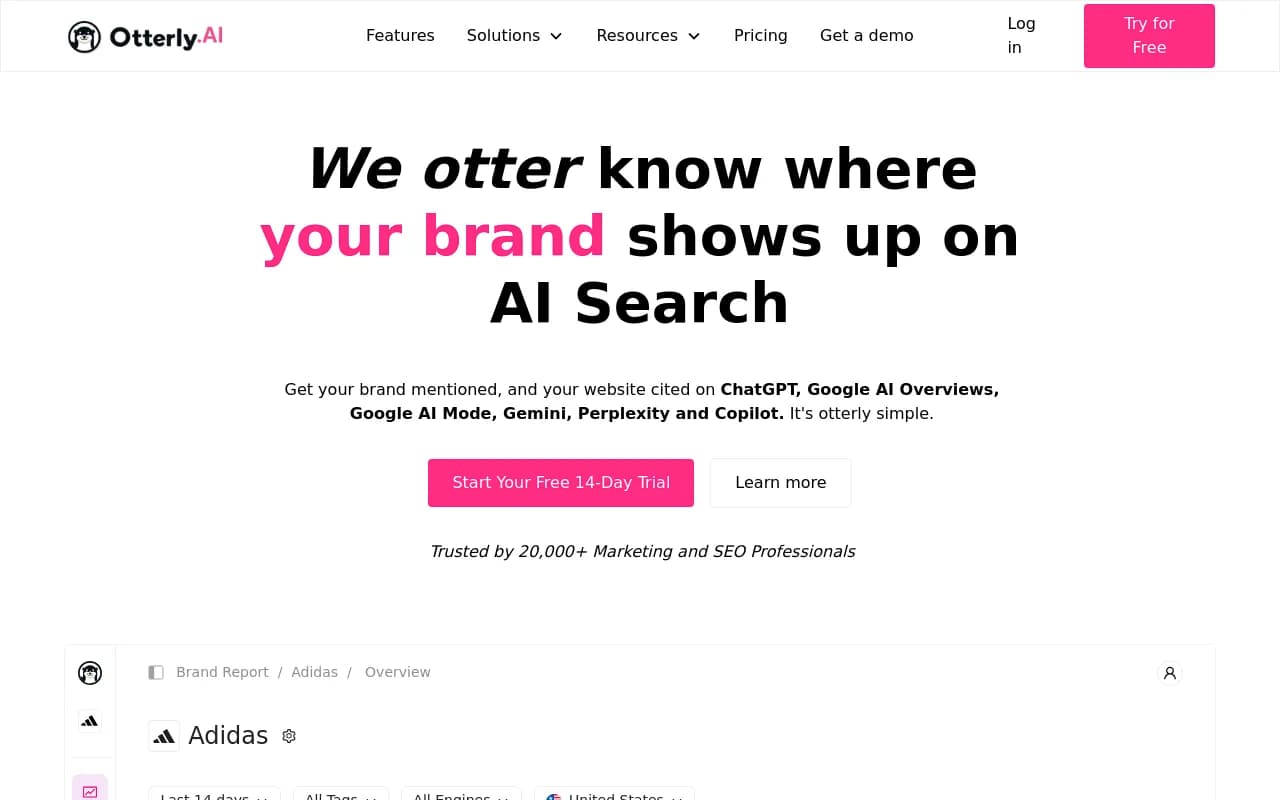
OtterlyAI is an AI search monitoring platform used by 20,000+ marketers to track brand mentions and website citations across ChatGPT, Google AI Overviews, Perplexity, Google AI Mode, Gemini, and Microsoft Copilot. The platform bills itself as "#1 rated AI search monitoring" and focuses on brand monitoring, competitive benchmarking, and GEO audits. OtterlyAI's entry point is $29/month for 15 prompts, making it more accessible for solo marketers and small teams testing AI visibility tracking. The platform includes AI keyword research and a 25+ factor GEO audit tool.
Side-by-Side Comparison
| Feature | Meteoria | OtterlyAI |
|---|---|---|
| Starting price | €75/mo (~$82/mo) | $29/mo |
| Entry prompt limit | 25 prompts | 15 prompts |
| Mid-tier pricing | €175/mo (100 prompts) | $189/mo (100 prompts) |
| Free trial | 7 days | Yes (duration unspecified) |
| AI engines covered | ChatGPT, Perplexity, Google AI Overview, Gemini, Grok | ChatGPT, Perplexity, Google AI Overviews, AI Mode, Gemini, Copilot |
| Seats included | Unlimited | Per-seat pricing |
| Projects included | Unlimited | Limited by plan |
| Sentiment analysis | ✓ (implicit & explicit) | ✓ (positive/neutral/negative) |
| Competitor tracking | ✓ | ✓ |
| Source analysis | ✓ | ✓ (website citations) |
| GEO audit tool | ✗ | ✓ (25+ factors) |
| AI keyword research | ✗ | ✓ |
| Content generation | ✗ | ✗ |
| Geographic targeting | ✓ (custom zones) | ✓ (location-focused) |
| User base | 1,000+ companies | 20,000+ marketers |
| Primary market | France/Europe | Global (English-first) |
Pricing comparison
| Plan | Meteoria | OtterlyAI |
|---|---|---|
| Free tier | ✗ | ✗ |
| Trial | 7 days free | Free trial available |
| Entry plan | €75/mo (25 prompts, unlimited seats) | $29/mo (15 prompts, Lite) |
| Mid-tier | €175/mo (100 prompts, unlimited seats) | $189/mo (100 prompts, Standard) |
| High-tier | €300+/mo (200+ prompts, unlimited seats) | Premium (pricing not public) |
| Annual discount | Not specified | Not specified |
Meteoria's pricing is straightforward but steep -- you're paying for unlimited seats and projects from the start, which makes sense for agencies managing multiple clients. OtterlyAI's $29 entry point is more accessible for individual marketers or small teams, but you'll hit seat limits and need to upgrade as you scale.
AI engine coverage
OtterlyAI monitors six platforms: ChatGPT, Google AI Overviews, Perplexity, Google AI Mode, Gemini, and Microsoft Copilot. That's comprehensive coverage of the major AI search experiences most users encounter.
Meteoria covers five: ChatGPT, Perplexity, Google AI Overview, Gemini, and Grok. The inclusion of Grok (X's AI) is interesting for brands active on X/Twitter, but the absence of Microsoft Copilot is a gap -- Copilot has significant enterprise reach through Microsoft 365.
Neither platform covers Claude, DeepSeek, or Meta AI. If you need broader engine coverage, you're looking at platforms like Promptwatch that monitor 10+ AI models.

Verdict: OtterlyAI has better mainstream coverage with Copilot. Meteoria's Grok support is niche but valuable for X-heavy brands.
Prompt limits and scalability
Both platforms gate features by prompt count, which directly limits how many queries you can monitor.
Meteoria's Basic plan (€75/mo) gives you 25 prompts. Pro (€175/mo) bumps that to 100. Enterprise starts at 200+ prompts for €300+/month. The unlimited seats and projects are nice, but 25 prompts won't cut it for most brands -- you'll burn through that tracking a handful of product categories and competitor mentions.
OtterlyAI's Lite plan ($29/mo) caps at 15 prompts, which is even tighter. Standard ($189/mo) gets you 100 prompts. The pricing is comparable to Meteoria at the 100-prompt tier, but OtterlyAI's entry barrier is lower.
For context, serious AI visibility tracking typically requires 150-350+ prompts to cover product categories, competitor mentions, geographic variations, and persona-specific queries. Both platforms force you into mid-tier or enterprise plans to do this properly.
Verdict: Meteoria's 25-prompt entry is better than OtterlyAI's 15, but both are restrictive. You'll need mid-tier plans ($175-$189/mo) for real coverage.
Feature depth: monitoring and analysis
Both platforms are monitoring-focused. You set up prompts, they query AI engines, and you get dashboards showing visibility scores, competitor positioning, and source citations.
Meteoria's approach
Meteoria emphasizes three pillars: measure, compare, optimize. The "measure" layer tracks visibility rates and position relative to competitors across custom prompts. The "compare" layer surfaces which sources (websites, articles) AI engines cite and analyzes sentiment (implicit and explicit) toward your brand. The "optimize" layer is less clear from their site -- they mention analyzing content and traffic for "LLM compatibility" but don't specify tools for fixing gaps.
Meteoria's sentiment analysis goes deeper than most competitors, tracking both explicit mentions ("Brand X is great") and implicit tone. That's useful for brand reputation work.
OtterlyAI's approach
OtterlyAI focuses on brand mentions, website citations, and competitive benchmarking. The standout feature is the GEO audit tool, which analyzes 25+ on-page factors to identify what's blocking your site from earning citations. This is more actionable than Meteoria's approach -- you get a checklist of technical and content issues to fix.
OtterlyAI also includes AI keyword research to discover conversational prompts your audience is asking. This helps you identify gaps in your content strategy before you start monitoring.
The sentiment analysis is simpler than Meteoria's -- positive, neutral, negative breakdowns without the implicit/explicit distinction.
Verdict: OtterlyAI's GEO audit and keyword research tools make it more actionable. Meteoria's sentiment analysis is richer but less immediately useful for optimization.
User experience and market positioning
OtterlyAI has 20,000+ users and positions itself as the "#1 rated AI search monitoring platform." The interface is English-first, the messaging is straightforward, and the $29 entry point makes it easy to test. The user base skews toward individual marketers and small teams.
Meteoria has 1,000+ companies and is heavily French-market focused. The website is entirely in French, the case studies are French brands (Cdiscount, Pierre Fabre, La Poste), and the positioning emphasizes agency use cases (unlimited seats/projects). If you're a French-speaking team or agency, Meteoria feels purpose-built for you. If you're an English-first team, the language barrier is real.
Verdict: OtterlyAI is more accessible and globally oriented. Meteoria is better for French-speaking agencies managing multiple clients.
What both platforms are missing
Neither Meteoria nor OtterlyAI helps you fix the gaps they identify. They show you where you're invisible, which competitors are winning, and which sources are getting cited -- but then you're on your own to create content, optimize pages, or build citations.
This is the core limitation of monitoring-only platforms. You get data but no action loop. Platforms like Promptwatch go further by showing you specific content gaps (which prompts competitors rank for but you don't), then helping you generate optimized content to close those gaps. That's the difference between a dashboard and an optimization platform.
Neither platform offers:
- Content generation tools
- AI crawler log analysis (seeing which AI bots hit your site and when)
- Traffic attribution (connecting AI visibility to actual revenue)
- Reddit or YouTube tracking (major citation sources for AI models)
- ChatGPT Shopping monitoring
Verdict: Both are monitoring dashboards, not optimization platforms. If you need end-to-end GEO, you'll need additional tools.
Pros and cons
Meteoria pros
- Unlimited seats and projects from day one (great for agencies)
- Rich sentiment analysis (implicit + explicit)
- Grok coverage (useful for X-focused brands)
- French-language interface and support
- 25 prompts at entry tier (vs OtterlyAI's 15)
Meteoria cons
- 2.5x more expensive at entry level (€75 vs $29)
- No Copilot coverage (enterprise gap)
- No GEO audit tool
- No AI keyword research
- Language barrier for non-French teams
- Smaller user base (1,000+ vs 20,000+)
OtterlyAI pros
- $29/mo entry point (accessible for testing)
- GEO audit tool with 25+ factor analysis
- AI keyword research included
- Copilot coverage (enterprise reach)
- Larger user base (20,000+ marketers)
- English-first interface
OtterlyAI cons
- Only 15 prompts at entry tier (very restrictive)
- Per-seat pricing (gets expensive for teams)
- Simpler sentiment analysis (no implicit/explicit)
- No Grok coverage
- Limited project management features
Who should pick Meteoria
Meteoria makes sense if you're:
- A French-speaking agency managing multiple clients (unlimited seats/projects is the key value)
- Focused on brand reputation and need deep sentiment analysis
- Tracking brands active on X/Twitter (Grok coverage)
- Willing to pay €175+/mo for 100+ prompts (the sweet spot for this platform)
Meteoria is not ideal if you're a solo marketer, need Copilot coverage, or want actionable optimization tools beyond monitoring.
Who should pick OtterlyAI
OtterlyAI makes sense if you're:
- Testing AI visibility tracking for the first time ($29 entry is low-risk)
- Need Copilot coverage for enterprise search visibility
- Want actionable GEO audits (25+ factors analyzed)
- Looking for AI keyword research to guide content strategy
- An English-first team or individual marketer
OtterlyAI is not ideal if you're managing multiple clients (seat limits get expensive), need Grok coverage, or require deep sentiment analysis.
Final verdict
OtterlyAI wins for most teams. The $29 entry point, GEO audit tool, and AI keyword research make it more accessible and actionable than Meteoria. The 20,000+ user base and English-first positioning give it broader appeal.
Meteoria is the better choice for French-speaking agencies managing multiple clients -- the unlimited seats and projects justify the higher price, and the sentiment analysis depth is genuinely differentiated.
But here's the reality: both are monitoring dashboards that leave you stuck after showing you the data. You see where you're invisible, then you're on your own to fix it. If you want a platform that closes the loop -- showing you content gaps, helping you generate optimized articles, and tracking the results -- you need something beyond pure monitoring. That's where platforms like Promptwatch come in, combining visibility tracking with content gap analysis and AI-powered content generation to actually improve your rankings in AI search.
For pure monitoring on a budget, start with OtterlyAI. For agency work in French markets, Meteoria's structure makes more sense. For end-to-end optimization, look beyond both.