Key takeaways
- GeoGen is significantly cheaper at entry level (€20/mo vs $95/mo), making it the obvious pick if budget is the primary constraint
- Peec AI has much stronger social proof -- 2,000+ marketing teams vs a handful of logos on GeoGen's site -- which matters if you're buying for a team that needs to justify the spend
- GeoGen covers more AI models (adds Grok and Copilot on top of the ChatGPT/Perplexity/Gemini trio), but Peec AI's three-model focus covers the vast majority of real AI search traffic
- Both tools are monitoring-only: no content generation, no crawler logs, no traffic attribution from either. You'll see the data but you're on your own to act on it
- Peec AI's visibility, position, and sentiment metrics are more clearly defined and better documented; GeoGen's dashboard is less mature
- Neither tool is a good fit if you need to actually move the needle on AI visibility -- they'll tell you where you stand, not how to improve
Overview
Peec AI

Peec AI describes itself as "AI search analytics for marketing teams," and that framing is accurate. It tracks three core metrics -- visibility (share of chats where your brand appears), position (where you rank within AI responses), and sentiment (how AI models describe your brand) -- across ChatGPT, Perplexity, and Gemini. The interface is clean, the onboarding is fast, and 2,000+ marketing teams have adopted it, which is a real signal of product-market fit. It's a solid monitoring tool. The limitation is that it stops at monitoring: there's no content generation, no crawler logs, no traffic attribution, and no way to understand why your visibility is what it is.
GeoGen
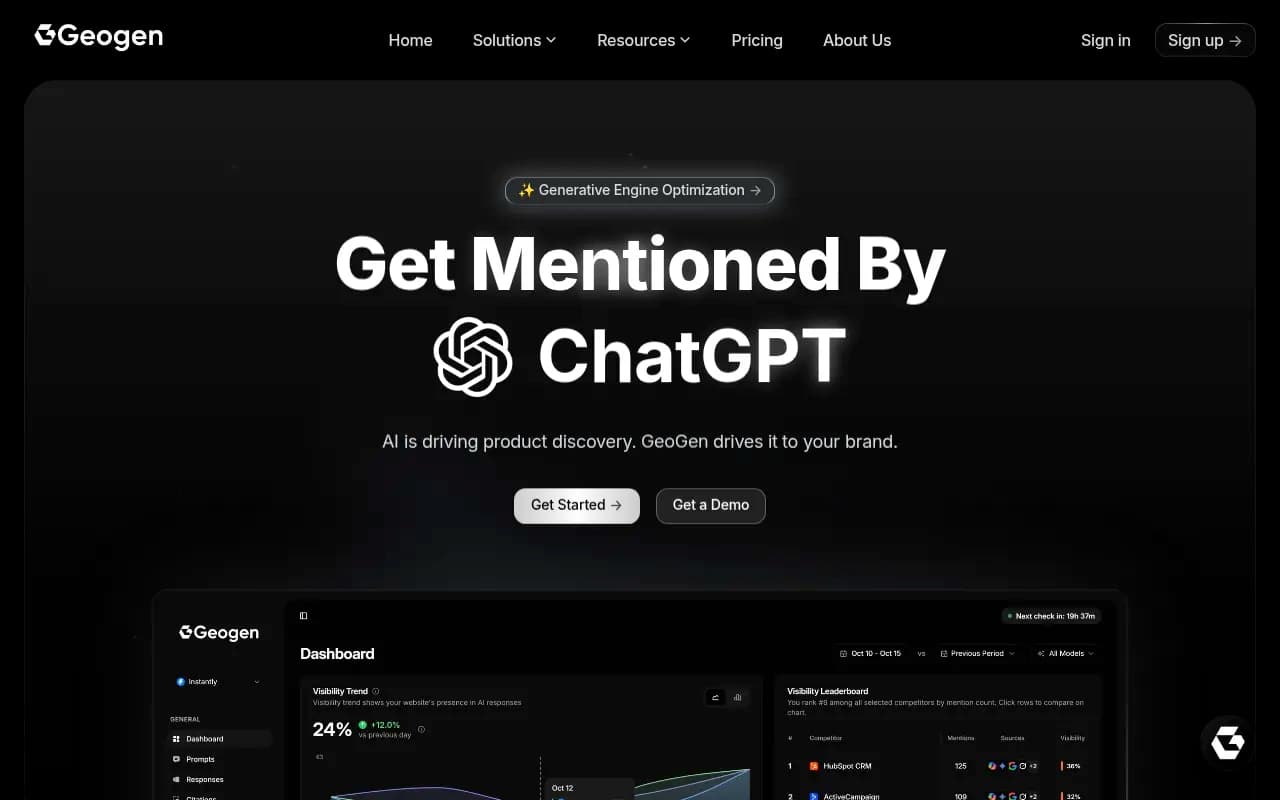
GeoGen positions itself as a "Generative Engine Optimization" platform, though in practice it's closer to a brand monitoring tool with a GEO label. It tracks brand mentions across ChatGPT, Gemini, Perplexity, Grok, and Microsoft Copilot, and claims to offer recommendations to improve AI search presence. The pricing is notably lower than Peec AI, starting at €20/mo. The customer base is smaller and less recognizable, and the product feels earlier-stage. There's a traffic attribution angle mentioned in community discussions, which would be genuinely useful if it works as advertised -- but documentation on this is thin.
Side-by-side comparison
| Feature | Peec AI | GeoGen |
|---|---|---|
| Starting price | $95/mo | €20/mo (~$22) |
| Free tier | Free trial only | No |
| AI models tracked | ChatGPT, Perplexity, Gemini | ChatGPT, Gemini, Perplexity, Grok, Copilot |
| Visibility tracking | Yes | Yes |
| Position tracking | Yes | Yes |
| Sentiment analysis | Yes | Limited |
| Competitor benchmarking | Yes | Yes |
| Content generation | No | No |
| Crawler logs | No | No |
| Traffic attribution | No | Partial (unclear) |
| Custom prompts | Yes | Yes |
| Multi-country tracking | Yes | Unknown |
| API access | Unknown | Unknown |
| Customer base | 2,000+ marketing teams | Small, early-stage |
| Agency support | Yes | Limited |
Head-to-head feature deep-dive
Pricing
Peec AI starts at $95/mo with a free trial available. GeoGen's pricing runs from €20/mo (Micro) up to €399/mo (Pro), with 20% off on annual billing. At face value, GeoGen wins on entry-level cost by a wide margin.
But the comparison gets murkier at higher tiers. GeoGen's Pro plan at €399/mo (~$440) is more expensive than Peec AI's mid-tier plans, so the cost advantage narrows or disappears depending on what you actually need. Peec AI's free trial is also a meaningful advantage -- you can validate whether the tool works for your use case before committing.
| Plan | Peec AI | GeoGen |
|---|---|---|
| Entry | $95/mo | €20/mo (~$22) |
| Mid-tier | Not publicly listed | €99-199/mo (estimated) |
| Top tier | Not publicly listed | €399/mo (~$440) |
| Annual discount | Unknown | 20% |
| Free trial | Yes | No |
Verdict: GeoGen is cheaper to start. Peec AI is safer to evaluate before buying.
AI model coverage
Peec AI covers ChatGPT, Perplexity, and Gemini. GeoGen adds Grok and Microsoft Copilot to that list. In raw numbers, GeoGen covers more ground.
That said, the three models Peec AI covers account for the overwhelming majority of AI search traffic. Grok and Copilot are real products with real users, but they're not where most brand discovery is happening right now. If you're tracking a niche where Copilot or Grok usage is high (enterprise Microsoft environments, for example), GeoGen's broader coverage matters. For most marketing teams, Peec AI's three-model focus is sufficient.
Verdict: GeoGen covers more models, but Peec AI's coverage is adequate for most use cases.
Core metrics and analytics
Peec AI's three-metric framework (visibility, position, sentiment) is well-defined and consistently documented. Visibility tells you how often your brand shows up; position tells you where in the response; sentiment tells you whether the framing is positive or negative. These are the right questions to ask.
GeoGen tracks brand mentions and competitor rankings, and mentions "recommendations to improve AI search presence" -- but the depth of these recommendations isn't well documented publicly. Community discussions suggest GeoGen has some traffic attribution capability, which would genuinely differentiate it from Peec AI. But "some traffic attribution" and "clear, reliable traffic attribution" are different things, and the evidence for the latter is thin.
Verdict: Peec AI's metrics are cleaner and better documented. GeoGen's traffic angle is interesting but unproven at scale.
Competitor benchmarking
Both tools let you benchmark your brand against competitors. Peec AI's dashboard shows competitor visibility scores side by side (the demo shows Salesforce at 62%, Attio at 47%, Monday at 65% -- you get the idea). GeoGen offers similar competitor ranking analysis.
Peec AI's benchmarking feels more polished based on available screenshots and documentation. GeoGen's is functional but the interface looks earlier-stage.
Verdict: Peec AI edges ahead on benchmarking UX.
Ease of use and onboarding
Peec AI's interface is genuinely clean. The dashboard is organized around prompts, sources, and models, with tagging to organize your tracking. Onboarding is fast -- you add prompts, set up competitors, and start seeing data quickly.
GeoGen's onboarding process is less documented. The website is functional but sparse on product detail, which is a mild red flag for a B2B tool. You'd want to test it before committing.
Verdict: Peec AI is the safer bet for teams that need to get up and running quickly.
Content optimization and actionability
This is where both tools fall short, and it's worth being direct about it: neither Peec AI nor GeoGen will help you actually improve your AI visibility. They'll show you where you stand. They won't tell you what content to create, which prompts to target, or why AI models are citing competitors instead of you.
If you're looking for a tool that closes that loop -- tracking gaps, generating content, and measuring the results -- neither of these is it. Platforms like Promptwatch are built specifically around that action cycle, combining monitoring with content gap analysis and AI content generation.

Verdict: Both tools are monitoring-only. Factor this into your decision if you need more than a dashboard.
Customer base and maturity
Peec AI claims 2,000+ marketing teams, with a mix of brands and agencies in its customer list. That's a meaningful number for a relatively young GEO tool category. GeoGen's customer logos include CloudBlast, ProxyScrape, TextBroker, and GdprWise -- smaller, less recognizable names. This isn't a knock on GeoGen, but it does suggest Peec AI is further along in product maturity and customer validation.
Verdict: Peec AI has stronger social proof and a more established customer base.
Pricing comparison
| Plan | Peec AI | GeoGen |
|---|---|---|
| Micro/Starter | $95/mo | €20/mo (~$22) |
| Growth/Mid | Not listed publicly | ~€99-199/mo |
| Pro | Not listed publicly | €399/mo (~$440) |
| Enterprise | Contact sales | Custom |
| Annual discount | Unknown | 20% off |
| Free trial | Yes | No |
Note: Peec AI's full pricing tiers aren't publicly listed beyond the entry point. GeoGen's pricing is published on their site.
Pros and cons
Peec AI
Pros:
- Clean, well-designed interface that marketing teams can actually use
- Clear three-metric framework (visibility, position, sentiment) that's easy to explain to stakeholders
- 2,000+ customer base gives confidence the product works
- Free trial lets you validate before paying
- Multi-country tracking supported
- Good agency adoption
Cons:
- $95/mo entry price is steep compared to GeoGen
- Only covers three AI models (no Grok, no Copilot)
- Monitoring-only -- no content generation, no crawler logs, no traffic attribution
- Full pricing tiers aren't publicly listed, which makes budgeting harder
- No way to understand why your visibility is what it is
GeoGen
Pros:
- Very affordable entry point at €20/mo
- Covers five AI models including Grok and Copilot
- 20% annual discount
- Some traffic attribution capability (if it works as described)
- No lock-in at low tiers
Cons:
- Smaller, less proven customer base
- Product feels earlier-stage with less documentation
- No free trial -- you're buying blind
- "Recommendations" feature is vague and not well documented
- Monitoring-only in practice, despite the GEO branding
- Less polished UX compared to Peec AI
Who should pick which tool
Pick Peec AI if:
- You're a marketing team that needs a clean, reliable dashboard to report AI visibility to stakeholders
- You want a free trial before committing
- You're tracking ChatGPT, Perplexity, and Gemini (the three biggest AI search platforms)
- You're an agency that needs a tool with enough credibility to show clients
- Budget isn't your primary constraint and you value a more mature product
Pick GeoGen if:
- Budget is tight and €20/mo is the difference between having a tool and not having one
- You specifically need Grok or Copilot coverage
- You're a small brand or solo marketer doing basic AI visibility checks
- You want to experiment with GEO tracking without a large upfront commitment
Consider neither if:
- You need to actually improve your AI visibility, not just measure it
- You need crawler logs, traffic attribution, or content generation
- You're running a multi-site operation with complex tracking needs
Final verdict
These two tools are more similar than different -- both are monitoring dashboards for AI search visibility, both lack the content optimization features that would make them genuinely actionable, and both serve teams that want to know where they stand in AI search results.
The decision mostly comes down to budget and maturity. GeoGen is the cheaper entry point and covers more AI models. Peec AI is the more polished product with a larger, more credible customer base and a free trial that lets you test before buying. For most marketing teams, Peec AI is the safer choice -- but if $95/mo is too much and you just need basic tracking, GeoGen at €20/mo gets the job done.
Just go in with clear expectations: whichever you pick, you'll know your visibility score. You won't know how to improve it.