Key takeaways
- Pendium.ai is a freemium entry point -- you can scan your AI visibility in 2 minutes with no credit card. AthenaHQ starts at $295/month and is built for teams that are already serious about GEO.
- AthenaHQ covers 8+ LLMs and includes citation analysis, content optimization recommendations, and executive dashboards. Pendium.ai focuses on ChatGPT, Claude, and Gemini with a lighter feature set.
- AthenaHQ has a recognizable enterprise client list (Coinbase, ZoomInfo, SoFi, PagerDuty). Pendium.ai's public examples skew toward early-stage startups and SMBs.
- Neither tool includes built-in AI content generation -- if you want to close the loop from "I found a gap" to "I published content that fixes it," you'll need to look elsewhere.
- AthenaHQ is the better pick for marketing teams running a structured GEO program. Pendium.ai is the better pick for getting a quick read on where you stand before committing to anything.
- Pricing transparency is a real difference: AthenaHQ publishes its self-serve price ($295/mo). Pendium.ai's paid tiers aren't publicly listed, which makes budgeting harder.
Overview
Pendium.ai
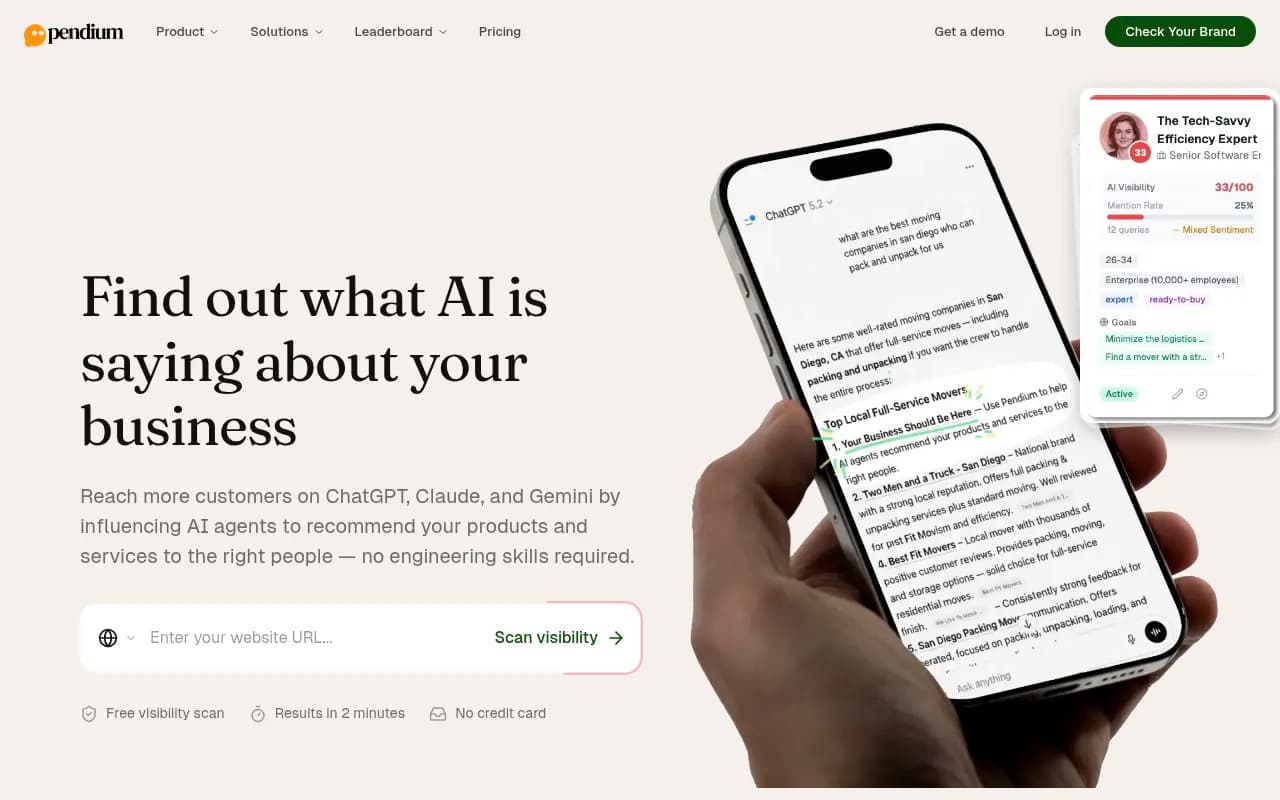
Pendium.ai pitches itself as the tool that helps you "teach AI agents to recommend your business." The core idea is simple: scan your brand's current AI visibility, see how ChatGPT, Claude, and Gemini perceive you, then figure out what content to publish to change that. The free scan is genuinely frictionless -- two minutes, no credit card, and you get a real result. That low barrier makes it a natural first stop for business owners and marketers who are just waking up to the fact that AI search is a thing they need to care about.
The platform appears to target a broad audience -- moving companies, SaaS startups, local services -- which is interesting but also means the feature depth is calibrated for accessibility rather than power users. There's no publicly listed pricing for paid tiers, which is a yellow flag if you're trying to plan a budget.
AthenaHQ

AthenaHQ positions itself as an "end-to-end AEO & GEO platform" and backs that up with a client list that includes Coinbase, ZoomInfo, SoFi, and PagerDuty. It's been featured in Forbes and the Wall Street Journal, and came out of Y Combinator. The platform is built around a credit-based model (1 credit = 1 AI query), which gives you granular control over how many queries you run but can also make cost estimation tricky at scale.
The feature set is meaningfully deeper than Pendium.ai: cross-platform tracking across 8+ LLMs, citation source analysis, content optimization recommendations, executive dashboards, and role-specific workflows for AEO managers, CMOs, SEO teams, and PR. It's a tool designed for teams that have already decided GEO is a priority and need infrastructure to run it properly.
Side-by-side comparison
| Feature | Pendium.ai | AthenaHQ |
|---|---|---|
| Free tier | Free visibility scan (no credit card) | Free audit only (sign-up required) |
| Starting price | Not publicly listed | $295/month ($95 first month) |
| LLMs monitored | ChatGPT, Claude, Gemini | 8+ LLMs (ChatGPT, Claude, Perplexity, Google AI Overviews, and more) |
| Citation analysis | Not mentioned | Yes |
| Content optimization | Guidance on what to publish | Automated recommendations |
| Executive dashboards | Not mentioned | Yes |
| Enterprise plan | Not mentioned | Custom pricing |
| Target audience | SMBs, startups, local businesses | Mid-market to enterprise marketing teams |
| Setup time | ~2 minutes (free scan) | ~10 minutes (free audit) |
| Competitor tracking | Visibility rankings by category | Yes, cross-LLM competitor comparison |
| API / integrations | Not mentioned | Not publicly detailed |
| Notable clients | Early-stage startups | Coinbase, ZoomInfo, SoFi, PagerDuty |
Head-to-head feature deep-dive
AI model coverage
Pendium.ai monitors ChatGPT, Claude, and Gemini. That's the three biggest consumer-facing AI assistants, which covers a lot of ground for most SMBs. If your customers are asking AI questions, they're probably using one of those three.
AthenaHQ covers 8+ LLMs, explicitly including Perplexity and Google AI Overviews alongside the big three. For B2B companies where Perplexity usage is higher, or for brands that care about Google's AI Mode, that broader coverage matters. It's not just a numbers game -- different LLMs have different citation behaviors, and a brand that ranks well in ChatGPT might be invisible in Perplexity.
Verdict: AthenaHQ wins on breadth. Pendium.ai is fine for most SMB use cases but leaves gaps for teams that need full LLM coverage.
Visibility tracking and reporting
Pendium.ai gives you an AI visibility score and brand ranking within your category. The free scan surfaces how AI agents currently perceive your business, which is a useful starting point. What's less clear is how granular the ongoing tracking gets -- there's no public documentation of historical trend data, prompt-level breakdowns, or page-level attribution.
AthenaHQ's tracking is more structured. It offers cross-platform visibility scores, citation source analysis (so you can see which pages and domains AI models are citing), and executive-level dashboards designed for reporting up the chain. The "AEO/GEO Manager Command Center" framing suggests it's built for someone whose job is to own this channel, not just check in on it occasionally.
Verdict: AthenaHQ is the stronger tracking tool for teams that need depth and reporting. Pendium.ai is better for a quick snapshot.
Content optimization
This is where both tools show their limits compared to more action-oriented platforms. Pendium.ai's pitch is "find out what AI says, then publish the content that gets you recommended" -- but the actual content guidance appears to be directional rather than specific. It tells you what kind of content to create; it doesn't create it for you or show you exactly which gaps to fill.
AthenaHQ includes "automated content optimization recommendations," which is a step further. You get specific suggestions tied to your visibility data. But again, there's no built-in content generation -- the recommendations tell you what to write, not how to write it.
If you're looking for a platform that takes you from gap identification all the way to published content, tools like Promptwatch go further -- the built-in AI writing agent generates articles grounded in real citation data, which neither Pendium.ai nor AthenaHQ currently offers.

Verdict: AthenaHQ edges ahead with more specific optimization recommendations, but neither tool closes the full loop to content creation.
Ease of use and onboarding
Pendium.ai's free scan is genuinely one of the lowest-friction entry points in the GEO space. Two minutes, no credit card, real results. That's hard to beat for someone who just wants to understand where they stand. The interface appears designed for non-technical users -- the "no engineering skills required" positioning is deliberate.
AthenaHQ requires more setup and is clearly designed for marketing professionals who know what GEO is. The 10-minute free audit is still accessible, but the platform's depth means there's a steeper learning curve once you're inside. Role-specific workflows (CMO view, SEO view, PR view) help, but it's still a tool that rewards investment.
Verdict: Pendium.ai wins on ease of entry. AthenaHQ wins on depth once you're up and running.
Enterprise and team features
Pendium.ai doesn't publicly mention team collaboration features, role-based access, or enterprise pricing. It may have these in paid tiers, but the lack of transparency makes it hard to evaluate.
AthenaHQ has clearly built for teams. The platform has distinct workflows for different roles (AEO/GEO managers, CMOs, SEO teams, PR, content marketing, brand marketing), executive dashboards for leadership reporting, and custom enterprise pricing. The client list -- Coinbase, ZoomInfo, PagerDuty -- confirms it can handle enterprise-scale deployments.
Verdict: AthenaHQ is the clear winner for teams and enterprise use cases.
Competitor intelligence
Pendium.ai shows brand rankings within categories, which gives you a rough sense of where you stand relative to competitors in AI recommendations. It's a useful benchmark but appears to be fairly high-level.
AthenaHQ includes cross-LLM competitor comparison, citation source analysis, and link building guidance -- meaning you can see not just that a competitor ranks higher, but why (which pages are being cited, which sources AI models trust). That's actionable intelligence rather than just a leaderboard.
Verdict: AthenaHQ wins on competitor intelligence depth.
Pricing comparison
| Plan | Pendium.ai | AthenaHQ |
|---|---|---|
| Free | Free visibility scan (ongoing access unclear) | Free audit only |
| Self-serve / starter | Not publicly listed | $295/month ($95 first month) |
| Annual discount | Unknown | ~17% off |
| Enterprise | Unknown | Custom pricing |
| Pricing model | Unknown (freemium) | Credit-based (1 credit = 1 AI query) |
The pricing gap here is real. AthenaHQ at $295/month is a meaningful commitment -- it's priced for teams with a GEO budget, not individuals testing the waters. Pendium.ai's freemium model is more accessible, but the lack of published paid pricing makes it impossible to compare apples to apples. You'd need to contact them or sign up to find out what ongoing monitoring actually costs.
AthenaHQ's credit-based model is worth understanding before you commit. It gives you control over spend, but if you're running a lot of queries across many prompts and competitors, costs can scale quickly. The 17% annual discount helps if you're ready to commit.
Pros and cons
Pendium.ai
Pros:
- Free scan with no credit card -- genuinely zero friction to get started
- Results in 2 minutes, which is fast enough to use as a quick gut-check
- Accessible to non-technical users and small business owners
- Covers the three most-used consumer AI assistants
Cons:
- Paid pricing not publicly listed -- hard to budget for
- Narrower LLM coverage (3 models vs 8+)
- Feature depth is unclear beyond the free scan
- No visible enterprise or team features
- No built-in content generation or detailed gap analysis
AthenaHQ
Pros:
- Deep tracking across 8+ LLMs including Perplexity and Google AI Overviews
- Citation source analysis shows you why competitors rank, not just that they do
- Role-specific workflows for different team members
- Enterprise-ready with a recognizable client list
- Automated content optimization recommendations
- Transparent self-serve pricing
Cons:
- $295/month is a real barrier for small teams or individuals
- Credit-based model can make cost estimation tricky at scale
- No built-in content generation -- you still need to write the content yourself
- Steeper learning curve than Pendium.ai
- No free ongoing tier -- the free audit is a one-time thing
Who should pick which tool
Pick Pendium.ai if:
- You're a small business owner or early-stage startup just figuring out AI visibility
- You want a free, fast snapshot of how AI agents perceive your brand right now
- You're not ready to commit budget to a GEO platform yet
- Your customers primarily use ChatGPT, Claude, or Gemini
Pick AthenaHQ if:
- You're a marketing team or agency with a dedicated GEO budget
- You need to track visibility across 8+ LLMs and report results to leadership
- Competitor intelligence and citation analysis are important to your strategy
- You're at a mid-market or enterprise company that needs structured workflows
- You want content optimization recommendations tied to real visibility data
Final verdict
These two tools aren't really competing for the same customer. Pendium.ai is a low-friction entry point -- useful for getting a quick read on your AI visibility without spending anything. AthenaHQ is a professional GEO platform for teams that are already running a structured AI search strategy and need the infrastructure to support it. If you're just starting out, Pendium.ai's free scan is worth five minutes of your time. If you're past that stage and need depth, reporting, and competitor intelligence, AthenaHQ is the more capable tool -- just be ready for the price tag.