Pendium.ai Review 2026
Tracks how AI agents like ChatGPT, Claude, and Gemini perceive and recommend brands. Monitors AI visibility scores across categories and industries for SaaS and software companies.
Key takeaways
- Pendium monitors AI visibility across 7 platforms (ChatGPT, Claude, Gemini, Grok, Perplexity, DeepSeek, Google AI Overviews) with persona-based query simulation
- Includes a content engine that generates AI-optimized articles, guides, and comparisons -- a step beyond pure monitoring tools
- Missing compared to Promptwatch: no AI crawler logs, no traffic attribution or visitor analytics, no Reddit/YouTube source tracking, no ChatGPT Shopping monitoring, no prompt volume/difficulty scoring, no query fan-outs, and no page-level citation tracking
- Best suited for small-to-mid-size businesses and local service companies wanting a simple entry point into AI visibility
- Free visibility scan available with no credit card required; paid pricing not publicly listed
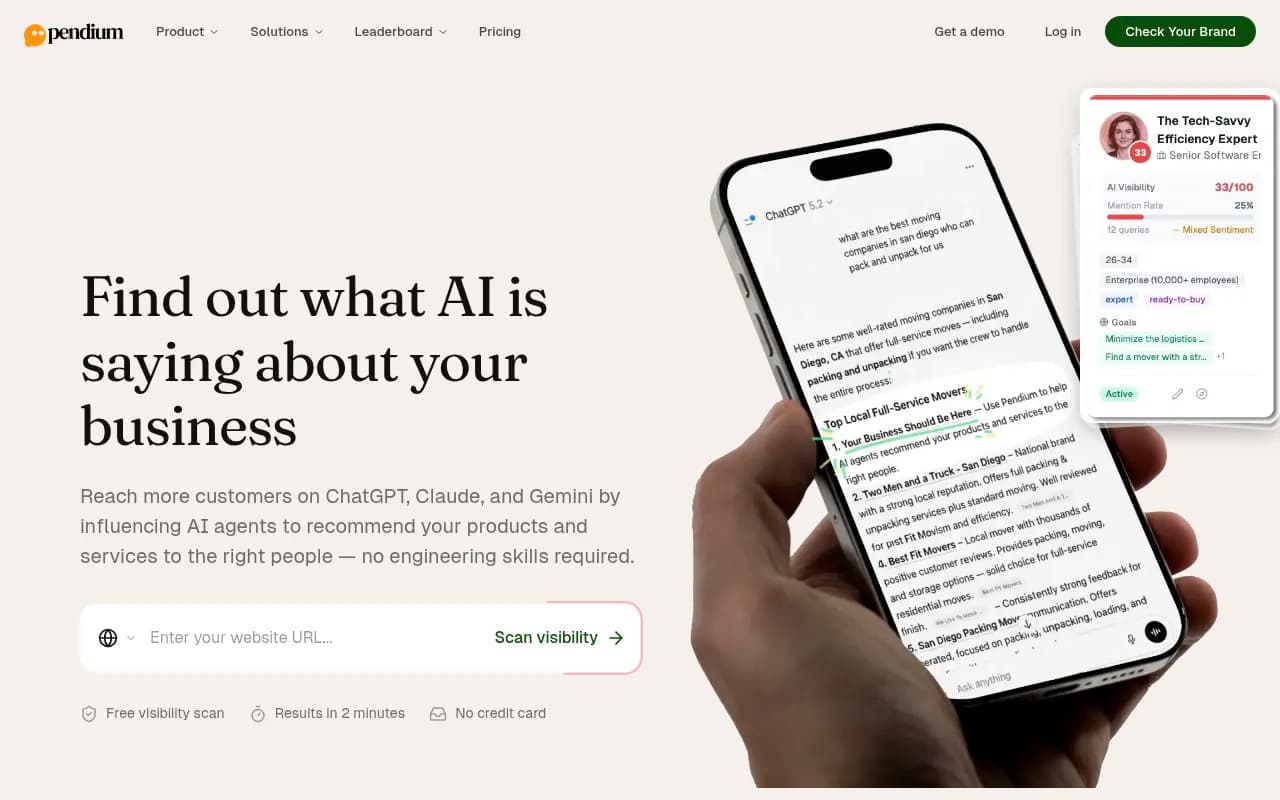
Pendium.ai is a Generative Engine Optimization (GEO) platform that helps businesses understand and improve how AI assistants like ChatGPT, Claude, and Gemini talk about them. Built with a non-technical audience in mind, it positions itself as an end-to-end solution: scan your visibility, identify gaps, generate content, and watch your AI recommendations improve over time. The pitch is simple -- your next customer is asking AI for a recommendation, and Pendium wants to make sure you show up in the answer.
The platform targets a broad range of businesses, from local service companies (moving companies, healthcare practices) to SaaS startups. The homepage showcases a mix of brand types, which signals that Pendium is going after the long tail of businesses that haven't yet thought seriously about AI search visibility. That's a real market. Most small and mid-size businesses have no idea what ChatGPT says when someone asks "who's the best moving company in Austin?" -- and that ignorance is increasingly costly as AI-assisted search becomes the default for many users.
Pendium appears to be a relatively early-stage product. There's no public pricing page, no case studies with specific numbers, and the feature set -- while coherent -- is thinner than what established GEO platforms offer. That's not necessarily a dealbreaker for the audience it's targeting, but it's worth knowing before you commit.
Key features
Visibility monitoring across 7 AI platforms Pendium tracks how your brand appears in responses from ChatGPT, Claude, Gemini, Grok, Perplexity, DeepSeek, and Google AI Overviews. It runs queries continuously and surfaces visibility scores broken down by platform. The idea is that each AI model has different training data and different tendencies -- what Gemini says about your business may differ significantly from what Perplexity says, and Pendium surfaces those differences. In practice, this kind of multi-model monitoring is genuinely useful because brands often have blind spots on specific platforms.
Persona-based query simulation This is one of Pendium's more interesting features. Rather than running generic queries, it simulates up to 10 distinct customer personas -- a price-conscious shopper, an enterprise buyer, a first-time customer, and so on -- and runs the queries each persona would actually ask. The logic is sound: AI models give different answers depending on how a question is framed, and a business that shows up for "best affordable moving company" might be invisible for "enterprise relocation services." Persona simulation helps surface those gaps. The platform claims to run 50+ real customer queries per account.
Content engine Pendium generates AI-optimized content -- guides, comparisons, how-tos -- designed to help AI models understand your business and recommend it more often. This goes beyond what pure monitoring tools offer. The content is described as "structured for AI comprehension and published to the sources AI platforms trust most," though the platform doesn't specify exactly where content gets published or what those trusted sources are. This is a meaningful differentiator versus basic trackers, but the lack of transparency about the publishing mechanism is a gap worth noting.
Site health analysis Pendium analyzes your existing online presence -- website, Yelp page, Google Business Profile -- and builds a profile of your business including services, reviews, and reputation signals. This feeds into both the visibility scoring and the content recommendations. It's a sensible onboarding approach that reduces setup friction for non-technical users.
Citation tracking The platform tracks which sources AI models cite when recommending businesses in your category. This helps you understand where AI is pulling its information from and, by extension, where you should be publishing or optimizing content. The depth of this feature isn't fully clear from the public-facing product, but citation tracking is a core component of any serious GEO workflow.
Topic and query breakdown Visibility scores aren't just shown at the brand level -- they're broken down by topic (pricing, reliability, coverage areas, specialties) and by specific query. This granularity is useful for prioritizing where to focus content efforts. If you're invisible on "pricing" queries but visible on "reliability" queries, that tells you something actionable.
Continuous 24/7 monitoring Pendium runs monitoring automatically and continuously, not just when you manually trigger a scan. This matters because AI model outputs change over time as models are updated and new content enters their training data. A visibility score from three months ago may not reflect your current standing.
Free visibility scan Anyone can run a free scan by entering their website URL. Results come back in about 2 minutes and show what major AI platforms say about the business. No credit card required. This is a smart acquisition mechanic -- it gives potential customers an immediate taste of the product's value before asking for payment.
Who is it for
Pendium's clearest fit is small-to-mid-size businesses that are just waking up to the idea that AI search visibility matters. Think a local moving company trying to figure out why competitors keep getting recommended by ChatGPT, or a 10-person SaaS startup that wants to show up when someone asks Claude for project management tools. The no-engineering-required positioning and the free scan are both signals that Pendium is optimizing for accessibility over depth.
Marketing managers at companies with 10-100 employees are probably the primary user. Someone who understands that AI search is changing customer acquisition but doesn't have the budget or technical resources for an enterprise GEO platform. The persona simulation feature in particular suggests Pendium is thinking about businesses with distinct customer segments -- a healthcare practice serving both individual patients and corporate clients, for example.
Pendium is less suited for large enterprises, SEO agencies managing multiple client accounts, or marketing teams that need deep analytics and attribution data. There's no mention of multi-site management, no API documentation, no white-label options, and no traffic attribution capabilities. If you need to connect AI visibility to actual revenue or manage GEO for 10+ clients, Pendium's current feature set will feel limiting.
Integrations and ecosystem
The public-facing product doesn't document specific integrations beyond the ability to input a website URL, Yelp page, or Google Business Profile as data sources. There's no mention of Google Search Console integration, Slack notifications, Zapier connectivity, or API access. For a tool at this stage, that's not surprising, but it does mean Pendium operates as a standalone product rather than part of a broader marketing stack.
There's no browser extension, no mobile app mentioned, and no Looker Studio connector. Export capabilities aren't documented. The booking flow for demos runs through Cal.com, which suggests a lean team and early-stage infrastructure.
Pricing and value
Pendium does not publish pricing on its website. The free visibility scan is available without a credit card, and there's a demo booking option via Cal.com for businesses that want to learn more. This opacity around pricing is common for early-stage GEO tools but makes it hard to evaluate value relative to competitors.
For context, comparable tools in the GEO space range from around $99/month at the entry level (Promptwatch's Essential plan) to several hundred dollars per month for more capable platforms. Without knowing Pendium's pricing, it's impossible to say whether it's competitively positioned. If you're evaluating Pendium, getting a pricing quote before investing time in setup is worth doing early.
Strengths and limitations
What Pendium does well:
- The persona simulation approach is genuinely differentiated. Running queries through multiple buyer personas rather than generic prompts produces more realistic visibility data.
- The free scan with 2-minute results is an excellent way to demonstrate value immediately. It lowers the barrier to trying the product significantly.
- The combination of monitoring and content generation in one product is the right instinct. Pure monitoring tools leave users stuck; Pendium at least attempts to close the loop.
- The multi-platform coverage (7 AI models) is solid for a product at this stage.
Where it falls short:
- No AI crawler logs. Knowing that an AI model is recommending your business is useful, but knowing whether AI crawlers can actually access and read your pages is a different and equally important question. Pendium doesn't appear to offer this.
- No traffic attribution. There's no way to connect AI visibility scores to actual website visits or revenue. You can see that ChatGPT mentions you more often, but you can't tell if that's driving customers to your site. This is a significant gap for any business trying to justify GEO investment.
- No Reddit or YouTube tracking. A meaningful portion of AI citations come from Reddit threads and YouTube content. Pendium doesn't appear to surface these sources, which means users are missing part of the picture when deciding where to publish content.
- No prompt volume or difficulty scoring. Pendium doesn't tell you how many people are asking a given query or how competitive it is to rank for it. That makes it harder to prioritize which gaps to close first.
- No ChatGPT Shopping tracking. As ChatGPT's product recommendation and shopping carousel features grow, this becomes an increasingly important channel -- especially for e-commerce and SaaS brands.
- Limited transparency about how the content engine publishes content and to which sources.
Bottom line
Pendium is a reasonable starting point for small businesses and early-stage startups that want to understand their AI visibility without a steep learning curve or a large budget. The free scan is genuinely useful, the persona simulation is a smart feature, and the combination of monitoring with content generation puts it ahead of pure trackers.
That said, it's a monitoring-and-content tool with real gaps in attribution, source intelligence, and technical depth. Teams that need to connect AI visibility to business outcomes -- or agencies managing multiple clients -- will quickly outgrow what Pendium currently offers. For those use cases, Promptwatch covers the full loop: crawler logs, traffic attribution, Reddit/YouTube source tracking, prompt volume scoring, and page-level citation data alongside content generation.
Best use case: A local service business or early-stage SaaS startup that wants a simple, accessible way to start tracking and improving AI recommendations without needing a dedicated analytics team.
Frequently asked questions
What is Pendium.ai?
Which AI platforms does Pendium monitor?
Is there a free plan or trial?
How does Pendium improve AI visibility?
Who is Pendium best suited for?
How does Pendium compare to Promptwatch?
Similar and alternative tools to Pendium.ai