Key takeaways
- Pendium.ai and Amplitude are not direct competitors -- one tracks AI brand recommendations, the other tracks in-product user behavior. If you're choosing between them, you may be solving two different problems.
- Pendium.ai is the right pick if your question is "how does ChatGPT or Claude describe and recommend my brand?" Amplitude answers "what are users doing inside my product?"
- Amplitude is a mature, enterprise-ready platform with 2,500+ reviews, deep funnel and retention analytics, and a generous free tier. Pendium.ai is earlier-stage with opaque paid pricing.
- Pendium.ai's free visibility scan takes 2 minutes and requires no credit card -- a low-friction way to see where you stand in AI recommendations before committing to anything.
- If you're a SaaS company, you probably need both: Amplitude for product decisions, Pendium.ai (or a more comprehensive AI visibility platform) for distribution through AI search channels.
- Amplitude has no AI search visibility features. Pendium.ai has no product analytics features. There's almost no overlap.
Overview
Pendium.ai
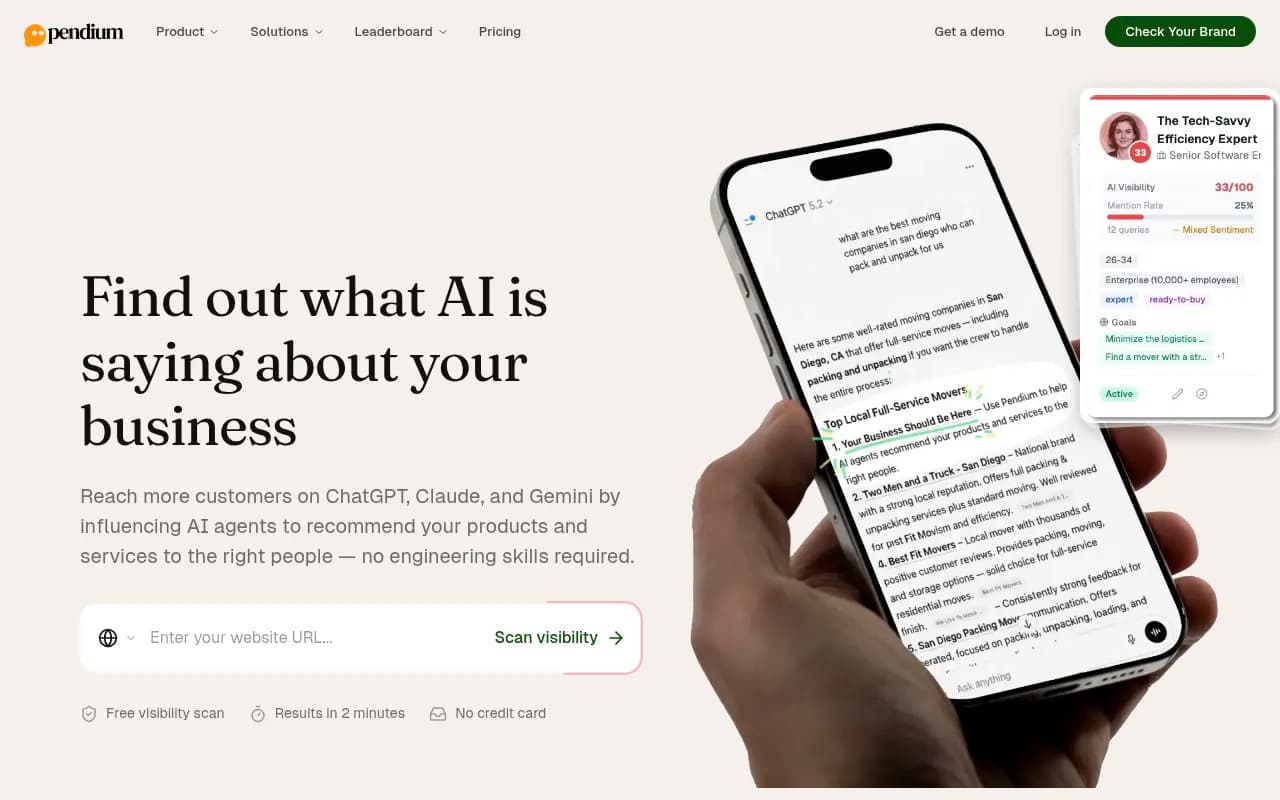
Pendium.ai is an AI visibility platform aimed at SaaS and software companies that want to know how AI agents like ChatGPT, Claude, and Gemini perceive and recommend their brand. The core pitch is simple: find out what AI is saying about your business, then publish content that gets you recommended to the right people. You can run a free visibility scan in about 2 minutes without entering a credit card, which is a genuinely low-friction entry point. The platform shows AI visibility scores, category rankings, and -- based on the website copy -- helps you understand what content to create to improve those scores. Paid plan pricing isn't publicly listed, which makes it harder to evaluate for budget planning.
Amplitude
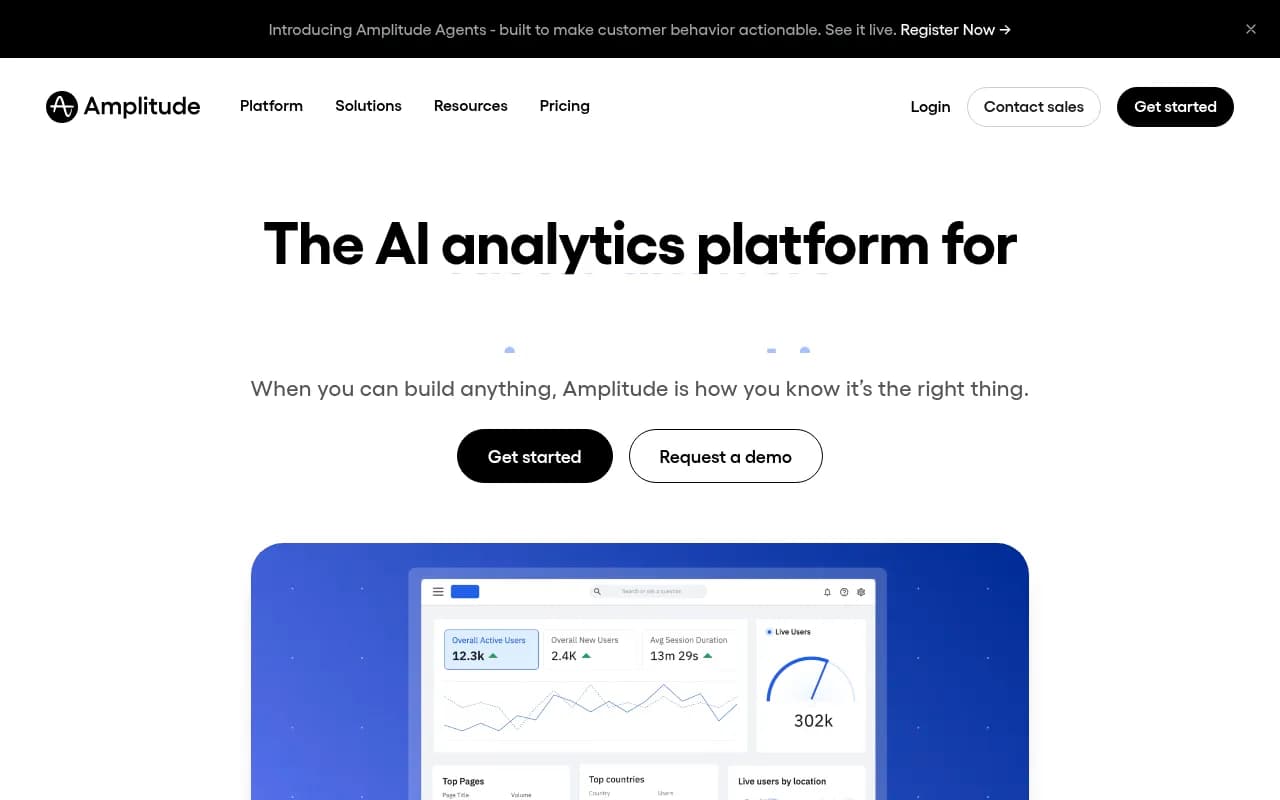
Amplitude is one of the most established product analytics platforms on the market, trusted by companies like Walmart, Atlassian, Square, and NBC. It tracks user behavior inside digital products -- funnels, retention, cohort analysis, A/B experimentation, and now AI-powered agents that monitor and optimize data issues automatically. The platform serves over 11,000 digital products and has 2,500+ reviews on G2 where it holds a "Market Leader" badge. Amplitude's free tier supports up to 10,000 monthly tracked users (MTUs), making it accessible for early-stage teams. Paid plans scale from $49/month for the Plus tier up to enterprise contracts in the tens of thousands per year.
Side-by-side comparison
| Feature | Pendium.ai | Amplitude |
|---|---|---|
| Primary use case | AI brand visibility & recommendations | Product analytics & user behavior |
| Free tier | Free visibility scan (no credit card) | Up to 10K MTUs free |
| Paid pricing | Not publicly listed | From $49/mo (Plus, 300K MTUs) |
| AI model monitoring | ChatGPT, Claude, Gemini | None |
| In-product analytics | No | Yes (funnels, retention, cohorts) |
| A/B experimentation | No | Yes |
| AI visibility scores | Yes | No |
| Content recommendations | Yes (what to publish to rank in AI) | No |
| User event tracking | No | Yes |
| Integrations | Not publicly detailed | 300+ integrations |
| API access | Not publicly detailed | Yes |
| Target audience | SaaS/software marketing teams | Product teams, growth teams |
| Maturity/scale | Early-stage | Enterprise-grade, 11K+ products |
| Open source | No | No |
Head-to-head feature deep-dive
Core purpose and use case
This is where the comparison gets a bit unusual. Pendium.ai and Amplitude are solving fundamentally different problems, and it's worth being direct about that upfront.
Pendium.ai answers: "When someone asks ChatGPT to recommend a project management tool, does my brand show up?" It's about external AI discoverability -- how AI agents perceive, describe, and recommend your brand to potential customers.
Amplitude answers: "Once a user signs up for my product, where do they drop off? Which features drive retention? What's the conversion rate from trial to paid?" It's about internal product behavior -- understanding what users do after they arrive.
The only scenario where you'd genuinely be choosing one over the other is if you have a very limited budget and need to prioritize. Otherwise, these tools sit in completely different parts of your stack.
Verdict: No winner here -- they're not competing for the same job.
AI visibility and brand monitoring
Pendium.ai is purpose-built for this. It tracks how AI models like ChatGPT, Claude, and Gemini recommend brands within categories and industries. The visibility score system gives you a benchmark (scores like 43/100 or 68/100) that tells you how prominently AI agents surface your brand compared to competitors. The content guidance feature then tells you what to publish to improve that score.
Amplitude has zero AI search visibility capabilities. It doesn't monitor LLMs, doesn't track brand mentions in AI responses, and doesn't offer any guidance on AI-driven content strategy. This isn't a gap -- it's just not what Amplitude is built for.
Worth noting: if you want a more comprehensive AI visibility platform that goes beyond scores into content gap analysis, crawler logs, and multi-model tracking across 10+ AI engines, Promptwatch covers that territory more deeply.

Verdict: Pendium.ai wins this category outright. Amplitude doesn't compete.
Product analytics and user behavior
Amplitude is one of the best product analytics tools available. Its core capabilities include:
- Funnel analysis to see where users drop off in any flow
- Retention charts showing which cohorts stick around
- Behavioral cohorts for segmenting users by what they actually do
- Session replay (available on higher tiers)
- A/B experimentation built into the same platform
- AI Agents that monitor your data 24/7 and flag anomalies
Pendium.ai has none of this. It doesn't track user events, doesn't integrate with your product's data layer, and doesn't offer any behavioral analytics.
Verdict: Amplitude wins this category outright. Pendium.ai doesn't compete.
Content and optimization guidance
Pendium.ai's content guidance is one of its more interesting angles. The idea is that once you know your AI visibility score and where competitors are outranking you, the platform helps you understand what content to publish to improve your standing with AI models. This is a meaningful capability for marketing teams trying to influence how AI agents recommend their brand.
Amplitude doesn't offer content recommendations in this sense. It has an AI assistant that helps you query your analytics data faster, but that's a different thing entirely.
Verdict: Pendium.ai wins for AI-driven content strategy. Amplitude's AI features are analytics-focused, not content-focused.
Pricing and accessibility
| Plan | Pendium.ai | Amplitude |
|---|---|---|
| Free | Free visibility scan | Up to 10K MTUs |
| Starter/Plus | Not listed | $49/mo (300K MTUs) |
| Growth | Not listed | Custom pricing |
| Enterprise | Not listed | Custom (typically $2K-$50K+/year) |
Amplitude's pricing is transparent and well-documented, which makes it easier to plan around. The free tier is genuinely useful for early-stage products -- 10,000 monthly tracked users covers a lot of ground before you need to upgrade.
Pendium.ai's free scan is a good hook, but the lack of public paid pricing is a friction point. You can't evaluate whether it fits your budget without talking to sales or signing up and seeing what's behind the paywall. That's a common pattern for early-stage SaaS, but it does make comparison harder.
Verdict: Amplitude wins on pricing transparency. Pendium.ai wins on zero-friction entry (no credit card for the free scan).
Integrations and ecosystem
Amplitude has 300+ integrations covering data warehouses, CDPs, marketing tools, CRMs, and more. It also has an MCP (Model Context Protocol) integration that lets you prompt Amplitude directly from AI interfaces. The ecosystem is mature and well-documented.
Pendium.ai's integration story isn't publicly detailed on the website. For a monitoring tool, the main question is whether it can pull data from your existing stack or push alerts to Slack/email -- and that's not clear from what's available.
Verdict: Amplitude wins on integrations by a significant margin, though this may matter less for Pendium.ai's specific use case.
Ease of use and setup
Pendium.ai's free scan takes 2 minutes and requires no technical setup. That's genuinely impressive for getting initial value. The broader platform appears designed for non-technical marketing users -- no engineering skills required is explicitly called out on the homepage.
Amplitude has a steeper setup curve because it requires instrumenting your product with tracking code (or using a CDP like Segment to pipe events in). That's not hard, but it's not a 2-minute experience either. Once set up, the interface is polished and the AI assistant makes querying data faster than it used to be.
Verdict: Pendium.ai wins on initial setup speed. Amplitude wins on long-term analytical depth once you're up and running.
Pricing comparison
| Plan | Pendium.ai | Amplitude |
|---|---|---|
| Free | Free visibility scan | Up to 10K MTUs/month |
| Entry paid | Not publicly listed | $49/mo (Plus, up to 300K MTUs) |
| Mid-tier | Not publicly listed | Custom (Growth) |
| Enterprise | Not publicly listed | Custom ($2K-$50K+/year typical) |
The honest summary: Amplitude's pricing is one of the more transparent in the product analytics space. Pendium.ai's opacity on paid plans is a real gap for anyone trying to budget.
Pros and cons
Pendium.ai
Pros:
- Free visibility scan with no credit card required -- genuinely fast to get started
- Purpose-built for AI brand monitoring, which is a real and growing need
- Visibility scores give you a concrete benchmark to track over time
- Content guidance connects monitoring to action
- Designed for non-technical users
Cons:
- Paid pricing is not publicly listed, making budget planning difficult
- Earlier-stage platform with less documented integrations and ecosystem
- Monitors fewer AI models than some competitors (ChatGPT, Claude, Gemini vs. 10+ on more comprehensive platforms)
- No product analytics, user behavior tracking, or experimentation features
- Limited public information on data methodology and prompt coverage
Amplitude
Pros:
- One of the most mature and trusted product analytics platforms available
- Generous free tier (10K MTUs) that's useful for real early-stage products
- Transparent, well-documented pricing
- 300+ integrations with a mature ecosystem
- Deep analytics: funnels, retention, cohorts, experimentation all in one place
- AI Agents for automated anomaly detection and optimization
- Strong enterprise support and documentation
Cons:
- Requires technical instrumentation to get value (not a 2-minute setup)
- No AI search visibility or brand monitoring features
- Higher tiers can get expensive quickly as MTU counts grow
- Can feel overwhelming for teams that just need simple analytics
Who should pick which tool
Pick Pendium.ai if:
- You want to know how ChatGPT, Claude, or Gemini describes and recommends your brand
- You're a SaaS or software company trying to improve your AI search discoverability
- You want a quick, no-commitment starting point (the free scan is genuinely useful)
- Your team is non-technical and needs a marketing-friendly interface
- You're early in your AI visibility journey and want a baseline score
Pick Amplitude if:
- You need to understand what users do inside your product after they arrive
- You want to run A/B experiments and tie them to retention or conversion outcomes
- You're building a digital product and need funnel, cohort, and retention analysis
- You need a platform with 300+ integrations and enterprise-grade reliability
- You want transparent pricing and a free tier that scales with early growth
Use both if:
- You're a SaaS company that cares about both product-led growth and AI-driven acquisition
- You want Amplitude to optimize what happens inside your product, and an AI visibility tool to optimize how potential customers discover you through AI search
Final verdict
Pendium.ai and Amplitude are solving different problems, so framing this as a head-to-head choice is a bit misleading. If you're a SaaS company, the real question isn't "which one?" -- it's "do I need AI brand visibility tracking, product analytics, or both?"
For product analytics, Amplitude is the clear choice: mature platform, transparent pricing, deep feature set, and a free tier that's actually useful.
For AI brand visibility, Pendium.ai is a reasonable starting point with its free scan, though teams that need more depth -- multi-model tracking, content gap analysis, crawler logs, and traffic attribution -- should evaluate more comprehensive platforms before committing.
The one scenario where you'd genuinely pick one over the other is a tight budget forcing a priority call. In that case: if you're pre-product-market fit, Amplitude's free tier helps you understand your users. If you're post-PMF and trying to grow through AI search channels, Pendium.ai's free scan at least tells you where you stand.