Key takeaways
- Promptwatch is a full-cycle optimization platform: it finds content gaps, generates AI-optimized content, and tracks results. Brantial is primarily a monitoring and strategy tool -- it shows you what's happening but relies on you to act on it.
- Brantial is cheaper to start ($59/mo vs $99/mo), which matters if you're a small team just getting into GEO.
- Promptwatch monitors 10+ AI models including Grok, DeepSeek, Mistral, and Meta AI. Brantial's documented coverage is narrower, centered on ChatGPT and Google SGE.
- Promptwatch has AI crawler logs (real-time visibility into which AI bots are crawling your site and what errors they hit). Brantial doesn't appear to offer this.
- For agencies managing multiple clients, Promptwatch has more mature infrastructure: multi-site plans, Looker Studio integration, API access, and custom enterprise pricing.
- Brantial's schema markup and entity optimization angle is genuinely useful for technical teams. Promptwatch's strength is data volume and the content generation loop.
Overview
Promptwatch

Promptwatch is the platform this site is built on, so I'll be upfront about that. But the comparison here is honest: Promptwatch has been around long enough to accumulate real data (1.1 billion+ citations processed), and it's built around a specific idea -- that monitoring alone doesn't move the needle. The core loop is: find the prompts where competitors are visible and you're not, generate content that fills those gaps, then track whether AI models start citing you. It's used by 7,000+ brands including Booking.com, Center Parcs, and Typeform, and it covers 10 AI models: ChatGPT, Claude, Gemini, Perplexity, Grok, DeepSeek, Copilot, Meta AI, Mistral, and Google AI Overviews.
Brantial
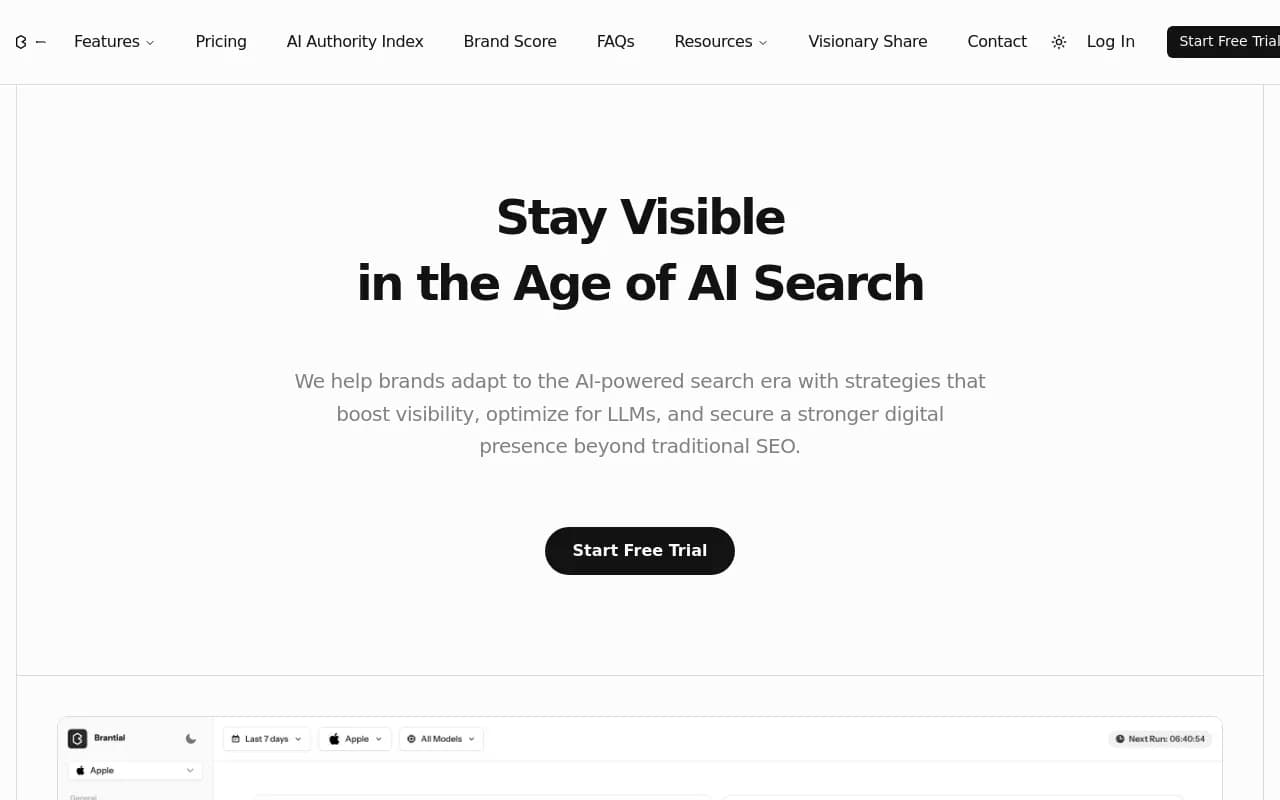
Brantial is a newer GEO platform positioning itself around helping brands "stay visible in the AI search era." Its pitch is solid: it covers AI visibility monitoring, content optimization for LLM readability (schema markup, entity signals), and analytics tracking citations and referral clicks. The pricing is accessible, and the product seems aimed at growth teams and marketers who want a lighter-weight entry into GEO without the complexity of an enterprise platform. Customers listed on their site include Vercel, Revolut, Zoom, and GitLab -- though it's worth noting these may be logos rather than confirmed case studies.
Side-by-side comparison
| Feature | Promptwatch | Brantial |
|---|---|---|
| Starting price | $99/mo (Essential) | $59/mo (Starter) |
| Free trial | 7-day free trial | Free trial available |
| AI models monitored | 10+ (ChatGPT, Claude, Gemini, Perplexity, Grok, DeepSeek, Copilot, Meta AI, Mistral, Google AI Overviews) | ChatGPT, Google SGE (limited documentation on others) |
| Prompt tracking | Yes, with volume estimates + difficulty scores | Yes |
| Answer gap analysis | Yes (shows exactly which prompts competitors rank for that you don't) | Limited |
| AI content generation | Yes (built-in writing agent for articles, listicles, comparisons) | No (optimization guidance only) |
| AI crawler logs | Yes (real-time logs per AI bot) | No |
| Citation & source analysis | Yes (880M+ citations analyzed) | Yes |
| Reddit & YouTube tracking | Yes | Not documented |
| ChatGPT Shopping tracking | Yes | Not documented |
| Traffic attribution | Yes (GSC integration, code snippet, server logs) | Yes (referral clicks, assisted conversions) |
| Multi-language/region | Yes | Not documented |
| Agency/multi-site plans | Yes (dedicated agency plans) | Up to 10 users on Pro |
| API access | Yes | Not documented |
| Looker Studio integration | Yes | Not documented |
| G2 rating | 4.7/5 | Not listed |
| Customers | 7,000+ brands | Listed logos (Vercel, Revolut, Zoom) |
Head-to-head feature deep-dive
AI model coverage
Promptwatch tracks 10 AI engines. That's not a marketing number -- it means you get separate visibility scores for ChatGPT, Perplexity, Claude, Gemini, Grok, DeepSeek, Copilot, Meta AI, Mistral, and Google AI Overviews. You can see which model is citing you, which isn't, and why the gap exists.
Brantial's documentation focuses on ChatGPT and Google SGE. That's fine for many use cases, but if your audience is using Perplexity or Claude (and a growing share is), you're flying blind on those channels.
Verdict: Promptwatch wins on breadth. If you care about more than just ChatGPT, the gap is significant.
Content gap analysis and optimization
This is where the two tools diverge most sharply.
Promptwatch's Answer Gap Analysis shows you the specific prompts where competitors are being cited and you're not. It's not just "you're missing content about X" -- it shows you the actual prompt, the competitor that's winning it, and the content angle that's getting cited. Then the built-in AI writing agent generates a full article or comparison piece grounded in that citation data.
Brantial takes a different approach: it focuses on making your existing content more AI-readable through schema markup, entity optimization, and contextual structuring. That's genuinely useful, especially for technical teams. But it doesn't generate new content for you, and it doesn't show you the specific prompt-level gaps your competitors are exploiting.
Verdict: Promptwatch for teams that want to create net-new content targeting AI search. Brantial for teams that want to optimize what they already have.
Crawler logs
Promptwatch shows you real-time logs of AI crawlers hitting your site -- which pages ChatGPT, Claude, Perplexity, and others are reading, how often they return, and what errors they encounter. This is genuinely useful for diagnosing why certain pages aren't getting cited (maybe the crawler is hitting a 404, or the page isn't being indexed at all).
Brantial doesn't appear to offer this. Their "speed and adaptability" messaging suggests they handle schema and entity updates on your behalf, but there's no mention of raw crawler log access.
Verdict: Promptwatch, clearly. Crawler logs are one of those features that sounds niche until you actually need to debug why your best page isn't getting cited.
Analytics and traffic attribution
Both platforms track citation counts, inclusion rates, and which pages are being cited. Brantial explicitly mentions referral clicks and assisted conversions as KPIs, which is a good sign -- it means they're thinking about connecting visibility to revenue, not just impressions.
Promptwatch's attribution goes deeper: you can connect AI visibility to actual traffic via a code snippet, Google Search Console integration, or server log analysis. Page-level tracking shows which specific pages are being cited by which models, and you can see how that translates to sessions and conversions.
Verdict: Roughly even on the basics. Promptwatch has more attribution options and more granular page-level data.
Prompt intelligence
Promptwatch assigns volume estimates and difficulty scores to each prompt, similar to how traditional SEO tools score keywords. It also shows "query fan-outs" -- how one prompt branches into related sub-queries. This lets you prioritize: go after high-volume, winnable prompts first instead of spreading effort across everything.
Brantial mentions analyzing "millions of real conversations to uncover intent, trends, and opportunities" but doesn't document prompt-level scoring or difficulty metrics in the same way.
Verdict: Promptwatch has more structured prompt prioritization data.
Ease of use and team fit
Brantial's pricing structure (Starter at $59/mo for 1 user, Growth at $149/mo for 5 users) suggests it's designed for smaller teams or individuals who want a clean, accessible entry point. The messaging is straightforward and the feature set is less overwhelming.
Promptwatch has more features, which means more to learn. The platform is well-documented and the UI is polished (4.7/5 on G2), but if you're a solo marketer who just wants to know "is ChatGPT mentioning my brand?", Brantial might feel more proportionate.
Verdict: Brantial for simplicity and solo users. Promptwatch for teams that want to go deep.
Agency and enterprise support
Promptwatch has dedicated agency plans, Looker Studio integration, API access, and custom enterprise pricing. It's clearly built to support agencies managing multiple client accounts.
Brantial's Pro plan at $299/mo supports 10 users, which works for a small agency team. But there's no documented API, no white-label options, and no mention of multi-site management at scale.
Verdict: Promptwatch for agencies. Brantial for in-house teams.
Pricing comparison
| Plan | Promptwatch | Brantial |
|---|---|---|
| Entry tier | $99/mo (Essential: 1 site, 50 prompts, 5 articles/mo) | $59/mo (Starter: 1 user) |
| Mid tier | $249/mo (Professional: 2 sites, 150 prompts, 15 articles, crawler logs) | $149/mo (Growth: 5 users) |
| Upper tier | $579/mo (Business: 5 sites, 350 prompts, 30 articles) | $299/mo (Pro: 10 users) |
| Agency/Enterprise | Custom pricing | Not documented |
| Free trial | 7-day free trial | Free trial available |
| Annual discount | Yes | Not documented |
Brantial is cheaper at every tier. The question is whether the feature gap justifies the price difference. For a team that needs crawler logs, content generation, Reddit tracking, and 10-model coverage, Promptwatch's $249/mo Professional plan is doing a lot more than Brantial's $149/mo Growth plan. For a team that just wants basic citation monitoring and content optimization tips, Brantial's pricing is hard to argue with.
Pros and cons
Promptwatch
Pros:
- Covers 10 AI models, including Grok, DeepSeek, and Mistral
- Built-in AI content generation grounded in real citation data
- Answer Gap Analysis shows exactly which prompts competitors are winning
- AI crawler logs for diagnosing indexing issues
- Reddit and YouTube citation tracking
- ChatGPT Shopping monitoring
- Strong traffic attribution (GSC, code snippet, server logs)
- Mature agency infrastructure (API, Looker Studio, multi-site)
- 1.1B+ citations processed -- the data depth is real
- 4.7/5 on G2 with 7,000+ customers
Cons:
- More expensive entry point ($99/mo vs $59/mo)
- More features means more to configure and learn
- Overkill for teams that just want basic brand mention tracking
Brantial
Pros:
- Lower starting price ($59/mo)
- Clean, accessible product for smaller teams
- Schema markup and entity optimization is a useful technical angle
- Tracks referral clicks and assisted conversions
- Good fit for teams optimizing existing content rather than creating new
Cons:
- Narrower AI model coverage (primarily ChatGPT and Google SGE)
- No built-in AI content generation
- No AI crawler logs
- Prompt-level scoring and difficulty metrics not documented
- No Reddit or YouTube citation tracking
- Agency/enterprise infrastructure not documented
- Smaller customer base and less public data on performance
Who should pick which tool
Pick Promptwatch if:
- You want to track visibility across 10+ AI models, not just ChatGPT
- You need to create new content targeting AI search, not just optimize existing pages
- You want to understand why AI crawlers aren't indexing certain pages
- You're an agency managing multiple client accounts
- You need to connect AI visibility to actual revenue with traffic attribution
- You want prompt-level data (volume, difficulty, fan-outs) to prioritize your work
Pick Brantial if:
- You're a solo marketer or small team just getting started with GEO
- Your primary focus is ChatGPT and Google SGE
- You want to optimize existing content for LLM readability (schema, entity signals) rather than generate new content
- Budget is a real constraint and you need the cheapest credible option
- You don't need crawler logs or deep prompt analytics
Final verdict
Promptwatch is the stronger platform for teams that want to do more than watch a dashboard. The content generation loop -- find gaps, create content, track results -- is what separates it from monitoring-only tools, and Brantial sits closer to the monitoring end of that spectrum. The 10-model coverage, crawler logs, and 1.1B+ citation dataset give Promptwatch a data advantage that's hard to replicate.
That said, Brantial isn't a bad product. If you're a small team with a tight budget who primarily cares about ChatGPT and Google SGE visibility, $59/mo is a reasonable starting point. Just know you'll likely outgrow it once you want to act on what you're seeing.
For most marketing teams and agencies taking AI search seriously in 2026, Promptwatch is the more complete tool.