Key takeaways
- Promptwatch covers the full optimization loop: find gaps, generate content, track results. Nudge is primarily a discovery and conversion tool for commerce brands.
- Nudge is built specifically for e-commerce -- its shoppable funnel feature is genuinely unique. Promptwatch is broader and works for any brand, agency, or marketing team.
- Pricing is a major gap. Promptwatch starts at $99/month with a free trial. Nudge has no public pricing, no free trial, and typically runs $500-$2,000/month at mid-market.
- Promptwatch monitors 10+ AI engines. Nudge focuses on ChatGPT, Perplexity, Claude, and Gemini.
- Promptwatch includes AI crawler logs, Reddit/YouTube citation tracking, and an AI writing agent -- none of which Nudge offers.
- If you're a DTC or retail brand trying to capture AI-driven shopping intent and convert it, Nudge has a compelling angle. For everything else, Promptwatch is the stronger choice.
Overview
Promptwatch

Promptwatch is an end-to-end AI search visibility platform used by 7,000+ brands and agencies. The core idea is simple: most companies have no idea how they appear (or don't appear) in ChatGPT, Perplexity, Claude, and other AI engines. Promptwatch fixes that by tracking specific prompts, showing you where competitors are visible and you're not, and then helping you create content that actually gets cited. It's the only platform in this space that closes the loop from "I don't know what's happening" to "here's the content I published and here's how my visibility improved."
It covers 10+ AI models, has crawler logs so you can see which AI bots are crawling your site, tracks citations down to the page level, and includes a built-in AI writing agent. Rated 4.7/5 on G2.
Nudge
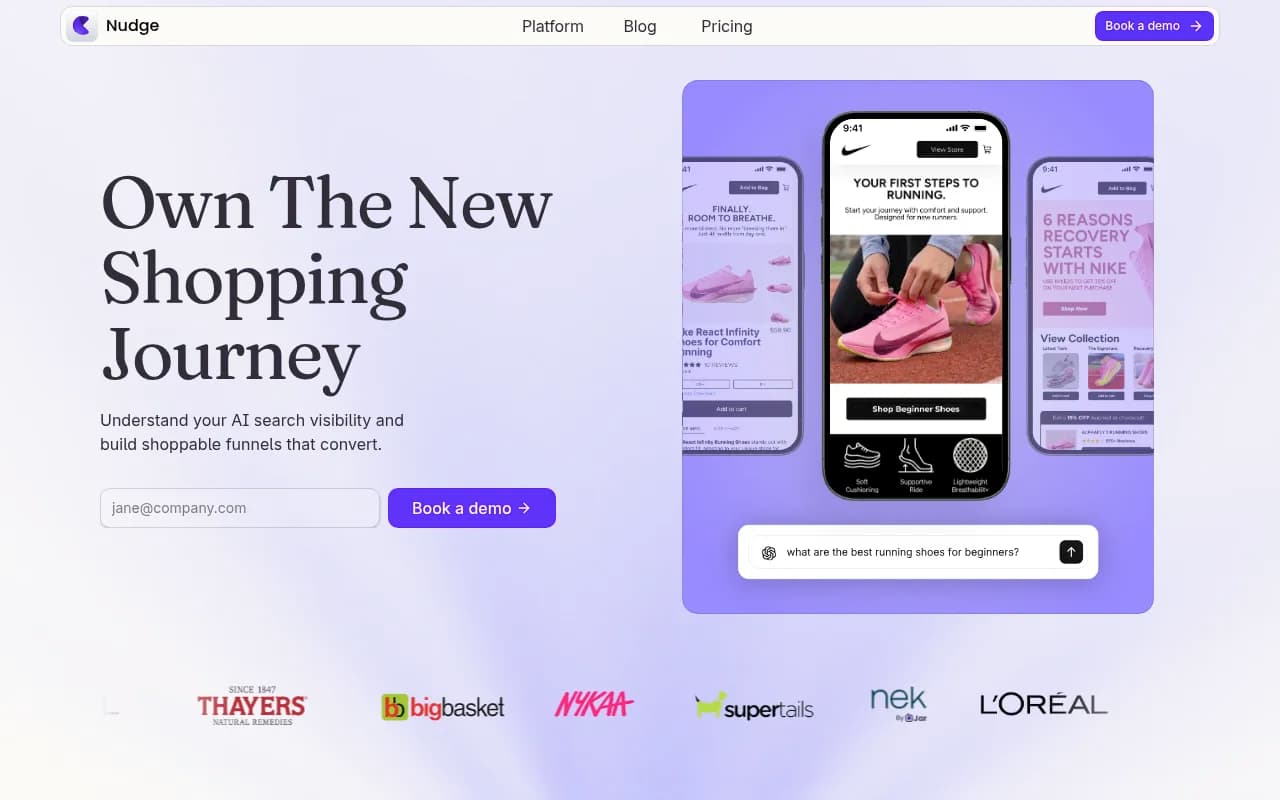
Nudge takes a narrower but interesting angle. It's positioned as an "AI discovery and conversion platform for commerce brands" -- the pitch being that 400M+ shoppers ask AI what to buy every month, and Nudge helps you show up in those conversations and then convert that intent into a sale. It combines AI search visibility tracking (brand mentions, sentiment, citation gaps) with shoppable funnel generation, where it builds product-specific landing pages optimized around the actual prompts shoppers are using.
It's a newer, more specialized product. The monitoring side covers ChatGPT, Perplexity, Claude, and Gemini. The funnel side is genuinely differentiated for e-commerce. But outside of retail and commerce, the value proposition gets thinner.
Side-by-side comparison
| Feature | Promptwatch | Nudge |
|---|---|---|
| Primary use case | AI visibility + GEO for any brand/agency | AI discovery + conversion for commerce brands |
| AI engines monitored | 10+ (ChatGPT, Perplexity, Claude, Gemini, Grok, DeepSeek, Copilot, Meta AI, Mistral, Google AI Overviews) | 4 (ChatGPT, Perplexity, Claude, Gemini) |
| Free trial | Yes, 7 days | No |
| Starting price | $99/month | ~$500/month (custom, no public pricing) |
| Content generation | Yes -- AI writing agent for articles, listicles, comparisons | Shoppable funnels only (commerce-focused) |
| Answer gap analysis | Yes | Partial (citation gaps) |
| AI crawler logs | Yes | No |
| Reddit/YouTube tracking | Yes | No |
| ChatGPT Shopping tracking | Yes | Yes |
| Prompt volume/difficulty scoring | Yes | Not publicly documented |
| Competitor heatmaps | Yes | Yes (competitive analysis) |
| Sentiment tracking | Yes | Yes |
| Multi-language/region | Yes | Not documented |
| API access | Yes | Not documented |
| Looker Studio integration | Yes | Not documented |
| Target audience | Brands, SEO teams, agencies | E-commerce/DTC brands |
| Self-serve signup | Yes | Demo required |
Head-to-head feature deep-dive
AI engine coverage
Promptwatch monitors 10 AI models: OpenAI/ChatGPT, Perplexity, Google AI Overviews, Google AI Mode, Claude, Gemini, Meta/Llama, DeepSeek, Grok, Mistral, and Copilot. That breadth matters because AI search isn't just ChatGPT anymore -- Perplexity has grown fast, Grok has a large user base through X, and Google AI Mode is becoming a real traffic driver.
Nudge covers ChatGPT, Perplexity, Claude, and Gemini. That's the core four, and for most commerce brands those are the platforms that matter most. But if you need visibility into Grok, DeepSeek, or Copilot, Nudge doesn't cover them.
Verdict: Promptwatch wins on breadth. Nudge covers the essentials for most e-commerce use cases, but the gap is real.
Content optimization and gap analysis
This is where the two tools diverge most sharply.
Promptwatch's Answer Gap Analysis shows you exactly which prompts your competitors rank for that you don't. It then surfaces the specific topics and questions your site is missing, and the built-in AI writing agent generates content -- articles, listicles, comparison pages -- grounded in 880M+ real citation data points. You can see which pages are getting cited, publish new content, and watch your visibility scores move. It's a full workflow.
Nudge's approach to content is narrower: it generates shoppable funnels built around specific shopper prompts. So if someone asks "what's the best running shoe for flat feet under $150," Nudge can build a landing page around that exact question with your products surfaced. That's genuinely useful for e-commerce conversion. But it's not the same as creating editorial content that gets cited by AI engines across a range of informational queries.
Verdict: Depends on your goal. For general content optimization and GEO, Promptwatch is the clear choice. For converting AI-driven shopping intent into sales, Nudge's funnel approach is unique.
Monitoring and tracking depth
| Capability | Promptwatch | Nudge |
|---|---|---|
| Brand mention tracking | Yes | Yes |
| Sentiment analysis | Yes | Yes |
| Citation source analysis | Yes | Partial |
| Page-level citation tracking | Yes | Not documented |
| AI crawler logs | Yes | No |
| Reddit/YouTube citation tracking | Yes | No |
| Prompt volume estimates | Yes | Not documented |
| Query fan-outs | Yes | No |
| Competitor heatmaps | Yes | Yes |
| ChatGPT Shopping tracking | Yes | Yes |
Promptwatch's crawler logs are worth calling out specifically. You can see in real time which AI bots (ChatGPT, Claude, Perplexity, etc.) are crawling your site, which pages they're reading, and what errors they're hitting. That's a diagnostic layer most tools don't have -- and it's often the first place to look when your visibility isn't improving despite publishing new content.
Nudge's monitoring is solid for what it covers: brand mentions, sentiment, competitive positioning, and citation gaps. But it doesn't appear to offer crawler-level diagnostics, Reddit/YouTube tracking, or the prompt intelligence layer (volume, difficulty, fan-outs) that Promptwatch provides.
Verdict: Promptwatch has meaningfully deeper monitoring capabilities. Nudge covers the basics well but stops there.
Shoppable funnels (Nudge-specific)
This is Nudge's most distinctive feature and worth understanding properly. The idea is that when a shopper asks an AI engine "what's the best protein powder for muscle gain," they're expressing purchase intent. Nudge captures that signal, identifies the decision criteria embedded in the prompt (ingredients, price, brand trust, etc.), and generates a landing page that matches the shopper's context -- surfacing the right products with the right framing.
Promptwatch doesn't have anything equivalent. It's not trying to. Promptwatch is about getting your brand cited in AI responses; Nudge is about what happens after that citation -- converting the click.
If you're a DTC brand or retailer, this is a real differentiator. If you're a SaaS company, a B2B brand, a publisher, or an agency managing multiple clients, it's not relevant.
Verdict: Nudge wins this category outright. It's the only tool in this comparison with a dedicated conversion layer for AI-driven shopping.
Pricing
| Plan | Promptwatch | Nudge |
|---|---|---|
| Free tier | No (7-day free trial) | No |
| Entry/Essential | $99/month (1 site, 50 prompts, 5 articles) | Not available |
| Professional | $249/month (2 sites, 150 prompts, 15 articles, crawler logs) | ~$500-$2,000/month (estimated) |
| Business | $579/month (5 sites, 350 prompts, 30 articles) | ~$500-$2,000/month (estimated) |
| Enterprise/Agency | Custom | ~$3,000-$10,000/month (estimated) |
| Annual discount | Yes | Not documented |
| Self-serve | Yes | No (demo required) |
Nudge doesn't publish pricing. Based on available market data, mid-market customers typically pay somewhere in the $500-$2,000/month range, with enterprise contracts running $3,000-$10,000/month. That's a significant premium over Promptwatch, and you can't test it without going through a sales process.
Promptwatch's self-serve model is a real advantage here -- you can start a free trial, explore the platform, and make a decision without talking to anyone. For smaller teams or agencies evaluating multiple tools, that matters.
Verdict: Promptwatch wins on pricing and accessibility. Nudge's pricing model is opaque and requires a sales conversation before you can evaluate anything.
Ease of use and onboarding
Promptwatch is self-serve. You sign up, start a free trial, add your domain, set up prompts, and you're tracking within minutes. The interface is built around the track-analyze-optimize workflow, so it's reasonably intuitive even if you're new to GEO.
Nudge requires a demo call to get started. That's not necessarily a red flag for enterprise buyers who expect a sales process, but it does mean you can't evaluate the product on your own terms. There's no public documentation or product tour that gives a clear sense of the interface.
Verdict: Promptwatch is more accessible. Nudge's demo-only model suits enterprise buyers but creates friction for everyone else.
Integrations and reporting
Promptwatch integrates with Google Search Console for traffic attribution, offers a Looker Studio connector for custom reporting, and has an API for custom workflows. It also supports server log analysis as a third option for connecting AI visibility to actual traffic.
Nudge's integration capabilities aren't publicly documented. Given its commerce focus, it likely integrates with e-commerce platforms (Shopify, etc.) for the funnel side, but specifics aren't available.
Verdict: Promptwatch has documented, flexible reporting options. Nudge's integrations are unclear from public information.
Pros and cons
Promptwatch
Pros:
- Full optimization loop: monitoring, gap analysis, content generation, and traffic attribution in one platform
- 10+ AI engines covered, including Grok, DeepSeek, and Copilot
- AI crawler logs give you diagnostic visibility most tools lack
- Reddit and YouTube citation tracking surfaces non-obvious influence channels
- Self-serve with a free trial -- no sales call required
- Transparent, accessible pricing starting at $99/month
- 7,000+ customers including Booking.com, Center Parcs, Typeform, Yelp
- Looker Studio integration and API for custom reporting
Cons:
- No dedicated e-commerce conversion layer (no shoppable funnels)
- Article limits on lower plans (5 articles/month on Essential) may feel restrictive for high-volume content teams
- The breadth of features means there's a learning curve to get full value
Nudge
Pros:
- Shoppable funnel generation is genuinely unique -- no other tool in this comparison does this
- Purpose-built for commerce brands, so the product decisions are tightly focused
- Competitive analysis and sentiment tracking are solid
- Covers the four most important AI engines for consumer shopping queries
Cons:
- No free trial -- you have to go through a sales process to evaluate it
- Pricing is opaque and significantly higher than Promptwatch
- Only covers 4 AI engines
- No crawler logs, no Reddit/YouTube tracking, no general content generation
- Limited documentation makes it hard to assess integrations and depth
- Narrow use case -- not useful for non-commerce brands, agencies, or B2B companies
Who should pick which tool
Choose Promptwatch if:
- You're a brand, marketing team, or agency that wants to track and improve AI search visibility across a broad range of AI engines
- You want to create content that gets cited by ChatGPT, Claude, Perplexity, and others -- not just monitor what's happening
- You need crawler logs to diagnose why your content isn't being picked up
- You're managing multiple clients or sites (agency plans available)
- You want to start quickly without a sales conversation
- Budget matters and you want transparent, predictable pricing
Choose Nudge if:
- You're a DTC or retail brand where AI-driven shopping discovery is a primary growth channel
- You want to convert AI-driven shopper intent into sales with purpose-built landing pages
- You're already spending $500+/month on tools and the shoppable funnel feature justifies the premium
- You're comfortable with a sales-led buying process
Final verdict
These two tools are less direct competitors than they might appear. Promptwatch is a full-cycle AI visibility platform for any brand or agency that wants to track, understand, and improve how they appear in AI search. Nudge is a specialized commerce tool that adds a conversion layer on top of AI discovery tracking.
For most companies -- especially those outside pure e-commerce -- Promptwatch is the stronger choice. It covers more AI engines, goes deeper on monitoring, includes content generation, and costs significantly less. The free trial means you can validate it before spending anything.
Nudge's shoppable funnel feature is the one thing Promptwatch doesn't do, and for the right e-commerce brand it could be genuinely valuable. But the opaque pricing, demo-only access, and narrower coverage make it a harder sell unless you're specifically a commerce brand with budget to match.
The short version: Promptwatch is the better platform for AI visibility and optimization. Nudge is the better tool if you're a retailer trying to turn AI shopping queries into conversions.