Key takeaways
- Evertune is a legitimate enterprise GEO platform, but its opaque pricing, limited public documentation, and monitoring-only approach make it a risky default choice for most teams.
- Most alternatives fall into two camps: monitoring dashboards that show you data (Peec AI, AthenaHQ, Otterly.AI) and platforms that also help you act on it (Promptwatch, Relixir, AirOps).
- Promptwatch is the only platform in this comparison rated as a "Leader" across all GEO categories, covering 10 AI models with built-in content gap analysis, AI writing, and crawler log monitoring.
- Profound is the strongest enterprise alternative if you need SOC 2 compliance and maximum engine coverage, but it's monitoring-heavy and expensive.
- Budget-conscious teams should look at Peec AI or Otterly.AI for basic tracking, with the understanding that neither will help you fix what they find.
Evertune has built a real product. It runs over a million custom prompts monthly through its EverPanel methodology, tracks brand sentiment across AI engines, and serves Fortune 500 clients. That's not nothing.
But here's the problem most teams run into: you can't find the pricing, the documentation is thin, and the platform is primarily built around monitoring. You see where you're invisible. You don't get much help becoming visible.
That gap -- between knowing you have a problem and being able to fix it -- is where the GEO market is splitting in 2026. Some tools are dashboards. Others are optimization engines. This guide covers both, so you can pick what actually fits your situation.
What Evertune does (and where it falls short)
Evertune positions itself as an enterprise AI visibility platform. Its core differentiator is statistical rigor: the EverPanel approach runs large prompt volumes to reduce noise in visibility data. For regulated industries where data confidence matters, that's genuinely useful.
What it doesn't do well:
- No published pricing. Every evaluation requires a sales cycle, which wastes time for teams comparing multiple tools.
- No content generation. Evertune shows you gaps but doesn't help you close them.
- Limited public case studies. It's hard to verify outcomes before committing.
- No AI crawler log monitoring. You can't see which pages AI bots are actually reading on your site.
If you're a Fortune 500 brand with a dedicated research team and a long procurement cycle, Evertune might be worth evaluating. For everyone else, the alternatives below offer more transparency and, in several cases, more capability.
The full comparison
| Tool | Best for | Pricing | AI engines | Content generation | Crawler logs | Free trial |
|---|---|---|---|---|---|---|
| Promptwatch | End-to-end optimization | From $99/mo | 10+ | Yes | Yes | Yes |
| Profound | Enterprise scale | From $499/mo | 10+ | No | No | No |
| Relixir | Enterprise GEO with content | Custom | Multiple | Yes | Unknown | No |
| Bluefish AI | Fortune 500 brand intelligence | Custom | Multiple | No | No | No |
| AthenaHQ | Mid-market monitoring | Custom | Multiple | No | No | No |
| Peec AI | GDPR-compliant tracking | From €89/mo | 4 | No | No | Yes |
| Otterly.AI | Budget entry point | From $29/mo | 6 | GEO audit only | No | Yes |
| AirOps | Content workflow automation | Free / Custom | 3 | Yes (workflow) | No | Yes |
| Evertune | Statistical rigor, enterprise | Custom | Multiple | No | No | No |
1. Promptwatch — best overall for optimization, not just monitoring
Promptwatch is the most complete platform in this comparison. Where Evertune stops at monitoring, Promptwatch runs a full loop: find gaps, create content, track results.
The Answer Gap Analysis shows exactly which prompts your competitors rank for that you don't. Not vague categories -- specific questions and topics that AI models want to answer but can't find on your site. From there, the built-in AI writing agent generates articles, listicles, and comparisons grounded in citation data from over 880 million analyzed citations. The content isn't generic SEO filler; it's engineered around what AI models actually cite.
Beyond content, Promptwatch monitors AI crawler logs in real time -- which pages ChatGPT, Claude, Perplexity, and others are reading, how often they return, and what errors they hit. Most competitors don't offer this at all. Traffic attribution (via code snippet, GSC integration, or server log analysis) closes the loop by connecting AI visibility to actual revenue.
It covers 10 AI models: ChatGPT, Perplexity, Google AI Overviews, Google AI Mode, Claude, Gemini, Meta/Llama, DeepSeek, Grok, and Mistral. Pricing starts at $99/month with a free trial available.

2. Profound — best for enterprise scale and compliance
Profound is the strongest pure-monitoring alternative for large organizations. It tracks 10+ AI engines, processes over 100 million queries per month, and holds SOC 2 Type II and HIPAA compliance certifications -- which matter in healthcare, finance, and other regulated sectors.
The Conversation Explorer feature gives access to 400M+ real prompts, which is genuinely useful for understanding how customers actually phrase questions to AI models. Account managers are included on enterprise plans.
The trade-off: Profound is expensive (starting around $499/month), doesn't generate content, and independent testing has found that its API-based tracking matches manual verification roughly 60% of the time. For a platform at that price point, that's worth knowing before you sign.
Profound

3. Relixir — best for enterprise GEO with content capabilities
Relixir is one of the few enterprise-focused platforms that combines tracking with content generation. It's built as an end-to-end GEO engine, which puts it closer to Promptwatch in philosophy than to monitoring-only tools like Evertune or AthenaHQ.
Pricing is custom and requires a sales conversation, which limits transparency. But if you're an enterprise brand that needs both visibility data and content output in one platform, Relixir is worth evaluating alongside Promptwatch.
4. Bluefish AI — best for Fortune 500 brand intelligence
Bluefish AI targets large enterprise brands and focuses on brand intelligence within AI-generated responses. It's a monitoring platform -- you get data on where your brand appears, how it's described, and how competitors compare.
What it doesn't offer: content generation, crawler log monitoring, or Reddit/YouTube tracking. Pricing is custom. For Fortune 500 teams with dedicated analytics functions who need clean brand intelligence data, Bluefish is a reasonable choice. For teams that also need to act on what they find, it's not enough on its own.
5. AthenaHQ — monitoring-focused with clean UX
AthenaHQ has built a clean, well-designed monitoring platform. It tracks brand mentions across AI engines, shows competitor comparisons, and surfaces which prompts are driving visibility for others in your category.
The limitation is the same one that affects most mid-market tools: it stops at the data. There's no content generation, no crawler logs, no traffic attribution. Pricing is custom, which makes it harder to evaluate without a sales call. Teams that want a polished monitoring experience and have separate content workflows might find it fits. Teams that want one platform to handle both will hit a ceiling quickly.

6. Peec AI — best for GDPR-compliant tracking on a budget
Peec AI is a European platform built with GDPR compliance as a core feature, not an afterthought. It uses browser-level rendering to capture what users actually see (rather than what an API returns), which improves tracking accuracy.
The base plan starts at €89/month and covers four AI platforms with a 25-prompt limit. That's genuinely useful for small teams or those just starting to track AI visibility. The "Actions" feature provides optimization suggestions, though it doesn't generate content.
For EU-based organizations where data residency and compliance matter, Peec AI is the most purpose-built option in this comparison.

7. Otterly.AI — best budget entry point
Otterly.AI covers six AI engines, integrates with Semrush, and monitors across 12 countries -- all starting at $29/month. For teams that want to start tracking AI visibility without a large budget commitment, it's the most accessible option here.
The GEO audit feature provides some optimization guidance, but the platform is primarily a monitoring tool. There's no content generation, no crawler logs, and no traffic attribution. Think of it as a starting point, not a destination.
Otterly.AI

8. AirOps — best for content workflow automation
AirOps approaches AI visibility from a different angle. Rather than tracking brand mentions, it's a content engineering platform that helps teams build workflows for creating AI-optimized content at scale. It covers three AI engines and has a free tier.
If your primary need is content production rather than visibility monitoring, AirOps is worth a look. If you need both tracking and content in one place, it's not the right fit.
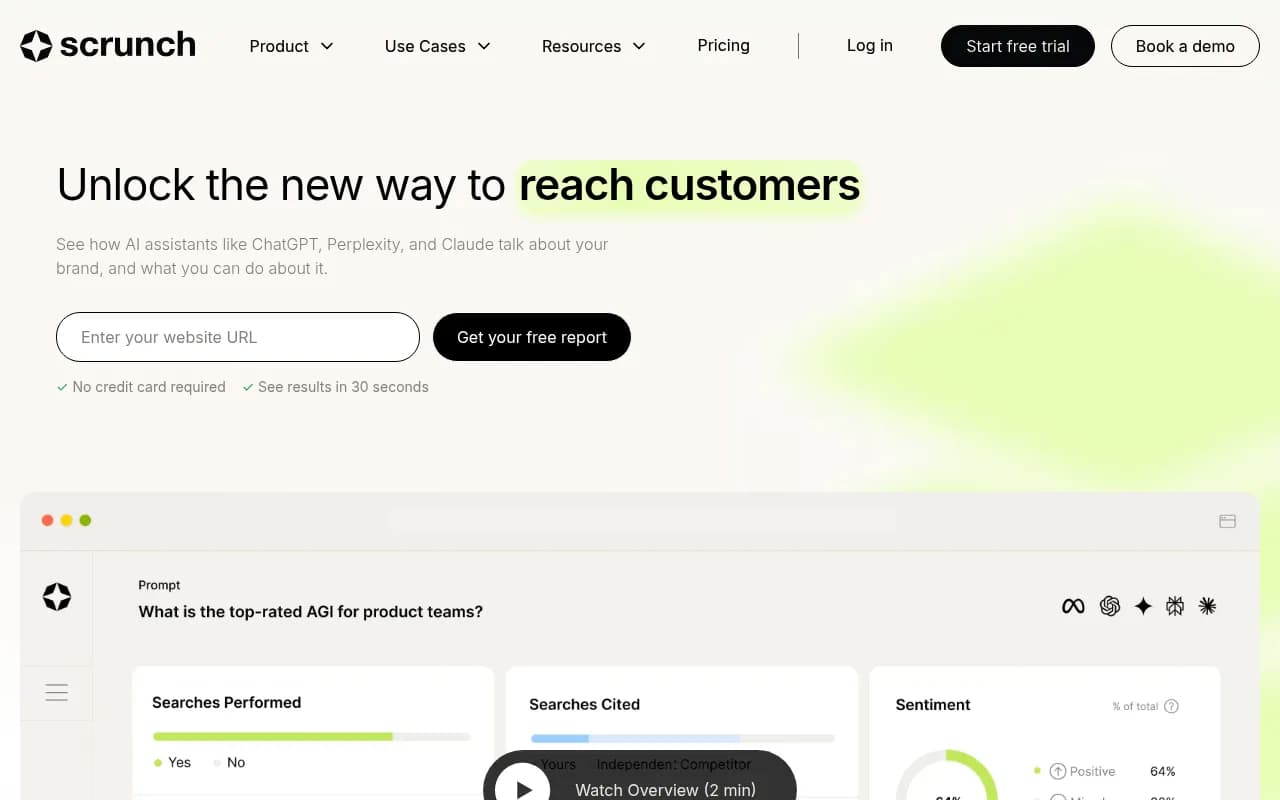
9. Scrunch AI — worth mentioning
Scrunch AI is a tracking and visibility platform that covers brand mentions across LLMs. It sits in the monitoring camp, similar to AthenaHQ, without content generation capabilities. Pricing is available on request.
How to choose
The most important question isn't which tool has the most features. It's what you actually need to do.
If you need to monitor and fix: Promptwatch is the clearest choice. It's the only platform here that covers the full loop from gap identification to content creation to traffic attribution, at a price that doesn't require a procurement process.
If you're enterprise with compliance requirements: Profound is the strongest monitoring option. Pair it with a content tool or consider Relixir if you want generation built in.
If you're budget-constrained: Peec AI (€89/mo) or Otterly.AI ($29/mo) get you started. Understand you'll hit limitations quickly if your goal is actually improving visibility, not just measuring it.
If Evertune's statistical rigor is the specific thing you need: It may still be worth evaluating, but go in knowing the pricing will require a sales cycle and the platform won't help you create content.
The GEO market in 2026 has a clear divide: tools that show you a problem, and tools that help you solve it. Most platforms in this list are in the first category. That's fine if you have the internal resources to act on data. If you don't, the monitoring-only approach will leave you with expensive dashboards and the same visibility problem you started with.
A broader look at the GEO tools landscape in 2026 -- most platforms cluster around monitoring, with fewer offering end-to-end optimization.