Key takeaways
- Conductor sits at the intersection of enterprise SEO and AI search visibility, so its alternatives split into two buckets: broad enterprise platforms (BrightEdge, seoClarity, Semrush) and AI-first trackers (Promptwatch, Profound, Peec AI, AthenaHQ).
- Most AI visibility tools stop at monitoring — they show you where you're invisible but leave you to figure out what to do next. A smaller group, including Promptwatch, actually helps you create content that gets cited.
- If you're primarily an SEO team that wants an AI layer, BrightEdge or seoClarity are natural fits. If AI search visibility is the main job, Promptwatch or Profound will serve you better.
- Pricing varies wildly: Promptwatch starts at $99/mo; enterprise platforms like Conductor and BrightEdge are quote-based and typically run into four to five figures annually.
- Free trials are available for most AI-first tools, making it easy to test before committing.
Conductor has been a credible enterprise SEO platform for years, and its recent push into AI search visibility tracking is real. But "real" doesn't mean it's the right tool for every team. Some organizations don't need a full enterprise operating system. Others need deeper AI search capabilities than Conductor currently offers. And some just want something they can actually afford without a procurement process.
This guide breaks down the most relevant Conductor alternatives in 2026, organized by what kind of team is actually looking for a replacement.
What Conductor actually does (and where it falls short)
Conductor is an enterprise content intelligence and SEO platform. It covers keyword research, content optimization, technical SEO monitoring, and — more recently — AI search visibility tracking. It lets you track brand mentions and citations across AI engines, customize tracking by persona, intent, topic, and region, and tie SEO performance to business outcomes.
That's a lot. Which is also the problem for many teams.
Conductor is quote-based, typically expensive, and built for large organizations with dedicated SEO teams. If you're a mid-market brand, a digital agency, or a team that specifically wants to improve how you appear in ChatGPT, Perplexity, or Google AI Overviews, you're probably paying for a lot of Conductor you won't use.
The other gap: Conductor's AI visibility features are still maturing. It tracks mentions and citations, but it doesn't yet offer the kind of content gap analysis and AI-native content generation that purpose-built GEO platforms provide.
The two types of Conductor alternatives
Before diving into specific tools, it's worth being clear about what you're actually replacing.
If you need Conductor's breadth — technical SEO, content workflows, enterprise reporting, and AI visibility all in one place — you're looking at BrightEdge, seoClarity, or Semrush.
If you primarily want AI search visibility — understanding where your brand shows up in LLM responses, what's missing, and how to fix it — you're looking at Promptwatch, Profound, Peec AI, or AthenaHQ.
Most teams shopping for a Conductor alternative are in the second camp. They already have an SEO tool. What they don't have is a clear picture of their AI search presence.
Best Conductor alternatives in 2026
1. Promptwatch — best for teams that want to act, not just monitor
Promptwatch is the most complete AI search visibility platform available right now, and the one that most directly addresses the gap that monitoring-only tools leave open.
The core difference is what happens after you see the data. Most tools show you that competitors are appearing in AI responses for prompts you're missing. Promptwatch shows you the same thing, then helps you do something about it. Its Answer Gap Analysis identifies exactly which prompts competitors rank for that you don't. Its built-in AI writing agent then generates articles, listicles, and comparisons grounded in real citation data — content specifically engineered to get cited by ChatGPT, Claude, Perplexity, and other AI models.
It also covers ground that most competitors skip entirely: AI crawler logs (which pages ChatGPT and Perplexity are actually reading on your site), Reddit and YouTube citation tracking, ChatGPT Shopping monitoring, prompt volume and difficulty scoring, and query fan-outs that show how a single prompt branches into sub-queries.
Pricing starts at $99/mo for the Essential plan (1 site, 50 prompts, 5 articles). The Professional plan at $249/mo adds crawler logs, city/state tracking, and 15 articles per month. A free trial is available.

2. BrightEdge — best enterprise alternative for large SEO teams
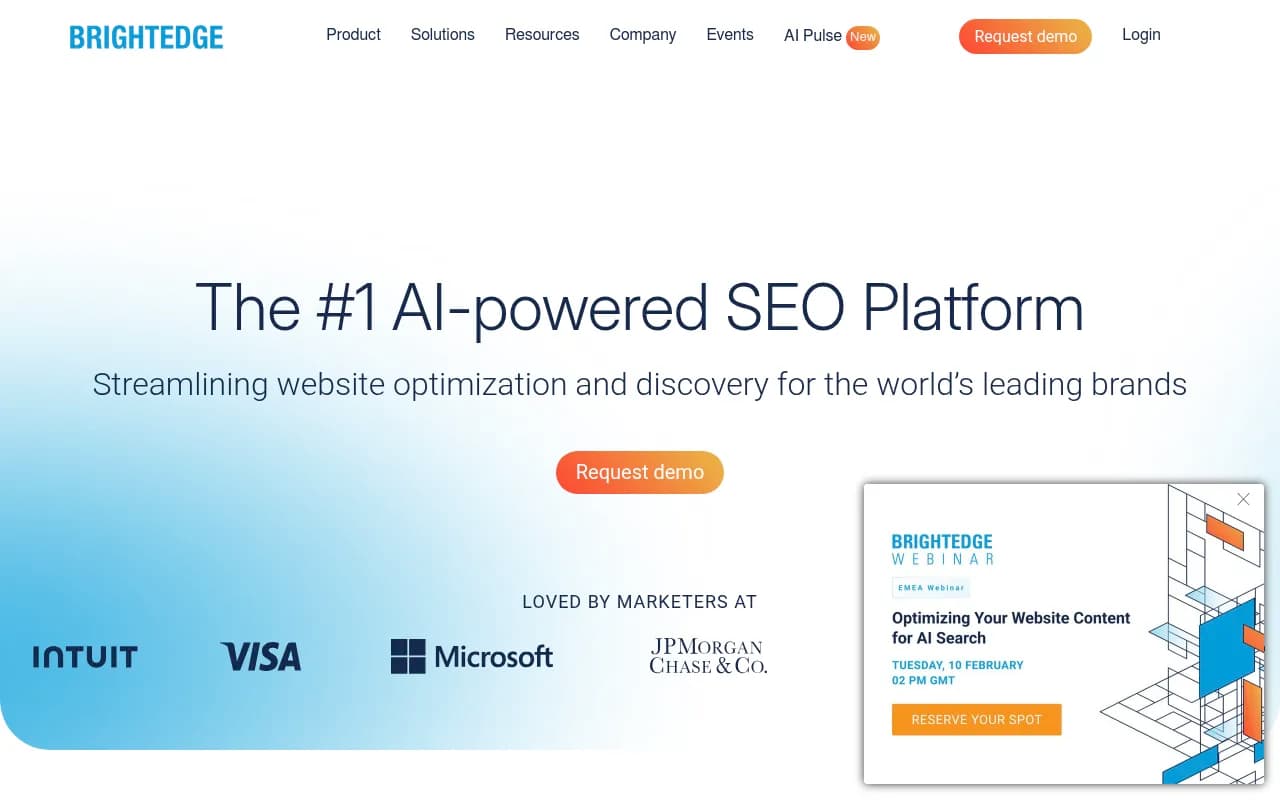
BrightEdge is the closest like-for-like replacement for Conductor in the enterprise SEO space. It covers organic search performance, content recommendations, competitive intelligence, and AI search visibility through its AI Catalyst feature set.
Where BrightEdge stands out is executive reporting and organizational standardization. Large teams with multiple stakeholders and complex approval workflows tend to find it easier to build consensus around BrightEdge's reporting structure than Conductor's.
The downside is the same as Conductor: it's quote-based, expensive, and built for organizations with dedicated SEO resources. It also doesn't offer the content generation capabilities that AI-first platforms provide.
3. seoClarity — best for hands-on SEO execution with AI search layers
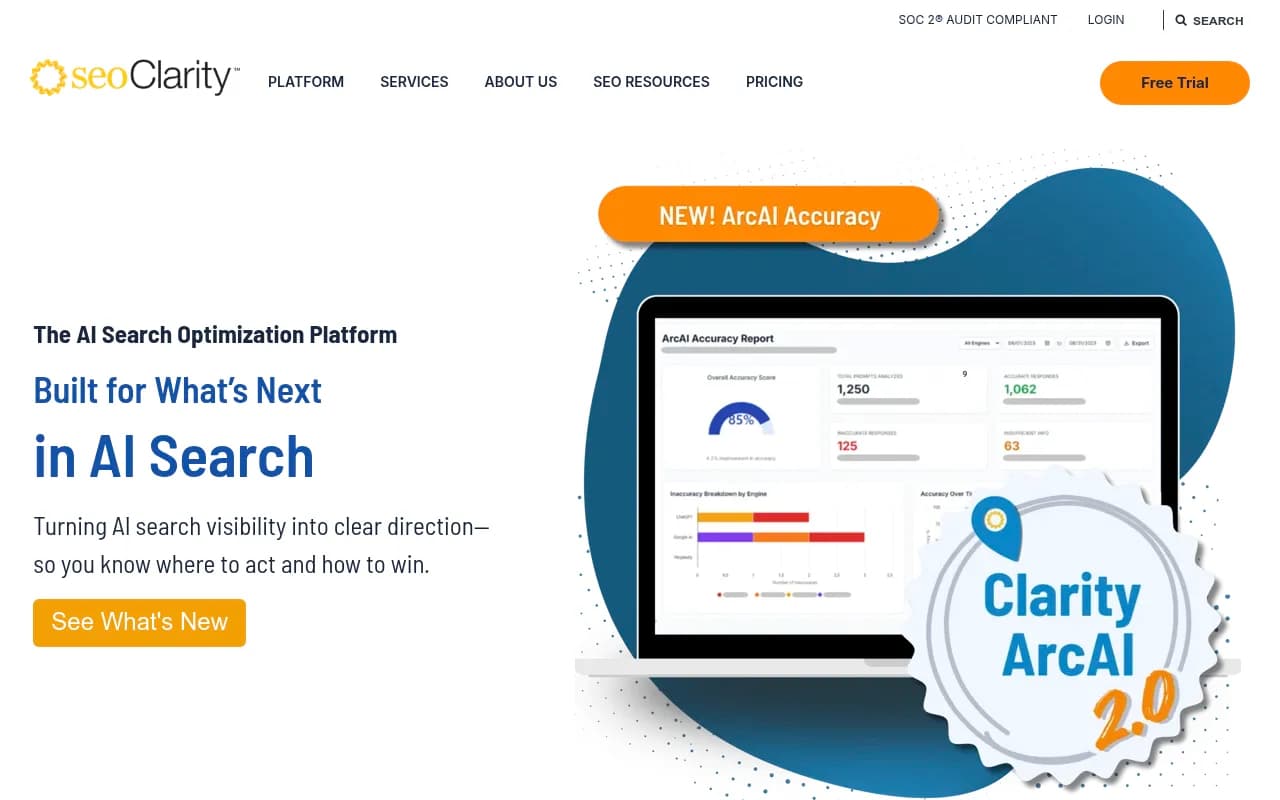
seoClarity combines enterprise SEO with AI search tracking in a way that's more execution-focused than Conductor. G2 consistently ranks it as the top Conductor alternative overall, and the reason is practical: it's better at helping teams actually do the work, not just report on it.
Its Clarity Grid technology processes large-scale keyword and SERP data, and its AI search visibility features track brand presence across LLMs. It's quote-based like Conductor and BrightEdge, so it's still an enterprise play, but teams that find Conductor too reporting-heavy and not execution-heavy enough often prefer seoClarity.
4. Profound — best for precise AI citation tracking
Profound is an AI-first visibility platform that focuses specifically on how brands appear in AI-generated responses. It covers ChatGPT, Perplexity, Google AI Overviews, and several other models, with strong entity extraction and attribution mapping.
It's more narrowly focused than Promptwatch — it doesn't have the content generation layer or the crawler logs — but for teams that want deep, precise tracking of AI citations and brand mentions, it's one of the better options available. Pricing starts at $99/mo.
Profound

5. Peec AI — solid monitoring for mid-market teams
Peec AI was one of the first tools to gain real traction in AI visibility tracking, particularly for Google AI Overviews and ChatGPT-style engines. It's effective for prompt-level analytics and brand presence monitoring.
The main limitations that have pushed teams to look elsewhere: cost scales up quickly for large keyword sets, and it's primarily a monitoring tool. There's no content gap analysis, no content generation, and no crawler logs. If you need to understand your AI search presence but already have a content team that can act on the data, Peec AI is a reasonable choice. If you need the full loop — find gaps, fix them, track results — you'll need to supplement it.

6. AthenaHQ — multi-engine tracking for brand-focused teams
AthenaHQ tracks brand visibility across Google AI Overviews, Perplexity, ChatGPT, and Claude. It's particularly strong for teams that care about brand narrative — how AI models describe your company, what descriptors they use, and how that compares to competitors.
Like most tools in this space, it's primarily a monitoring platform. It doesn't offer content generation or the kind of actionable optimization workflows that Promptwatch provides. Pricing starts at $295/mo, which puts it at the higher end of the AI-first tracker category.

7. Semrush — best if you're already in the Semrush ecosystem
Semrush has added AI visibility tracking through its AI Visibility Toolkit, which makes it a reasonable option if you're already a Semrush customer and want to add AI search monitoring without switching platforms. The toolkit adds prompt tracking and brand mention monitoring on top of Semrush's existing SEO suite.
The limitations are real, though. Semrush uses fixed prompts rather than custom ones, which limits how precisely you can track your actual competitive landscape. There's no AI traffic attribution, no content generation for AI search, and no crawler logs. It's a useful add-on, not a replacement for a purpose-built GEO platform.
8. Ahrefs — best for SEO-first teams adding AI visibility
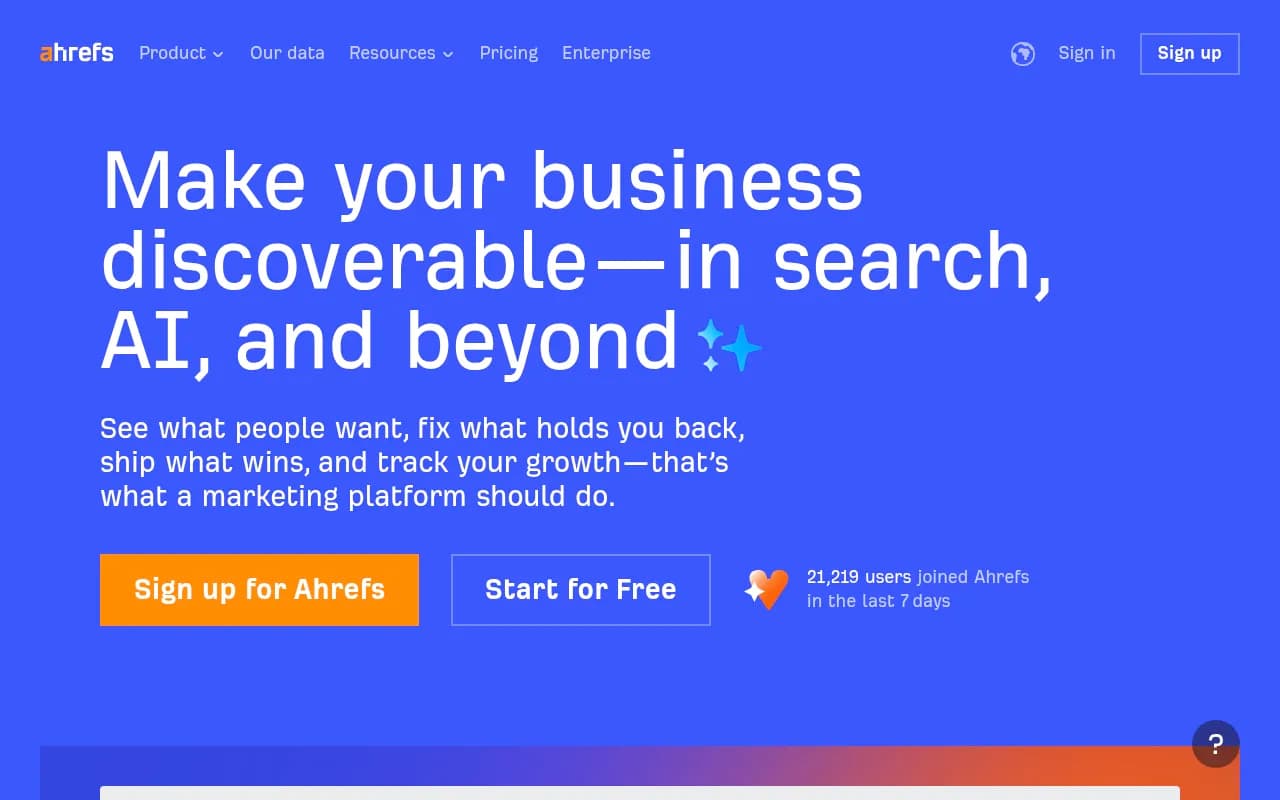
Ahrefs' Brand Radar feature adds AI visibility tracking to its core SEO platform. If your primary job is still traditional SEO — backlinks, keyword rankings, site audits — and AI search is a secondary concern, Ahrefs is a natural fit because you're already there.
The AI visibility layer has the same constraints as Semrush: fixed prompts, no AI traffic attribution, no content generation specifically for AI search. It's a starting point, not a complete solution.
9. Scrunch AI — brand narrative analysis
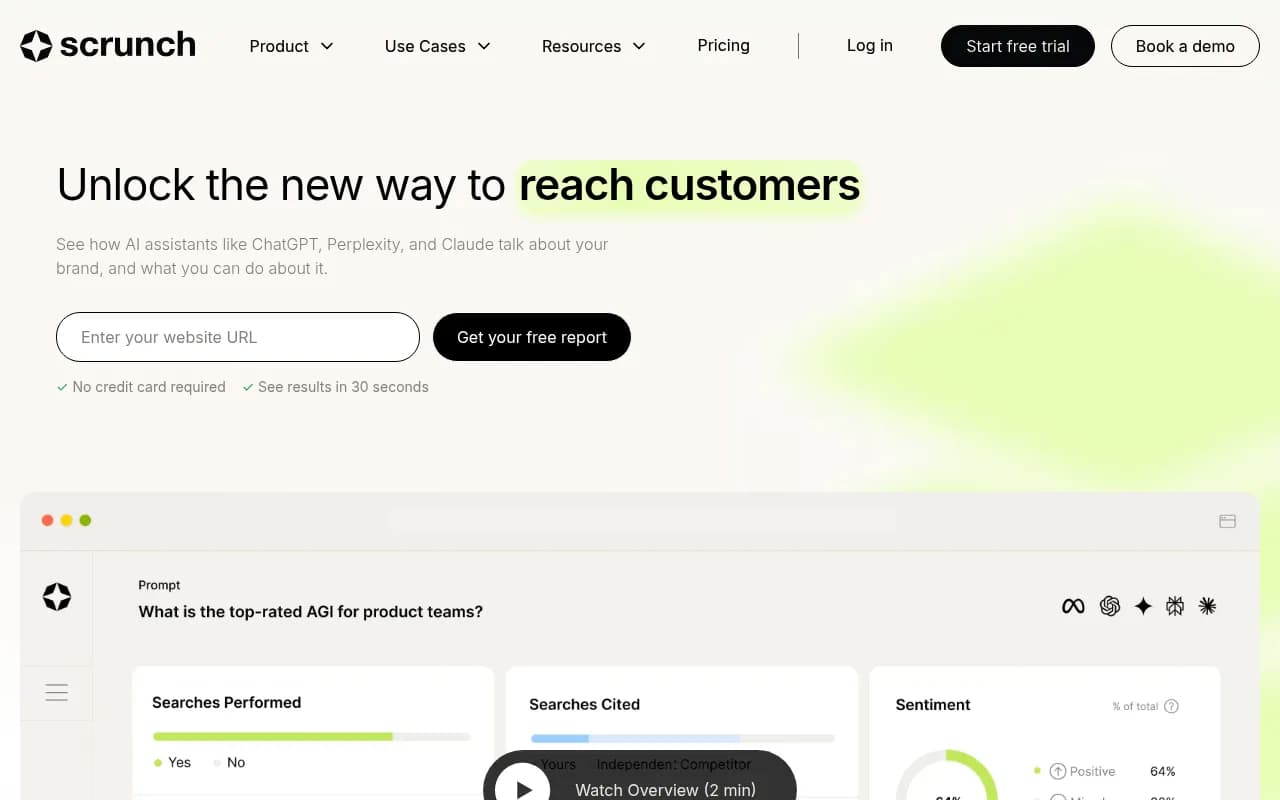
Scrunch AI focuses on how AI models describe and characterize your brand. It's useful for PR and brand teams that want to understand the narrative AI engines are building around their company, rather than just tracking citation frequency.
It's a narrower use case than most of the tools on this list, but for the right team — one that's already tracking visibility elsewhere and specifically wants to audit brand narrative — it fills a real gap.
10. Otterly.AI — lightweight monitoring for smaller teams
Otterly.AI is a basic AI search monitoring tool that tracks brand mentions across ChatGPT, Perplexity, and Google AI Overviews. It's simpler and more affordable than most options here, which makes it accessible for smaller teams or individuals who want a quick read on their AI search presence.
The tradeoff is depth. No crawler logs, no content generation, no visitor analytics, no Reddit or YouTube tracking. It's a monitoring dashboard, not an optimization platform.
Otterly.AI

Comparison table
| Tool | Category | Starting price | AI models tracked | Content generation | Crawler logs | Best for |
|---|---|---|---|---|---|---|
| Promptwatch | AI-first GEO platform | $99/mo | 10+ | Yes | Yes | Teams that want to find gaps and fix them |
| Conductor | Enterprise SEO + AI | Quote | Multiple | No | No | Large enterprise SEO teams |
| BrightEdge | Enterprise SEO + AI | Quote | Multiple | No | No | Enterprise teams, executive reporting |
| seoClarity | Enterprise SEO + AI | Quote | Multiple | No | No | Hands-on SEO execution at scale |
| Profound | AI-first tracker | $99/mo | 9+ | No | No | Precise citation and entity tracking |
| Peec AI | AI-first tracker | ~$99/mo | Multiple | No | No | Mid-market AI visibility monitoring |
| AthenaHQ | AI-first tracker | $295/mo | 4+ | No | No | Brand narrative and multi-engine tracking |
| Semrush | Broad SEO suite + AI | $99/mo + toolkit | Limited | No | No | Existing Semrush users |
| Ahrefs | SEO suite + AI layer | Suite pricing | Limited | No | No | SEO-first teams |
| Scrunch AI | Brand narrative | Custom | Multiple | No | No | PR and brand narrative teams |
| Otterly.AI | Basic monitoring | Low | 3 | No | No | Small teams, basic monitoring |
How to choose
The decision really comes down to two questions.
First: do you need a full enterprise SEO platform, or specifically an AI search visibility solution? If you're replacing Conductor because it's too expensive or too complex, and you still need all its SEO capabilities, BrightEdge or seoClarity are the natural moves. If you're replacing Conductor because its AI visibility features aren't deep enough, you're better served by a purpose-built platform.
Second: do you need to just see the data, or do you need to act on it? This is where most tools fall short. Monitoring tells you that you're invisible for certain prompts. That's useful. But knowing you're invisible and knowing what to create to fix it are different problems. Tools like Promptwatch close that loop — they show you the gap, help you create content engineered to fill it, and then track whether it worked.
For most marketing and SEO teams that are serious about AI search visibility in 2026, the practical recommendation is to pair a lightweight traditional SEO tool (Ahrefs, Semrush, or SE Ranking) with a dedicated GEO platform. That combination gives you more depth on the AI side than any enterprise all-in-one currently provides, at a lower total cost.
If you want one platform that covers the full AI visibility loop — tracking, gap analysis, content creation, and results measurement — Promptwatch is the most complete option available at a price point that doesn't require a procurement committee.