Nudge Review 2026
Compares brand visibility across ChatGPT, Perplexity, Claude, and Gemini with sentiment tracking and competitive analysis features.
Key takeaways
- Commerce-first GEO platform: Nudge is built specifically for ecommerce brands tracking AI visibility and converting AI-driven traffic -- not a general-purpose monitoring tool
- Lacks content gap analysis and AI writing: Unlike Promptwatch, Nudge doesn't show you which prompts competitors rank for that you don't, and it doesn't generate optimized content to close those gaps
- Shoppable funnel builder is the differentiator: The platform's unique strength is generating prompt-aligned product pages and buying guides that convert AI referrals into sales
- No AI crawler logs or traffic attribution: Missing the infrastructure-level visibility (crawler activity, indexing issues) and conversion tracking that platforms like Promptwatch provide
- Best for brands with existing traffic: If you're already getting AI referrals and need to convert them, Nudge helps. If you're invisible in AI and need to fix that first, you need a platform with optimization tools.
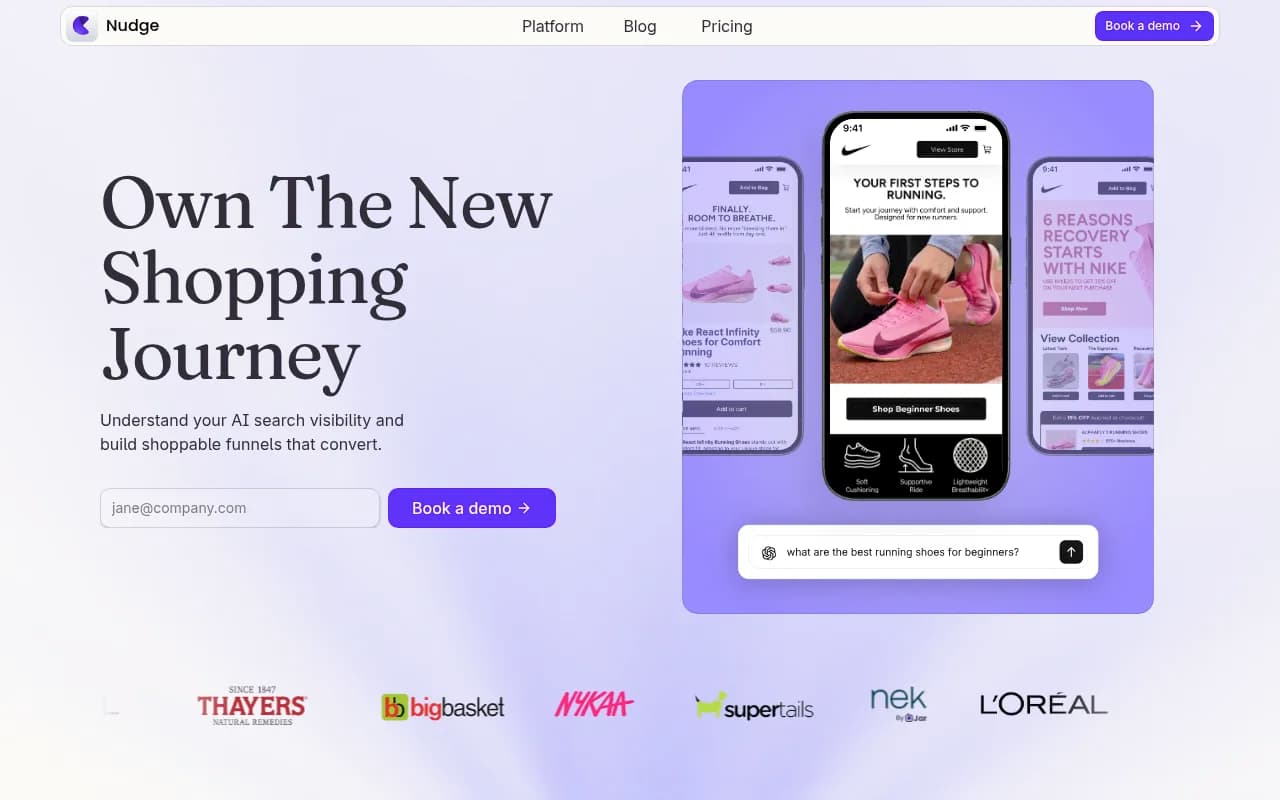
Nudge is a commerce-focused AI visibility and conversion platform launched in 2024 to help DTC brands and retailers understand how AI shopping assistants recommend their products. The pitch is straightforward: 100M+ consumers now use ChatGPT, Perplexity, and similar tools to decide what to buy, and if your products don't show up in those answers, you lose sales without knowing it. Nudge tracks where your brand appears in AI responses, then helps you build shoppable experiences optimized for the prompts shoppers actually use.
The target audience is ecommerce marketing teams at mid-market to enterprise brands -- companies selling physical products through Shopify, Magento, or similar platforms who are starting to see AI-driven traffic and want to understand it. Think supplement brands, outdoor gear companies, beauty retailers, consumer electronics sellers. Teams that already have product catalogs, existing content, and some baseline visibility in AI answers.
Nudge positions itself as an "AI discovery and conversion platform" rather than just a monitoring tool. The core idea: tracking visibility is table stakes, but what matters is turning AI mentions into revenue. Most GEO platforms stop at showing you dashboards. Nudge wants to close the loop by generating the landing pages and product funnels that convert AI referrals.
Key features
AI Search Visibility Tracking monitors how ChatGPT, Perplexity, Google AI, and Gemini mention your brand and products across shopping queries. You define a set of prompts relevant to your category ("best protein powder for weight loss", "top wireless earbuds under $100"), and Nudge runs them regularly to see where you appear. The dashboard shows mention frequency, sentiment, which SKUs get recommended, and how your positioning compares to competitors. This is standard GEO monitoring -- similar to what Otterly.AI, Peec.ai, or Promptwatch offer. The difference is Nudge focuses exclusively on commerce queries and product recommendations rather than general brand mentions.
Prompt Intelligence surfaces the specific shopping questions where you appear or don't appear. The platform categorizes prompts by intent (comparison, use case, budget, alternatives) and shows which ones drive the most visibility. You can see prompt-level performance over time and identify which queries are worth optimizing for. However, Nudge doesn't provide prompt volume estimates or difficulty scores -- you're working blind on which prompts actually matter to shoppers. Platforms like Promptwatch include volume data and query fan-outs to help prioritize.
Competitive Benchmarking compares your AI visibility against competitors. You can see which brands AI engines recommend over yours for specific prompts, how often they appear, and what positioning they use. The comparison view shows share of voice across tracked queries and highlights where competitors are winning. This is useful for understanding the competitive landscape, but it's descriptive rather than prescriptive -- Nudge shows you the gap but doesn't tell you how to close it.
Shoppable Funnels is where Nudge differentiates itself. The platform generates prompt-specific landing pages and buying guides designed to convert AI referrals. You pick a shopping query ("best running shoes for flat feet"), and Nudge builds a page that addresses that exact question with product recommendations, comparison tables, and decision criteria. These pages are optimized for both AI citation (so ChatGPT links to them) and human conversion (so shoppers who click actually buy). The funnel builder includes templates for use-case guides, product comparisons, and category overviews. You can customize the content, add your own products, and publish directly. This is genuinely useful if you're getting AI traffic and need somewhere to send it. The limitation: Nudge doesn't help you create the foundational content that gets you cited in the first place. It assumes you're already visible and just need better landing pages.
Catalog Optimizer analyzes your product pages and scores them for AI readability. The tool flags missing data (specs, use cases, comparisons), vague descriptions, and other issues that prevent AI models from understanding and recommending your products. You get a prioritized list of fixes with specific recommendations for each SKU. This is valuable for large catalogs where manual audits are impractical. The optimizer integrates with Shopify and other commerce platforms to pull product data directly. However, it's a diagnostic tool -- it tells you what's wrong but doesn't fix it for you. You still need to manually update product pages or hire writers.
Citation Gap Analysis shows which sources AI models cite when recommending competitors but not you. If ChatGPT links to a Reddit thread, YouTube review, or third-party article when suggesting a competitor's product, Nudge surfaces that citation and suggests you create similar content. This is a lighter version of what Promptwatch's Answer Gap Analysis does -- Nudge identifies the gaps but doesn't help you fill them with AI-generated content.
Integrations include Shopify, Google Ads, Meta, Klaviyo, and other commerce tools. The Shopify integration pulls product catalogs, inventory, and sales data to enrich visibility insights. You can see which products are both visible in AI and actually converting, or which high-margin SKUs are invisible and need optimization. The ad platform integrations let you compare AI visibility to paid search performance -- useful for understanding where AI is replacing or complementing your existing channels.
Who is it for
Nudge is built for ecommerce marketing teams at brands doing $5M-$100M+ in annual revenue. The ideal user is a growth marketer, SEO lead, or ecommerce director who's starting to see traffic from ChatGPT or Perplexity in Google Analytics and wants to understand it. You already have a product catalog, existing content, and some baseline visibility in AI answers. You're not starting from zero -- you're trying to scale what's working.
Smaller DTC brands (under $2M revenue) will find Nudge expensive and over-featured. If you're just launching or have limited SKUs, you don't need enterprise-grade visibility tracking and funnel builders. You need to get cited at all first, which requires content creation and optimization tools Nudge doesn't provide.
Larger retailers and marketplaces (Wayfair, Chewy, etc.) are the upper end of the target market. These teams have hundreds or thousands of SKUs, dedicated ecommerce ops, and the budget for specialized tools. Nudge's catalog optimizer and competitive benchmarking make sense at this scale.
Agencies managing multiple commerce clients could use Nudge, but the platform isn't multi-tenant. You'd need separate workspaces for each client, and pricing is per-workspace. Agencies focused on AI visibility might prefer Promptwatch's agency plans or tools like Search Party that are explicitly built for multi-client management.
B2B SaaS companies, service businesses, and non-commerce brands should look elsewhere. Nudge is laser-focused on product recommendations and shopping queries. If you're not selling physical goods or don't have a product catalog, the platform's core features (shoppable funnels, catalog optimizer) are irrelevant.
Integrations and ecosystem
Nudge integrates with Shopify, Magento, WooCommerce, and other ecommerce platforms to pull product catalogs and sales data. The Shopify integration is the most developed -- it syncs inventory, pricing, product descriptions, and order data in real time. You can see which products are visible in AI, which are converting, and which need optimization, all without leaving Nudge.
Google Ads and Meta integrations let you compare AI visibility to paid channel performance. If you're spending heavily on Google Shopping ads for a product that's invisible in ChatGPT, Nudge flags that gap. Conversely, if a product is highly visible in AI but has low ad spend, you might reallocate budget.
Klaviyo integration connects email performance to AI visibility. You can see if products recommended by AI are also top performers in email campaigns, or if there's a disconnect between what AI suggests and what your customers actually buy.
The platform includes a REST API for custom integrations and data exports. Documentation is limited compared to more mature platforms, but the basics (pulling visibility data, pushing product updates) are covered. No Zapier integration yet, which limits no-code automation options.
No browser extensions or mobile apps. Nudge is web-only, accessed through a standard dashboard. For a platform focused on monitoring and optimization, this is fine -- you're not using it in the field.
Pricing and value
Nudge uses custom pricing based on the number of prompts tracked, products monitored, and AI engines covered. There's no public pricing page -- you have to book a demo for a quote. Based on conversations with the team and user reports, expect $500-$2,000/month for mid-market plans and $3,000-$10,000/month for enterprise.
The pricing model is opaque, which is frustrating if you're trying to budget or compare options. Competitors like Promptwatch publish transparent pricing ($99-$579/month for standard plans), making it easier to evaluate fit before talking to sales.
No free trial or freemium tier. You're committing to a demo and likely a multi-month contract before you can test the platform. For a tool in a nascent category (GEO for commerce), this is a barrier. Brands want to experiment and prove ROI before signing annual deals.
Value depends on your existing AI visibility and traffic. If you're already getting 1,000+ visits/month from ChatGPT or Perplexity, Nudge's funnel builder and catalog optimizer can improve conversion rates and justify the cost. If you're invisible in AI and need to get cited first, you're paying for monitoring and diagnostics without the optimization tools to fix the problem. Promptwatch's content generation and gap analysis would deliver more value at a lower price point.
Enterprise features include SOC 2 Type II compliance, single sign-on, dedicated support, and multi-user workspaces. These matter for large retailers with security and compliance requirements, but they're overkill for smaller brands.
Strengths and limitations
Nudge's biggest strength is the shoppable funnel builder. No other GEO platform offers this. If you're getting AI referrals and need to convert them, Nudge gives you a purpose-built tool to create prompt-specific landing pages that actually drive sales. The templates are well-designed, the customization options are solid, and the integration with your product catalog makes it easy to populate pages with real SKUs and pricing.
The commerce focus is also a strength. Nudge isn't trying to be a general-purpose GEO tool for every industry. It's built for ecommerce teams, with features (catalog optimizer, Shopify integration, product-level tracking) that match how those teams work. The UI and workflows assume you're managing a product catalog, not a blog or SaaS site.
Competitive benchmarking is more detailed than most alternatives. You can see exactly which competitors AI recommends, how often, and for which prompts. The comparison views are visual and easy to understand, which helps when presenting to executives or stakeholders.
The limitations are significant. Nudge lacks content gap analysis -- it doesn't show you which prompts competitors rank for that you don't. Promptwatch's Answer Gap Analysis is a core feature that tells you exactly what content you're missing and why AI models aren't citing you. Nudge shows you where you're invisible but not what to do about it.
No AI content generation. Nudge doesn't help you create the articles, guides, or product pages that get you cited in the first place. The catalog optimizer flags issues, but you're on your own to fix them. Promptwatch includes an AI writing agent that generates optimized content based on real citation data and competitor analysis. That's the difference between a diagnostic tool and an optimization platform.
No AI crawler logs or traffic attribution. Nudge doesn't show you which AI models are crawling your site, how often, or what errors they encounter. It doesn't track AI-driven visitors or connect visibility to actual revenue. Promptwatch offers both -- crawler logs to understand indexing and a tracking snippet to measure conversions. Without these, you're flying blind on whether your AI visibility improvements are actually driving business results.
Limited AI model coverage. Nudge tracks ChatGPT, Perplexity, Gemini, and Google AI. It's missing Claude, Grok, DeepSeek, Mistral, Meta AI, and Copilot -- all of which Promptwatch monitors. For a platform charging enterprise prices, the model coverage should be more comprehensive.
No prompt volume or difficulty data. Nudge doesn't tell you which prompts shoppers actually use or how hard they are to rank for. You're guessing at which queries to optimize for. Promptwatch provides volume estimates and difficulty scores based on 1.1 billion+ data points, so you can prioritize high-value, winnable prompts.
Bottom line
Nudge is a solid choice for mid-market to enterprise commerce brands that are already visible in AI search and want to improve conversion rates. If you're getting traffic from ChatGPT or Perplexity and need better landing pages to turn those visits into sales, the shoppable funnel builder is genuinely useful. The catalog optimizer helps at scale if you're managing hundreds of SKUs and need to systematically improve AI readability.
But if you're invisible in AI and need to get cited first, Nudge won't solve that problem. It's a monitoring and conversion tool, not an optimization platform. You'll see where you're missing but not how to fix it. For brands in that position, Promptwatch is the stronger choice -- it shows you the content gaps, generates optimized articles to fill them, and tracks the results with crawler logs and traffic attribution. That's the full loop from invisible to visible to converting.

Best use case in one sentence: Ecommerce brands with existing AI visibility who need to convert AI referrals into sales through prompt-specific landing pages and product funnels.
Tags:
Frequently asked questions
What is Nudge and who is it for?
How much does Nudge cost?
What AI models does Nudge track?
Does Nudge help you create content to improve AI visibility?
What makes Nudge different from other GEO tools?
Does Nudge integrate with Shopify?
Similar and alternative tools to Nudge