Key takeaways
- AI visibility is no longer optional for SaaS startups -- 67% of SaaS buyers now use AI-generated answers to make purchase decisions, and one in five clicks for major retailers comes from ChatGPT
- Most sub-$300/month platforms stop at monitoring: they show you where you're invisible but don't help you fix it
- Promptwatch is the only platform in this price range that combines tracking, content gap analysis, AI-powered content generation, and traffic attribution in one workflow
- Peec AI is a solid choice if you want clean competitive benchmarking and don't need content creation tools
- Rankshift suits teams that want flexible, credit-based usage without a monthly prompt commitment
- LLM Pulse offers the lowest entry price but has the thinnest feature set of the four
Why SaaS startups need to care about AI visibility right now
The numbers are hard to ignore. According to Forbes, one in five clicks for Walmart now comes from ChatGPT. Adobe reported that AI-sourced traffic for U.S. retail grew 1,100% year over year, with those visitors showing 12% higher engagement and being 5% more likely to convert. And Pew Research found that when Google shows an AI summary, click-through rates on traditional results drop from 15% to 8%.
For SaaS specifically, the shift is even more pronounced. When a potential customer asks ChatGPT "what's the best project management tool for remote teams" or "which CRM is best for early-stage startups," the answer they get shapes their shortlist. If your product isn't cited, you don't exist in that moment.
The problem is that most SaaS startups are working with limited budgets and limited time. You need a tool that fits under $300/month, covers the AI engines your buyers actually use, and ideally does more than just tell you you're invisible.
This guide compares four platforms that all fit that budget: Promptwatch, Rankshift, Peec AI, and LLM Pulse. We'll look at what each one actually does, where they fall short, and which situations each one fits best.
The four platforms at a glance
Before going deep, here's a quick comparison across the dimensions that matter most for a SaaS startup:
| Feature | Promptwatch | Rankshift | Peec AI | LLM Pulse |
|---|---|---|---|---|
| Starting price | $99/mo | Credit-based | ~$99/mo | Free / ~$49/mo |
| AI models tracked | 10+ (ChatGPT, Perplexity, Claude, Gemini, Grok, DeepSeek, Copilot, Meta AI, Mistral, Google AI Overviews) | ChatGPT, Perplexity, AI search | ChatGPT, Perplexity, Claude | ChatGPT, Perplexity, Claude |
| Content gap analysis | Yes | No | Limited | No |
| AI content generation | Yes (built-in writing agent) | No | No | No |
| Crawler log monitoring | Yes (Pro+) | No | No | No |
| Reddit/YouTube tracking | Yes | No | No | No |
| Traffic attribution | Yes (GSC, snippet, server logs) | No | No | No |
| Prompt volume/difficulty | Yes | No | No | No |
| ChatGPT Shopping tracking | Yes | No | No | No |
| Free trial | Yes | Yes | Yes | Yes (free tier) |
| Best for | Full optimization loop | Flexible usage, credit model | Competitive benchmarking | Budget entry point |
Promptwatch: the platform that actually helps you fix the problem
Promptwatch sits in a different category from the other three, even though it overlaps on price at the $99/month Essential tier. The difference is what it does after it shows you data.
Most AI visibility tools follow the same pattern: you set up prompts, the tool runs them across AI engines, and you get a dashboard showing your visibility score. That's useful. But it leaves you with a question: now what?
Promptwatch answers that question. Its Answer Gap Analysis shows you the specific prompts your competitors rank for that you don't -- not just "you're missing coverage in project management," but the actual questions AI models are answering where your competitors get cited and you don't. From there, the built-in AI writing agent generates content engineered to get cited: articles, listicles, comparisons, all grounded in 880M+ citations analyzed across real AI responses.
Then it closes the loop. Page-level tracking shows which of your pages are being cited, how often, and by which models. Traffic attribution (via a code snippet, Google Search Console integration, or server log analysis) connects those citations to actual sessions and revenue.
That three-step cycle -- find gaps, create content, track results -- is what makes it an optimization platform rather than a monitoring dashboard.

A few other things worth knowing for SaaS startups specifically:
The AI Crawler Logs feature (available on the Professional plan at $249/month) shows you in real time which AI crawlers are hitting your site, which pages they're reading, and any errors they're encountering. If ChatGPT's crawler can't access your pricing page or your integration docs, you'll see it. Most competitors don't offer this at all.
Prompt Intelligence gives you volume estimates and difficulty scores for each prompt, plus query fan-outs that show how one question branches into sub-queries. For a startup trying to prioritize where to invest content effort, this is genuinely useful -- you can focus on high-volume, winnable prompts instead of guessing.
The Reddit and YouTube tracking surfaces discussions that directly influence AI recommendations. AI models frequently cite Reddit threads when answering software questions. Knowing which threads are being cited, and what they say about your category, is a real competitive edge.
Pricing: Essential at $99/month (1 site, 50 prompts, 5 articles), Professional at $249/month (2 sites, 150 prompts, 15 articles, crawler logs, state/city tracking), Business at $579/month. The Professional plan is the sweet spot for most growing SaaS startups and still fits under $300/month.
Rankshift: flexible credits, solid tracking
Rankshift takes a different approach to pricing. Instead of a fixed monthly prompt allowance, it uses a credit-based model -- you buy credits and spend them on the queries you actually want to run. For startups with irregular usage patterns (a big push before a product launch, then quieter periods), this can be more economical than paying for prompts you don't use.

On the feature side, Rankshift covers the major AI search engines -- ChatGPT, Perplexity, and AI search broadly -- and gives you brand visibility tracking and competitive comparisons. The interface is clean and the setup is relatively quick.
What it doesn't do: there's no content gap analysis, no built-in content generation, no crawler logs, no traffic attribution, and no Reddit or YouTube tracking. It's a monitoring tool. You'll see your visibility scores and how you compare to competitors, but the "what to do about it" part is left to you.
That's not necessarily a dealbreaker. If you already have a content team or an agency handling your GEO strategy, Rankshift gives you the data layer without the overhead of a more complex platform. The credit model also means you can scale usage up or down without changing your plan.
Best for: SaaS startups that want flexible, usage-based monitoring and are handling content strategy separately.
Peec AI: competitive benchmarking done well
Peec AI has built a reputation for clean competitive analysis. Its strength is showing you how your brand stacks up against competitors across AI engines, with clear visualizations and reports that are easy to share with stakeholders or clients.

Zapier's review of AI visibility tools called Peec AI their pick for "best LLM monitoring tool for smart suggestions," and the Evertune roundup noted it's "relatively affordable, user-friendly, and accessible compared to enterprise-level alternatives." The Pro plan is around €199/month (roughly $215 at current rates), which includes 100 prompts and Slack support.
The competitive comparison features are genuinely good. You can see which AI engines mention your competitors, how often, and in what context. For a SaaS startup trying to understand the competitive landscape in AI search, this is valuable.
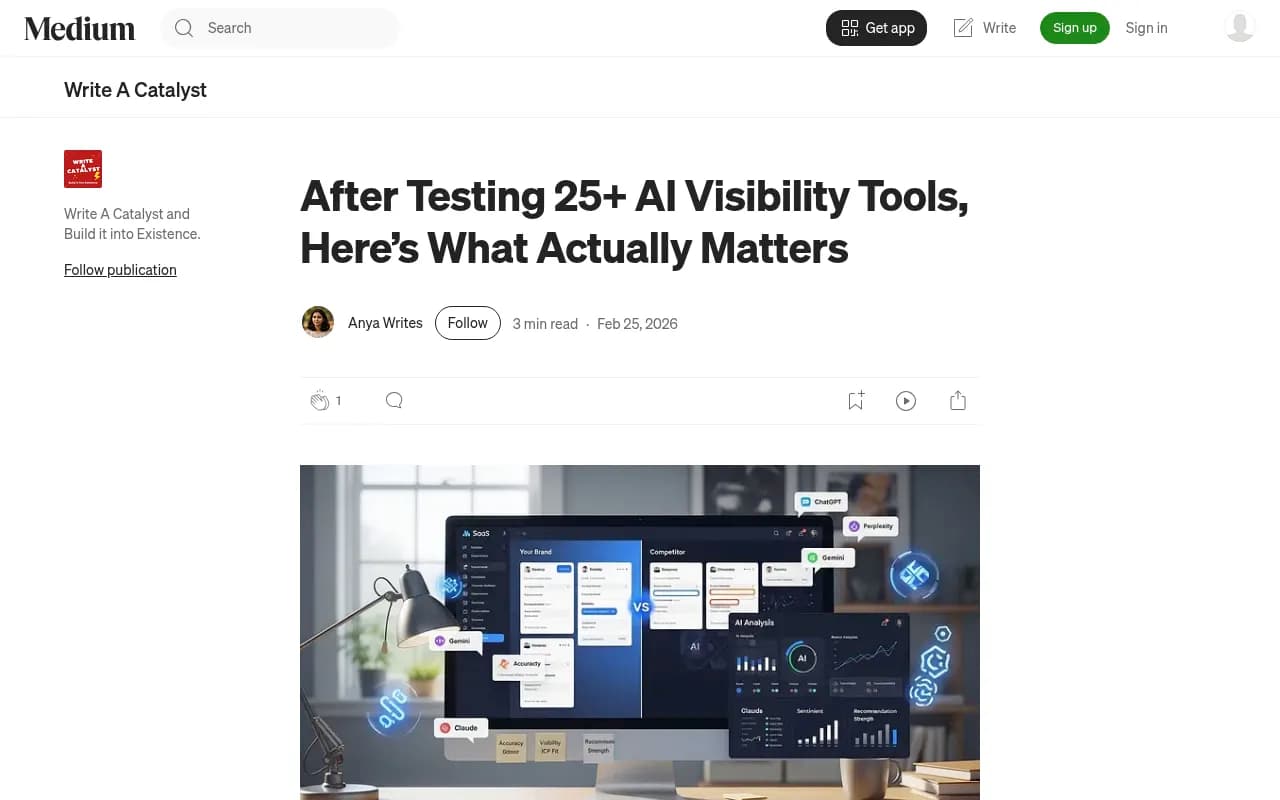
The limitation is the same one that affects most monitoring tools: Peec AI is better at benchmarking than fixing. There's no content generation, no gap analysis that tells you what to write, and no traffic attribution. One Medium reviewer who tested 25+ AI visibility tools described Peec AI as "more about benchmarking than fixing" -- which is accurate and worth knowing before you sign up.
Best for: SaaS startups that need strong competitive benchmarking and agency-friendly reporting, and are comfortable handling content optimization separately.
LLM Pulse: the budget entry point
LLM Pulse positions itself as the best overall value alternative in the AI visibility space, and it has a free tier that makes it genuinely accessible for very early-stage startups. Paid plans start around $49/month.
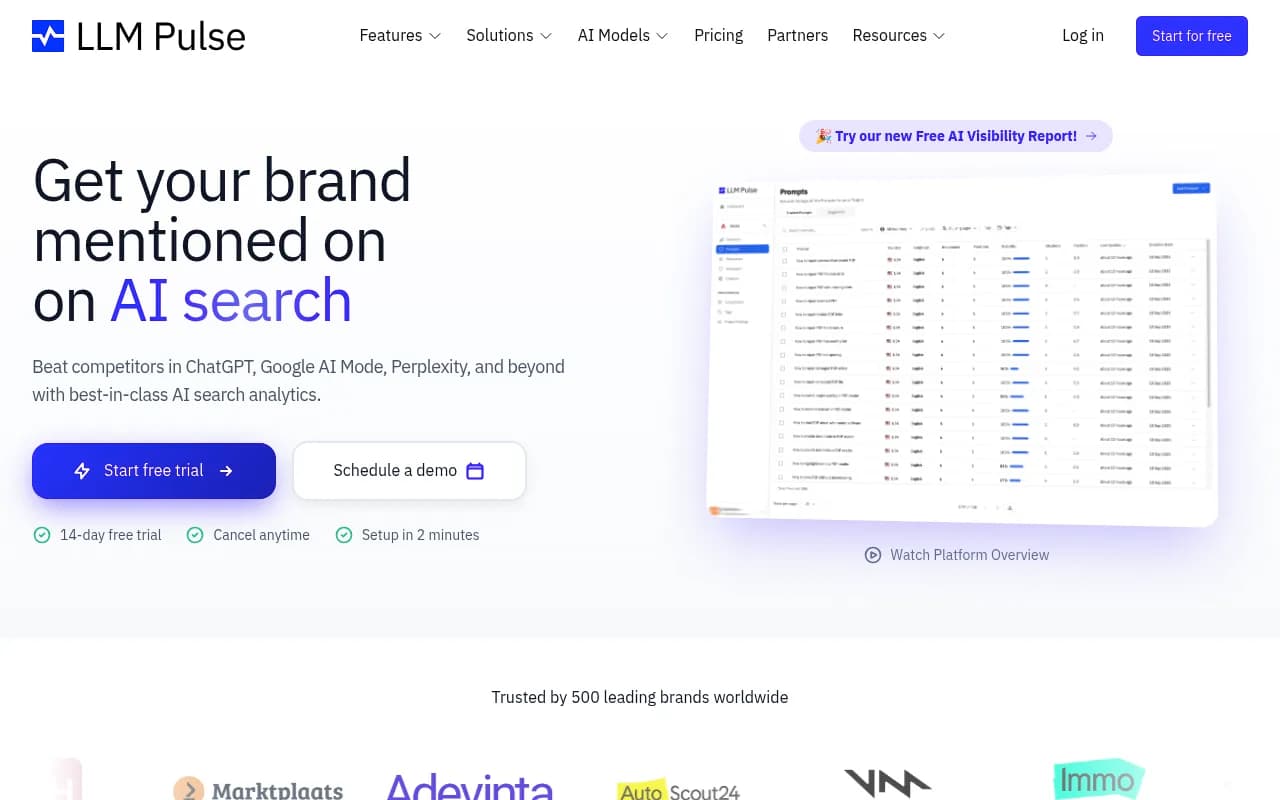
It covers the core use case: tracking your brand mentions across ChatGPT, Perplexity, and Claude, with basic competitive comparisons. The interface is straightforward and the setup is fast.
The honest assessment is that LLM Pulse is thin on features compared to the other three. No crawler logs, no content generation, no traffic attribution, no Reddit tracking, no prompt volume data. It's a basic monitoring tool at a low price point.
For a pre-seed startup that just wants to know whether ChatGPT mentions them at all, LLM Pulse is a reasonable starting point. But most SaaS startups that are serious about AI visibility will outgrow it quickly.
Best for: Very early-stage startups that want basic monitoring before committing to a more capable platform.
How to choose: matching the tool to your situation
The right choice depends on what stage you're at and what you actually need.
If you're at seed stage or later and AI visibility is a real growth channel you're investing in, Promptwatch is the clear choice. The combination of gap analysis, content generation, and traffic attribution means you're not just watching your visibility score -- you're actively improving it. The Professional plan at $249/month gives you everything a growing SaaS startup needs and stays under the $300 budget.
If you have a content team or agency already handling your GEO strategy and just need reliable data, Rankshift's credit-based model gives you flexibility without paying for unused capacity.
If competitive benchmarking is your primary goal -- say, you're preparing a board deck or trying to understand how you compare to three specific competitors across AI engines -- Peec AI's reporting is the cleanest of the four.
If you're pre-product-market-fit and just want to know whether you show up in AI answers at all, LLM Pulse's free tier costs nothing and takes 10 minutes to set up.
What actually matters in an AI visibility platform
A few things worth keeping in mind as you evaluate any tool in this space:
Monitoring vs. optimization. Most platforms show you data. Very few help you act on it. Before signing up for anything, ask: "If this tool shows me I'm invisible for a key prompt, what does it help me do next?" If the answer is "nothing, that's up to you," you're paying for a dashboard.
Which AI engines are covered. ChatGPT and Perplexity are the obvious ones, but Google AI Overviews reaches 1.5 billion people monthly according to Google's Q1 2025 earnings. Claude, Gemini, and Grok are all growing. A platform that only tracks two or three engines is giving you a partial picture.
Traffic attribution. Visibility scores are useful, but what you actually care about is whether AI citations are driving signups and revenue. Very few platforms in this price range connect citations to actual traffic. Promptwatch does this; the others in this comparison largely don't.
Prompt quality over quantity. A platform that lets you track 500 prompts is less useful than one that tells you which 50 prompts actually matter for your category and have real volume behind them. Prompt Intelligence features that include volume estimates and difficulty scores are worth paying for.
The AI search landscape is moving fast. The platforms that will be most valuable over the next 12-18 months are the ones built around a feedback loop: find what's missing, create content to fill the gap, measure whether it worked. That's the workflow to optimize for, regardless of which tool you choose.