First Page Sage Review 2026
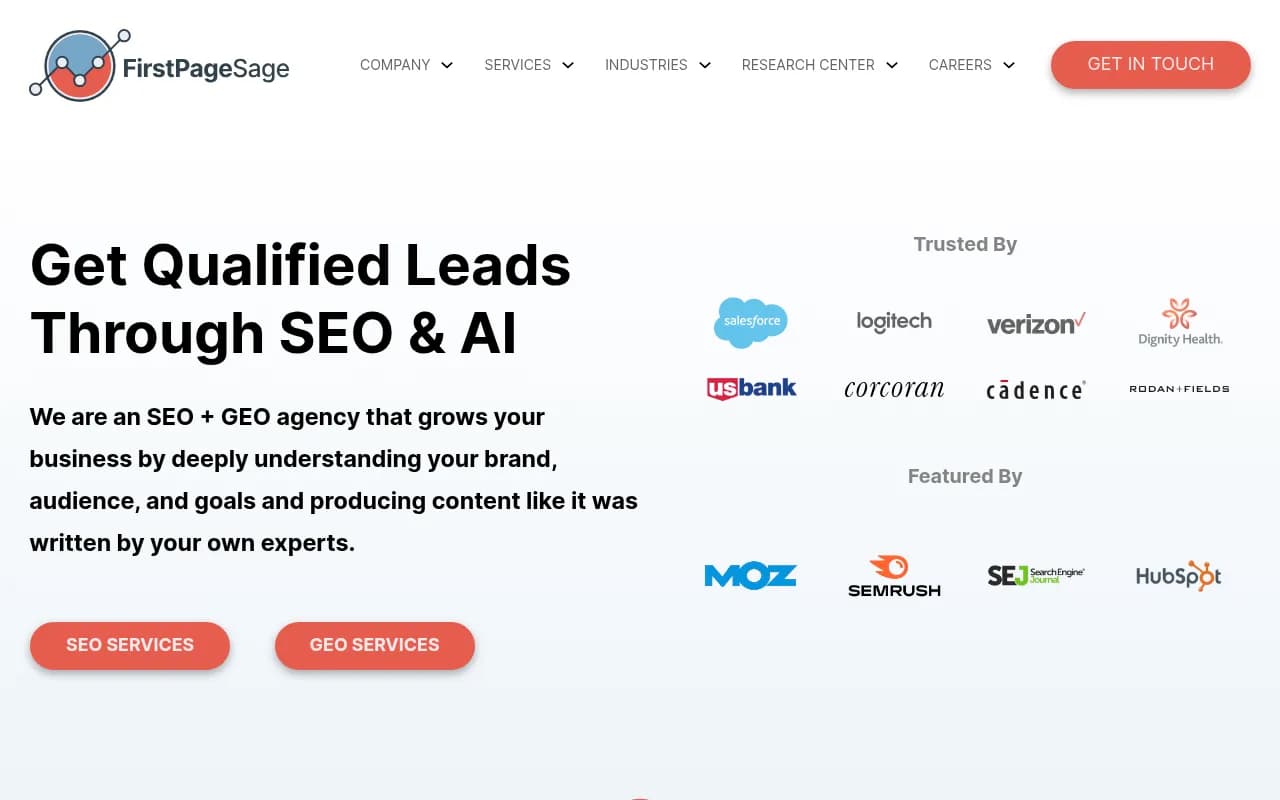
First Page Sage is a premium SEO and Generative Engine Optimization (GEO) agency that creates expert-level thought leadership content to rank on Google and AI search engines, driving qualified leads for mid-market and enterprise brands.
Key takeaways
- First Page Sage is a full-service SEO and GEO agency, not a SaaS tool -- you're buying a managed service, not software access
- Strong track record with enterprise clients (Salesforce, Verizon, Logitech, US Bank), which signals quality but also signals pricing that rules out most small businesses
- The agency's GEO offering is newer and worth watching, but it's a managed service -- companies that want to track and optimize AI visibility themselves should look at dedicated platforms like Promptwatch instead
- Pricing is custom and not publicly listed, but based on industry context, monthly retainers typically start in the $5,000-$10,000+ range for full-service campaigns
- Best fit for mid-market to enterprise companies that want to outsource SEO and content entirely, not for teams that want in-house control
First Page Sage is a San Francisco-based SEO and content marketing agency that has been operating since around 2009. The core pitch is straightforward: they write expert-level content that earns top Google rankings, and those rankings generate qualified leads. Over the years, they've built a reputation in the B2B and enterprise space, working with recognizable names like Salesforce, Verizon, Logitech, US Bank, Dignity Health, and Alcoa. That client list is not accidental -- it reflects a positioning strategy aimed squarely at companies with serious marketing budgets and long sales cycles.
More recently, the agency has expanded into Generative Engine Optimization (GEO), which is their term for optimizing content to appear in AI-generated answers from ChatGPT, Perplexity, Google AI Overviews, and similar platforms. This is a natural extension of their content-first philosophy, since the same depth and authority that earns Google rankings also tends to get cited by AI models. The GEO service is still maturing compared to their core SEO offering, but it signals that the agency is paying attention to where search is heading.
The agency is featured by Moz, Semrush, Search Engine Journal, and HubSpot, mostly for their research and data-driven content on SEO topics. They publish their own studies on things like SEO ROI by industry, average conversion rates, and content marketing benchmarks -- which serves double duty as thought leadership and lead generation for the agency itself.
Key features
Thought leadership content production
This is the core of what First Page Sage does. Rather than producing generic SEO content at scale, they position themselves as a team that writes like your internal subject matter experts. In practice, this means their writers go through an onboarding process to understand your industry, audience, and competitive positioning before producing content. The output includes long-form articles, white papers, research reports, and forecasts -- content designed to rank AND to be shared by your sales and marketing teams.
- Writers are matched to clients by industry vertical
- Content is reviewed for accuracy and brand voice before publication
- Thought leadership pieces (white papers, forecasts) are produced alongside SEO-focused articles
SEO strategy and keyword research
Before any content is written, the agency builds a keyword strategy tied to your business goals. This isn't just a list of high-volume terms -- they map keywords to buyer intent and funnel stage, prioritizing terms that are likely to convert rather than just drive traffic.
- Keyword mapping to conversion funnel stages
- Competitor gap analysis to identify ranking opportunities
- Long-tail and question-based keyword targeting for featured snippets and AI citations
Conversion funnel optimization
One thing that separates First Page Sage from pure content agencies is their attention to what happens after someone lands on a page. They build and optimize conversion paths, connecting informational content to product or service pages, and setting up lead capture mechanisms.
- Landing page optimization tied to organic traffic
- Internal linking strategy to move visitors down the funnel
- CTA placement and testing within content
Generative Engine Optimization (GEO)
The GEO service is designed to make clients visible in AI-generated answers. The approach is content-based: produce content that AI models are likely to cite when answering questions in your industry. This involves understanding how models like ChatGPT and Perplexity select sources, and structuring content accordingly.
- Content structured for AI citation (direct answers, clear sourcing, authoritative tone)
- Optimization for Google AI Overviews specifically
- Monitoring of AI visibility as part of reporting (though the depth of this monitoring is unclear compared to dedicated platforms)
Technical SEO
The agency handles the technical side of SEO as part of their service, including site audits, page speed improvements, schema markup, and HTML tag optimization. Their pricing research mentions a one-time fee for restructuring web pages and editing HTML tags, suggesting this is treated as a setup phase rather than ongoing work.
- Site architecture and crawlability audits
- Schema markup implementation
- Page speed and Core Web Vitals optimization
- HTML tag editing (title tags, meta descriptions, headers)
Link building
Link acquisition is part of the ongoing monthly service. The agency builds backlinks through a combination of content-driven outreach (earning links to their published thought leadership pieces) and direct outreach.
- Content-based link earning through research and data pieces
- Outreach to relevant industry publications
- Monthly link building as part of retainer
Tracking, attribution, and reporting
The agency sets up tracking and reporting so clients can see the connection between SEO activity and business outcomes. This includes organic traffic reporting, keyword ranking tracking, lead attribution, and ROI calculations.
- Custom reporting dashboards
- Lead attribution from organic channels
- ROI reporting by campaign
Persona research using generative AI
First Page Sage mentions using generative AI for persona research -- essentially using AI tools to build detailed buyer personas that inform content strategy. This is a process-level use of AI rather than a product feature, but it's worth noting as it affects how content is targeted.
Who is it for
The clearest fit for First Page Sage is a mid-market or enterprise B2B company with a long sales cycle, a complex product or service, and a marketing team that wants to outsource content production entirely. Think a SaaS company with an ACV above $10,000, a healthcare system trying to reach referring physicians, or a financial services firm building authority in a regulated space. The client list -- US Bank, Dignity Health, Salesforce, Alcoa -- tells you exactly who they're built for.
Companies in the $10M-$500M revenue range tend to get the most value here. They're large enough to have real marketing budgets and long enough sales cycles to benefit from thought leadership content, but not so large that they have fully staffed in-house content teams. The agency model works well when you want expertise without the overhead of hiring a full content team internally.
Industries where they particularly shine include B2B technology, financial services, healthcare, and professional services -- verticals where content authority matters and where buyers do extensive research before making decisions. Their published benchmarks and case studies skew heavily toward these sectors.
Who should NOT use First Page Sage: small businesses or early-stage startups with limited budgets (the pricing is simply out of reach), companies that want in-house control over their content strategy, or teams that need fast turnaround on large content volumes. Also, if your primary goal is to track and improve your AI search visibility with granular data -- monitoring which AI models cite you, analyzing citation gaps, understanding prompt volumes -- a managed agency service won't give you that level of control. That's a job for a dedicated platform.
Integrations and ecosystem
First Page Sage operates as a managed service, so "integrations" look different than they would for a SaaS product. They work within your existing marketing stack rather than offering native integrations.
- Google Analytics and Google Search Console: Standard for tracking organic performance and reporting
- CRM integration: They set up lead attribution that connects to your CRM (Salesforce, HubSpot) for ROI reporting
- CMS compatibility: They publish content to whatever CMS you're using (WordPress is most common)
- Reporting: Custom dashboards, likely built in Google Looker Studio or similar
There's no API, no browser extension, and no mobile app -- this is a service business, not a software product.
Pricing and value
First Page Sage does not publish pricing on their website, which is typical for premium agencies. Based on their own published research on SEO agency pricing tiers and the caliber of their client list, expect monthly retainers in the range of $8,000-$20,000+ for full-service SEO campaigns. Their pricing research mentions a one-time upfront investment (around $5,000) for technical setup, followed by ongoing monthly fees.
They categorize SEO agencies into three tiers in their own pricing guides:
- Offshore/budget agencies: $50/hour consulting, low monthly retainers
- Mid-tier agencies: $100-$200/hour, moderate retainers
- Premium agencies (where First Page Sage sits): $200-$300/hour consulting, high monthly retainers
There is no free trial and no freemium tier -- this is a custom engagement model. Prospective clients go through a discovery call and receive a custom proposal.
For the right client, the value proposition is real: if a single new enterprise customer is worth $50,000-$500,000 in revenue, paying $10,000/month for content that generates two or three of those per year is a strong ROI. But that math only works at a certain deal size and sales cycle length.
Strengths and limitations
What they do well
- Content quality: The agency's positioning around expert-level, thought leadership content is genuine. Their published content (both for clients and their own site) is consistently well-researched and substantive. This is not a content farm.
- Enterprise credibility: The client list (Salesforce, Verizon, US Bank) gives them credibility in enterprise sales conversations that most agencies can't match.
- Full-funnel thinking: Unlike agencies that just produce content and hand it off, First Page Sage connects content to conversion paths and tracks lead attribution. That's a more complete service.
- GEO awareness: They're one of the few traditional SEO agencies that has built a dedicated GEO service, rather than just adding a paragraph about AI to their existing SEO pitch.
Honest limitations
- Price point excludes most businesses: The premium positioning means this service is simply not accessible to small businesses, startups, or companies without significant marketing budgets. There's no scaled-down offering.
- GEO monitoring depth is unclear: The agency says they optimize for AI visibility and monitor results, but the depth of that monitoring -- which AI models, how frequently, what metrics -- is not transparent. Companies that want granular AI visibility data (citation tracking, prompt volume analysis, competitor heatmaps across 10+ AI models) need a dedicated platform like Promptwatch, not an agency report. The agency can produce content optimized for AI citation, but it can't give you the real-time visibility data that a platform provides.
- Managed service limitations: You're dependent on the agency's timeline, processes, and priorities. If you want to move fast, pivot strategy, or have direct control over content decisions, an agency model creates friction.
- No self-serve option: There's no way to access their research, tools, or frameworks without engaging as a client. Their published benchmarks are valuable, but the actual service is entirely custom.
Bottom line
First Page Sage is a legitimate premium SEO and content agency with a strong track record in the enterprise B2B space. If you're a mid-market or enterprise company with a complex product, a long sales cycle, and a budget to match, they're worth a serious conversation. The combination of expert content production, technical SEO, and conversion optimization is genuinely differentiated from lower-tier agencies.
That said, if your goal is to understand and improve your visibility in AI search engines with real data -- tracking citations across ChatGPT, Perplexity, Claude, and others, analyzing which prompts your competitors rank for, and generating content based on actual citation data -- an agency service won't give you that. For AI search visibility as a discipline, a dedicated platform like Promptwatch is the right tool.

Best use case: A B2B SaaS or professional services company with $1M+ annual marketing budget that wants to fully outsource SEO and thought leadership content to a team that can write credibly in their industry.
Frequently asked questions
What is First Page Sage?
Who are First Page Sage's typical clients?
How much does First Page Sage cost?
What is their GEO service?
How does First Page Sage compare to a GEO platform like Promptwatch?
Does First Page Sage offer any self-serve tools or free resources?
Similar and alternative tools to First Page Sage