Key takeaways
- Google doesn't penalize content for being AI-written. It penalizes content that provides little value, and mass AI production makes that kind of thin content trivially easy to produce, which is why AI-heavy sites dominate the enforcement lists.
- The clearest sign of a real penalty is a manual action in Search Console, often labeled "Scaled Content Abuse" or "thin content with little or no added value." This is different from a normal algorithmic ranking dip.
- The August 2026 spam update and the March 2026 core update both targeted scaled content abuse specifically, with reported traffic drops of 50-80% for the worst-hit sites.
- Recovery isn't about polishing individual pages. The pattern that actually works is consolidating hundreds of thin pages into far fewer comprehensive guides, 301-redirecting the old URLs, and letting authority rebuild around a smaller footprint.
- Not every traffic drop is a penalty. A Search Console logging bug active from 2025 into 2026 inflated impressions on many sites, and AI Overviews can eat into blue-link clicks without any quality issue at all. Check the Manual Actions report before you panic.
Why "AI content" isn't really the problem
I want to get this out of the way early because it changes how you should think about everything else in this guide: Google has never said it will penalize a page for being written by AI. Its own developer blog post on the subject is pretty blunt about this — Google Search rewards high-quality content, however it's produced. The June 2026 quality rater guidelines score pages on helpfulness, accuracy, and user satisfaction. Nowhere in that scoring does a rater ask "did a human write this?"
What actually gets punished is what Google calls scaled content abuse: "many pages generated for the primary purpose of manipulating search rankings and not helping users... regardless of how it's created," per the official spam policy. That phrase "regardless of how it's created" matters. A content farm churning out 500 words of human-written fluff a day is exposed to the exact same policy as a site running an AI pipeline at scale. AI just makes the thin-content-at-scale playbook cheap enough that thousands of sites tried it in 2025, and Google spent 2026 cleaning it up.
So the real question isn't "is my content AI-generated." It's "does my content look like it was generated primarily to fill a rankings slot rather than to help someone." That's a much harder thing to hide, and it's what the five signs below are actually detecting.
Sign 1: You have a manual action, not just a ranking dip
The single most reliable signal is sitting in Search Console right now if it exists: the Manual Actions report. Go to search.google.com/search-console/manual-actions. If Google has determined your site violates its spam policies, it tells you directly, and the language has gotten more specific over time. Older notices said things like "thin content with little or no added value." Newer ones, as documented in a Reddit thread from late 2026, now use the exact phrase "Scaled-Content Abuse" as a distinct manual action category.
A real example from a Google Search Central Community thread in September 2026: a media site called The AI Journal got flagged for thin content on August 26, 2026. Organic traffic dropped roughly 50%, and the notice said it "affects all pages" — meaning even the homepage stopped showing up for brand-name searches. One expert respondent in the thread put it bluntly: this isn't something you fix by pruning a few bad pages. Google isn't identifying individual URLs as the problem; it's identifying a pattern across the whole domain.
If you see a manual action, stop reading everything else in this guide and start there. Everything downstream depends on whether it's a manual action (a human reviewer flagged your site) or an algorithmic effect from a core or spam update (no direct notice, just a ranking change).
Sign 2: Your traffic cliff lines up with a known update window
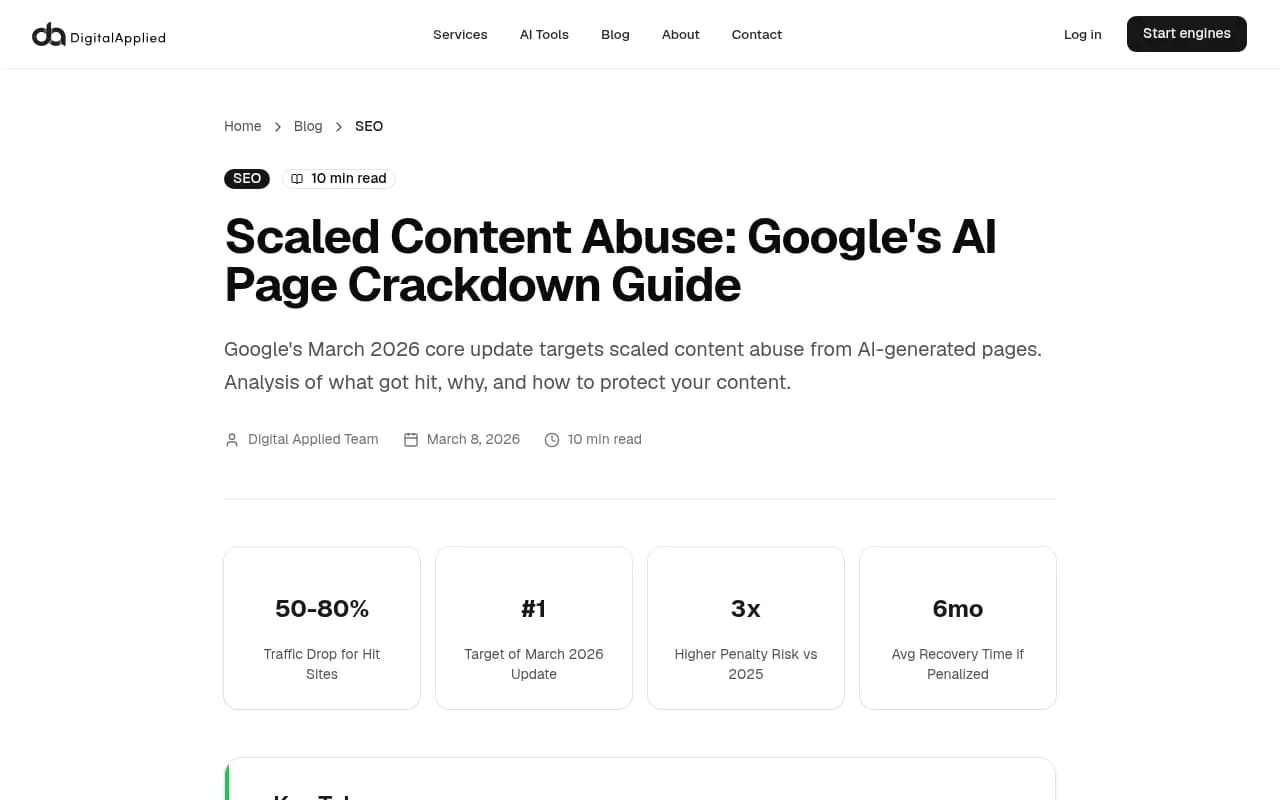
Two dates matter a lot in 2026. The March 2026 core update explicitly named scaled content abuse as a top enforcement priority, and case analyses put the damage at 50-80% traffic loss for the worst-affected sites, a roughly 3x higher penalty risk compared to 2025, and an average recovery time of around six months for sites that did recover.
Then came the August 2026 spam update, rolling out over about two and a half days between August 18 and 21. SEO analyst Glenn Gabe documented specific cases from that rollout: one site with over 1.5 million indexed URLs showing classic scaled content abuse patterns (programmatic pages, aggressive ads, poor UX) took a major hit, and another site that had scaled to 250,000+ URLs in a risky niche lost visibility across roughly 25,000 queries.
If your traffic fell off a cliff within a day or two of either window and you were publishing AI content at high volume beforehand, that's not a coincidence you can talk yourself out of. Cross-reference your analytics dates against the update timeline before you assume it's something else.
Sign 3: The pages that dropped share the same fingerprints
Analysts studying penalized sites have identified a consistent set of behavioral and structural tells Google's systems appear to weight heavily:
- High semantic similarity across dozens or hundreds of pages on the same domain
- Experiences described in vague, generic terms with no specific detail
- No citations to primary sources, just restated claims
- Users pogo-sticking — clicking through, then immediately hitting back to try a different result
- Low time-on-page relative to how long the content would take to actually read
- Publishing velocity that's abnormally fast for the site's age and team size
- Missing or generic author bios and "About" pages
- Backlink profiles pointing mostly to other low-quality content farms
Run a site:yourdomain.com search combined with a few commercial or irrelevant keywords to spot anything that looks injected or off-brand, and use the URL Inspection tool in Search Console to check whether specific pages are still indexed. If most of your recently published pages read like they were assembled from the same template with the nouns swapped out, that's the pattern Google's systems are built to catch.
Sign 4: Your content was dated for authority but pulls stale facts
This one is subtle but it shows up a lot in AI-generated pages: a page claims "as of 2026" in its intro, then cites statistics, prices, or facts that are clearly a couple of years stale, because the model generating the copy was trained on older data and nobody fact-checked before publishing. Readers notice this fast, and so does Google's helpfulness scoring, because it's exactly the kind of inconsistency that erodes trust signals. If you're running any kind of automated publishing pipeline, this is worth auditing specifically, page by page, not just spot-checking a few examples.
Sign 5: Your impressions dropped but you're assuming the wrong cause
Here's the twist that trips a lot of site owners up: not every traffic drop in 2026 is a quality penalty. Google confirmed a Search Console logging bug active from roughly May 2025 into 2026 that inflated impression counts across the board. The fix, rolling out through late 2025 and into 2026, caused a lot of sites to see an apparent impressions drop that was actually just the data correcting itself, not a real loss in visibility. On top of that, Google removed the ability to request 100 results per page in September 2025, which killed off a huge amount of scraper-driven phantom impressions that had been inflating everyone's numbers for years.
And separately, Google's AI Overviews and AI Mode can reduce blue-link clicks for a query even when your actual ranking hasn't moved an inch — that's a zero-click effect, not a penalty. Before concluding you've been hit, isolate your date ranges and look at clicks, not just impressions, and check the Manual Actions report first. It's genuinely possible to spend weeks "fixing a penalty" that was never a penalty at all.
The recovery framework that's actually working
The single biggest mistake site owners make after getting flagged is trying to improve pages one at a time. If you have hundreds or thousands of thin AI pages, editing each one individually almost never recovers the site, because the underlying pattern (a large share of low-value pages on the domain) doesn't change much just because a few dozen got better.
The pattern that's actually working in 2026 is consolidation:
- Audit and cluster. Group your existing pages by topic overlap. A crawler like Screaming Frog or Sitebulb will surface duplicate and near-duplicate content fast.
- Pick a winning URL per cluster. For each group of overlapping pages, choose the strongest candidate to become the consolidated page.
- Merge the best material, rewrite what's left. Combine the useful parts of the losing pages into the winner, add original analysis, specific examples, and named sources where you can.
- 301-redirect the losers to the consolidated page. Never mass-redirect deleted pages to your homepage — Google can treat unrelated redirects like soft 404s. If there's genuinely no relevant destination, let the page 404 or 410 cleanly instead.
- Pause batch AI publishing entirely while you do this. Set a quality bar every future piece has to clear before it goes live.
- Wait before judging results. Google's own guidance on core updates says some changes show up within days, but a full evaluation takes longer — give it at least a week before reading Search Console data, and plan for months, not days, before calling the recovery complete.
The numbers behind this approach are real. A documented case from a B2B SaaS site consolidated 40 blog posts into 12 comprehensive guides, redirected the rest, and recovered roughly 70% of lost traffic within three months, with several consolidated pages outranking anything the originals ever achieved. Seer Interactive pruned 14,000 low-value pages from a site that had declined -17.3% annually for five straight years and turned it into +23% organic traffic year over year, sustained over six months. CNET's pruning effort showed a documented 29% increase in estimated organic traffic over a three-month window in one analysis.
Tools that help you audit, prune, and rebuild
| Task | Tool | What it's good for |
|---|---|---|
| Find the manual action | [tool:google-search-console] Google Search Console | The only authoritative source for manual actions and indexing status |
| Crawl and cluster thin pages | [tool:screaming-frog-seo-spider] Screaming Frog SEO Spider | Desktop crawler that surfaces duplicate content and thin pages at scale |
| Enterprise-scale technical audits | [tool:sitebulb] Sitebulb | Turns large, messy sites into prioritized audit reports |
| Rewrite consolidated pages to a real quality standard | [tool:surfer-seo] Surfer SEO | Content optimization grounded in what's actually ranking, not just AI output |
| Research and brief before you write | [tool:frase] Frase | Builds briefs from real SERP data so writers aren't guessing |
| Cross-check rankings as you recover | [tool:semrush] Semrush | Tracks visibility recovery across the consolidated URLs over time |
If you're managing the cleanup at agency scale across multiple client sites, a broader technical SEO platform is worth a look too; the software directory at surferstack.com has side-by-side comparisons if you're choosing between crawlers or audit tools.
Where AI search visibility fits into this
One thing worth flagging separately: a drop in classic Google rankings and a drop in AI search visibility (how often ChatGPT, Perplexity, or AI Overviews cite your pages) are related but distinct problems, and they don't always move together. Promptwatch's own research on citation behavior shows how volatile AI citation patterns can be independent of anything happening in classic search — Reddit's share of ChatGPT Search citations, for instance, collapsed from roughly 4% to 0.5% in a single day on August 14, 2026, according to Promptwatch's citation data. That kind of platform-wide shift has nothing to do with any individual site's content quality.
If part of your traffic strategy depends on being cited in AI answers rather than just ranking in blue links, it's worth tracking that separately from your classic SEO recovery. Tools like Promptwatch monitor crawler activity from ChatGPTBot, ClaudeBot, PerplexityBot and others hitting your site, which pages actually get cited, and whether your consolidation work is translating into AI visibility, not just Google rankings.

A quick decision table for what you're actually dealing with
| Symptom | Likely cause | What to do |
|---|---|---|
| Manual action visible in Search Console | Real penalty (scaled content abuse or similar) | Site-wide consolidation, not page-by-page edits |
| Traffic dropped right after March or August 2026 update, no manual action | Algorithmic quality reassessment | Audit for the five signs above, consolidate proactively |
| Impressions dropped but clicks are flat | Search Console logging bug or AI Overviews eating blue-link space | No action needed on content; check if it's a reporting artifact |
| AI citations dropped but Google rankings are stable | Platform-specific AI search shift, not a Google penalty | Track separately with an AI visibility tool |
The bottom line
Nothing about this is mysterious once you strip away the "is it the AI" framing. Google is looking for pages that exist primarily to occupy a ranking slot rather than to answer a real question well, and AI-generated content happens to be the easiest way to produce that kind of page at volume. Check the Manual Actions report first, line up your traffic drop against known update dates, look honestly at whether your pages share the thin-content fingerprints above, and if they do, consolidate rather than patch. The sites recovering in 2026 aren't the ones that added a few sentences to each of their thousand pages. They're the ones that cut the thousand down to a hundred that are actually worth reading.