Key takeaways
- Scrunch AI's Core plan costs $250/mo but only covers 4 LLMs — Claude, Gemini, Meta AI, and Grok all require an Enterprise contract
- Most reviewers flag the same frustration: Scrunch shows you where you're invisible but doesn't help you fix it
- The best alternatives combine monitoring with content generation, gap analysis, and traffic attribution
- Promptwatch is the only platform rated "Leader" across all GEO categories in a 2026 comparison of 12 platforms
- If budget is the main concern, tools like Peec AI and Airefs offer solid monitoring at a fraction of the price
Scrunch AI raised over $15M, landed customers like Lenovo and Crunchbase, and built something genuinely interesting with its AXP (Agent Experience Platform). The idea of delivering AI-optimized content directly to AI agents crawling your site is clever. But there's a recurring pattern in reviews: people sign up, get a dashboard full of visibility data, and then... sit there wondering what to do with it.
One user on r/GrowthHacking put it bluntly: "I've tried a couple and they all kind of blur together. Some are decent for tracking, but I'm still waiting to find one that actually helps make better decisions, not just dump data."
That's the core problem with Scrunch and, honestly, most of its competitors. They're monitoring tools dressed up as optimization platforms.
This guide focuses specifically on alternatives that have built-in content generation or at least a clear path from "here's your visibility gap" to "here's what to publish." Pure trackers are useful, but if you're paying $250-$1,000+/month, you should be getting more than a dashboard.
What's actually wrong with Scrunch AI
Before jumping to alternatives, it's worth being specific about the friction points, because different problems call for different solutions.
The pricing structure is the most common complaint. The Core plan at $250/month limits you to ChatGPT, Perplexity, Google AI Overviews, and Copilot. Claude, Gemini, Meta AI, Grok, and Google AI Mode all require Enterprise pricing. For a category where "monitor all the major AI engines" is table stakes, that's a significant limitation.
The AXP feature — the most genuinely differentiated thing Scrunch offers — is also Enterprise-only. So the thing that makes Scrunch interesting is locked behind a contract.
G2 reviewers (4.6/5 across 50+ reviews) consistently flag two other issues: prompt credits deplete quickly when tracking multiple engines, and optimization suggestions are described as "minimal." You can see that you're not being cited. You can't easily figure out why, or what to write to change that.
For teams that just want a monitoring baseline, Scrunch is fine. For teams that want to actually improve their AI visibility, the tool creates an expensive bottleneck.
The 7 best Scrunch AI alternatives in 2026
1. Promptwatch
Promptwatch is the most complete alternative if content generation is your priority. It's the only platform in a 2026 comparison of 12 GEO tools rated as a "Leader" across all categories — and the core reason is that it's built around a loop, not just a dashboard.
The workflow goes: find gaps with Answer Gap Analysis (which shows exactly which prompts competitors rank for that you don't), generate content with a built-in AI writing agent trained on 880M+ citations, then track whether that content gets cited. Page-level tracking shows which pages AI models are citing, how often, and on which platforms.
That last part matters more than it sounds. Most tools tell you your overall "visibility score." Promptwatch tells you that your /pricing page is being cited by Perplexity but not Claude, and that your /blog/comparison-guide is being ignored entirely. That's actionable.
Other features worth knowing about: real-time AI crawler logs (see when GPTBot, ClaudeBot, and PerplexityBot hit your pages and what errors they encounter), prompt volume and difficulty scoring, Reddit and YouTube citation tracking, and ChatGPT Shopping monitoring. It covers 10 AI models including DeepSeek, Grok, and Mistral — all on standard plans, not locked behind Enterprise.
Pricing: Essential $99/mo (1 site, 50 prompts, 5 articles), Professional $249/mo (2 sites, 150 prompts, 15 articles, crawler logs), Business $579/mo (5 sites, 350 prompts, 30 articles). Free trial available.

2. Profound
Profound is the enterprise-grade option. It covers 9+ AI engines, has solid competitive intelligence features, and is used by larger marketing teams that need detailed reporting. Pricing starts at $99/month for the Starter tier and scales to $5,000+/month for enterprise.
The tradeoff: Profound is strong on monitoring and competitive analysis but doesn't have built-in content generation. You'll get clear data on where you're losing visibility to competitors, but you'll need to take that data elsewhere to act on it. For teams with dedicated content operations, that's fine. For teams that want everything in one place, it's a gap.
Profound

3. Peec AI
Peec AI is a solid mid-market option, particularly if you're tracking visibility across multiple languages. It supports 115+ languages, which makes it one of the few tools that actually works for global brands running campaigns in non-English markets.
The monitoring features are clean and the interface is easier to navigate than most enterprise tools. Like Profound, though, it's primarily a monitoring platform. Content generation isn't built in. It's a good choice if your main need is tracking and you have a separate content workflow.

4. AthenaHQ
AthenaHQ positions itself as a research-first platform. It's good at showing you the competitive landscape — which brands are winning for which prompts, how sentiment shifts across AI models, where your category is moving. The depth of competitive intelligence is genuinely useful for strategy work.
The limitation is similar to the others: AthenaHQ is monitoring-focused. It doesn't help you create content that fixes what it finds. If you're a strategist who needs to build a case for investment or brief a content team, AthenaHQ gives you good ammunition. If you're the person who then has to execute, you're on your own.

5. Relixir
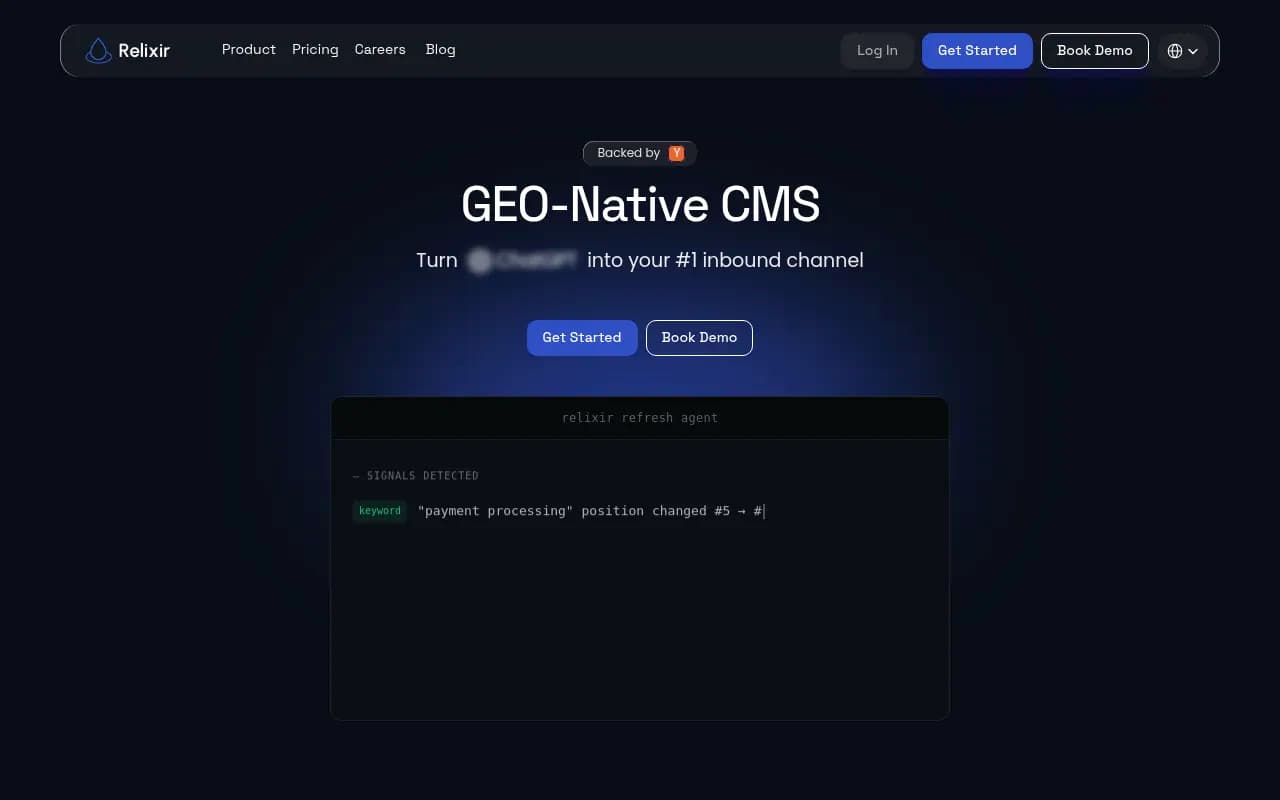
Relixir is an end-to-end GEO engine built specifically for enterprise brands. It combines visibility monitoring with content workflows and automated optimization suggestions. The platform is designed around the idea that AI search optimization should be a continuous process, not a one-time audit.
It's one of the few platforms besides Promptwatch that has a clear path from "here's your gap" to "here's the content to fill it." The enterprise focus means pricing is on the higher end and the onboarding is more involved, but for larger teams with complex needs, that structure can be worth it.
6. Otterly.AI
Otterly.AI is a monitoring-only platform, but it's worth including because it's genuinely good at what it does and priced accessibly. It tracks brand mentions across ChatGPT, Perplexity, and Google AI Overviews, with clean reporting and a straightforward interface.
The honest assessment: if you're a small team or agency that needs basic AI visibility tracking and you're not ready to invest in a full optimization platform, Otterly.AI is a reasonable starting point. Just go in knowing that you'll hit a ceiling quickly. There's no content generation, no gap analysis, and no crawler logs.
Otterly.AI

7. Airefs
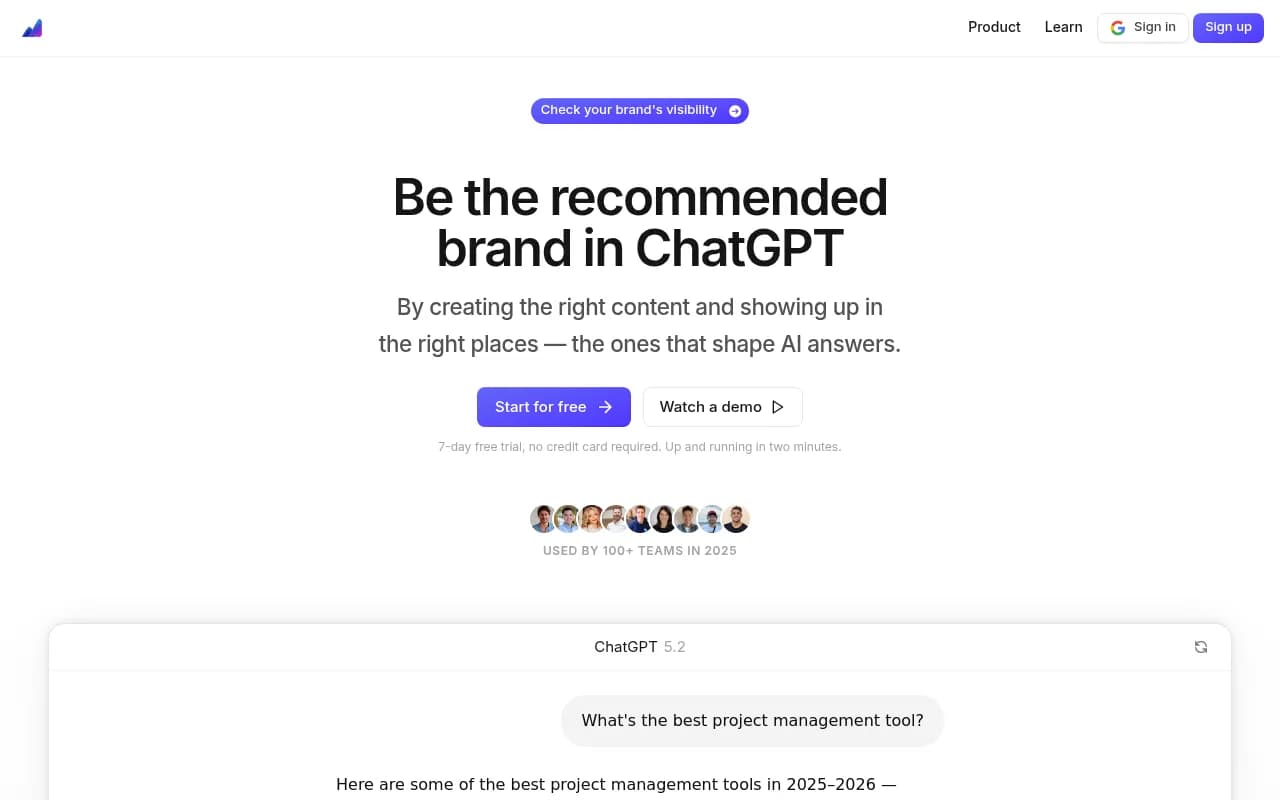
Airefs is the most affordable full-stack option in this list at $24/month. It includes Reddit monitoring (which most tools ignore entirely), a ChatGPT-first methodology, and an optional done-for-you agency service. For small teams or solo marketers who want more than basic tracking without paying enterprise prices, it's a strong option.
The coverage is narrower than Promptwatch or Profound — fewer AI engines, less depth on competitive intelligence — but for the price point, it punches above its weight.
How they compare
| Tool | Built-in content generation | AI engines covered | Crawler logs | Starting price | Best for |
|---|---|---|---|---|---|
| Promptwatch | Yes (AI writing agent) | 10 | Yes | $99/mo | Teams that want to find gaps AND fix them |
| Profound | No | 9+ | No | $99/mo | Enterprise monitoring and competitive analysis |
| Peec AI | No | Multiple (115+ languages) | No | Mid-market | Global brands, multilingual tracking |
| AthenaHQ | No | Multiple | No | Mid-market | Strategy and competitive intelligence |
| Relixir | Yes (automated workflows) | Multiple | No | Enterprise | Large teams with complex content needs |
| Otterly.AI | No | 3 (ChatGPT, Perplexity, AI Overviews) | No | Low | Basic monitoring on a budget |
| Airefs | No (but done-for-you service) | Fewer | No | $24/mo | Small teams, affordable full-stack |
What to actually look for in a Scrunch alternative
The monitoring vs. optimization distinction is the most important one to get clear on before you start evaluating tools. Most platforms in this category are monitoring tools. They show you data. A smaller number are optimization platforms that help you act on it.
If you have a content team that can take visibility data and run with it, a monitoring-only tool might be enough. You get the gap analysis, you brief your writers, they produce the content. The tool's job is done.
If you don't have that capacity, or if you want the content strategy and the content production to be informed by the same data, you need a platform with built-in generation. The risk with separate tools is that the data and the content end up disconnected — you're writing based on what the monitoring tool showed you last month, not what's actually driving citations right now.
A few other things worth checking:
Crawler logs. Most tools don't have them. Knowing that GPTBot crawled your site is one thing. Knowing it hit your homepage, got a 404 on your most-cited blog post, and hasn't returned in three weeks is a different kind of useful. Promptwatch has this; most competitors don't.
Prompt volume data. Not all prompts are worth optimizing for. A tool that shows you visibility gaps without telling you how often those prompts are actually being asked is making you guess at prioritization. Look for volume estimates and difficulty scores.
Traffic attribution. AI visibility scores are interesting. Revenue impact is what you actually need to justify the spend. The best platforms connect AI citations to actual traffic and conversions, either through a code snippet, GSC integration, or server log analysis.
Reddit and YouTube tracking. AI models cite Reddit threads and YouTube videos constantly. If your monitoring tool only looks at traditional web pages, it's missing a significant chunk of what's actually influencing AI recommendations in your category.
The bottom line
Scrunch AI isn't a bad product. For enterprise teams with existing content operations and a need for deep LLM coverage, it has real strengths — particularly if you can access the AXP feature. But the pricing structure creates a frustrating situation where the most interesting capabilities are locked behind Enterprise, and the standard plans leave you with data and no clear path to action.
The alternatives above cover a range of needs and budgets. If you want the most complete replacement — one that tracks visibility, identifies gaps, generates content to fill them, and closes the loop with traffic attribution — Promptwatch is the strongest option in 2026. If you're primarily a monitoring shop and want something more affordable, Otterly.AI or Airefs will get you started without the overhead.
The category is moving fast. Tools that were monitoring-only a year ago are adding content features. The gap between trackers and optimizers is narrowing. But right now, that gap still exists, and it's worth being deliberate about which side of it you need to be on.