
Key takeaways
- Semrush and Ahrefs now track AI visibility, through the Semrush AI Toolkit (from $99/mo, or inside Semrush One from $199/mo) and Ahrefs Brand Radar (Custom Prompts from $50/mo). Pricing comes from third-party roundups, so check the vendor pages before buying.
- Suite add-ons win when you already live in the suite and only need a monitoring layer. Dedicated platforms win when you need to know why AI cites you, track AI crawlers, attribute AI traffic, or produce content that closes gaps.
- The suites build prompt sets from keywords. AI behavior shifts fast, so keyword-derived tracking can drift from what people actually ask.
- A sensible 2026 setup is often a split: keep Semrush or Ahrefs for backlinks and keyword research, and add one dedicated AEO tool for AI visibility.
- Run a 14-day test on the same 30 prompts in two tools before committing. Differences show up quickly.
Why this question comes up now
A year ago, "Do I need a separate AEO tool?" had an easy answer: no, because the suites didn't track AI answers. Today both Semrush and Ahrefs do. So the question got harder, and the vendor blog posts you will find are all biased. The suite vendors say extend what you have. The dedicated vendors say suites are shallow. Both are partly right.
This guide tries to separate the cases. I will cover what the suites actually give you, where they stop, what a dedicated platform adds, and a decision framework you can apply in an afternoon.
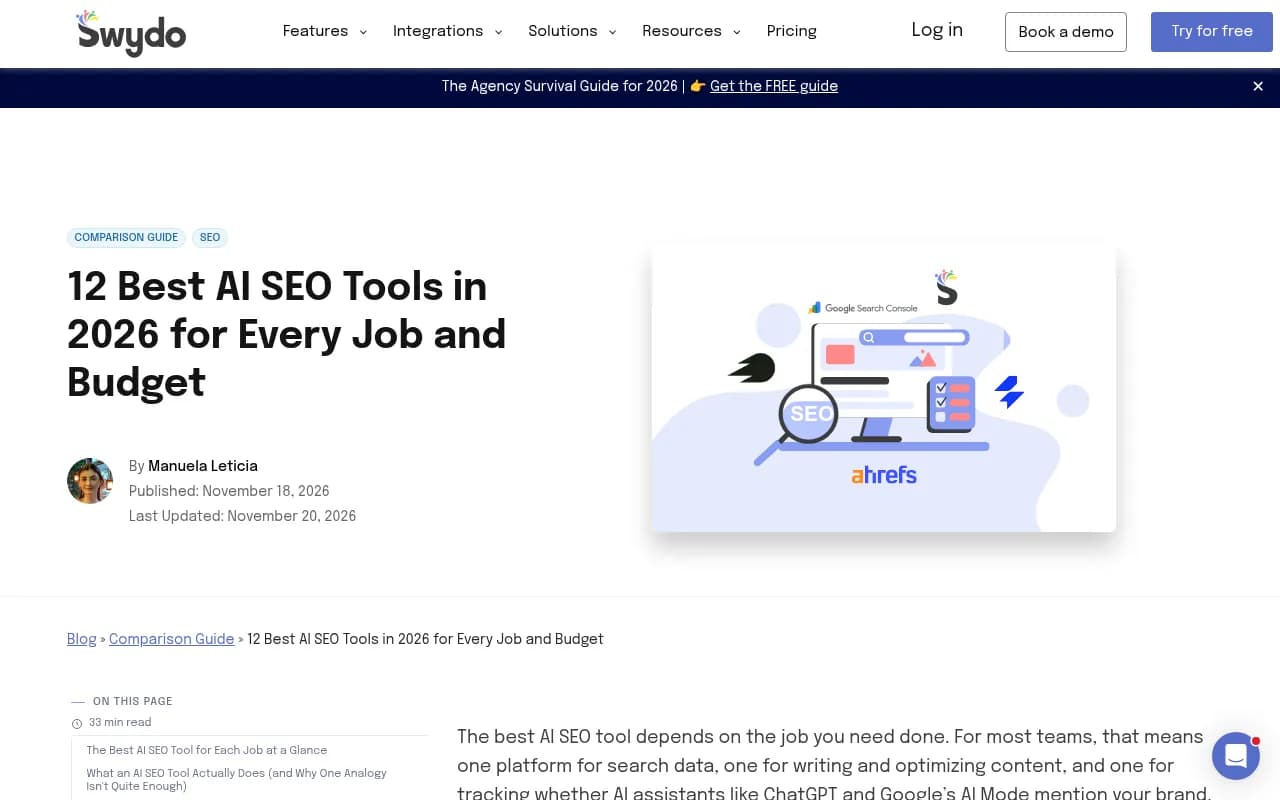
The Swydo roundup above is a good example of how even neutral lists now split the category into jobs: search data, content, and AI visibility tracking are treated as separate purchases.
What Semrush and Ahrefs actually offer for AEO
Semrush
Semrush sells AI visibility in two ways. The AI Visibility Toolkit is an add-on at roughly $99/mo per domain on top of an active subscription, and Semrush One starts around $199/mo with the SEO toolkit and AI visibility in a single plan. The pitch is convenience: keywords, backlinks, audits and AI tracking sit behind one login.
The honest strength is workflow continuity. If your team already builds reports in Semrush, adding AI share-of-voice to the same dashboards costs little in training time. The honest weakness is depth. The toolkit is described, even by friendly roundups, as a data-rich add-on attached to an SEO platform, not a purpose-built AEO system.
Ahrefs Brand Radar
Ahrefs packages AI tracking as Brand Radar. Third-party roundups list Custom Prompts from $50/mo, an Index tier from $199/mo, and an all-models tier at $699/mo. The data scale and Google AI Mode coverage get good marks. Critics point out that prompts are derived from keywords rather than real AI conversations, and that the built-in index refreshes monthly.
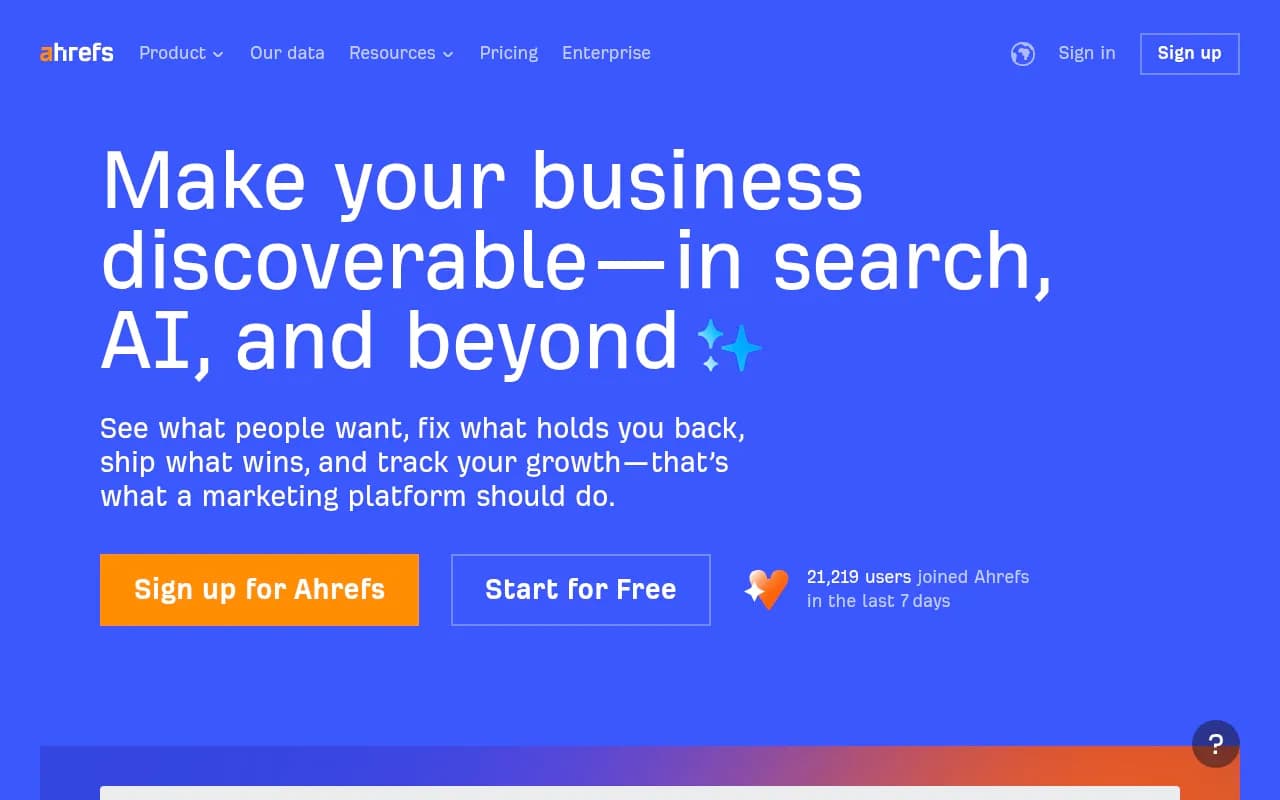
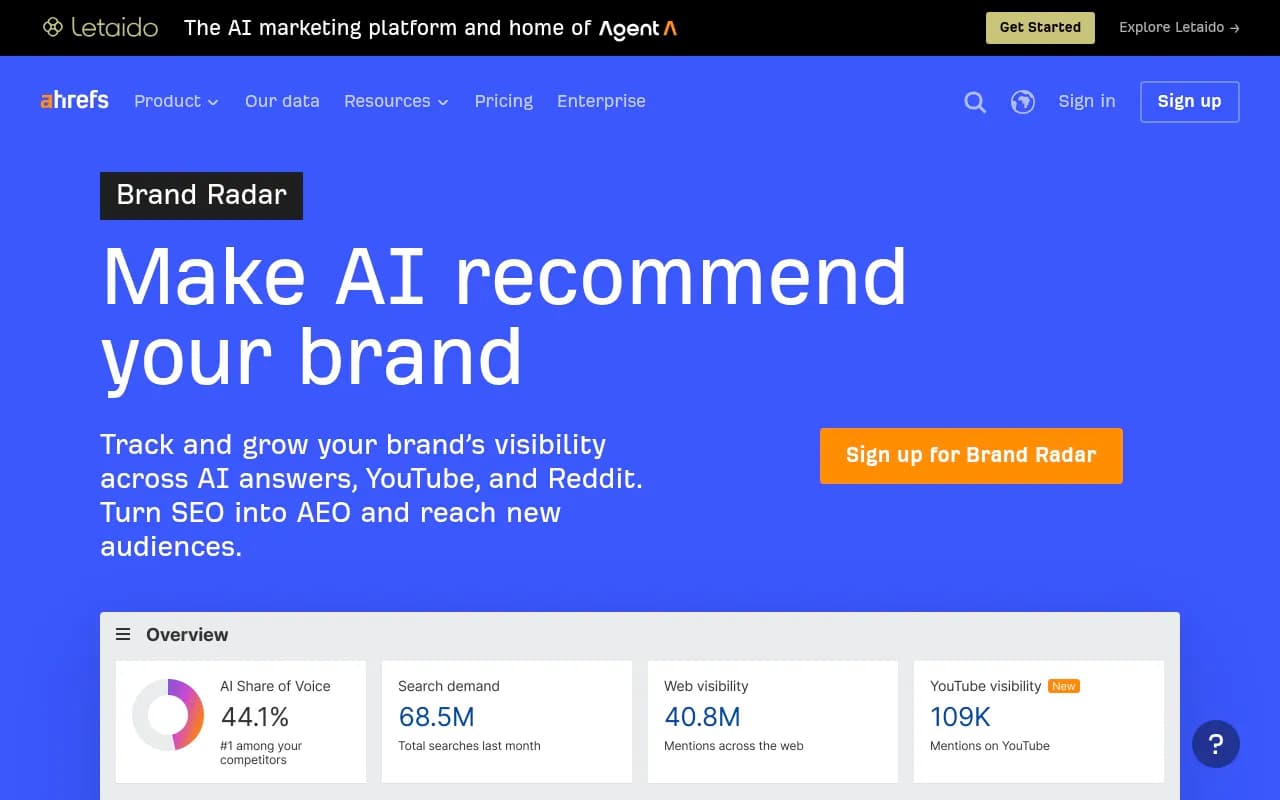
The Swydo guide frames the choice well: pick Semrush if AI visibility is a priority and you want it in the plan, pick Ahrefs when link building drives your strategy and AI tracking can wait or live in a cheaper tool.
Where suite add-ons run out of road
There are five gaps I see repeatedly when teams outgrow an add-on.
- Keyword-derived prompts. AI answers are shaped by query fan-outs, the searches a model runs behind the scenes. Promptwatch Data's ChatGPT query fanout report shows how unstable this is: average searches per response were 2.15 in early December, about 1.84 by early March, and 1.0 per response when fanouts returned in April, while average query length dropped from about 117 characters to roughly 53. If the behavior moves that much, a static keyword list is a weak proxy.
- No crawler visibility. Suites tell you whether you were mentioned. They mostly cannot tell you whether GPTBot, ClaudeBot or PerplexityBot even read the page. Without that, you cannot tell an access problem from a content problem.
- No traffic attribution. Knowing you were cited is step one. Knowing whether it sent visitors and conversions is the part finance cares about.
- No execution. Profound's own comparison notes that Ahrefs offers no AEO content workflows. Semrush is similar: it tells you what to do and leaves the doing to you.
- Narrow source tracking. Citations come from G2, Reddit, YouTube, LinkedIn and review sites, and suites rarely break these out well.
That last point matters more than it used to. Promptwatch's November 2026 ChatGPT citation share data (Nov 1 to 25, 1-in-8 sample) puts Reddit at 0.23% of ChatGPT citations, down from 3.71% in June, with G2 and LinkedIn at 0.18% each. Review sites hold five of the top 10 spots, and the top 20 sites together earn under 2% of citations. The rest is spread over hundreds of thousands of domains. A tool that only tracks mentions will miss most of that picture. For the wider shift away from social sources, see the social media citations report from November 2026.
What a dedicated AEO platform adds
A dedicated platform is built around the loop of monitor, trace, act, measure. Concretely, that means:
- Prompt tracking collected from the real interfaces of ChatGPT, Gemini, Perplexity, AI Overviews and AI Mode, not just API calls. User-facing answers and citations can differ from API output.
- Citation analysis: which of your pages get cited, which third-party pages name you, which Reddit threads and YouTube videos show up.
- AI crawler logs that verify bot visits against operator IP ranges.
- Visitor analytics tying AI referrals to conversions.
- Some form of action layer, from prioritized to-do lists to content generation.
Promptwatch is the one we use and recommend at 1001 SEO Media's network. It covers that whole loop in one product: Brand Narrative and Fact Check for what AI says about you, IP-verified AI crawler logs, visitor analytics, an Action Board, and a Content Agent that writes and publishes to WordPress, Webflow or Framer, then tracks whether the page gets crawled, cited and clicked. Prices are public: Essential is $95/mo, Professional $245/mo, Business $579/mo, with agency plans from $199/mo. Confirm current numbers at promptwatch.com/pricing.

It is not the only credible option. Profound and Bluefish target enterprise programs, Otterly and Peec are cheaper trackers, and others sit in between. Here is the field as it looks to me.
Comparison: suites versus dedicated platforms
| Option | Type | Starting price (verify) | Strongest at | Typical gap |
|---|---|---|---|---|
| Semrush AI Toolkit / Semrush One | Suite add-on | $99/mo add-on; One from $199/mo | One login for SEO plus AI | Shallower AI data, no crawler logs |
| Ahrefs Brand Radar | Suite add-on | From $50/mo (Custom Prompts) | Data scale, AI Mode coverage | Keyword-derived prompts, monthly index refresh |
| Promptwatch | Dedicated, end-to-end | $95/mo Essential | Crawler logs, traffic attribution, content execution | Content Agent starts on Business |
| Profound | Dedicated, enterprise | Quote-based | Engine coverage, enterprise reporting | Higher price, no agentic execution |
| Otterly.AI | Dedicated tracker | From about $29/mo | Cheap entry point | Monitoring only |
| Peec AI | Dedicated tracker | Varies | Simple prompt tracking | No crawler logs or content tools |
| Bluefish AI | Dedicated, enterprise | Quote-based | Fortune 500 positioning | Narrower fit for small teams |
For head-to-head detail, see Promptwatch vs Semrush, Promptwatch vs Ahrefs, and Promptwatch vs Profound. The 2026 platform comparison covers the rest.
The dedicated alternatives worth knowing
Profound
The enterprise name. Strong engine coverage and prompt volumes drawn from real conversations. Expect a quote-based sales process and pricing that suits large programs more than small teams.
Profound

Otterly.AI
The budget entry. A Lite plan around $29/mo is the lowest published entry point among dedicated trackers. Good for finding out whether AI visibility matters to you yet. You will outgrow it if you need crawler data or content workflows.
Otterly.AI

Peec AI
A straightforward prompt tracker aimed at marketing teams. Clean interface, narrower scope.

Scrunch AI and AthenaHQ
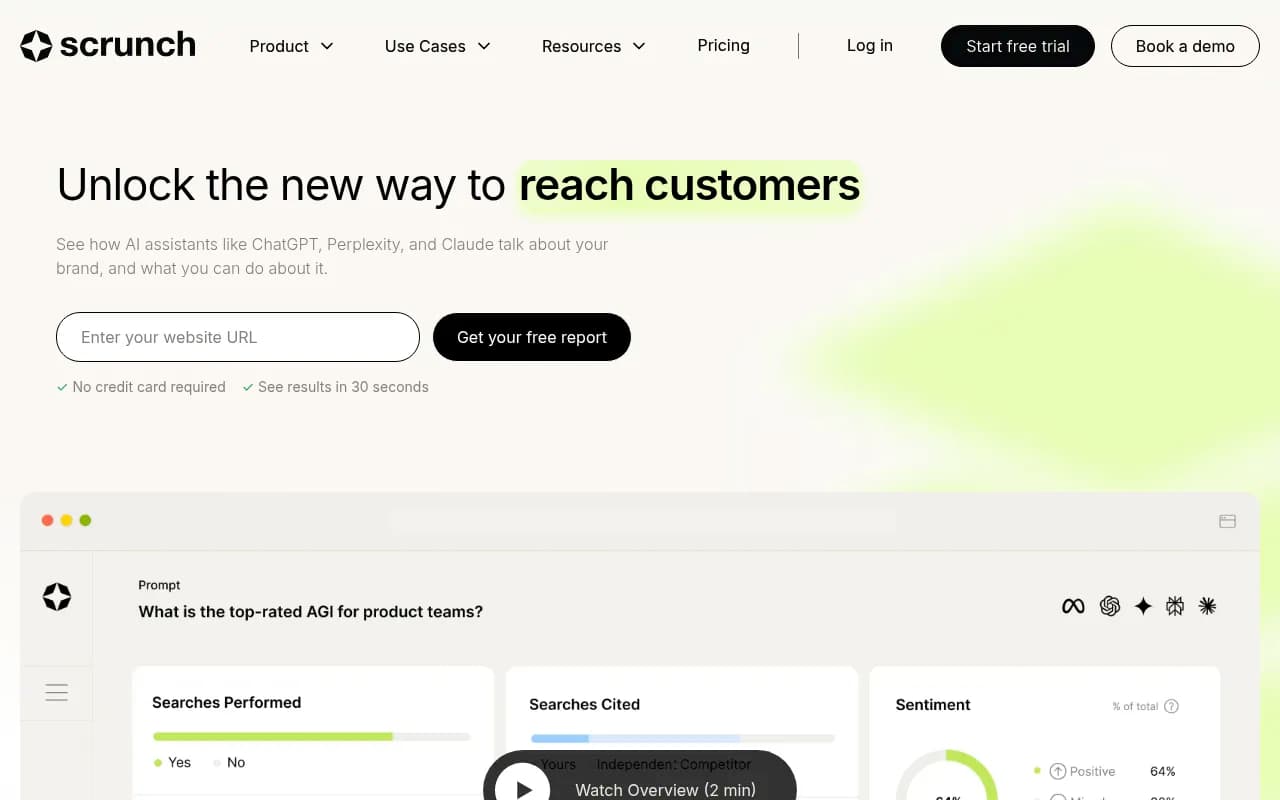
Both sit between simple trackers and enterprise suites. Scrunch leans toward AI bot access monitoring, which is useful if crawlability is your biggest question.

Others on our radar
Xseek (GPTBot crawler monitoring), Airefs, Qwairy and Bluefish AI show up in most 2026 roundups. If you want to browse more, the GEO software directory at bestgeosoftware.com lists dozens.
So when does a dedicated platform win?
I would stop pretending the answer is always "buy the specialist." It is not. Here is how I would decide.
Stay with the suite add-on when
- You already pay for Semrush or Ahrefs and use most of it.
- Your question is "are we mentioned, and how do we compare to competitors?" and nothing deeper.
- You are testing whether AI search matters for your business at all. A $50 to $99 add-on is a cheap experiment.
- Your team cannot absorb another tool and another login.
Buy a dedicated platform when
- AI search already sends you leads, and you need to prove it. You need AI traffic attribution, not just mention counts.
- You suspect an access problem. If AI bots fail to read your pages, no amount of content work will fix it. Crawler logs settle this fast. For a free first pass, try the Agentic Readiness Check or the AI Crawler URL Inspector.
- You need to fix gaps, not list them. Dashboards report a score; they do not write the page.
- You run an agency and need pitch reports, white-label output, or many client projects.
- You operate in several countries or cities and need local targeting.
- Sentiment and accuracy matter: what AI claims about you, checked against sources.
The case studies are worth a look if you want numbers rather than adjectives. Crisp reported 2x higher conversion rates from AI traffic, and TreeHouse grew AI search to about 25% of organic conversions by fixing crawler access and publishing proprietary data. Those are vendor-published results, so read them with that in mind.
The split-stack option
Most teams I would advise end up here. Keep Semrush or Ahrefs for what they are best at: keyword research, backlinks, site audits. Ahrefs in particular is still the benchmark for link data, and Ahrefs Webmaster Tools is free for verified sites. Then add one dedicated AEO tool. You pay for two products, but each does the job it was built for. If budget forces a choice, cancel the suite's AI add-on, not the dedicated tool.
How to test two tools fairly
Vendor demos are optimized. Run your own bake-off.
- Pick 30 prompts: 10 category questions, 10 competitor comparisons, 10 branded. Use the same list in every tool.
- Run both tools for 14 days on the same engines (ChatGPT, AI Overviews, Perplexity at minimum).
- Compare the answers, not the dashboards. Open five responses in the real ChatGPT UI and check whether each tool reported the same brands and sources.
- Ask each tool one "why" question: why is competitor X cited and we are not? See which one points at a specific page or gap.
- Check one workflow end to end. Can you go from a gap to a published page to a measured result without leaving the product?
- Count seats and limits. Prompt caps and response limits are where cost surprises hide. Promptwatch, for example, includes unlimited team seats on every plan.
If you are choosing a content-focused companion, Surfer SEO and Clearscope handle on-page optimization well but do not replace AI visibility tracking.

A note on citation data and what to optimize
Whatever you buy, ground decisions in how AI actually cites. The November 2026 Promptwatch Data report suggests three things: get listed and reviewed on G2, Capterra, Gartner and Trustpilot; publish direct answers on your own site; and do not build a ChatGPT plan around Reddit. Separately, the content type report found product pages were the most cited type in ChatGPT at 22.4% (Sep 28 to Oct 4, 2026), and the domain rank distribution report shows the median cited domain sits around DR 56 to 57 in all four major engines. You do not need a DR 90 site to be cited.
If you would rather outsource the program, agencies exist for this. 1001 SEO Media runs technical SEO, content, and generative engine optimization work, and it uses Promptwatch for AI visibility measurement.
Where to go next
- Run the free AI visibility report to see how ChatGPT, Gemini and Perplexity currently describe your brand.
- Start a 7-day trial of the paid plans if you want to compare crawler logs and attribution against your current suite.
- Browse rank-tracking options at ai-rank-tools.com if you are still building a shortlist.
FAQ
Do I need a separate AEO tool if I have Semrush or Ahrefs?
Not always. If you only need to know whether you are mentioned and how you compare to competitors, the add-ons are cheaper than a new vendor. You need a dedicated tool when you want crawler logs, traffic attribution, deeper citation tracing, or content execution.
Is Semrush or Ahrefs better for AI visibility?
Semrush is the easier pick if you want AI tracking bundled into one plan. Ahrefs is better when backlink data drives your strategy and you can run AI tracking separately or cheaply.
How much do the add-ons cost?
Third-party roundups list the Semrush AI Toolkit at about $99/mo, Semrush One from $199/mo, and Ahrefs Brand Radar Custom Prompts from $50/mo, with higher tiers up to $699/mo. These move often, so confirm on the vendor pages.
Can I cancel Semrush or Ahrefs if I buy a dedicated AEO platform?
Only if you do not rely on keyword research, backlinks or audits. A dedicated AEO tool does not replace a backlink index. Most teams keep both.
What should I measure to judge an AEO tool?
Share of voice, position, sentiment and self-citation rate tell you where the problem is. Then check whether the tool shows AI crawler activity and AI-referred conversions, because those separate visibility from revenue.