Key takeaways
- A blended global AI visibility score hides the markets where you are losing. Track each country and language as its own market.
- Country and language are separate settings. The country tells the engine where the user is, the language controls how the question is asked and answered.
- Engines cite very different sources. Promptwatch Data shows ChatGPT drawing 0.46% of citations from social platforms while Google AI Overviews draws 12.2% (Sep 28 to Oct 4, 2026), so one engine does not predict another.
- Tool pricing for multi-market tracking varies a lot. Some tools put extra countries behind higher tiers or add-ons, so price the plan you would actually use.
- I could not find verified public data on exactly how Meta AI answers differ country by country. Treat that as something you measure for your own brand, not something you assume.
Why market-level tracking matters
Here is the plain version. When someone in Spain asks an AI assistant for a recommendation in Spanish, the engine runs searches, reads local publishers, review sites and retailers, and recommends the brands those sources mention. A person in the US asking the same question gets a different set of sources. A brand that leads in one market can be close to absent in another.
A single global visibility score averages that away. You see a healthy 40 and miss that it is 65 in the US and 8 in Germany.
There is evidence that engines disagree even within one market. In a comparison published by 3RD across 60 tracked brands, the most visible competitor was a different brand on different assistants for 37 of them (62%) on the same prompt set. That is one vendor's dataset, so read it as directional. Profound has published something similar for Google's own models: across 15,155 brand configurations it found a median 8-point visibility gap between a brand's best and worst Google model (Gemini, AI Overviews, AI Mode), driven by which sources each model cites rather than by mention counts.
Now multiply that by countries. Engine, language and country are three separate axes, and your visibility can move on any of them.
What we know about Gemini and Meta AI by market
I want to be honest about the limits here. Public, verified data on country-level variation specifically for Meta AI and Gemini is thin.
What is solid:
- Gemini sits inside Google's ecosystem. Profound's research found Gemini leans on Reddit, YouTube and Wikipedia, while AI Overviews and AI Mode cite social and UGC platforms at roughly double Gemini's citation depth. If your market's strongest sources are local publishers rather than those, expect different outcomes.
- Engines cite different numbers of sources. Promptwatch's average sources per response data shows ChatGPT citing about 5 sources per answer when search triggers, AI Overviews about 10, and Perplexity almost exactly 10 every day. Copilot swung widely. So "visibility" across engines needs normalising before you compare it.
- Source mixes differ sharply by engine. Promptwatch's social media citations report (Sep 28 to Oct 4, 2026) shows social platforms at 12.2% of AI Overviews citations, 2.7% of Perplexity citations and 0.46% of ChatGPT citations. YouTube alone is 4.28% of AI Overviews citations. If your local market leans on YouTube reviews, that matters on one engine and barely on another.
What I could not verify: whether Meta AI is available in each of your countries, and how its answers shift between them. Check availability market by market before you promise a stakeholder coverage. Also note that Meta is crawling heavily: Promptwatch Data on Meta-WebIndexer shows it growing from about 2% to nearly 38% of tracked AI crawler requests between mid-July and August 9, 2026. That suggests Meta is building its own retrieval layer, which makes crawler access to every country version of your site worth checking.
The practical takeaway is simple. Do not assume Gemini or Meta AI behaves like ChatGPT, and do not assume the US result carries over. Measure.
Country and language are separate settings
This is where setups go wrong. A market is a country plus a language. If you sell in Belgium, you may need French (Belgium), Dutch (Belgium) and possibly English, each tracked separately. If you sell to Spanish speakers in the US, that is a different market from Spain.
The country controls where the engine thinks the user is. The language controls how the prompt is written and how the answer comes back. Setting only one gives you misleading data. A Spanish prompt run from a US location is not the same test as a Spanish prompt run from Madrid.
Also ask how each tool sets the country. Many vendors do not document it, which makes it hard to know whether results reflect a real local user or just a translated prompt.
What to look for in a multi-country tool
Before you buy, check these points:
- Does the tool scrape the real user interface of each engine, or use API outputs that can differ from what users see?
- How is the country set, and can you also set a city or state for local queries?
- Which engines return country-specific answers on your plan, and is Meta AI or Gemini one of them?
- Does each additional country cost another prompt slot, a higher tier, or an add-on?
- Can you see the cited sources per market, so you know which local publishers shape the answer?
- Can you export or report per market for regional teams?
Tools compared for multi-market tracking
The table below uses vendor claims from the research I gathered. Pricing changes often, so confirm on each vendor's site.
| Tool | How markets work | Cost notes | Best for |
|---|---|---|---|
| Promptwatch | One monitor per country and language, optional city or US state; live-interface scraping | Multi-market on every plan from $95/mo | Brands that want tracking plus content action |
| Otterly.AI | Each country takes another prompt slot | Prompt allowances of 15, 100 and 400 across Lite, Standard, Premium; AI Mode, Gemini, Claude are paid add-ons | Smaller teams and agencies on a budget |
| Ahrefs Brand Radar | Custom prompts by assistant and location | From $199 per platform, $699/mo for all platforms | Teams already living in Ahrefs |
| Semrush | Location-based brand performance | Reported at $99/month per extra location | Teams inside the Semrush suite |
| SE Ranking (SE Visible) | 7 countries, 5 languages per vendor listing | From $99/mo | Budget SEO teams |
| AthenaHQ | One region and language on Starter | Multiple countries on Enterprise | Brands combining monitoring with GEO actions |
| Profound | Regions added through Enterprise | No public price; trial is 50 preset prompts, one region, one language | Enterprise programs |
Promptwatch
Promptwatch is the one I would put first for multi-country work, mainly because the market structure is built into how monitoring is organised. You create a monitor per market, for example DE in German, FR in French for Paris, and BE in French (Belgium), and each keeps its own time series. It scrapes the live interfaces of engines like ChatGPT, Google AI Overviews, Google AI Mode, Gemini, Perplexity, Copilot, Meta AI and Amazon Alexa, in each country and language, which matters because user-facing answers and citations can differ from API outputs.

A few things are useful for market comparison. The Visibility by Country map shows where your brand appears and which countries you do not track yet. Heatmaps let you compare any two dimensions, such as models against countries, on Visibility, Sentiment, Position or Share of Voice. Citation reports show which local publishers, Reddit threads and YouTube videos feed each market. Brand merging rolls local brand names or legal entities into one brand.
Crawler logs help too. IP-verified logs show whether AI crawlers, including Meta's, actually reach your country versions and whether they hit errors. And Content Gap Analysis tests each prompt's fan-out sub-queries against your pages, so you can see which local questions your site does not answer. Then the Content Agent can write and publish to Webflow, Framer or WordPress, writing in the prompt's language.
Otterly.AI
Otterly is a sensible entry point if the budget is tight. The catch for international work is that each country takes another prompt slot, and engines like Gemini and AI Mode are paid add-ons. A 15-prompt Lite plan evaporates quickly across five markets.
Otterly.AI

Ahrefs Brand Radar
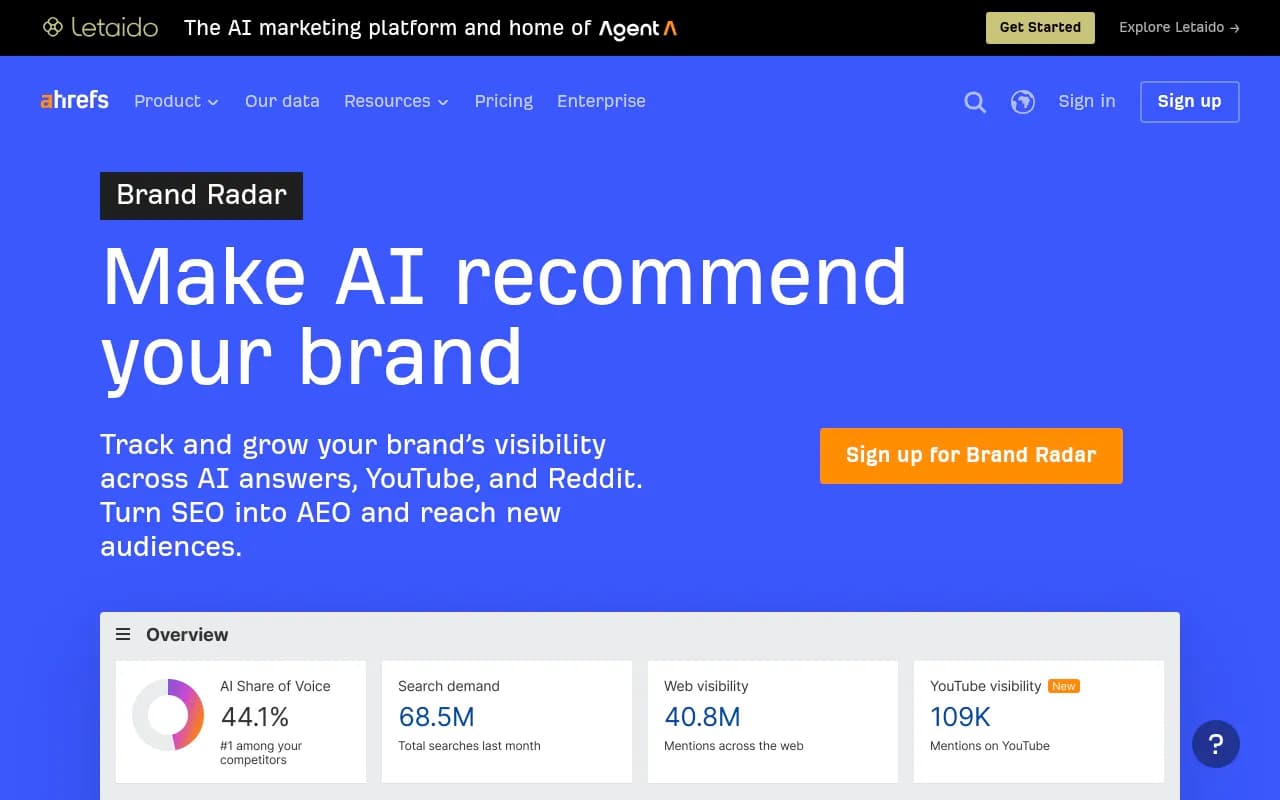
Brand Radar supports custom prompts by assistant and location and is strong for large-scale benchmarking. One source quotes the prompt index at 405M+ and another at 450M+, so check Ahrefs directly before you cite a figure. Pricing is per platform, which gets expensive if you want every engine.
Semrush and SE Ranking
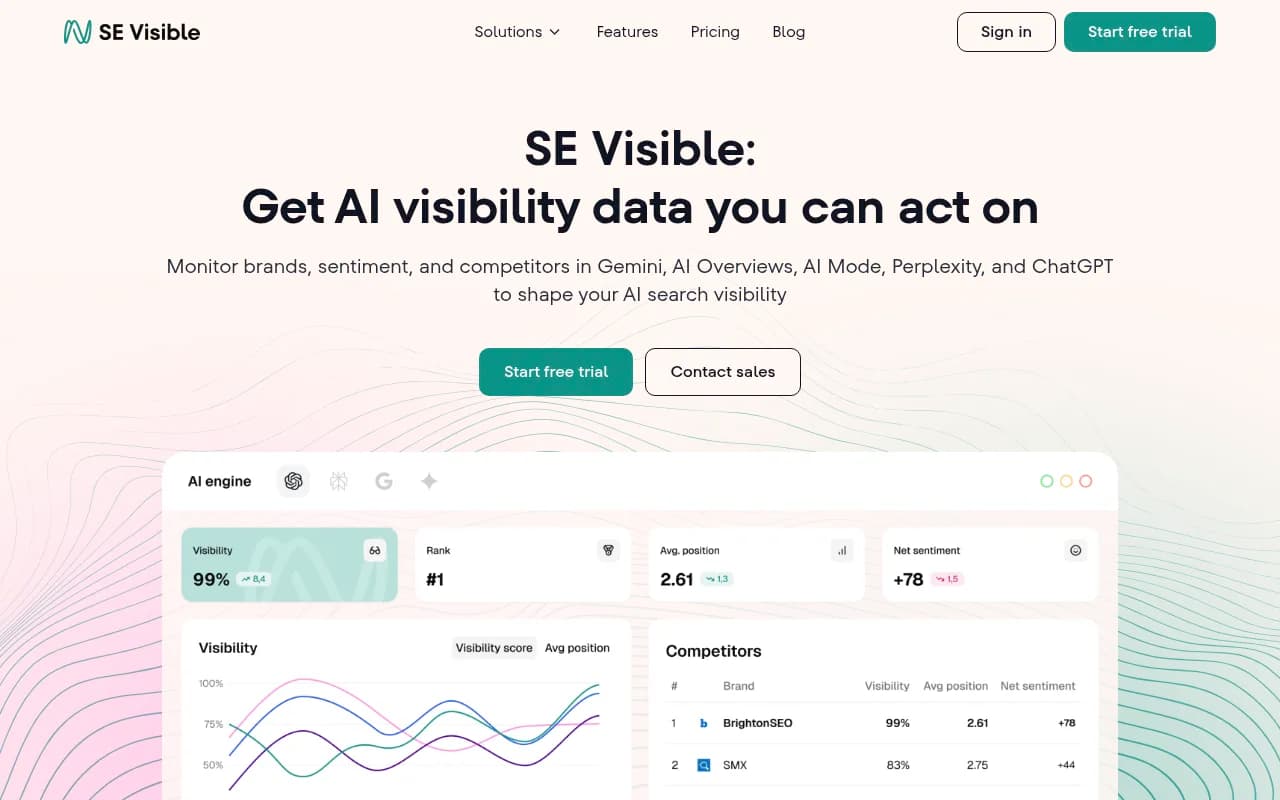
Both suit teams that want AI tracking inside a tool they already use. Extra locations cost more in Semrush, and SE Visible should be priced separately from other SE Ranking add-ons.
Profound and AthenaHQ
Both are credible, but the multi-market story sits at higher tiers. AthenaHQ's Starter has one region and language, and Profound's trial is one region and one language with preset prompts you cannot edit.
Profound


If you want to browse more options in the category, the GEO software directory at bestgeosoftware.com and the rank tracker list at ai-rank-tools.com are worth a look.
How to set up market-level tracking
Step 1: pick your markets properly
List each country and language pair you actually sell in. Resist tracking 17 markets on day one. Start with your top three by revenue plus one underperformer you suspect is weak.
Step 2: build local prompt sets
Do not translate your US prompts word for word. People phrase questions differently in each language, and local products, retailers and regulations change what a good prompt is. Pull ideas from Search Console data in that market, People Also Ask, and local sales conversations. Tracking 20 to 40 buyer questions per market is a reasonable baseline, per the 3RD guidance in my research, and prompts with branded terms should be tracked separately from unbranded ones.
Step 3: run each engine in each market
Include Gemini and Meta AI alongside ChatGPT, AI Overviews and Perplexity, but check which are available where. Give it two weeks before judging. A few days of data can point either way, since AI answers are probabilistic.
Step 4: read the metrics together
Low share of voice in one market is a coverage problem. Late position is a prominence problem. Mentions without citations to your own site point to a content or crawlability problem. Weak sentiment is a reputation problem, and sentiment really does vary by market: the same product can be called reliable in one language and expensive in another, depending on local reviews.
Step 5: look at the sources
This is the step that tells you what to do. For each lagging market, list the domains the engine cites. Those are your targets: local review sites, publishers, forums, comparison pages. If your own local site never appears, check crawler access and whether the local pages answer the questions the fan-out is asking.
Fixing a lagging market
A few patterns show up repeatedly.
Weak local content gets exposed faster by AI than by classic search. One practitioner quoted in Promptwatch's multi-country piece put it well: AI amplifies the mistakes, and a UK site that was weaker than a Dutch one used to get away with it. Not anymore.
So start with the basics. Make sure local pages exist, are crawlable by the AI bots, and answer the specific questions in that market. Then work on third-party presence: the local publishers and review sites that the engines cite. Promptwatch's content type data shows product pages as the most cited type in ChatGPT at 22.4% of citations (Sep 28 to Oct 4, 2026), followed by landing pages and listicles, so well-built local product and landing pages are not wasted effort.
Also keep your expectations calibrated. Promptwatch's half-life data found landing pages and docs stayed cited longest among pages ChatGPT cited on July 6, 2026, while news lost half its pages within 36 days. Evergreen local pages beat reactive ones.
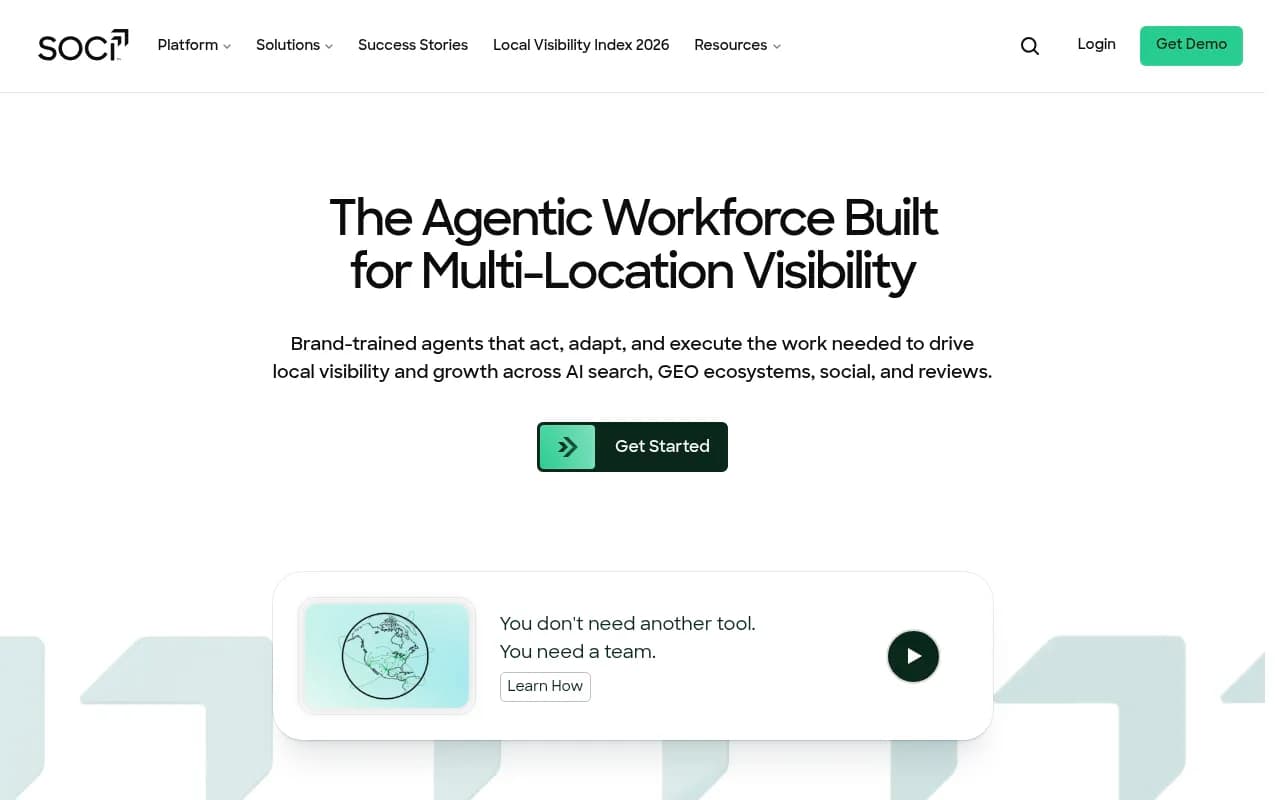
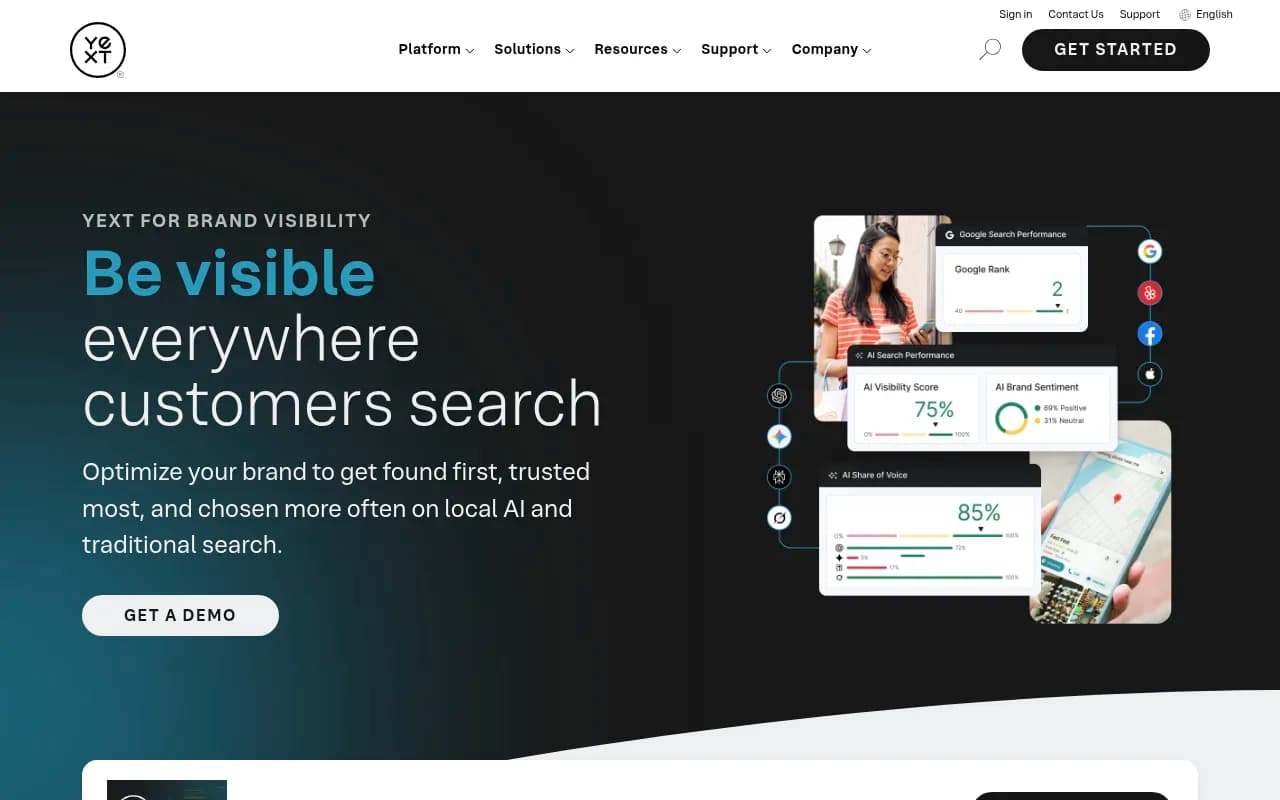
For local, multi-location work, tools like SOCi, Yext and Chatmeter focus on listings and reputation signals. SOCi's 2026 Local Visibility Index found brand locations appearing in AI recommendations only 6.5% of the time, which tells you how selective these engines are about local recommendations.
Reporting to regional teams
Give each market owner a view of their own numbers. A country manager does not care about the global blend. Per-market PDF reports, a shared dashboard with a competitor comparison, and a weekly digest cover most needs. Keep one global rollup for leadership, but show the spread between best and worst markets next to it. That spread is usually the more honest headline.
Common mistakes
- Averaging markets into one score and calling it done.
- Setting the language but not the country, or the reverse.
- Judging a change after three days of data.
- Tracking only the US version of an engine and assuming the rest follow.
- Buying the entry plan, then discovering Gemini, extra countries or Perplexity cost extra.
- Treating monitoring as the strategy. Dashboards do not change answers. Content, authority and crawler access do.
Final thoughts
The short version: treat each country and language as its own market, run Gemini and Meta AI next to the engines you already watch, and let the cited sources tell you what to fix. Where public data is missing, like Meta AI's country-by-country behaviour, your own monitoring is the only reliable source. Start with three markets, two weeks of data and 20 to 40 local prompts each, then expand where the gaps are largest. For wider context on how engines differ, the research hub at Promptwatch Data is a good place to keep checking.
Prices and plan limits change often, so confirm current details on each vendor's pricing page, including promptwatch.com/pricing, before you commit.