Key takeaways
- Most AI visibility tools stop at monitoring. These four platforms each claim to go further with built-in content generation or optimization capabilities.
- AirOps is primarily a content operations platform that happens to support AI search workflows -- it's powerful but requires significant setup.
- Atomic AGI leans heavily into analytics and traffic analysis; its content generation features are limited compared to the others.
- Searchable is good for discovery and exploration but struggles as a long-term optimization platform.
- Promptwatch is the only platform here that closes the full loop: find gaps, generate content grounded in citation data, then track whether that content actually gets cited by AI models.
The AI visibility tool market has exploded. There are now well over 100 platforms claiming to help you show up in ChatGPT, Perplexity, Google AI Overviews, and the rest. Most of them are dashboards. They show you a visibility score, maybe a list of prompts where competitors appear and you don't, and then... nothing. You're left figuring out what to do with that information.
A smaller group of platforms is trying to solve the harder problem: not just showing you where you're invisible, but actually helping you fix it. That means built-in content generation, gap analysis tied to real citation data, and tracking that connects new content to actual visibility improvements.
This comparison focuses on four platforms that sit in that more ambitious category: AirOps, Atomic AGI, Searchable, and Promptwatch. They're not identical -- their approaches differ significantly -- so let's get into what each one actually does.
What we're comparing and why
Before getting into the tools, it's worth being clear about what "built-in content generation" means in this context. There's a spectrum:
- At one end: a basic AI writing button that generates generic blog posts
- At the other end: content generation grounded in real citation data, prompt volume analysis, competitor gap analysis, and optimized specifically to get cited by AI models
The difference matters enormously. Generic AI content doesn't move visibility scores. Content engineered around what AI models actually cite -- specific sources, formats, topics, and angles -- does.
With that framing in mind, here's how the four platforms compare.
AirOps
AirOps started as a workflow automation tool for content teams and has evolved into what it calls a "content engineering platform." The positioning is around AI search visibility, but the actual product feels more like a powerful content operations system that you can configure for GEO purposes.
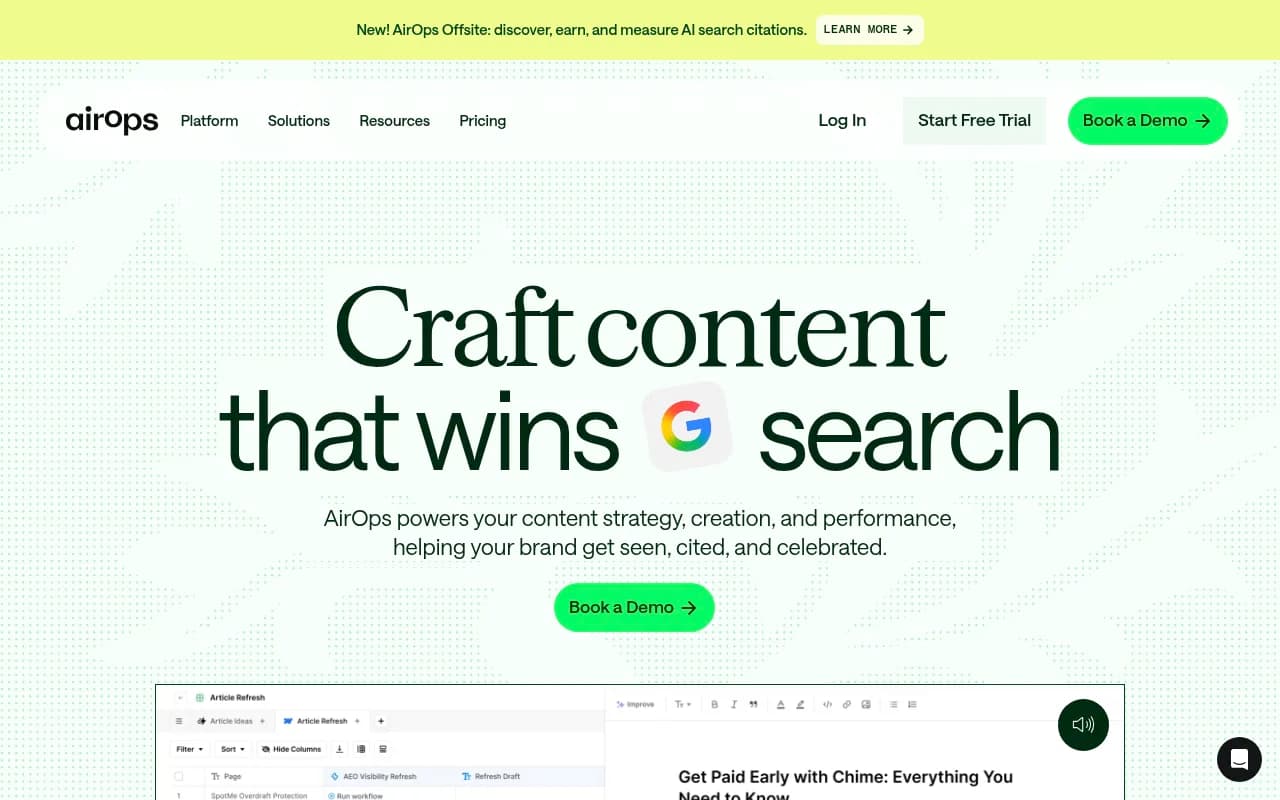
What AirOps does well: it gives you flexible workflows for generating content at scale. You can build pipelines that pull in data, run it through AI models, and output structured content. For teams with technical resources and a clear content strategy already in place, this is genuinely useful.
The limitation is that AirOps doesn't come with built-in AI visibility intelligence. It doesn't tell you which prompts your competitors are winning, which topics AI models want to cite, or how your visibility score is changing over time. You'd need to bring that data in from elsewhere. It's a content production engine, not an AI visibility platform.
One review from orchly.ai described it well: "AirOps felt less like a traditional SEO or AI visibility tool and more like a content operations platform." That's accurate. If you already know what to write and just need to produce it efficiently, AirOps is strong. If you need to figure out what to write first, you'll need something else alongside it.
Pricing isn't publicly listed for most tiers, which makes it harder to evaluate for smaller teams.
Atomic AGI
Atomic AGI positions itself as an analytics-first SEO platform with AI traffic analysis. The focus is on understanding how AI-referred traffic behaves on your site -- where it lands, how it converts, what it does differently from organic search traffic.
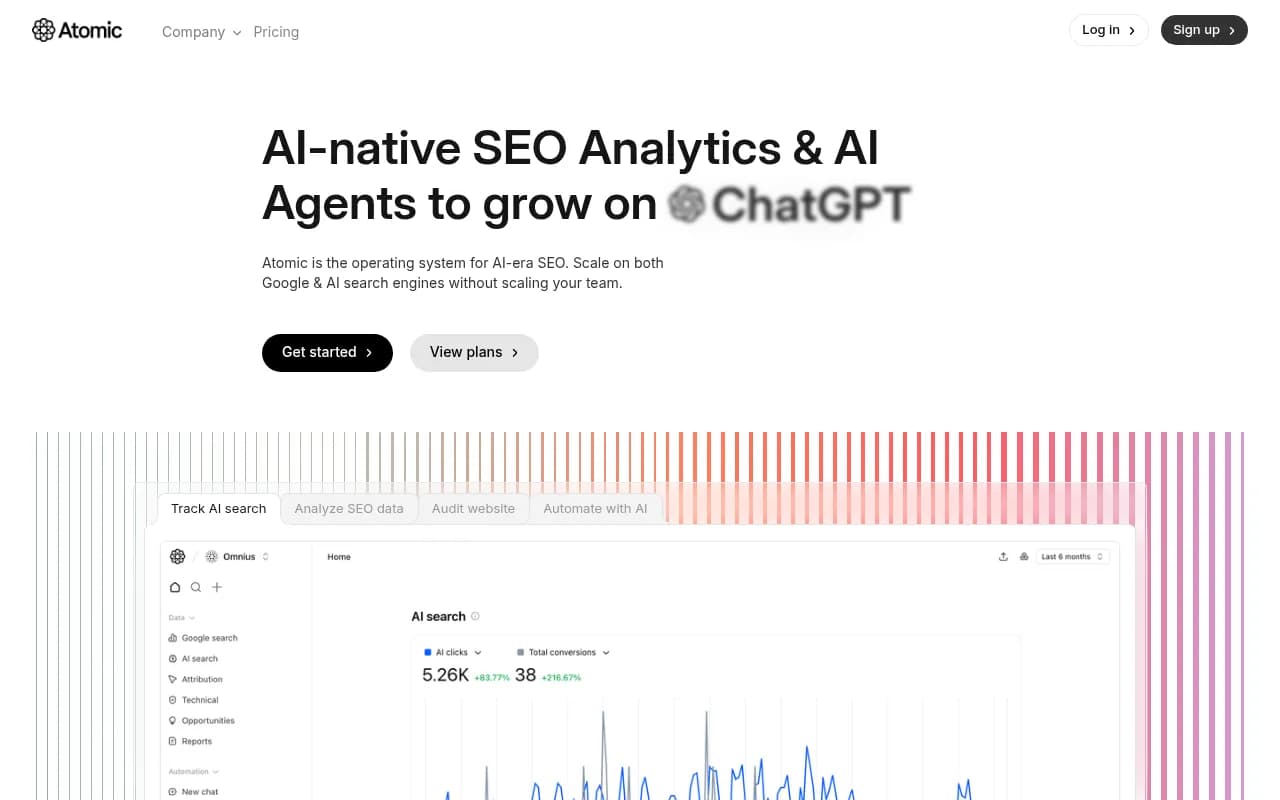
This is actually a useful and underserved capability. Most AI visibility tools track whether you appear in AI responses, but don't connect that to what happens after someone clicks through. Atomic AGI tries to fill that gap.
The content generation angle is thinner here. Atomic AGI has some content workflow features, but they're not the core product. The platform is better described as an AI traffic analytics tool with some content support, rather than a full optimization platform.
At $10/month for entry-level access (per the orchly.ai comparison), it's the most affordable option in this comparison by a wide margin. That makes it worth considering as a complement to a more comprehensive platform, particularly if you want detailed traffic behavior data.
What it doesn't do: it won't tell you which prompts to target, which competitors are outranking you in AI responses, or generate content specifically optimized for AI citation. The AI visibility scope is narrower than the others here.
Searchable
Searchable is built around a chat-based interface for exploring AI answers. You can query multiple AI models, see how they respond to prompts relevant to your brand, and get a sense of where you appear (or don't).
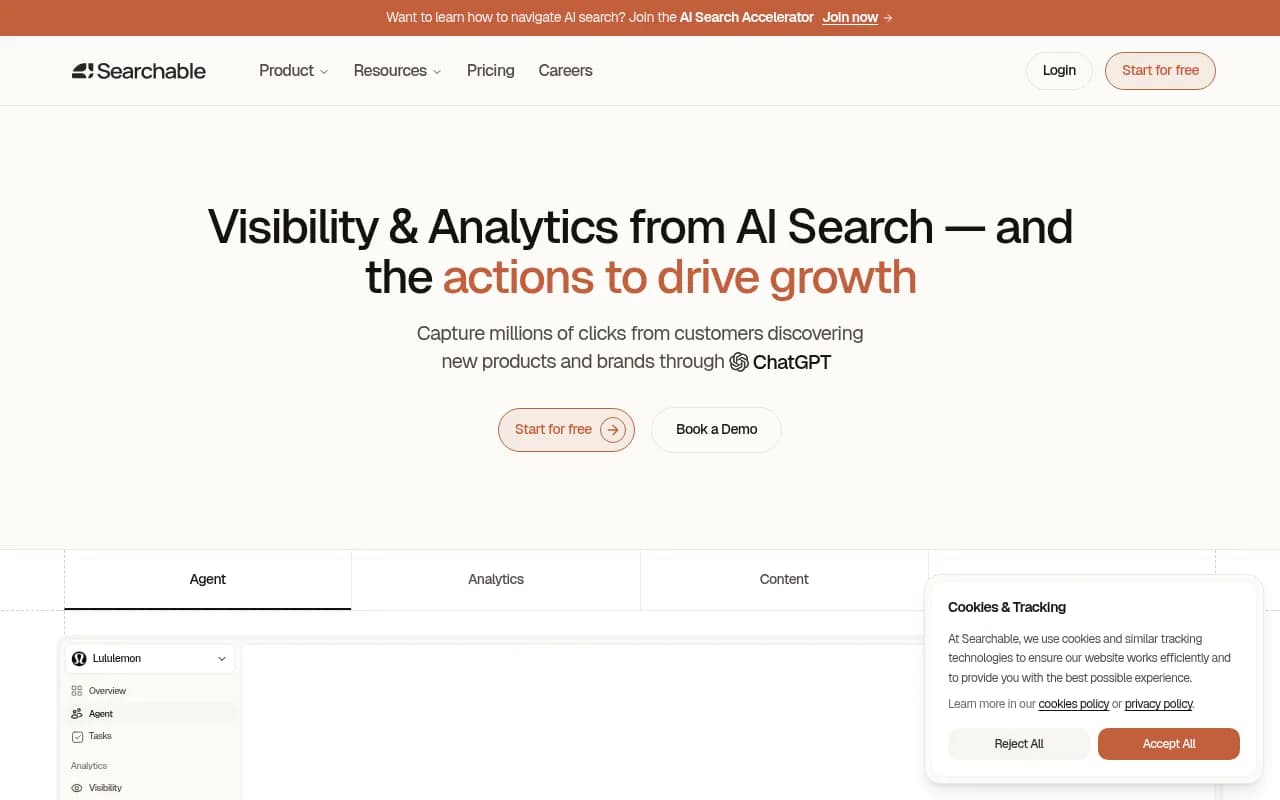
The discovery experience is genuinely good. For teams new to AI visibility, Searchable makes it easy to understand what AI models are saying about your industry and where competitors show up. The interface is approachable.
The content generation capability is where Searchable starts to feel limited. It has some tools for creating content based on what you find, but they're not deeply integrated with citation data or prompt volume intelligence. You can see a gap and then write something, but the connection between the two isn't tight.
The bigger issue is scalability. Searchable works well for exploration and spot-checking, but teams that want to systematically track visibility across dozens of prompts, monitor changes over time, and run an ongoing optimization program tend to outgrow it. The orchly.ai review noted that "once teams start thinking about AI visibility as part of their long-term SEO and content strategy, Searchable can feel limited."
Pricing information is limited publicly, which makes direct comparison harder.
Promptwatch
Promptwatch is the most comprehensive platform in this comparison, and the one most explicitly built around the full optimization loop rather than just monitoring.

The core difference is what happens after you see your visibility data. Most tools stop at "here's where you're not appearing." Promptwatch is designed around what comes next.
The Answer Gap Analysis shows you exactly which prompts competitors are visible for that you're not -- not as a vague category, but as specific prompts with volume estimates and difficulty scores. You can see what your site is missing and prioritize which gaps are actually worth closing.
The built-in AI writing agent then generates content grounded in that analysis. It's not generic AI writing -- it pulls from 880M+ citations analyzed to understand what formats, topics, and angles AI models actually cite. The output is articles, listicles, and comparisons engineered to get picked up by ChatGPT, Claude, Perplexity, and others.
Then the tracking closes the loop. Page-level visibility tracking shows which specific pages are being cited, by which models, and how often. Traffic attribution (via code snippet, GSC integration, or server log analysis) connects visibility improvements to actual sessions and revenue.
Beyond the core loop, Promptwatch has capabilities the others don't: real-time AI crawler logs showing which pages ChatGPT, Claude, and Perplexity are actually reading; Reddit and YouTube tracking to surface discussions that influence AI recommendations; ChatGPT Shopping tracking; and competitor heatmaps across 10 AI models.
It monitors OpenAI/ChatGPT, Perplexity, Google AI Overviews, Google AI Mode, Claude, Gemini, Meta/Llama, DeepSeek, Grok, Mistral, and Copilot -- the widest coverage in this comparison.
Pricing starts at $99/month (Essential: 1 site, 50 prompts, 5 articles), $249/month (Professional: 2 sites, 150 prompts, 15 articles, crawler logs), and $579/month (Business: 5 sites, 350 prompts, 30 articles). A free trial is available.
Side-by-side comparison
| Feature | AirOps | Atomic AGI | Searchable | Promptwatch |
|---|---|---|---|---|
| AI visibility monitoring | Limited | Medium | Yes | Yes (10 models) |
| Content generation | Yes (workflow-based) | Basic | Basic | Yes (citation-grounded) |
| Answer gap analysis | No | No | No | Yes |
| Prompt volume & difficulty | No | No | No | Yes |
| AI crawler logs | No | No | No | Yes |
| Traffic attribution | No | Yes (AI traffic focus) | No | Yes |
| Reddit/YouTube tracking | No | No | No | Yes |
| ChatGPT Shopping tracking | No | No | No | Yes |
| Competitor heatmaps | No | No | No | Yes |
| Starting price | Not public | $10/month | Not public | $99/month |
| Best for | Content ops teams | AI traffic analytics | Discovery & exploration | Full-cycle GEO optimization |
Which tool is right for you?
The honest answer depends on where you are in your AI visibility journey.
If you're just starting to explore what AI models say about your industry, Searchable is a low-friction way to get oriented. The chat-based interface makes it easy to poke around without a steep learning curve.
If you have a content team that already knows what to produce and needs to scale production, AirOps has real power. Just don't expect it to tell you what to write -- bring your own strategy.
If you want to understand how AI-referred visitors behave on your site specifically, Atomic AGI's analytics focus is interesting and the price point is hard to argue with as a supplementary tool.
If you want a platform that takes you from "I don't know where I'm invisible" all the way to "I published content that's now being cited by Perplexity," Promptwatch is the only option in this comparison that does that end-to-end. The gap analysis, the citation-grounded content generation, the crawler logs, the traffic attribution -- they're designed to work together as a system, not as separate features you have to stitch together yourself.
For marketing teams and SEO teams that are serious about AI search as a channel, the monitoring-only approach is increasingly hard to justify. The question isn't whether you're being cited -- it's what you're doing about it.
A note on the broader market
These four platforms represent different philosophies about what an AI visibility tool should do. AirOps and Atomic AGI come from adjacent spaces (content ops and analytics, respectively) and have extended into AI visibility. Searchable was built for exploration. Promptwatch was built specifically for the optimization problem.
That origin matters. Tools built for monitoring tend to stay monitoring tools. Tools built for optimization tend to keep adding capabilities that close the loop between data and action.
The 2026 AI visibility market has no shortage of dashboards. What's rarer is a platform that treats visibility as a means to an end -- more traffic, more leads, more revenue -- and builds its entire product around that outcome.
For teams evaluating these platforms, the right question isn't "which one shows me the most data?" It's "which one helps me do something with it?"