Key takeaways
- AirOps is a workflow automation platform that connects AI models into structured content pipelines -- strong for teams that want repeatable processes, weaker on actual AI visibility data.
- Content at Scale focuses on bulk article generation at low cost per word, but produces content without grounding it in what AI models actually cite.
- Promptwatch is the only one of the three built around a full optimization loop: find the prompts you're missing, generate content designed to be cited, then track whether it worked.
- If your goal is GEO (getting your brand cited in ChatGPT, Perplexity, Gemini, etc.), the tool you pick matters a lot -- most content automation tools don't know what AI models want to cite.
- All three have legitimate use cases. The right choice depends on whether you're optimizing for output volume, workflow flexibility, or actual AI search visibility.
The GEO tool market has gotten genuinely confusing. You've got workflow automation platforms calling themselves AI visibility tools, bulk content generators claiming they'll get you cited in ChatGPT, and dedicated GEO platforms that actually track what's happening inside AI search engines. AirOps, Content at Scale, and Promptwatch all live somewhere in this space -- but they're solving different problems.
This guide breaks down what each tool actually does, where each one wins, and which one makes sense depending on what you're trying to accomplish.
What each tool is actually built for
Before comparing features, it's worth being honest about the core purpose of each platform.
AirOps
AirOps is a content engineering and workflow automation platform. The core idea is that content teams shouldn't be stitching together prompts manually in ChatGPT -- they should have structured, repeatable pipelines that move from brief to published article with minimal friction.
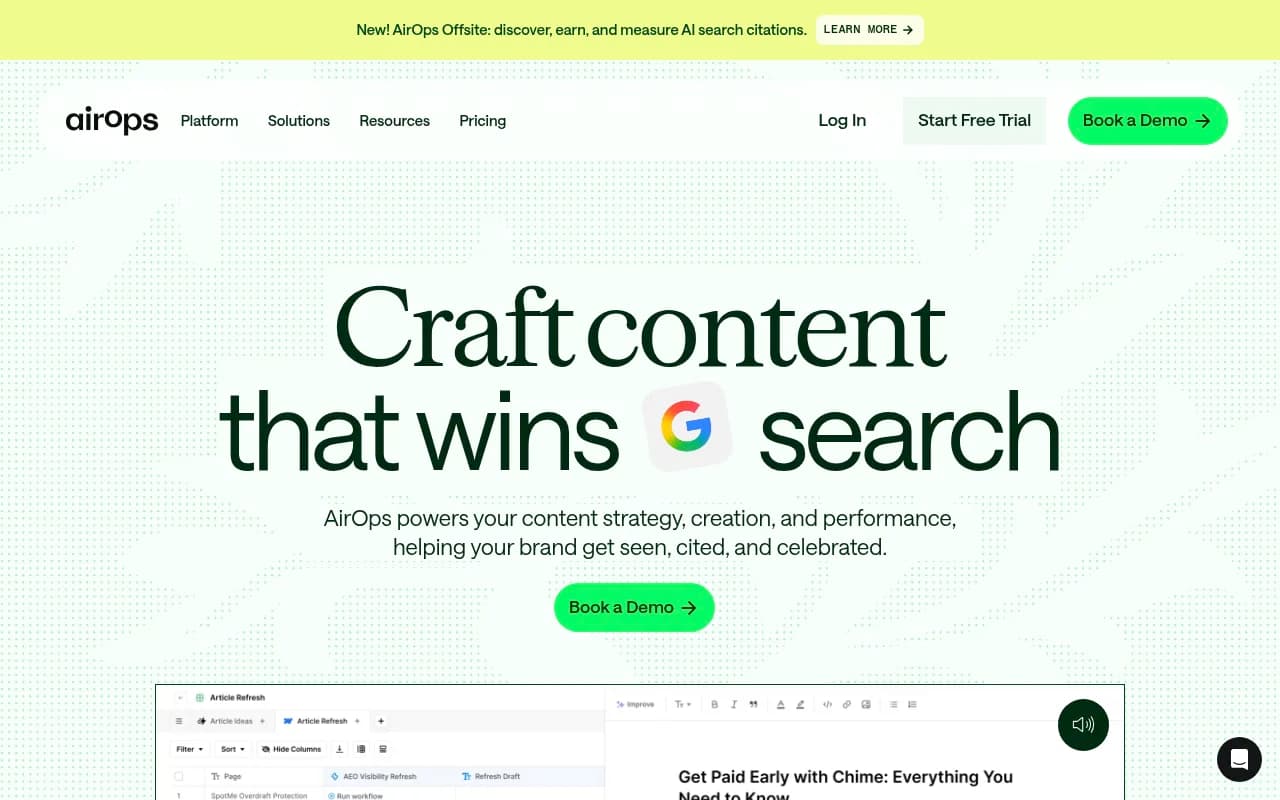
In May 2026, AirOps launched its Quill agent, which is designed to handle end-to-end content production with AI search visibility baked in. The platform lets you build workflows using leading AI models, connect them to your CMS, and run content operations at scale. It also added AI search visibility insights tied to content production -- so you can see which content is performing in AI search and which isn't.
AirOps is genuinely good at workflow automation. If you have a content team that needs to produce 50 articles a month with consistent structure, brand voice, and SEO inputs, AirOps gives you the infrastructure to do that without chaos.
What it's less good at: it doesn't have deep prompt-level tracking of what AI models are actually citing, it doesn't show you which specific prompts your competitors are winning that you're not, and it doesn't have crawler logs that show you how AI bots are interacting with your site.
Content at Scale
Content at Scale is a bulk AI content generation platform. The pitch is simple: give it a keyword or topic, and it produces a long-form, SEO-structured article. It's built for teams that need volume -- agencies managing dozens of client sites, publishers running content-heavy operations, or brands trying to cover a large topic cluster fast.

The platform uses a multi-model approach (combining several LLMs) to try to produce content that passes AI detection tools and reads more naturally than single-model output. It has some SEO optimization features baked in.
The honest limitation: Content at Scale doesn't know what AI models want to cite. It can produce an article about "best project management tools," but it has no visibility into whether ChatGPT is currently citing your competitors for that query, what angle the AI response takes, or what sources it pulls from. You're writing in the dark about AI search behavior.
Promptwatch
Promptwatch is built around a different premise entirely. Rather than starting with "how do we produce more content," it starts with "what are AI models actually saying about your brand, and what's missing?"

The platform tracks how your brand appears across 10 AI models (ChatGPT, Perplexity, Claude, Gemini, Grok, DeepSeek, Copilot, Meta AI, Mistral, and Google AI Overviews), shows you which prompts your competitors are winning that you're not, and then helps you create content specifically designed to close those gaps. It also has AI crawler logs that show you which pages AI bots are reading, how often, and when those pages move from crawl to citation.
The content generation side (Content Agents) produces articles grounded in real prompt data, citation analysis, and competitor visibility -- not just keyword research. That's a meaningfully different input than what AirOps or Content at Scale use.
Feature comparison
| Feature | AirOps | Content at Scale | Promptwatch |
|---|---|---|---|
| AI search visibility tracking | Partial (tied to content) | No | Yes (10 AI models) |
| Prompt-level monitoring | No | No | Yes |
| Answer gap / competitor analysis | No | No | Yes |
| AI content generation | Yes (workflow-based) | Yes (bulk) | Yes (citation-grounded) |
| AI crawler logs | No | No | Yes |
| Page-level citation tracking | No | No | Yes |
| Traffic attribution from AI | No | No | Yes |
| Reddit / YouTube insights | No | No | Yes |
| ChatGPT Shopping tracking | No | No | Yes |
| Prompt volume & difficulty scores | No | No | Yes |
| Multi-language / multi-region | Partial | Partial | Yes |
| CMS integrations | Yes | Yes | Yes |
| Pricing (entry) | Custom | ~$250/mo | $99/mo |
The table tells a clear story. AirOps and Content at Scale are content production tools with some SEO awareness. Promptwatch is a GEO platform that includes content production as one part of a larger optimization loop.
Where AirOps wins
AirOps is the right choice when your primary problem is workflow chaos. If your content team is spending hours manually prompting AI tools, copy-pasting into briefs, and managing handoffs between writers and editors, AirOps gives you the infrastructure to fix that.
The platform's strength is in its flexibility. You can build custom workflows that pull in brand guidelines, competitor data, keyword research, and CMS publishing in one connected pipeline. The Quill agent handles a lot of the heavy lifting for teams that want AI to do more of the drafting.
It's also a reasonable choice for teams that already have solid GEO monitoring in place and just need a better content production system. If you're using Promptwatch for visibility tracking and gap analysis, AirOps could sit alongside it as the production layer.
Where it falls short for GEO specifically: AirOps doesn't know which prompts are driving AI citations in your category, doesn't show you what sources AI models are pulling from, and can't tell you whether the content you're producing is actually getting cited. You're optimizing for production efficiency, not AI visibility.
Where Content at Scale wins
Content at Scale makes sense when you need raw volume at low cost per article. For agencies managing 20+ client sites, or publishers trying to cover a broad topic cluster quickly, the bulk generation approach is genuinely useful.
The multi-model output is better than single-model content for avoiding the obvious tells of AI writing. And the SEO structure (headers, meta descriptions, internal link suggestions) is solid enough for traditional search.
But for GEO, Content at Scale has a fundamental gap: it has no visibility into what AI models are actually citing. You can produce 500 articles and have zero of them cited by ChatGPT because they're not answering the specific questions AI models are being asked, or because they're not structured the way AI models prefer to pull from.
If your goal is traditional SEO volume, Content at Scale is fine. If your goal is AI search visibility, you're missing the data layer that makes content generation meaningful.
Where Promptwatch wins
Promptwatch wins when the goal is actually getting cited in AI search engines. The platform's core loop -- find the gaps, create content that fills them, track whether it worked -- is the only approach in this comparison that closes the feedback cycle.
The Answer Gap Analysis is particularly valuable. It shows you the specific prompts where competitors are being cited and you're not, which means you're not guessing about what to write. You're writing content that addresses a known gap in AI model responses.
The Content Agents then generate articles grounded in that prompt data, plus citation analysis, competitor visibility, and brand guidelines. The output is engineered to answer the exact questions AI models are already exposing -- not generic SEO content.
And then the tracking side shows you whether it worked. AI crawler logs show when ChatGPT or Perplexity bots hit your new pages. Page-level citation tracking shows when those pages start appearing in AI responses. Traffic attribution connects the visibility to actual revenue.
That full loop is what separates Promptwatch from both AirOps and Content at Scale. The other two tools help you produce content. Promptwatch helps you produce content that gets cited.
The honest trade-offs
None of these tools is perfect for every situation.
AirOps has a steeper learning curve for teams that just want to write articles. Building custom workflows takes time and some technical comfort. If you don't need that flexibility, it's overkill.
Content at Scale produces volume, but the quality ceiling is lower than workflow-based or citation-grounded approaches. For competitive categories where AI models are selective about what they cite, bulk generation without visibility data is a gamble.
Promptwatch is the most complete GEO platform in this comparison, but it's not a pure content production tool. If you need to produce 200 articles a month, you'll want to combine it with a production workflow. The Content Agents are designed for quality over quantity -- articles grounded in real data, not bulk output.
Which tool should you use?
Here's a practical breakdown:
Use AirOps if: You have a content team that needs structured, repeatable workflows. You're producing high volumes of content and the bottleneck is process, not strategy. You already have GEO monitoring in place and need a better production layer.
Use Content at Scale if: You need bulk article production at low cost per piece. Your primary goal is traditional SEO coverage across a broad topic cluster. You're not yet focused on AI search visibility specifically.
Use Promptwatch if: Your goal is getting cited in ChatGPT, Perplexity, Gemini, or other AI search engines. You want to know which prompts your competitors are winning and you're not. You need the full loop -- gap analysis, citation-grounded content generation, and tracking that connects visibility to revenue.
For most marketing teams in 2026 where AI search is a real channel, Promptwatch is the most complete answer. It's the only one of the three that actually knows what AI models are citing and helps you fix it.
For teams that need both GEO optimization and high-volume production, combining Promptwatch (for strategy and tracking) with AirOps (for workflow automation) is a reasonable stack. Content at Scale fits best in traditional SEO contexts where AI visibility isn't the primary goal yet.
A note on the broader GEO tool landscape
These three tools represent three different philosophies in a market that's still figuring out what "AI search optimization" actually means. Most tools in this space are monitoring-only dashboards -- they show you data but don't help you act on it. AirOps and Content at Scale are action-oriented but lack the visibility data to make those actions strategic. Promptwatch is the rare platform that combines both.
If you're evaluating other tools in this space, tools like Profound and AthenaHQ offer strong monitoring but less content generation capability. Otterly.AI and Peec.ai are solid for basic tracking but stop well short of the full optimization loop.
Profound

Otterly.AI

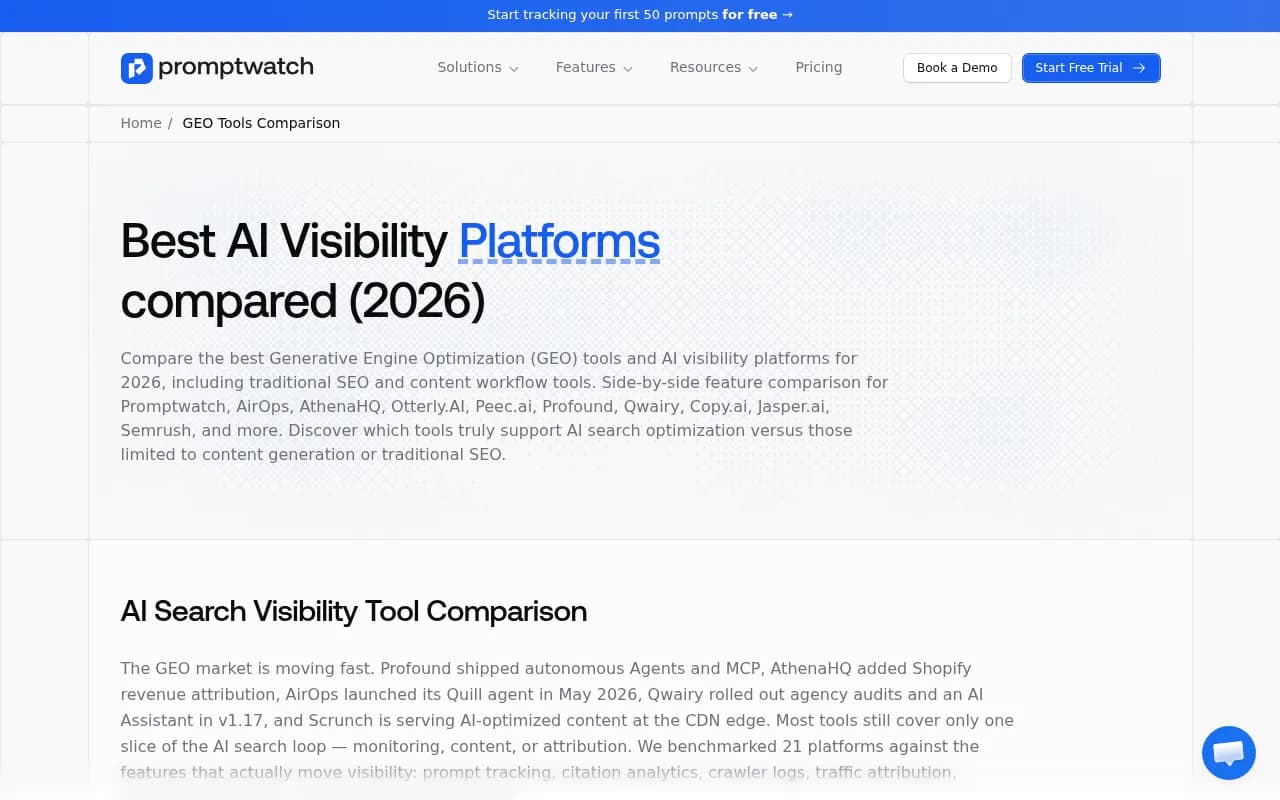
The GEO market is moving fast -- Promptwatch's own comparison of 21 platforms found that most tools still cover only one slice of the AI search loop. The platforms that combine monitoring, content generation, and attribution in one place are still rare. That's the gap worth paying attention to when choosing where to invest.