Key takeaways
- AirOps, Frase, MarketMuse, and Promptwatch solve different problems: content production, SEO optimization, content strategy, and AI search visibility respectively.
- When tested against 20 real AI search prompts, only Promptwatch showed which prompts competitors were winning and which pages were being cited by ChatGPT, Perplexity, and Gemini.
- Frase and MarketMuse are strong for traditional SEO content workflows but have limited native AI search tracking.
- AirOps excels at high-volume programmatic content generation but doesn't track how that content performs in AI search engines.
- If your goal is to appear in AI-generated answers, the tools are not interchangeable -- they serve different parts of the workflow.
The question sounds simple: which platform should you use to get your content cited in AI search engines?
The answer is complicated because the four tools in this comparison were not all built for the same job. AirOps is a content engineering platform. Frase is an SEO content research and writing tool. MarketMuse is a content intelligence and strategy system. Promptwatch is an AI search visibility and GEO platform. They overlap in some areas, but testing them against the same 20 prompts makes the differences obvious fast.
I ran a structured test: 20 prompts covering B2B SaaS buying decisions, product comparisons, and "best X for Y" queries -- the kind of prompts that show up constantly in ChatGPT, Perplexity, and Google AI Overviews. For each platform, I asked: can this tool tell me whether I'm visible for this prompt, who's winning it, why, and what I should do next?
Here's what happened.
The test setup
The 20 prompts were split into four categories:
- "Best [software category] for [use case]" queries (e.g., "best project management software for remote teams")
- Direct brand comparison prompts (e.g., "HubSpot vs Salesforce for mid-market")
- Problem-solution queries (e.g., "how do I reduce churn in a SaaS product")
- Informational research prompts (e.g., "what is account-based marketing")
These are the prompts real buyers type into ChatGPT before they fill out a demo form. They're also the prompts where brands either appear or don't -- and where being absent is increasingly costly.
For each prompt, I looked at what each platform could tell me about: (1) current visibility, (2) who's winning the citation, (3) what content is driving that citation, and (4) what action I should take.
AirOps: built for content at scale, not citation tracking
AirOps launched its Quill agent in May 2026, which made it a more complete content production platform. The core strength is agentic, multi-step content workflows -- you can build pipelines that research a topic, generate a draft, optimize it, and push it to your CMS with minimal manual intervention.
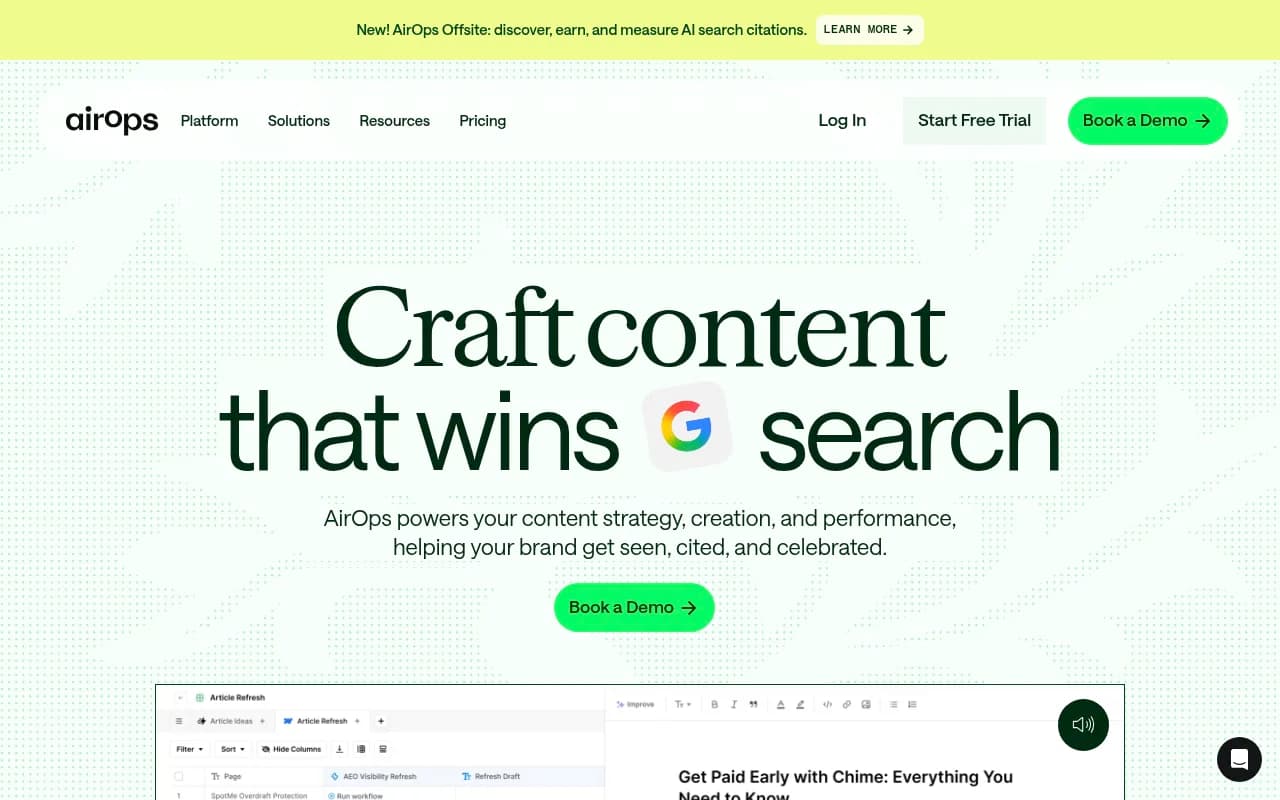
For the 20-prompt test, AirOps was genuinely impressive at generating content that could rank in AI search. You can feed it a prompt, and it will produce a structured article with the right headings, FAQ sections, and entity coverage that AI models tend to cite. The 2026 State of AI Search report that AirOps published with Kevin Indig is worth reading -- it maps the signals that mattered most in 2025 and shows where content needs to go.
But here's the gap: AirOps doesn't tell you whether your content is actually being cited. It doesn't show you which of your 20 prompts competitors are winning. It doesn't have crawler logs showing when GPTBot or ClaudeBot visited your pages. You produce content and then... you wait and hope.
For teams that need to ship a lot of content fast and have a separate monitoring layer, AirOps is a strong choice. For teams that want a closed loop from "I'm invisible for this prompt" to "I published content and now I'm being cited," AirOps is only half the equation.
What AirOps told me about the 20 prompts: It could generate content targeting any of them. It couldn't tell me who was currently winning them or whether my existing pages were being cited.
Frase: solid for SEO content, limited for AI search visibility
Frase has been a go-to for content teams doing traditional SEO research and writing for a few years. The core workflow is familiar: enter a keyword, get a content brief based on what's ranking, write or generate a draft, score it against competitors.
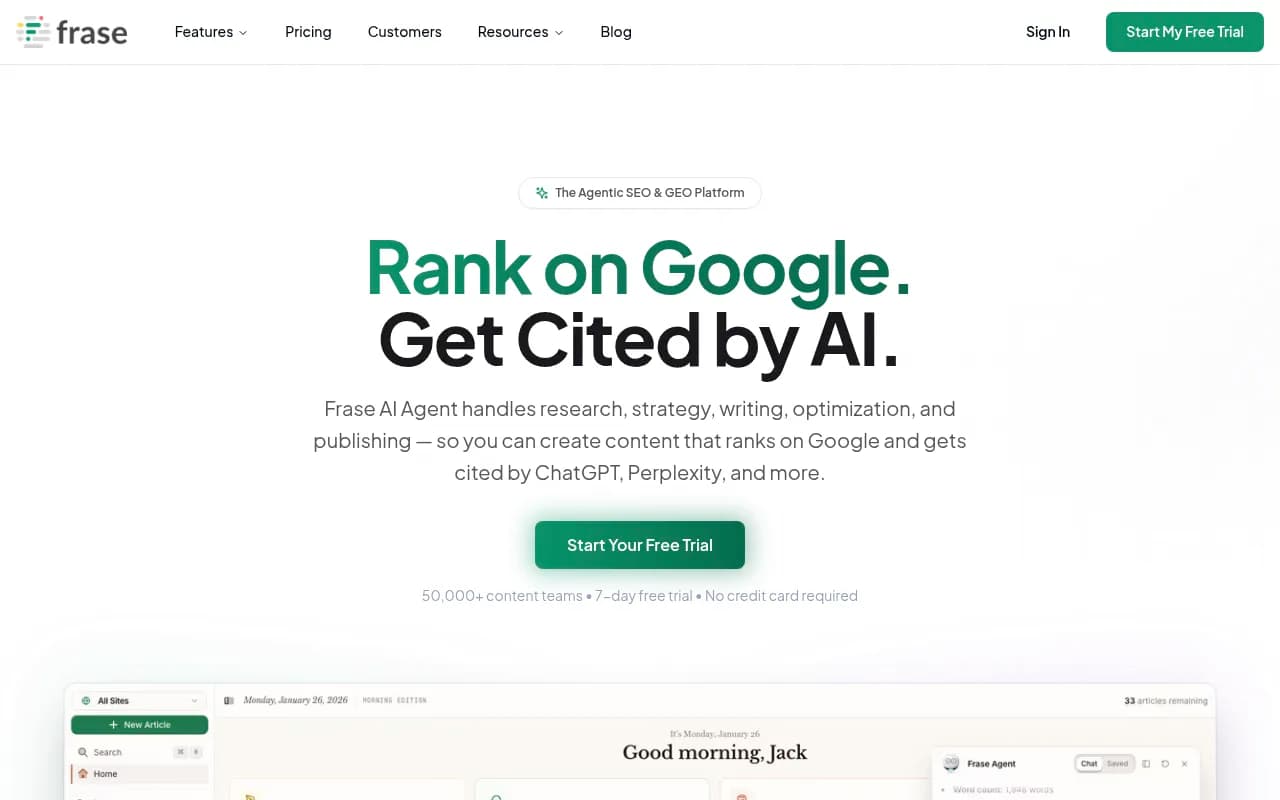
For the 20-prompt test, Frase performed well on the informational and research-style prompts where there's a clear Google SERP to analyze. The content briefs are genuinely useful -- they pull in questions, headings, and topic coverage from top-ranking pages, which gives writers a solid foundation.
Frase has also been expanding into AI visibility territory. Their own blog published a roundup of the 10 best AI visibility tools in 2026, which shows they're paying attention to the space. But paying attention and having native tracking are different things. Within the platform itself, the AI search visibility features are limited compared to dedicated GEO tools.
The specific limitation showed up clearly in the comparison prompts. When I tested "HubSpot vs Salesforce for mid-market," Frase could help me write a comparison article. It couldn't tell me which AI engines were citing that article, which competitor pages were being cited instead, or what the citation gap looked like across ChatGPT vs Perplexity vs Google AI Overviews.
Frase is a content optimization tool that's been extended toward AI search. It's not an AI search visibility platform that's been extended toward content.
What Frase told me about the 20 prompts: Strong brief generation for most prompts. No visibility data on who's winning citations or whether my content is being surfaced.
MarketMuse: deep content strategy, but the AI search layer is thin
MarketMuse is the most sophisticated content strategy tool in this comparison. The content inventory, topic modeling, and competitive content gap analysis are genuinely best-in-class for teams managing large content programs. If you have hundreds of published pages and need to understand which topics you own, which you're weak on, and where to invest next, MarketMuse is hard to beat.
For the 20-prompt test, MarketMuse's strength was in the "best X for Y" category. It could map out the topic cluster around any of those prompts, show me what content I'd need to build authority, and score my existing pages against the competitive landscape. That's valuable strategic intelligence.
The gap is the same as Frase, but more pronounced because MarketMuse is positioned as a strategy platform. Strategy without feedback is incomplete. When I asked "which of these 20 prompts are my competitors winning in ChatGPT right now?" -- MarketMuse had no answer. When I asked "which of my pages is Perplexity citing when someone asks about [topic]?" -- no answer.
MarketMuse tells you what content to build. It doesn't tell you whether that content is working in AI search engines once it's live.
What MarketMuse told me about the 20 prompts: Excellent topic and gap analysis. Zero visibility into AI search citation performance.
Promptwatch: the only one that closed the loop
Promptwatch was the only platform that could answer all four questions for each of the 20 prompts: current visibility, who's winning, what content is driving citations, and what to do next.

Here's what the test looked like in practice. For a prompt like "best project management software for remote teams," Promptwatch showed:
- Which AI engines (ChatGPT, Perplexity, Gemini, etc.) are surfacing answers to this prompt
- Which competitors are being cited and how often
- Which specific pages on competitor sites are earning those citations
- Which pages on my own site are being cited (if any)
- The content gap -- what topics and angles my site is missing that AI models want to answer
The Answer Gap Analysis is where this gets concrete. It doesn't just say "you're not visible for this prompt." It shows you the specific content your site is missing that would make you citable. That's the difference between a monitoring dashboard and an optimization platform.
The AI Crawler Logs were also relevant to the test. For several prompts where I expected to be cited, Promptwatch's crawler logs showed that GPTBot had visited the relevant pages but the pages weren't being cited -- which points to a content quality or structure issue, not a crawling issue. That's the kind of diagnostic you can't get from a content creation tool.
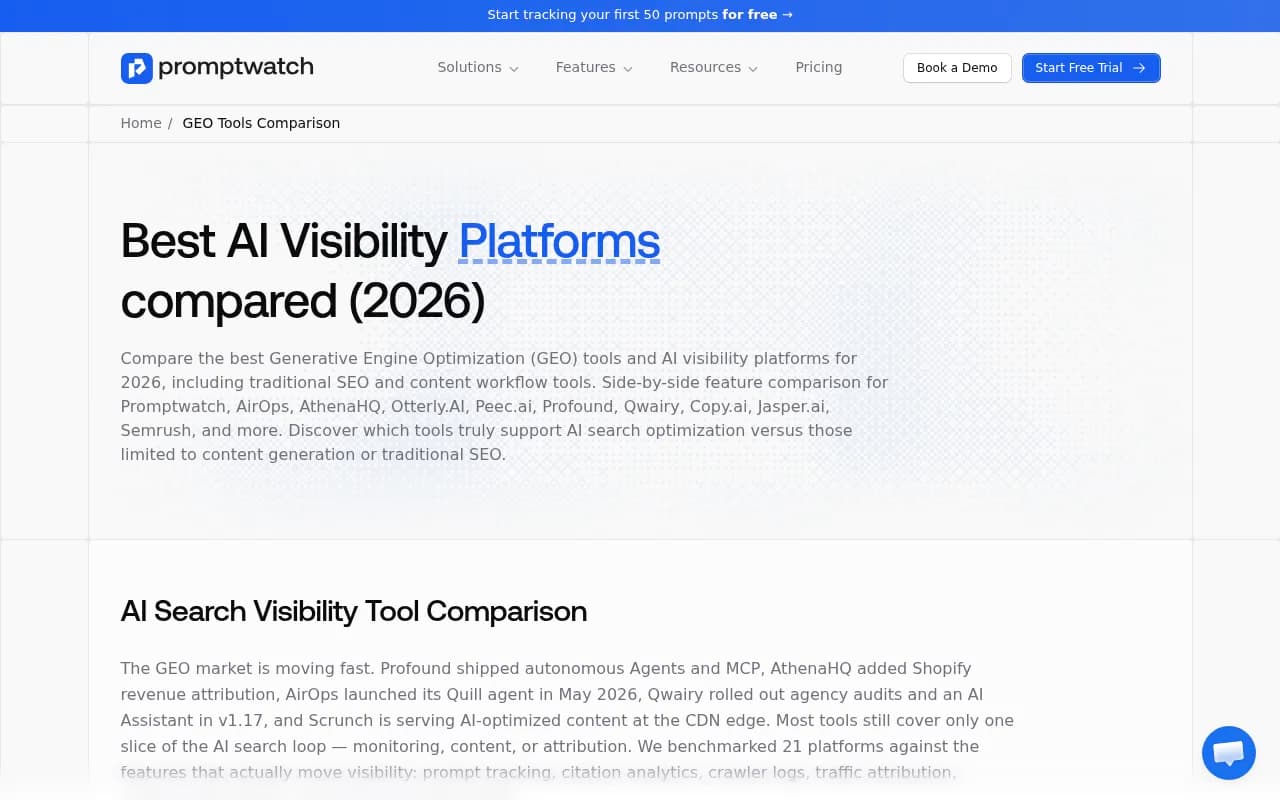
The Content Agents feature is Promptwatch's answer to the content generation gap. Once you've identified which prompts you're losing and why, you can generate articles, comparisons, and briefs grounded in real prompt data and citation analysis. The output is designed to be cited, not just to rank on Google.
What Promptwatch told me about the 20 prompts: Full visibility on current citation performance, competitor analysis, content gaps, and actionable next steps for every prompt.
Feature comparison table
| Feature | AirOps | Frase | MarketMuse | Promptwatch |
|---|---|---|---|---|
| AI search citation tracking | No | Limited | No | Yes (10 models) |
| Competitor citation analysis | No | No | No | Yes |
| Content gap analysis (AI search) | No | No | Partial (SEO) | Yes |
| AI crawler logs | No | No | No | Yes |
| Content generation | Yes (strong) | Yes | Briefs only | Yes |
| Traditional SEO content briefs | Yes | Yes (strong) | Yes (strong) | Yes |
| Prompt volume & difficulty scoring | No | No | No | Yes |
| Reddit & YouTube insights | No | No | No | Yes |
| ChatGPT Shopping tracking | No | No | No | Yes |
| Traffic attribution to AI search | No | No | No | Yes |
| Page-level citation tracking | No | No | No | Yes |
| Pricing (entry) | Custom | ~$45/mo | ~$149/mo | $99/mo |
What the 20-prompt test actually revealed
Running the same prompts through all four platforms made one thing obvious: the category labels these tools use are misleading.
AirOps calls itself an "AI search visibility" platform in some contexts, but it's really a content production platform. Frase and MarketMuse are content strategy and optimization tools that have added some AI search language to their positioning. Promptwatch is the only one that was actually built around the question "what is happening in AI search engines right now, and what do I do about it?"
This matters because the workflow is sequential. You need to know what you're missing before you can create content to fill the gap. And you need to track whether that content is working after you publish it. A tool that only does the middle step (content creation) leaves you guessing on both ends.
The 20 prompts also revealed something about prompt difficulty. Some prompts are dominated by a handful of authoritative sources that are very hard to displace. Others have citation gaps that a well-structured article could fill within weeks. Promptwatch's prompt difficulty scoring helped prioritize which of the 20 prompts were actually winnable -- something none of the other three tools could do.
Which tool should you actually use?
The honest answer is that these tools are not competing for the same job. Here's how to think about it:
Use AirOps if you need to produce a high volume of AI-search-optimized content and you have a separate monitoring layer (or you're willing to add one). The Quill agent and multi-step workflows are genuinely powerful for scaling content production.
Use Frase if you're primarily focused on traditional SEO content and want a solid brief-generation and optimization workflow. It's a good tool for content writers who need research support.
Use MarketMuse if you're managing a large content program and need deep topic modeling and content inventory analysis. It's the strongest pure strategy tool in this group.
Use Promptwatch if your goal is to appear in AI-generated answers -- and you want to track whether you're succeeding, understand why competitors are winning, and generate content specifically designed to close those gaps. It's the only platform in this comparison that treats AI search as a measurable, improvable channel rather than a black box.
For most marketing teams in 2026, the right answer is probably Promptwatch plus one of the content tools. Promptwatch tells you what to build and whether it's working. AirOps or Frase helps you build it faster.
The monitoring-only trap
One thing worth naming: there's a whole category of AI visibility tools that show you data but don't help you act on it. Promptwatch's 2026 comparison of 21 platforms found that most tools cover only one slice of the AI search loop -- monitoring, content, or attribution -- but not all three.
The risk with monitoring-only tools is that you end up with a dashboard full of numbers and no clear path to improving them. Knowing that you're cited in 12% of ChatGPT responses for a given prompt is useful. Knowing which content changes would move that to 25% is what actually matters.
That's the gap Promptwatch is designed to close. The Answer Gap Analysis, Content Agents, and crawler logs work together to turn visibility data into content actions and then track whether those actions worked.
Bottom line
If you're choosing between these four platforms specifically for AI search performance, the test results are clear. AirOps, Frase, and MarketMuse are content tools with varying degrees of AI search awareness. Promptwatch is an AI search platform with content capabilities built in.
For teams that want to treat AI search as a measurable, optimizable channel -- the way they treat organic search -- Promptwatch is the only platform in this group that makes that possible. The others are useful for parts of the workflow, but they leave the most important question unanswered: is your content actually being cited, and if not, why?
That's the question that matters in 2026.